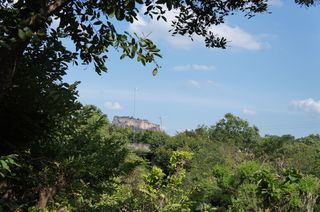
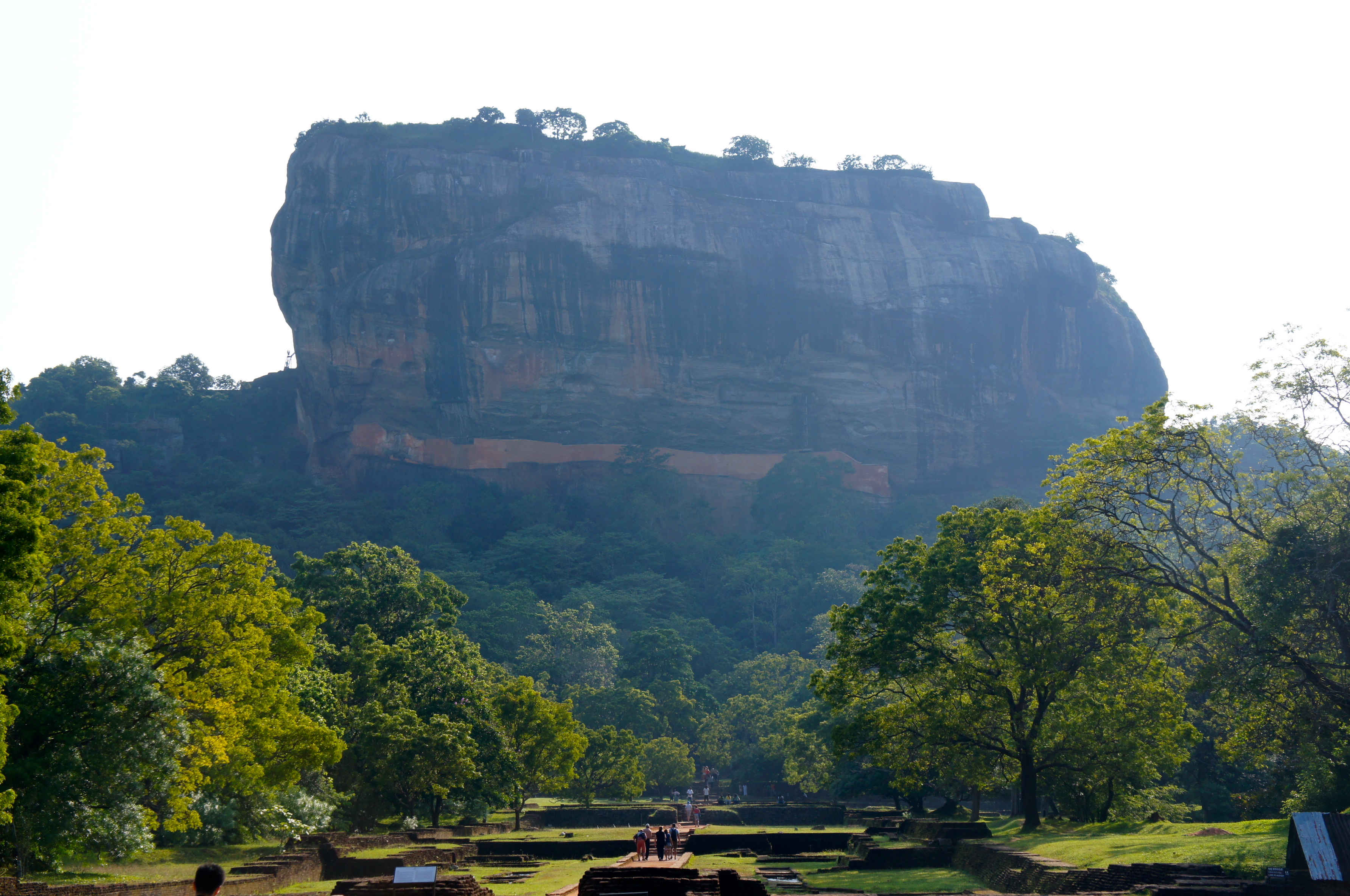
We are sitting at breakfast when Sid points out a large poster behind me. He says it is a picture of what Sigiriya, the kingdom on a rock, would have been like in ancient times. There appears to be a Sri Lankan king and queen in the foreground overlooking a bustling scene of people and elephants at work, and in the background a massive red rock with a grand palace on top. As the story goes, the king in the picture is King Kassapa, who rose to power by killing off his father and deposing his brother. King Kassapa then sets about building a fortress and kingdom unlike any other to keep out a vengeful brother and anyone else seeking to take the throne. When we arrive at Sigirya, I can see that the king chose his fortress well. It’s not likely that many folks would want to scale a 1,200-foot stony outcrop to reach its top. Actually, I take that back. There are busloads of tourists who’ve come to do just that. Sigiriya, a World Heritage site, is one of Sri Lanka’s most popular destinations and justifiably so. In the early morning sunlight, the rock looks like an inverted piece of the Grand Canyon with shades of oranges, reds and browns crawling up its face with bits of green on its crown. Geologists believe that the rock is the hardened magma plug of a long-extinct and eroded volcano. At its base are well-landscaped, stone-lined water gardens with pools that may have featured fountains back in Sigiriya’s heyday of the late 400s AD.
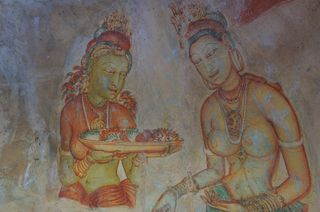
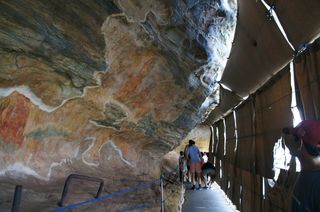
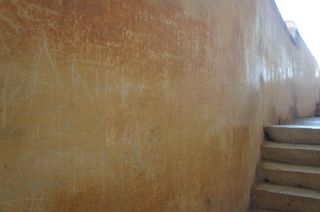
 Sid, Pradeep and I start our climb with a series of stone staircases that are at first short with landings bounded by massive boulders and brick walls, then grow steeper as we ascend to get closer to the rock. I’ve mentally prepared myself for an arduous climb since Sid has told me that it can be very windy on the rock and he mentioned a very narrow, rickety walkway known to sway with the wind. Pradeep said that when he visited in December with Uncle Emil’s daughter from France that she had to stop several times along the way to catch her breath. I climbed a volcano in Nicaragua once, but that was over 10 years ago and I start to wonder about what lies ahead. I am happy to see a pretty sturdy metal walkway constructed along the rock face, replacing the rickety, wooden one that definitely looks less than safe. A winding spiral staircase takes us higher and deposits us into a naturally carved concave in the rock where there are some faint and some well-preserved wall paintings of smiling, buxom and bejeweled ladies. As legend has it, King Kassapa was quite the ladies man with a harem of 100 concubines. These portraits are said to be depictions of them. They look happy serving each other plates of fruit and admiring flowers. Just beyond this ancient gallery is the mirror wall, which hugs the side of the rock and features 1,000-year-old graffiti. I can’t make any of it out on the shiny, yellowish wall, but I do see more modern etchings left by recent visitors.

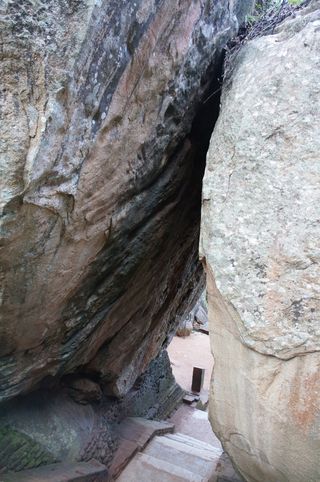
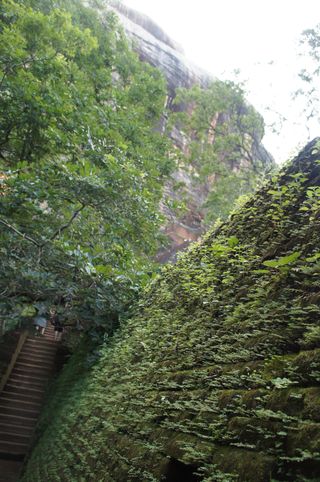
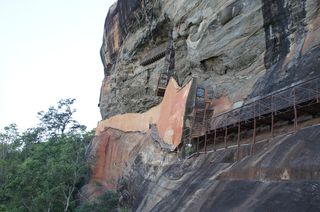
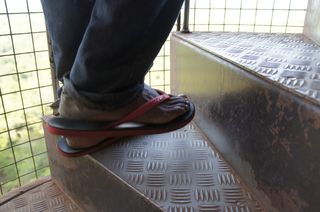
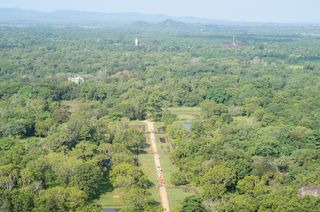
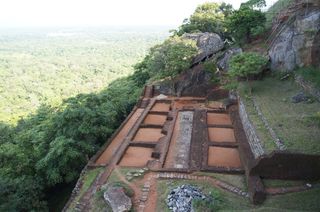
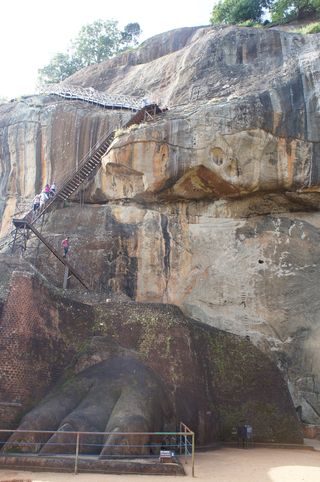
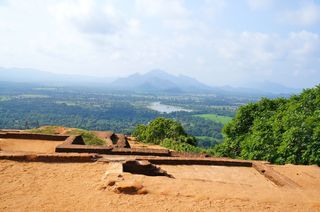
Our climb continues up more stone stairs and we reach a landing with a gorgeous view below and a glimpse of a standing Buddha in the distance, presumably blessing the rock. Immediately below us is another cool terrace garden that looks perfectly serene overlooking the green treetops. After another steep set of stairs we find ourselves on a larger landing marked by the giant stone paws of a lion. Sigiriya’s other name is Lion Rock and when the palace here was at its full glory, visitors had to reach the summit via a staircase leading between the lion’s paws and through its mouth. I wish I could have seen that. Instead, we see another metal staircase, steeper than any we’ve climbed so far. We trudge upward, taking slow steady steps and I start to feel the sweat popping off my brow, my breathing getting more and more labored. But I don’t stop for fear that it will be hard to start again. The stairs are barely wide enough for a stream of ascending tourists to pass the descending ones and everyone has a tight hand on the railings. After making it up an almost vertical set of steps, I want to have a Rocky moment when we get to the top and hop around with my arms over my head in victory, but I’m too tired. Not too tired to notice that it is beautiful here, though. We catch our breath as we walk along ruddy stone walls that may have been palace walls. You absolutely feel royal, looking across the lush Sri Lanka landscape. Signs mark the palace grounds and Kassapa’s throne. Where there aren’t terraces of stacked red bricks there are flat grassy plateaus and languid pools of water. After wandering and wondering how such a place could have been constructed, we start our descent. Sid thinks lots of people probably died while building the place and I am a reminded of the Great Wall in China where its deceased construction workers were buried in its walls. We suspect something similar must have happened here, or they just fell to a grassy grave. Not a happy thought as we make our way down a sheer rock face. Our descent is slowed by a small group of young women in tank tops and shorts, one of which appears to be terrified of heights. Her face is bright red and she is sweating and holding on to the metal railing for dear life while taking each step downward gingerly. She is as much afraid of holding up the people behind her as she is of climbing down, but we tell her that it is OK and to take her time, hoping to put her at ease. Once secure on a sturdy landing, the women stop to take a break and allow their friend to rest. We find out that they are student from the UK and Australia. I know this must have been a life-changing experience for at least one of them.
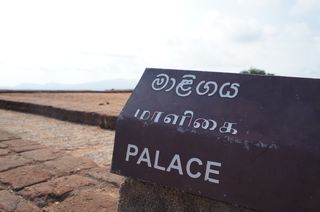
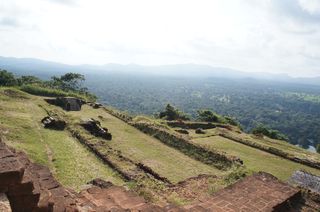
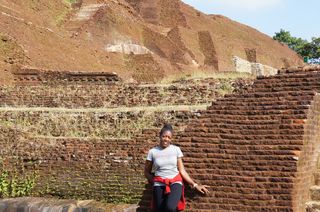
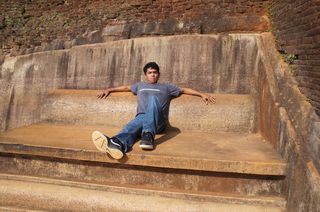
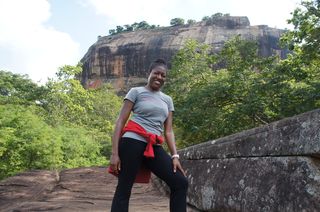
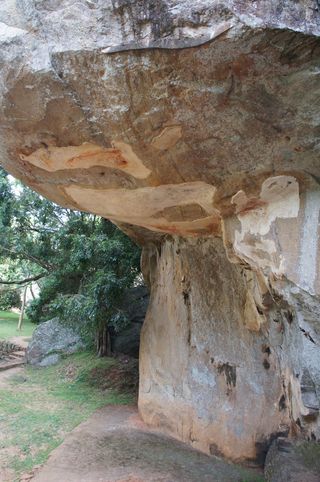
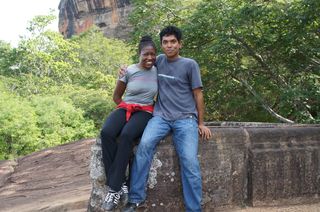
The rest of our descent is uneventful and Pradeep shows us other sights around the rock, taking us to a secluded place where we can take great pictures with Sigiriya rising in the background and small concave formations where Buddhist monks may have prayed. The other theory about Sigiriya is that it may not have been a fortress and palace at all, but rather, an ancient monastery. There’s also a combination of the two stories where after Kassapa’s death the palace later became a monastery. Either way, the place is a wonder.

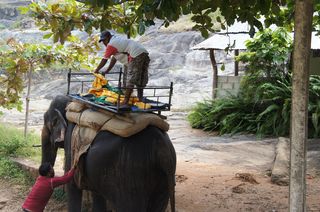
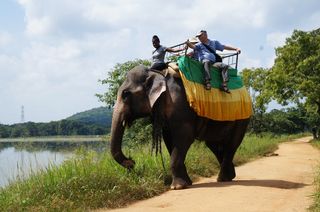
Back on terra firm and in our white van, Sid mentions that you can take elephant rides at the bottom of Sigiriya and he asks if I want to ride one. My answer, of course, is a resounding yes. I can’t imagine a better way to end my trip to Sri Lanka. So, we set off on a search for an elephant safari. We spot an elephant lumbering down a back road toward the rock with a few tourists perched atop its back in a canopy. Sid hopes that I can ride one bare back and so do I. The places near Sigirya are booked and we make our way further north on A6 towards Habarana. We see another elephant walking along the roadway carrying its tourist cargo and I think this isn’t the most scenic of settings for an elephant ride. Sid and Pradeep tell me that there are lots of wild elephants in the area who sometimes go on a rampage and take out anything in their path, including cars. Finally, we stop at the Chaaya Village Hotel in Habarana and speak to a man who says he can give me an elephant ride. We hop out immediately and make our way down a gravel path leading to a lake and several elephants dressed with a yellow and green skirted carrier. I’m chagrined to see chains around their necks and a little sad that I won’t get to ride an elephant barebacked. But I hope with all my heart that these lovely beasts are being treated well and board a waiting pachyderm along with a pair of German tourists.
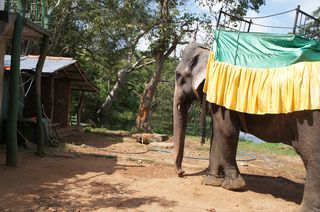
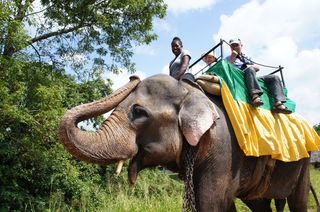
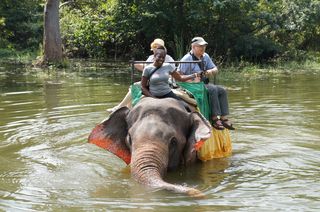
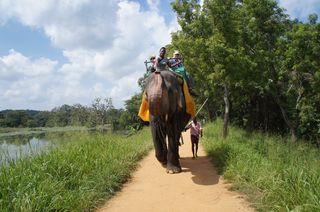
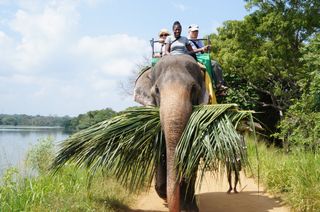
As we set out the guide asks if I want to sit around the elephants neck. Well, of course I do! It’s almost as good as riding bareback. Our mahout, or elephant guide and trainer, tells us that our elephant’s name is Rajan and that he’s 26-years old. I wouldn’t have guessed him to be a day over 10. I rub the large prickly groove in the top of his head in greeting. Then, we are given a bunch of bananas to feed Rajan as we start a very leisurely, loping stroll around the lake. As it turns out, Rajan is one hungry elephant. It’s not long before he flings his trunk back towards me, snorting, in search of a snack. I oblige, dropping a small banana into the waiting nose/appendage which goes to his mouth and comes immediately back again for more. Given the size of the banana, I imagine that this is like giving one peanut to a 300-pound man and expecting him to be satisfied. This exchange goes on for a bit before we realize that we are about to run out of bananas. I decide to rub his prickly head instead of granting him a banana each time he offers his trunk and this seems to work for a while, until he decides that he’s going to snack on his own. He proceeds to drift off the path to sample the grass and snatch a few leaves from a nearby tree. This is when I start to realize that my position around Rajan’s neck maybe a bit more precarious than I thought. When he raises his head or turns his head to the left or right, I think my hips might snap. Satisfied for the moment, we continue along the lake and I learn that I am enjoying my elephant ride with Franz and his wife from Hamburg. They’d also visited Sigirya earlier in the day and stayed at a resort in the middle of a rice field. They planned to end their trip to Sri Lanka on the beach. Then we realize that our path around the lake actually leads into the lake. Our mahout gives a shout and Rajan starts to descend into the lake for a dip, much to our delight. Rajan seems to enjoy it too. His ears flap back and his trunk waves back and forth in the water. He wades about halfway, rests for a moment so that we can all take in the moment and then returns slowly to the path rising out of the water. It seems that this brief bathing break has made Rajan hungry again and after we’ve run out of bananas he takes another small detour down an embankment for a grassy treat. The embankment feels so steep that I’m afraid that I might drop some 10 feet to the ground and roll into the lake. I grab onto the carrier to prevent such a scenario. Rajan’s mahout gives another shout and disappears down a path leaving us perched atop Rajan alone on the main path. We sense that Rajan wants to go, too, as he looks longingly after the mahout and we hope that he doesn’t make a run for it. We watch the mahout and another guide chop down several coconut palms and drag them back up the path. This turns out to be a treat for Rajan and he happily rolls the palms in his trunk and I think he may be moving a bit faster towards home so that he can enjoy his treat. When we are back and have disembarked, we pose for photos with Rajan and he offers his trunk for a pat. As I leave with Sid and Pradeep, I see that they’ve already freed Rajan of his carrier and he is standing on a hill with his pile of leaves, snapping them with his trunk, pushing them into his mouth with ears flapping. This makes me happy.



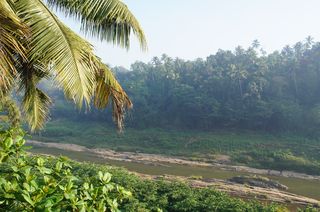
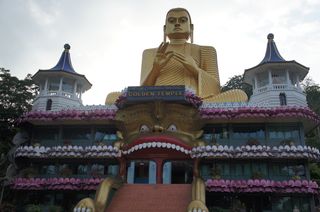
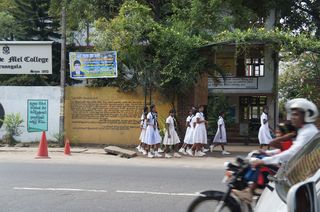
Once again we are on A6, this time heading south towards Negombo and our ultimate destination, the airport where I’ll head back to the states later in the evening. I know there is still much more to see and do in Sri Lanka, but I’ll have to be happy with my brief, but wonderful stay. I spend the next few hours watching the country pass by my car window and I see coconut trees on either side of the road, stretching as far as the eye can see. Pradeep says that we are in the Coconut Triangle, the heart of coconut tree plantations. Farther down the road, he stops to point out a cocoa tree with small reddish brown cocoa pods hanging from its limbs. I marvel at the variety of plant life in this place and remember that Pradeep and Sid had shown me a jackfruit tree the other day. I told them that it would be hard to starve in a place like this with so many fruits and vegetables available to eat and Sid added that Sri Lankans use everything on the coconut tree. It’s wood and palms for housing along with coconut water and meat for eating. To me, that’s a true sign of living in paradise. And, Pradeep points out that the plants in Sri Lanka are literally alive. We stop to look at a small delicate flower that reminds me of those white flowering weeds in the yards back home. When we point our fingers toward them, they lean away from us as if dropping off to sleep. And of course, we can’t leave Sri Lanka without a look at one more giant Buddha, a few miles back in Kurunegala, we hop out of the van to spy on a Buddha seated atop a rock known as Elephant rock. After trying to capture the Buddha on camera, Sid points out a group of school girls across the street who find me more interesting than the Buddha. He says they are talking about my hair. I turn to snap a photo of them and they giggle and hurry off down the street, embarrassed that I’ve caught them.

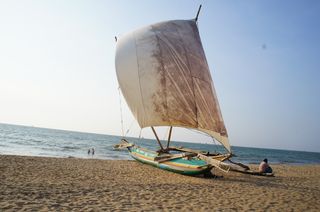
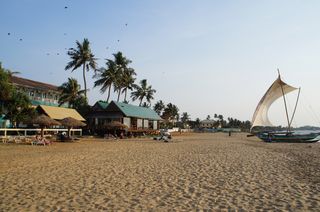
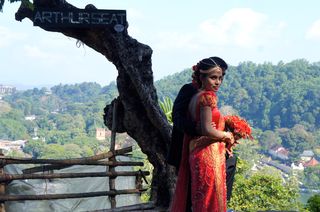
When we arrive in Negombo, it has more of an old world European feel than any of the other places we’ve visited so far. I suspect it is because of the small cathedral-style churches. Pradeep says that there is a large Christian population here, Roman Catholic in particular. I see Catholic saints taking the place of Buddha statutes in small roadside pavilions and suddenly we are back at the beach. We stop at the Hotel Sunset Beach, where we decide to spend my remaining hours in Sri Lanka. We make a dinner reservation, settle into our oceanside beach chairs and order a few drinks. We decide that we want to compare the beach bar drinks to those at the Coconut Bar. The pina colada here doesn’t come close. It’s cloyingly sweet. Pradeep makes a face as he tastes it, knowing his pina colada at the Coconut Bar is way better, secure in his bartending skills. As the sunsets, we watch a stream of wedding parties make their way to the beach for photos and Sid tells me more about wedding traditions in Sri Lanka. A wedding is a two-day event where on the first day the family gathers for the wedding ceremony and after the wedding night the bride wears red as a symbol of her newlywed status. The family gathers again for a big party to celebrate. We watch the newlyweds pose in front of a Sri Lankan fishing boat known as a oruva. At dinner, I hope for the same giant juicy prawns that I ate on my first night, only to be disappointed by small, typical sized shrimp. We talk about how over priced things can be at resorts and think about sweet and savory crab at the Coconut Bar. I say my final goodbyes to the Indian Ocean sitting in the sand, listening to its waves slap the shore. We take final sip of arrack and head to the airport. In a throng of departing tourists, I hug the best guides to Sri Lanka a girl could have and try to melt into the crowd, not looking forward to the 20 hours of travel ahead and desperately wishing I was back on the beach.