Thailand-Cambodia Postscript 2: The Road to Siem Reap

We realize right away that we like our guide J.J. a lot. Mainly because she is the picture of efficiency. We are about an hour into our 5 hour drive to the Cambodia border on the way to Siem Reap and we’ve stopped at large filling station with restrooms. She checks the bathrooms before giving them a thumbs up, informing us that there is a western style toilet. She hands each of us tissues to use as toilet paper and offers a squirt of antibacterial hand sanitizer as we exit. She seems to have thought of everything.
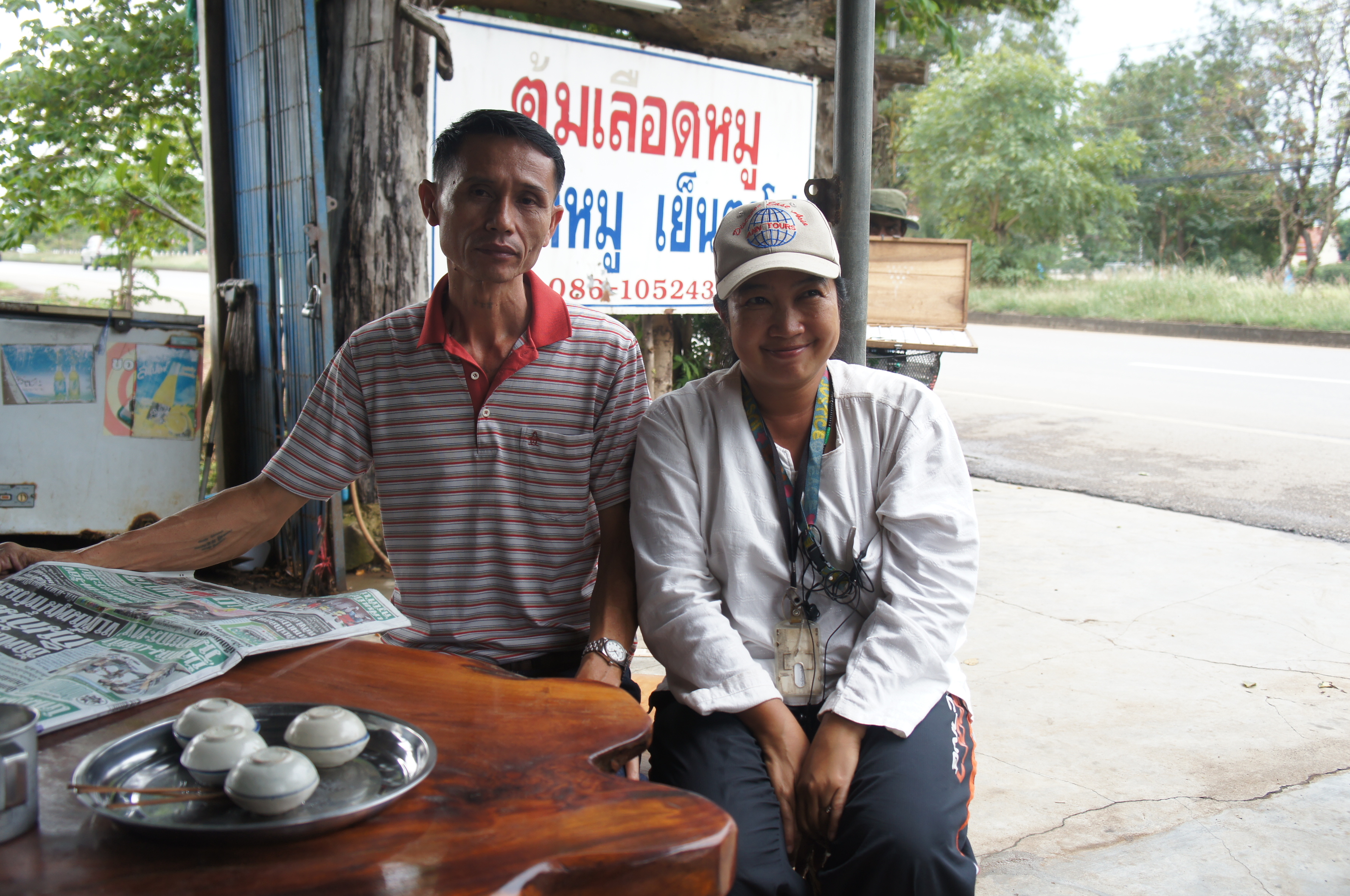
Wichai our unflappable driver and J.J. our resourceful guide

We are lucky enough to have transport from Bangkok to the Cambodia border via Lyle’s driver Wichai, but since Wichai doesn’t speak much English, I decided to employ a guide to point out interesting sights along the way. Ann Tours, a Vietnam-based tour company offering tours across SE Asia, sent us J.J. who wears her long black tresses pulled back in a loose ponytail topped with a baseball cap. She’s got an agenda featuring 4 temple stops, but we get a late start because of Bangkok’s notorious traffic, so we’ll only have time for 2 in order to rendezvous with another guide who will drive us to Siem Reap.

Wichai is probably the most unflappable defensive driver I’ve ever seen. He zooms right up to the bumper of cars ahead of us then expertly darts laterally into the next lane without so much as a blink of an eye. His tactics are totally necessary on Highway 304 where there seem to be no rules of the road and I feel like I’m in good hands. But when Nancee and Karen take their turn in the middle of the backseat, they see a little more than they’d like of cars, trucks and bikes speeding by Indy 500 style. I think my trip to Sri Lanka earlier this year was a great introduction to hurtling Asian traffic patterns.
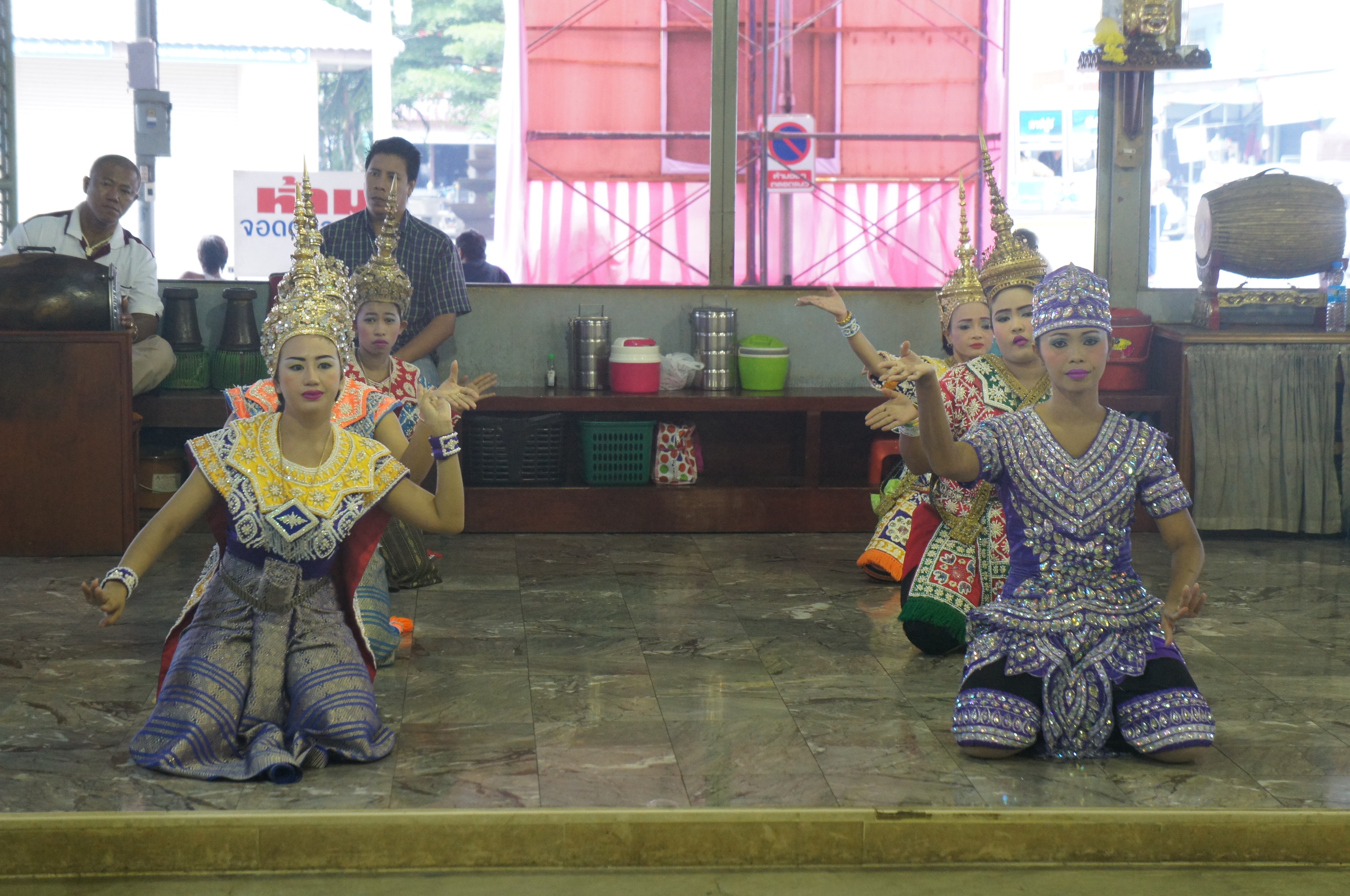
Worshipers pay for a traditional dance performance as a blessing for Buddha
Lighting incense

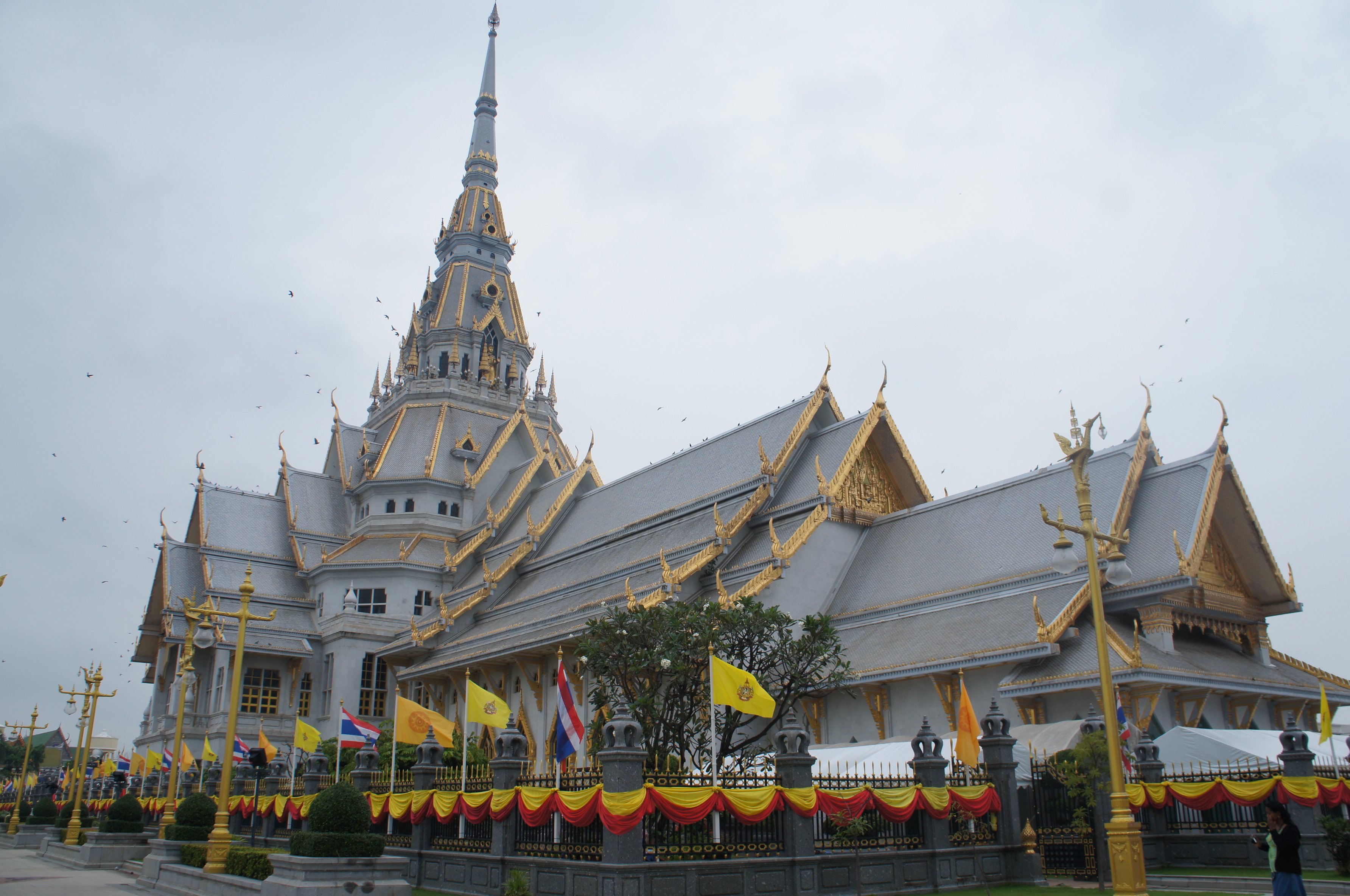
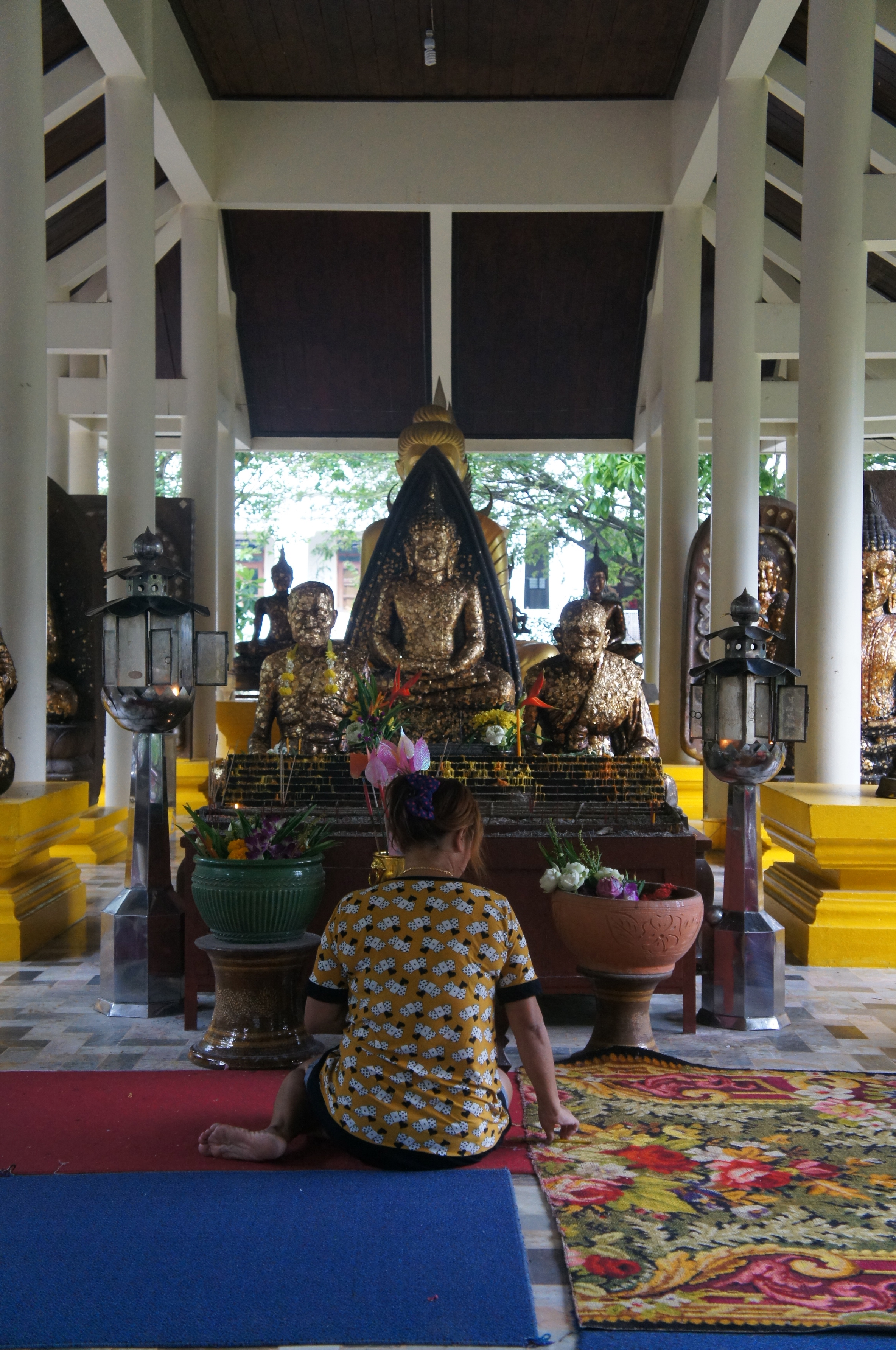
Our first stop is Wat Sothorn in Chachoengchao, Thailand. J.J. tells us that this is one of the most important temples in this province and the richest. There’s no doubt that money is flowing freely into the coffers of this temple and donations are big business here. The gilded trim of Wat Sothorn glints brightly even on this grey day, but the pavilion next door is where parishioners leave money for dancers to perform a traditional dance as a blessing for Buddha, deposit dozens of eggs or a roast pig as an offering or simply light a stick of incense. J.J. informs us that Thailand is 95 percent Buddhist and confirms that the practice incorporates some Hinduism and from what we can tell here a lot of belief in luck and good fortune. Under the pleasing smile of several Buddhas in one room, worshipers shake a red can full of sticks until one fateful numbered stick falls out. They then take this stick to a woman with the corresponding fortune. Karen, Nancee and I try it and J.J. translates our fortunes. Mine isn’t so good, she tells me. She says that I need to concentrate and focus more. Not bad advice. Karen is told that a member of her family will be in better health, which is good news for her since her mother has been experiencing some health issues. But Nancee gets the best news with word that she’ll have good luck in the future.
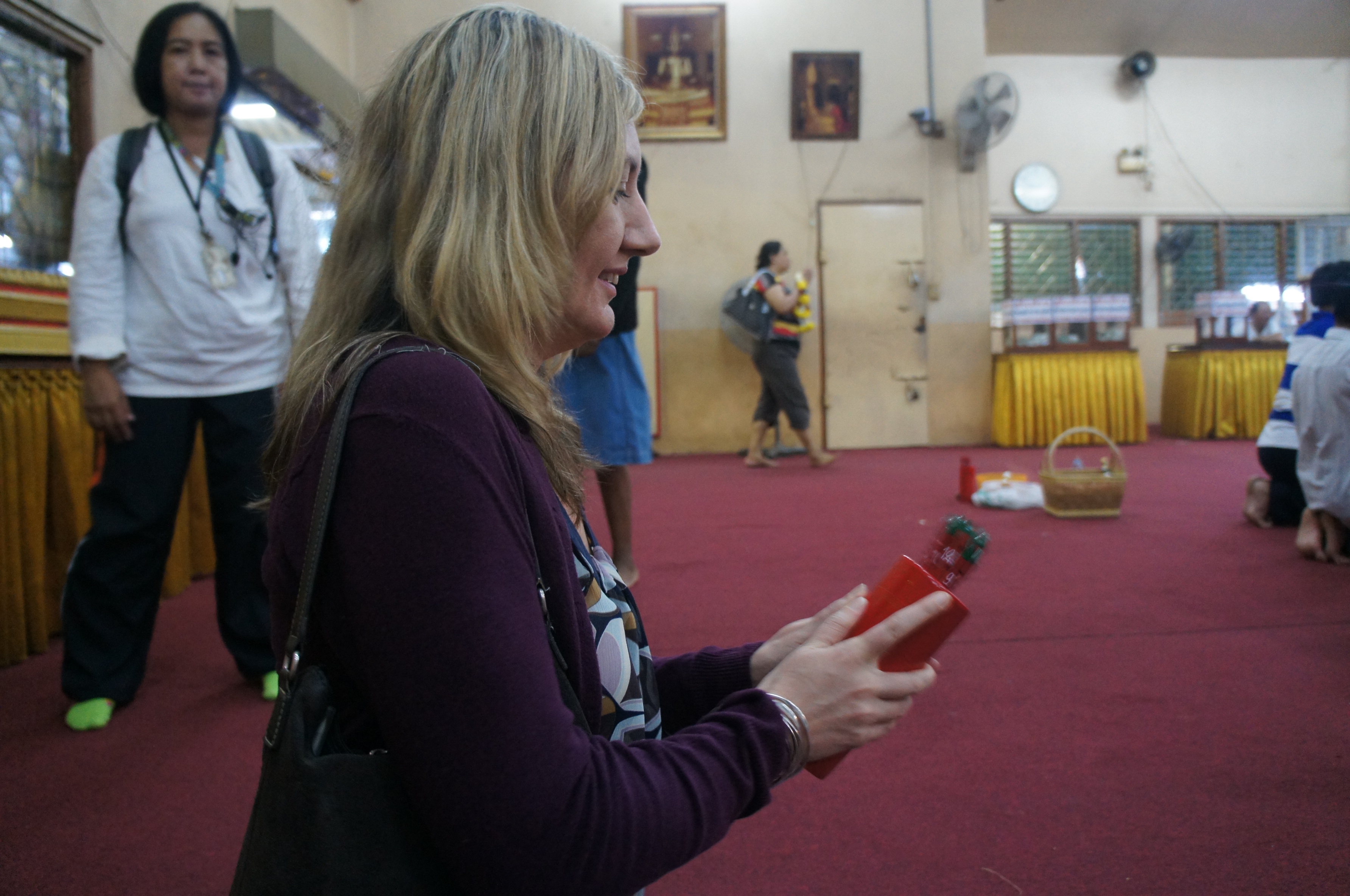
Karen tries her luck with the lucky sticks
Offering blessings and hoping for good luck
Playing the lotto, Thai style
Inside Wat Sothorn
Wat Sothorn

Beyond this room, there is an open air pavilion full of amulets or charms for purchase to be left for Buddha next to tables full of lottery tickets also for purchase. Old lottery tickets have been turned to hats and other decorative items. Inside the temple, we can see that donations of devotion have gone toward a gorgeous marble floor filled with dancing fish to represent the sea and a celestial painted ceiling representing the sky with a cluster of gold leafed deities sitting cross-legged below. J.J. explains that the knotted or curly tresses of each comes from Greek representations of Buddha that have been carried into Thai images of the man turned god. We also learn that his long earlobes represent long life.

J.J. is full of these kinds of tidbits, but the stuff that we love learning most from her is about Thai culture. While rubbing our hands with more antibacterial sanitizer, she gives us more intel on the sex trade in Thailand, explaining that many of the women involved are from poor villages who come to Bangkok to earn money for their families back home. It’s a short-lived career because only the younger women are coveted and older sex workers can only get old Chinese men as clients. She makes a disapproving face with this last detail. I guess it isn’t much different than prostitution in the states, where poor, uneducated women feel they have few other choices.
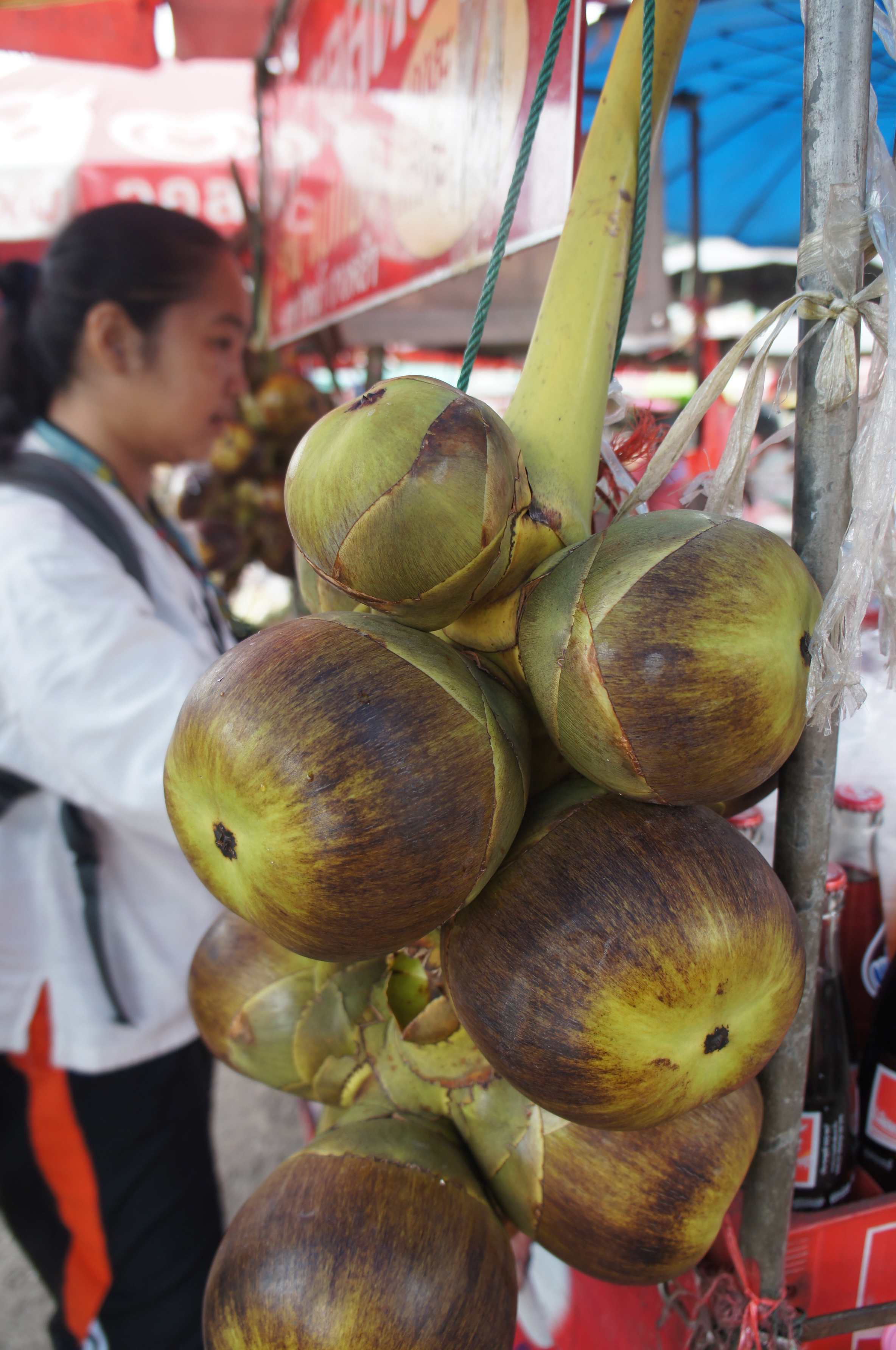
Tasty roadside treat of palm fruit and coconut roasted in palm leaf
Palmyra fruit
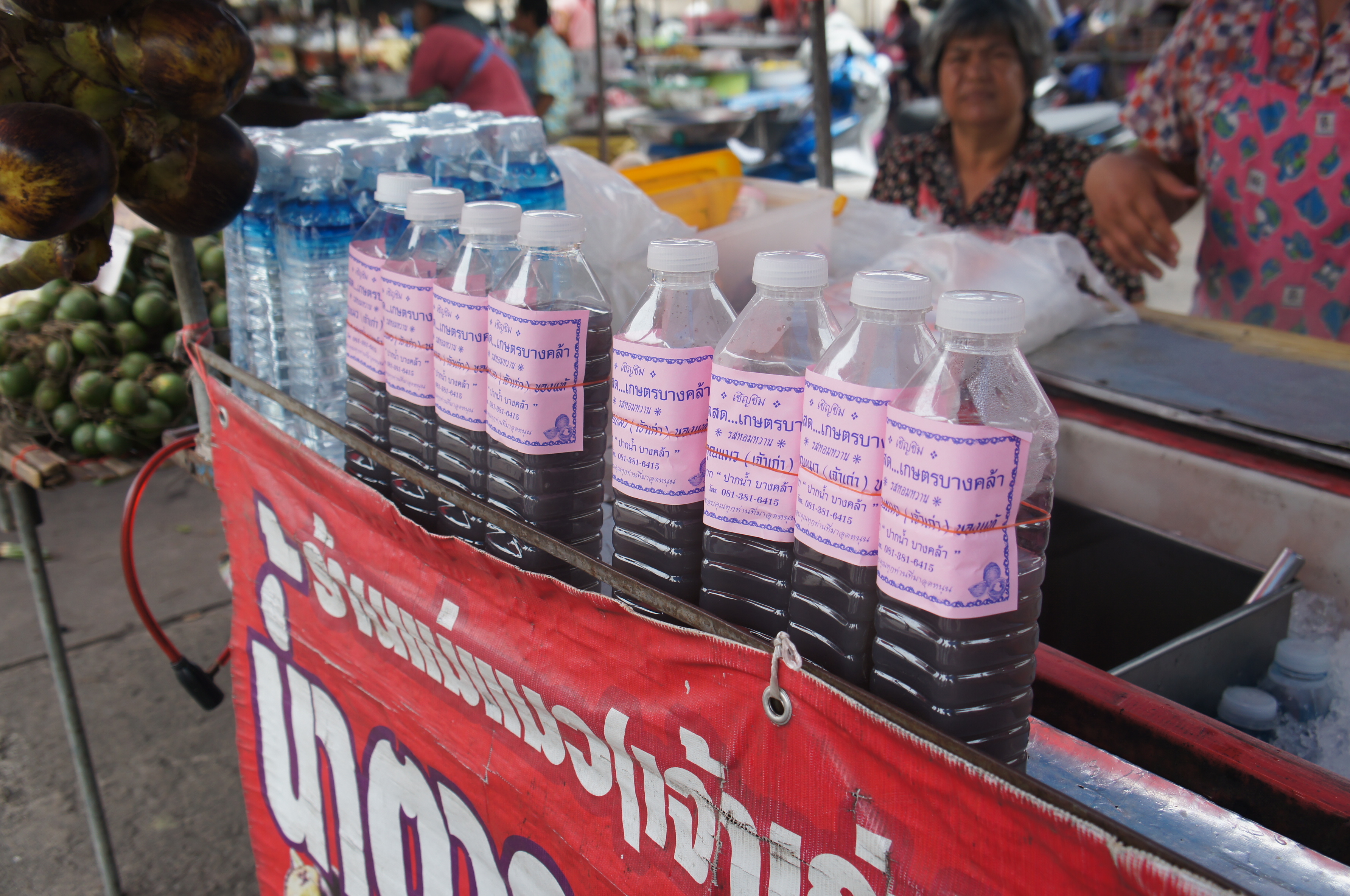
Palmyra juice, which would later be known as “ham juice.”

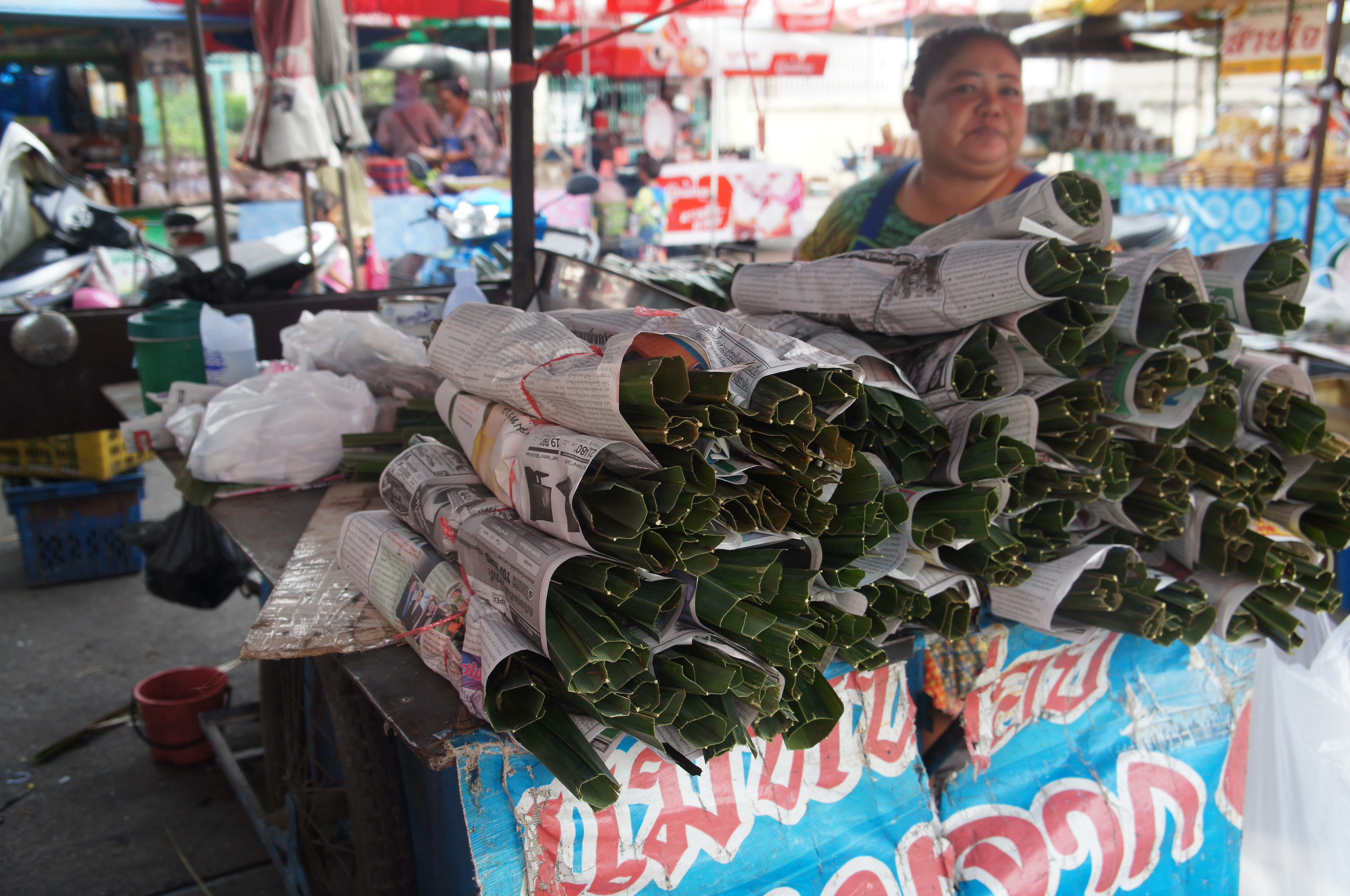
J.J. is also our guide to street food, taking us to a few food stalls standing across the street from the temple. The first thing we try is a gooey coconut treat roasted in the center of a palm leaf. The sweet warm goo is a combination of palm fruit and coconut. It’s a lot of work to peel back the leaf get to the treat, but well worth it. Nancee is intrigued by a purple-colored beverage that J.J. tells us is the juice of the palmyra fruit. It has a sweet and savory taste that we can’t compare to any fruit we know and we’d later discover that it tastes best cold. After several hours in a car, the juice takes on a smokey pork flavor and we dubb it “ham juice,” from that point forward.

Our next temple stop serves as a juxtaposition between a well-funded temple and one that seems to be forgotten by time. Where Wat Sothorn had bronze and topiary bunnies surrounding it, Wat Pho Bang Khla has a menagerie of real animals roaming its grounds, including a flock of furry flying fox bats hanging from its trees. The bats are the curious attraction here and J.J. says they fly out at night in search of fruit to eat, but never the fruit of the people in the region where they live. Instead of donations of money and food, this temple ekes out its existence by selling fish food. Unlucky animals purchased for good luck like roosters and turtles have found refuge here along with stray dogs, one of which is too adorable for words. The monks seem to fit the place. One wears a hearing aid and another smokes without apparent care. J.J. notes that Buddhist monks have 280 ancient rules that they must follow, but with the advent of the modern age, things like smoking or talking on mobile phones didn’t get added to the list. We’ve seen our share of monks with phones glued to their ears during this trip.
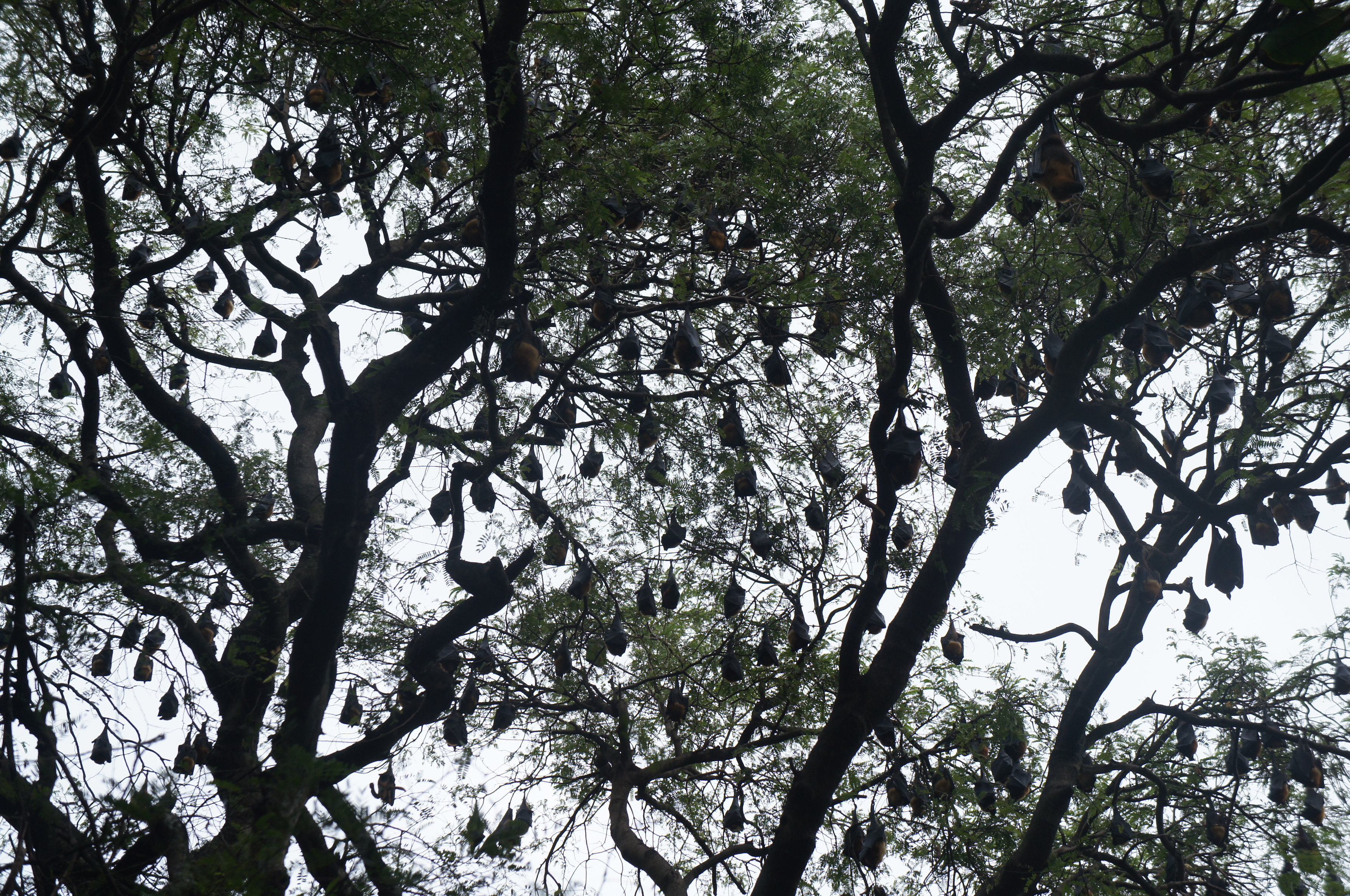
Flying fox bats hang from the trees at Wat Pho Bang Khla
Cutest resident of Wat Pho Bang Khla
Wat Pho Bang Khla
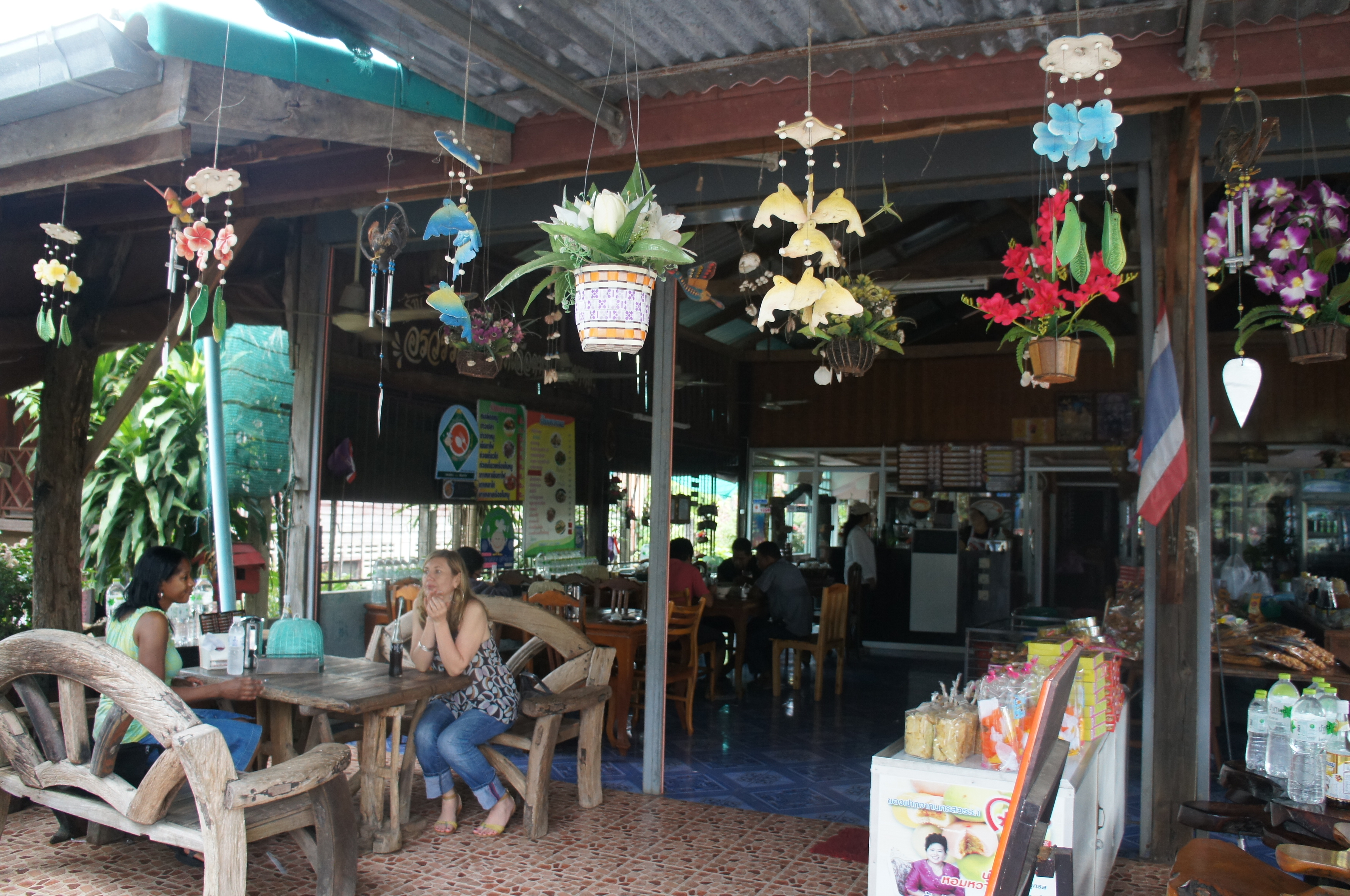
Lunch at a Thai roadside diner

For lunch, J.J. inspects a roadside eatery before giving it her trademark stamp of approval. It’s super cute and quaint with seating made from tree stumps, so we approve, too. It’s our last chance to eat before we reach the border and we enjoy simple stir fried and fried rice dishes before moving on. The roadside stop would later feel like our last stop in civilization before reaching the Thailand-Cambodia border. We enter at Aranya Prathet on the Thai side of the border in a drizzle, which makes the huge, crowded marketplace seem dismal and a tad depressing.

We reluctantly part ways with J.J. and Wichai and head off into a maze of vending stalls with our new guide, Mr. Visoth, who is a young man with a very formal name. We try to keep up with him wanting to stop and look at the gritty commercial chaos around us, but we are afraid to get left behind fearing that we’d get swallowed  up in it, never to be found again. But somehow this scene pales in comparison to the muddiness of Poi Pet, the Cambodia side of the border. Faceless people push huge carts of what we aren’t sure. The people are faceless because they wear wide brimmed or straw hats pulled low on their heads just above their eyes and surgical masks over their mouths and chins. It feels like the Wild West of the East or the template for Mad Max’s Thunderdome, a place where people must constantly hustle to survive. Lonely Planet calls Poi Pet the pit of Cambodia and the description seems to fit. It’s a no mans land of sorts with oddly-placed casinos where the Thai can go to gamble without entering Cambodia.

The rain seems to make Poi Pet steamier and its customs office is a sauna filled with folks of all nationalities. In line, a young Swedish man asks if I have my Visa. I explained that we got ours online and he says that he thinks he may have paid too much for his. He and his friends are on a 3 month tour of Asia and seem to be winging it. After what seems like an hour wait, we make it through customs and board a rickety bus with Cambodian locals to a large bus terminal where we meet yet another guide to take us another 2 hours by air-conditioned bus to Siem Reap. Dee greets us with a warm smile and tells us to take a nap on the bus because there won’t be much to see. We’ve been up since 6 or 7 am, so we take his advice and nod off as we pass the Cambodian countryside punctuated by stilted homes with thatched roofs, rice farming families in conical straw hats behind ox-pulled carts.

We awake outside our oasis in Siem Reap, the Auberge Mont Royal d’Ankor Hotel and agree to meet Dee at 8 am for our tour of the ancient temples of Angkor Wat the next morning. We love our hotel’s polished wooden stairs and the huge room with three full sized beds that awaits us. It feels comfortable and homey and we steal a few moments to kick off our shoes and rest before we explore Siem Reap.
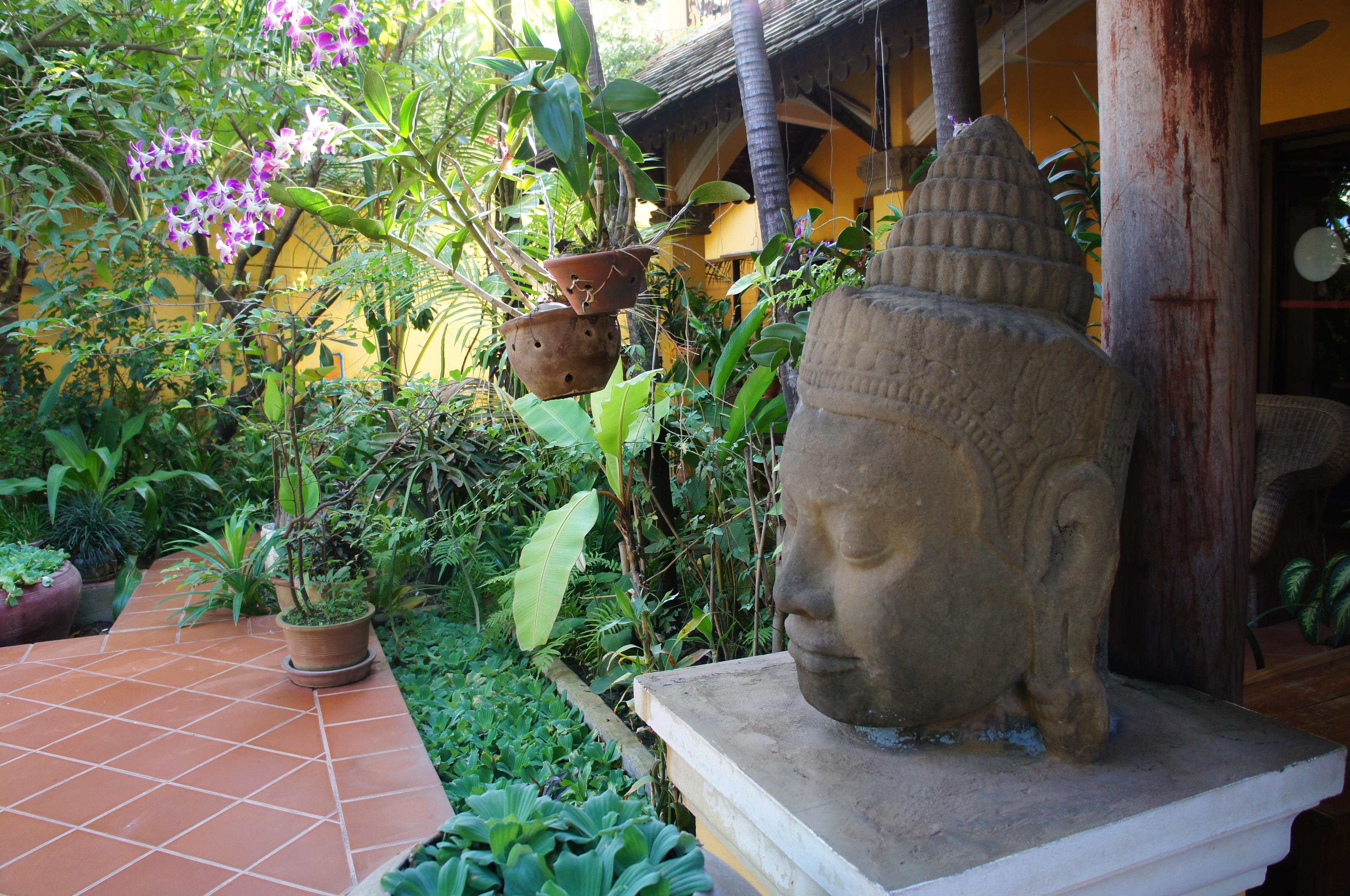
Our oasis at the Auberge Mont Royal d’Ankor Hotel

Thailand-Cambodia Postscript 1: Ayutthaya by Tuk-Tuk

Author’s note: I’m back from a whirlwind tour of Thailand and Siem Reap in Cambodia and I loved every minute. I’ll be recapping my adventures right here, so follow along…

Our train to Ayutthaya is late. We are sitting on the 8:30 express train that will take us to Thailand’s ancient capital city of Ayutthaya, but it hasn’t left yet and it is after 9 am. Lucky for us that the express train isn’t so express, because we practically ran from the subway, thinking we’d miss this train and have to take a later and slower train. In fact when we board our train, workers are scrubbing down the outside of the train with soapy water and cargo is still being loaded.

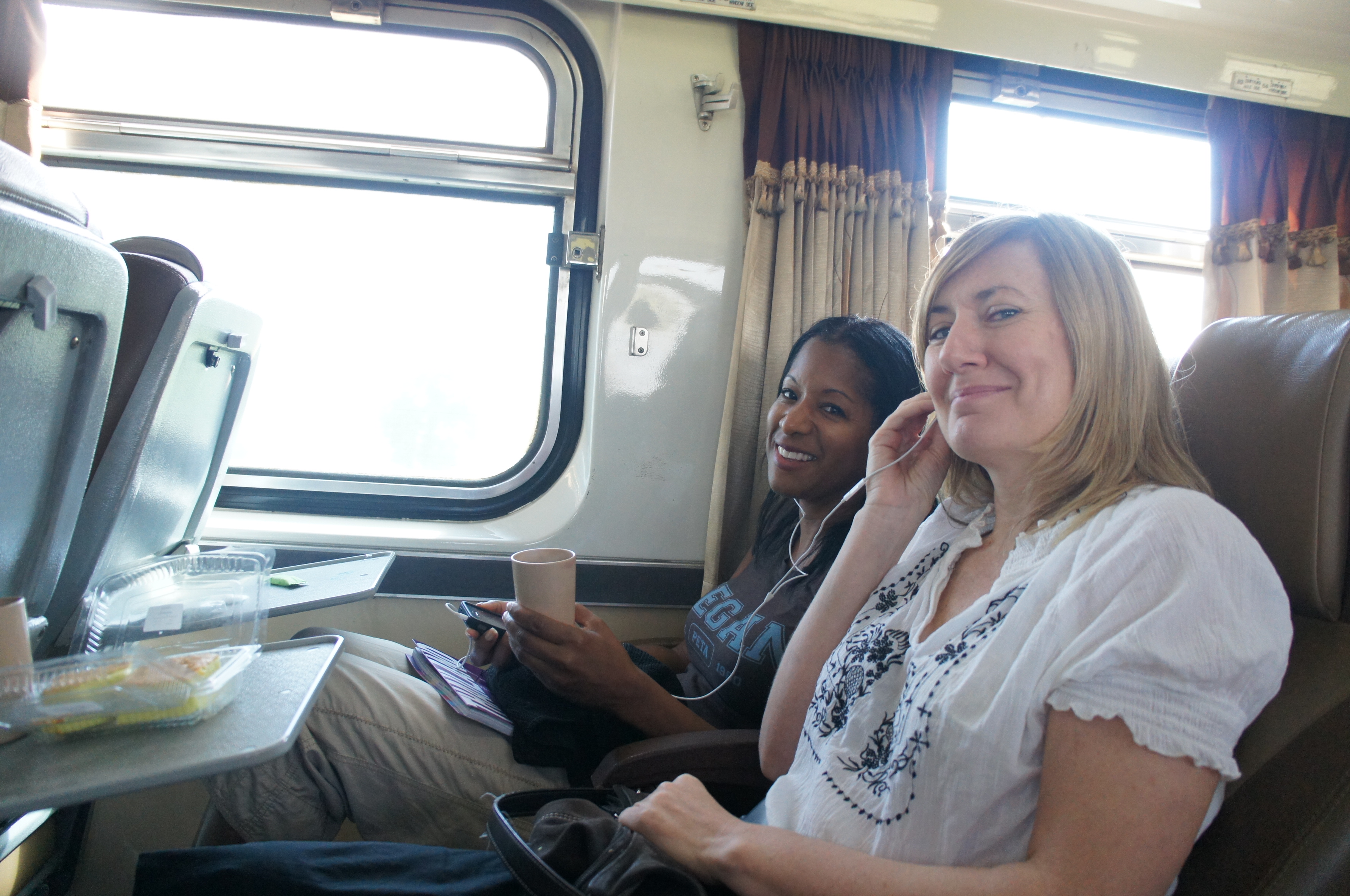
Nancee and Karen listen to tunes on the way to Ayutthaya

We settle into our seats next to curtained windows on what appears to be a first-class train, costing us about $10 per seat. We are pretty certain we are in first class when the train gets started and an attendant wearing a bit too much make up serves us spongy yellow cake, an apple pastry and tea from a heavy metal cart. Nancee and Karen don’t like the yellow spongy cake so much, but I thought it was good early morning train food and I’m as sucker for anything with apple in it. We pick up passengers along the way including a Buddhist monk, backpackers and luggage-toting Thais. The scenery along the way is pretty unremarkable except for a stockpile of broken toilets in the middle of a field. It’s hard to hear the stops along the way and we try to pay attention to town signs, but the backpackers exiting the train were a better sign that we’d reached our stop.

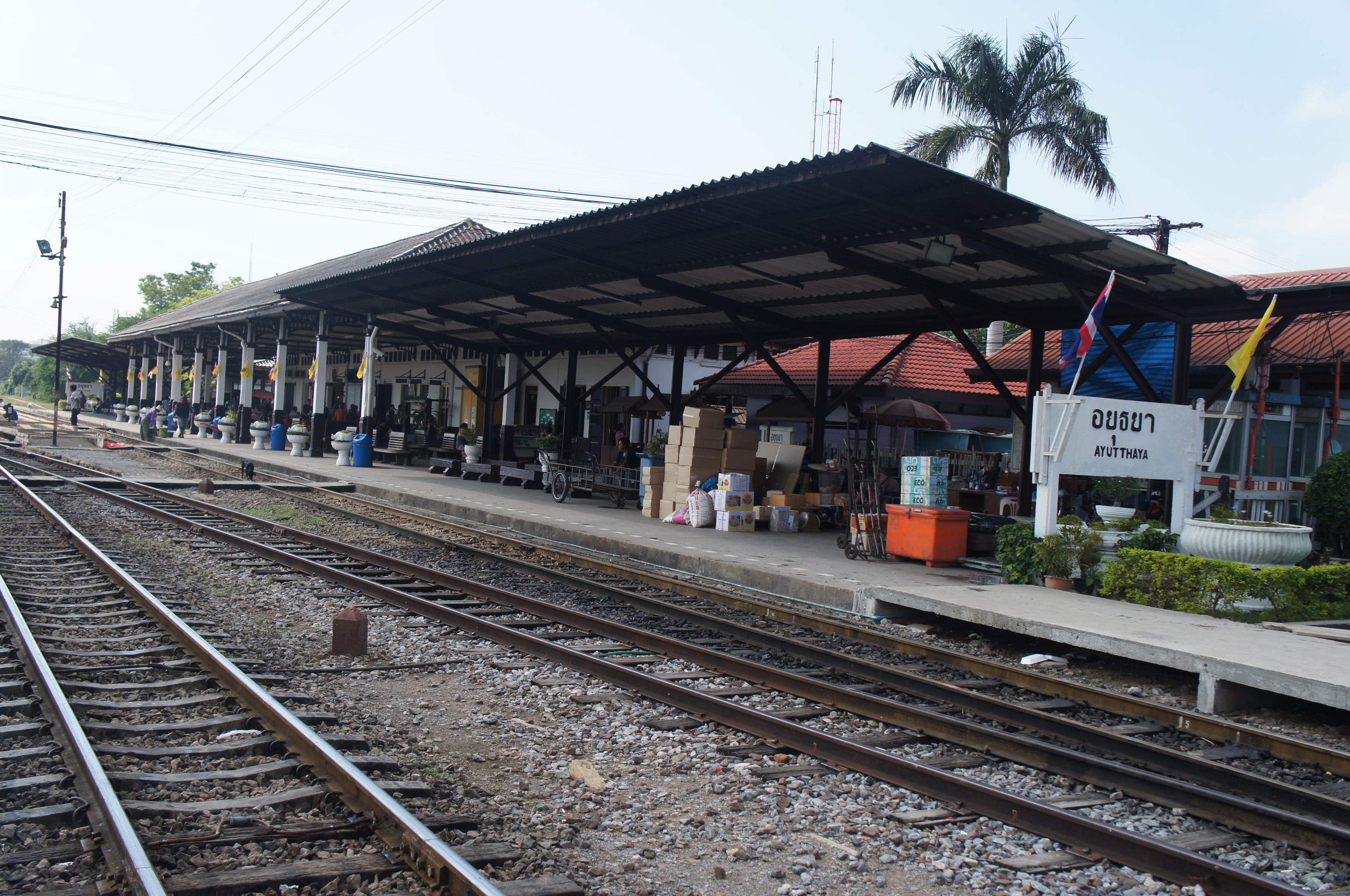
Ayutthaya train station

It would have been easy to miss the Ayutthaya train stop. The sign is small, appropriate for the size of the train station. We have to cross the train tracks to get to the station and walk into town, but first Nancee has to take a bathroom break. We spot a sign that looks related to the train station and she heads in that direction, but quickly comes trotting back with a territorial tan and white dog barking at her heels. No bathroom there, or if there is, this dog is not having any potty breaks anywhere on its turf. Nancee has to sniff elsewhere.

Nancee’s stand-off with a Thai dog

Just outside the train station we realize that Ayutthaya isn’t as small and sleepy as we think. Cars and tuk-tuks jam the street and we immediately eliminate the thought that we’d tour around on bikes as suggested by the Lonely Planet guide. We’d like to keep all our limbs, thank you very much, so we head out on foot. Our destination is a ferry to take us onto the island of Ayutthaya which is surrounded by the Chao Phraya, Lopuburi and Pa Sak Rivers. Ayutthaya was rumored to be one of the largest cities in the world during its hey day as the capital of Siam in the 1700s and merchants from around the globe marveled at the more than 400 temples that once loomed there. What we’ll see today are shadows of this city’s former glory.

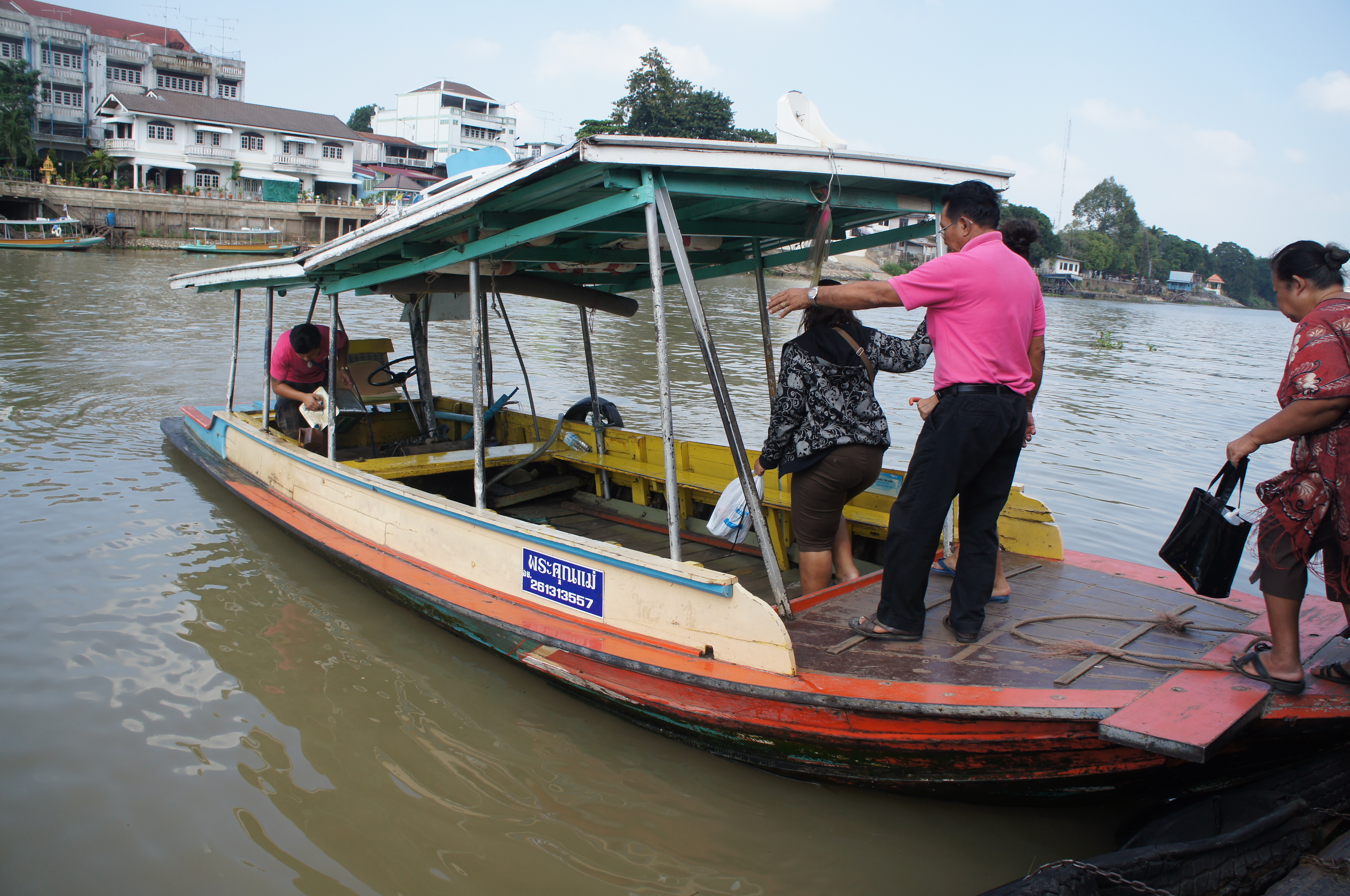
Ayutthaya ferry

We plunk down 5 baht for our ferry ride across the murky Pa Sak and board what is more like a motorized raft with a few other tourists, schoolchildren and other Thais going about their daily routines. Our plan is to make our way to the tourism office to find a guide to tour the old ruins, but we allow ourselves to be distracted by a weekday market with locals shopping for groceries, clothing and anything else you under the sun. The food is what catches our eye mostly, even though we aren’t sure what we are seeing. The variety of fruits and vegetables on this side of the world has always intrigued me. They are so alien and inviting and make apples and oranges seem so mundane. We stop at a red prickly item and wonder if it is fruit or vegetable. We’d later learn that it is dragon fruit and when cut open reveals a white pulpy center with small black seeds not unlike a kiwi. The taste is similar, too.

Dragon fruit

Back on our quest to experience a more ancient Ayutthaya, we cross busy store-lined thoroughfares in search of the tourism office when a man appears on our path smiling broadly and holding up a map. He says he can take us to see the temples. We are hesitant at first and he can sense this, so he crafts his pitch. He points to the places that he will take us by tuk-tuk, his smile never leaving his face. He’ll take us to 6 sites he says and then he pulls out a small book and flips through its worn pages with handwritten testimonials from tourists he’s won over before. There are glowing notes from an American couple and an Italian couple among others. He also insists that there will be “no shopping, no shopping.” We are sold. We decide on a price that we are willing to pay each and think 500 baht or $16 seems fair. So does our new guide named Tony, and we hop into the back of his tuk-tuk that is shaped like a tiny flat-bed truck.

Tony, our tuk-tuk guide

Our first stop is at a spire-shaped temple with its tip seemingly balancing the sun. It’s suddenly grown very hot in Ayutthaya and we pause in the shade as Tony explains that this site and many others were almost submerged by flood water during last year’s monsoon season. He points to a waterline on the pavilion where we are standing and it is well above our heads. He tells us that it was hard at the time to find food. He says he did a lot of fishing, smiling all the while he talks about what sounds horrifying. It’s these kinds of stories while traveling that make you count your blessings. He tells us that we can walk around the temple (Wat Phu Khao Thong) and climb (79 steps, per Lonely Planet) to the top. So, we do. The sun is beating down something fierce but we make it up and pose for a few pics along the way. At the top we find of all things a napping dog along with a small group of tourists that I guess to be French. We take turns bending our heads to navigate a small tunnel into the heart of the temple and find a very small mirrored alter to Buddha that will only fit one person at a time.

Climbing Wat Phu Khao Thong

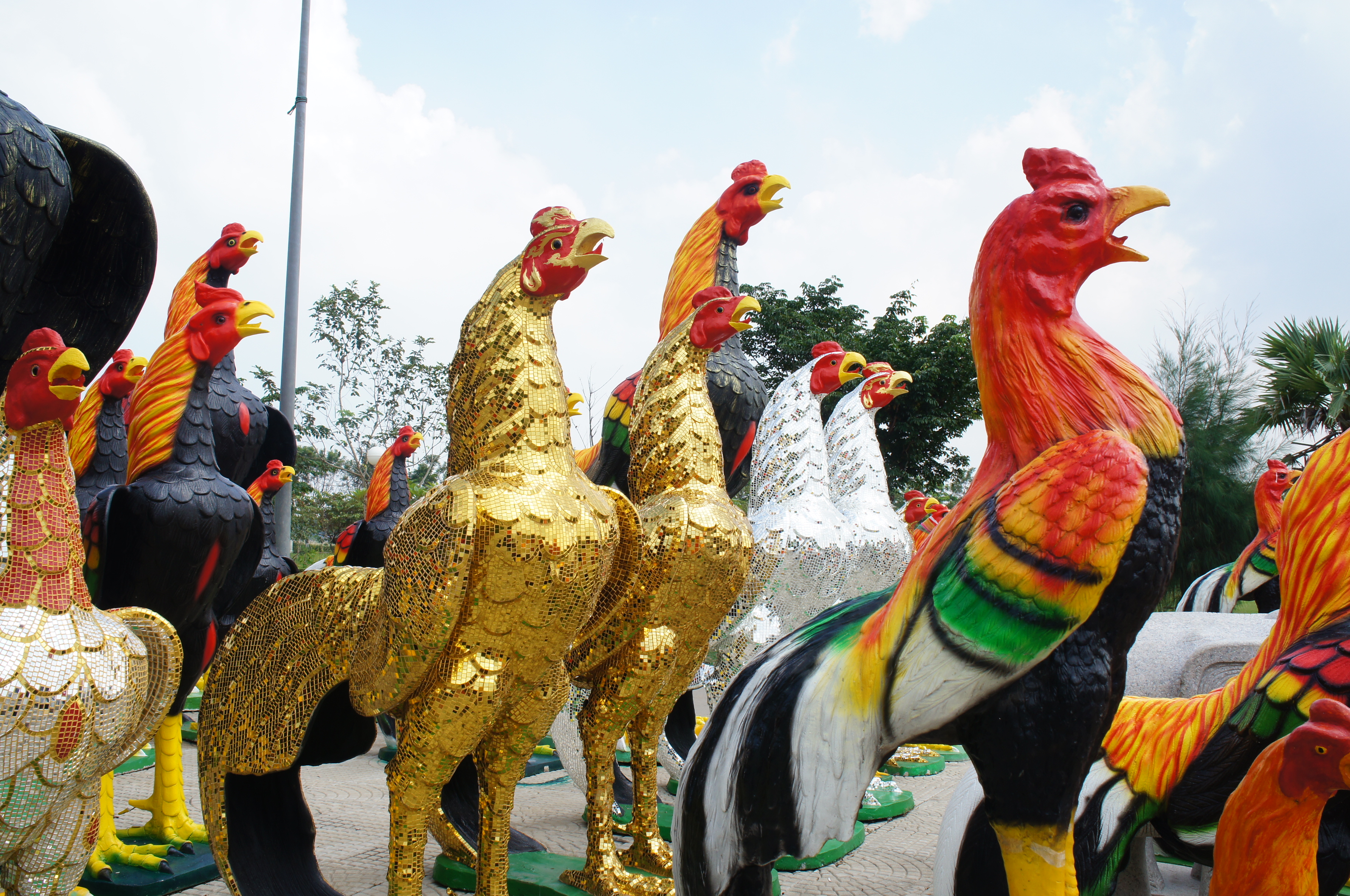
Back on the ground and on the way to another temple, I ask Tony to stop at a cluster of colorful, 4-10 feet tall roosters, seeming to salute a bronze statue of a man on horseback. I’d asked him about the roosters earlier. According to Tony, legend has it that in ancient times the king of Thailand’s rooster beat the king of Burma’s rooster in a huge cock fight and now it is considered good luck to own a rooster, which would explain the roosters roaming about the temple grounds and in town. Upon further investigation, I learn that the man on horseback is King Naresuan also known as “The Black Prince” one of Thailand’s most revered kings for his fight to free Ayutthaya from Burmese occupation in the late 16th century, and that it was his rooster that won the legendary cock fight.

Lucky roosters

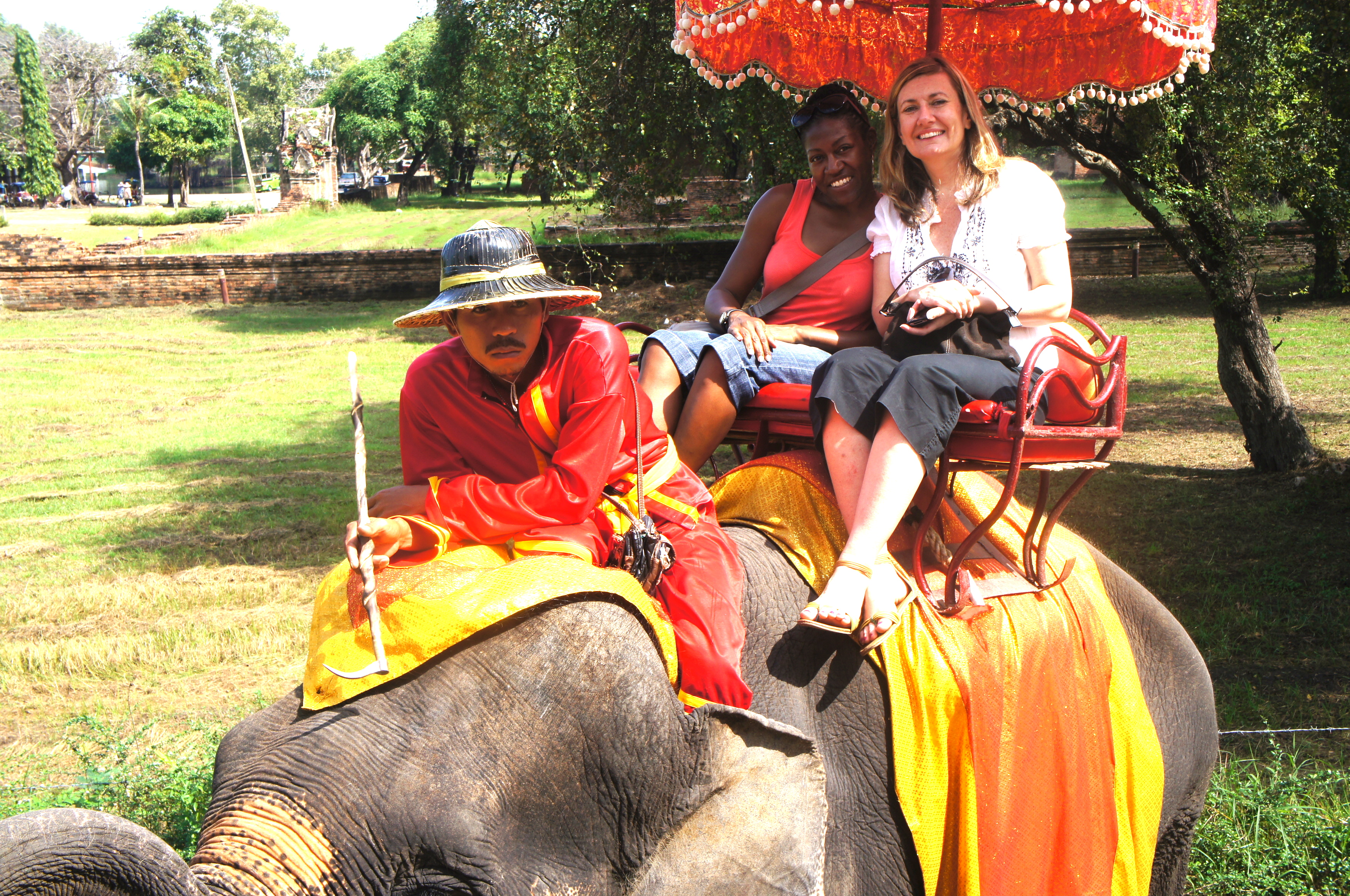
At Wat Chaiwatanaram, we can see the former grandeur that reigned at Ayutthaya with much of it still in tact. But we can’t inspect the ruins closely due to flood damage. We see the tale tell water lines on temple signage nearby. This temple is in the Khmer architectural style that we are going to see much more of in Siem Reap at Angkor Wat and we make vain attempts to photograph it even though the sun has decided to hide behind passing clouds. A huge yellowing stone reclining Buddha in the middle of a field was our next stop, followed by Wat Phra Si Samphet, which is said to be the largest temple in Ayutthaya. But what captures our attention are the elephants decorated with tourists under bright red umbrellas. Tony encourages us to tour the area by elephant and we hesitate for a moment because we wonder about the treatment of the elephants. It’s the same concern I had on my elephant ride in Sri Lanka. Karen has never been on an elephant ride and she’s intrigued but torn. I tell her that I’ll go if she does. Nancee decides that she doesn’t want to take the trip, so Karen and I embark upon a 15 minute elephant lope near the temple guided by a mahout. The journey is pretty unremarkable except for a lovely view of a few of the chedis or stone monuments to Buddha and a well orchestrated photo op with the elephants where we pay them, literally, through the nose. If I were to go back, I’d skip the elephant ride and save myself the stress of wondering if the animals are OK during a 15-minute long tour. It wasn’t worth it, cute as those creatures are. Karen agreed.

Wat Chaiwatthanaram
Stone reclining Buddha
Elephant tour of Wat Phra Si Sanphet

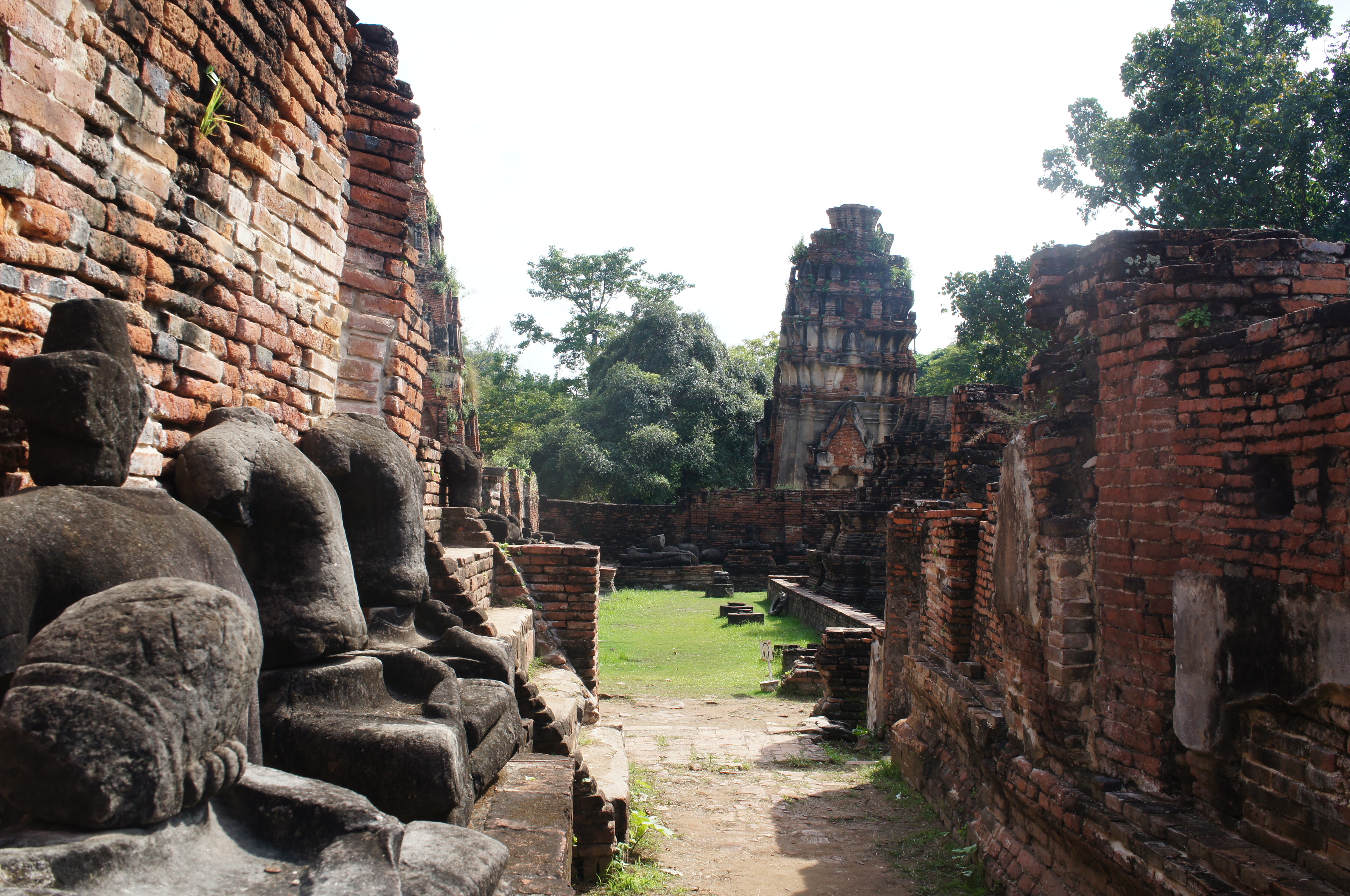
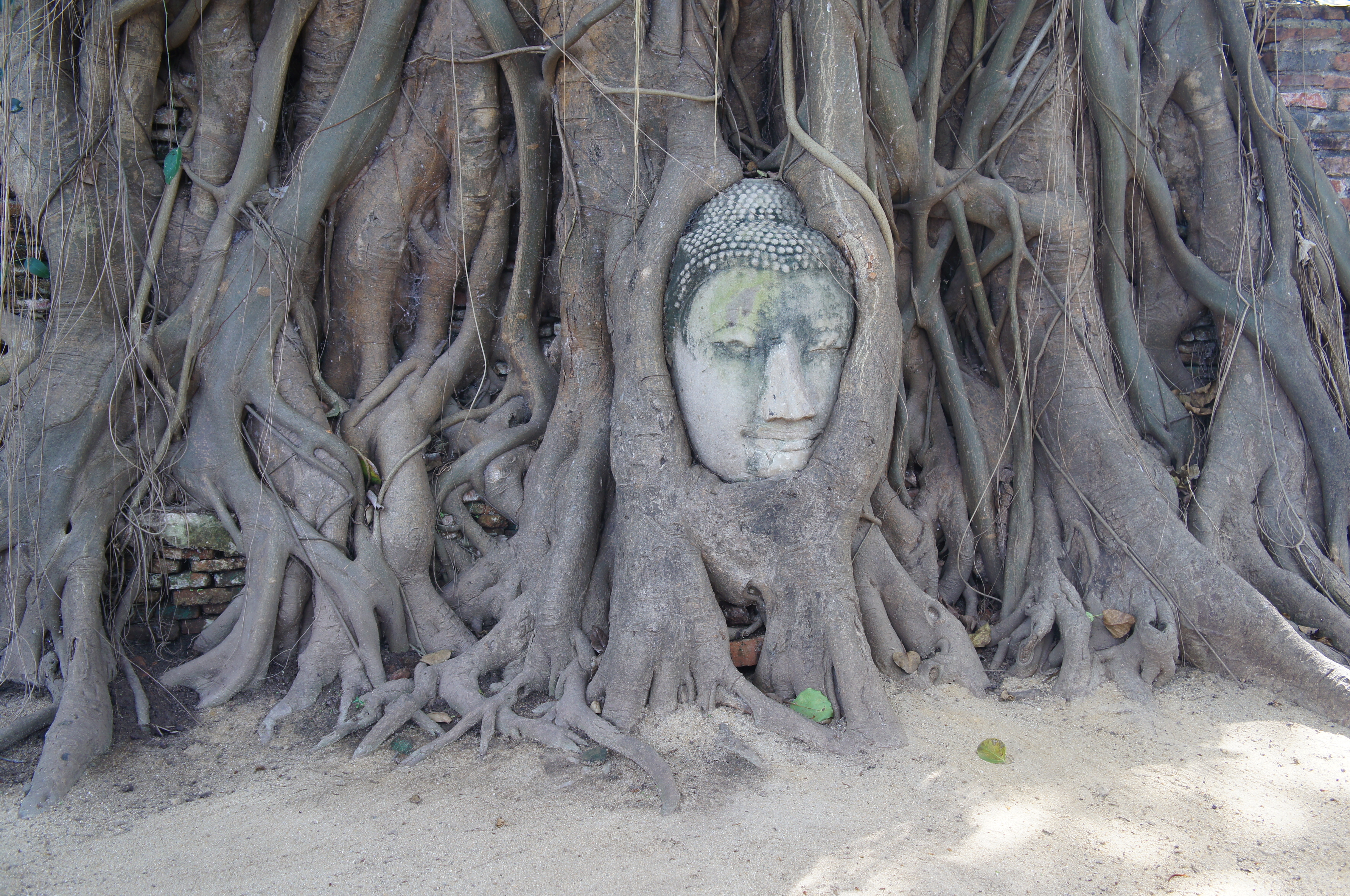
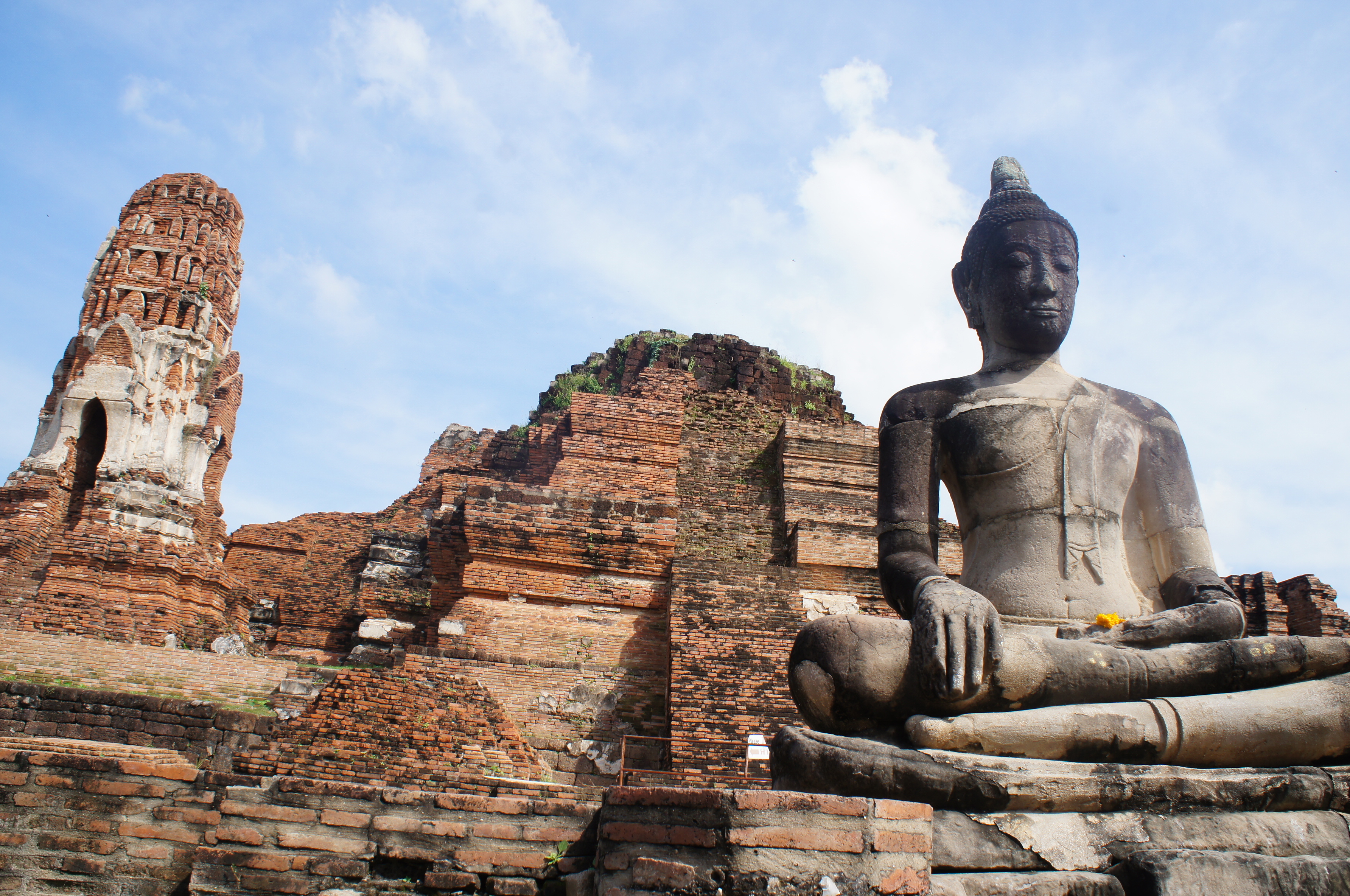
Our next tour stop was our favorite and the favorite of many who come to Ayutthaya with good reason. Wat Phra Mahathat is probably the most photogenic of the temples we’ve seen in my opinion. Ransacked by the Burmese, the temple is littered with headless Buddha figures amidst stone ruins that appear to be melting in the sun. It’s clearly a site of much destruction, yet it is strangely beautiful and serene. We wander apart taking it in independently. The most photographed feature at this temple is a Buddha head mysteriously entwined in the roots of a tree.

Wat Phra Mahathat
Headless Buddhas
The rooted Buddha head

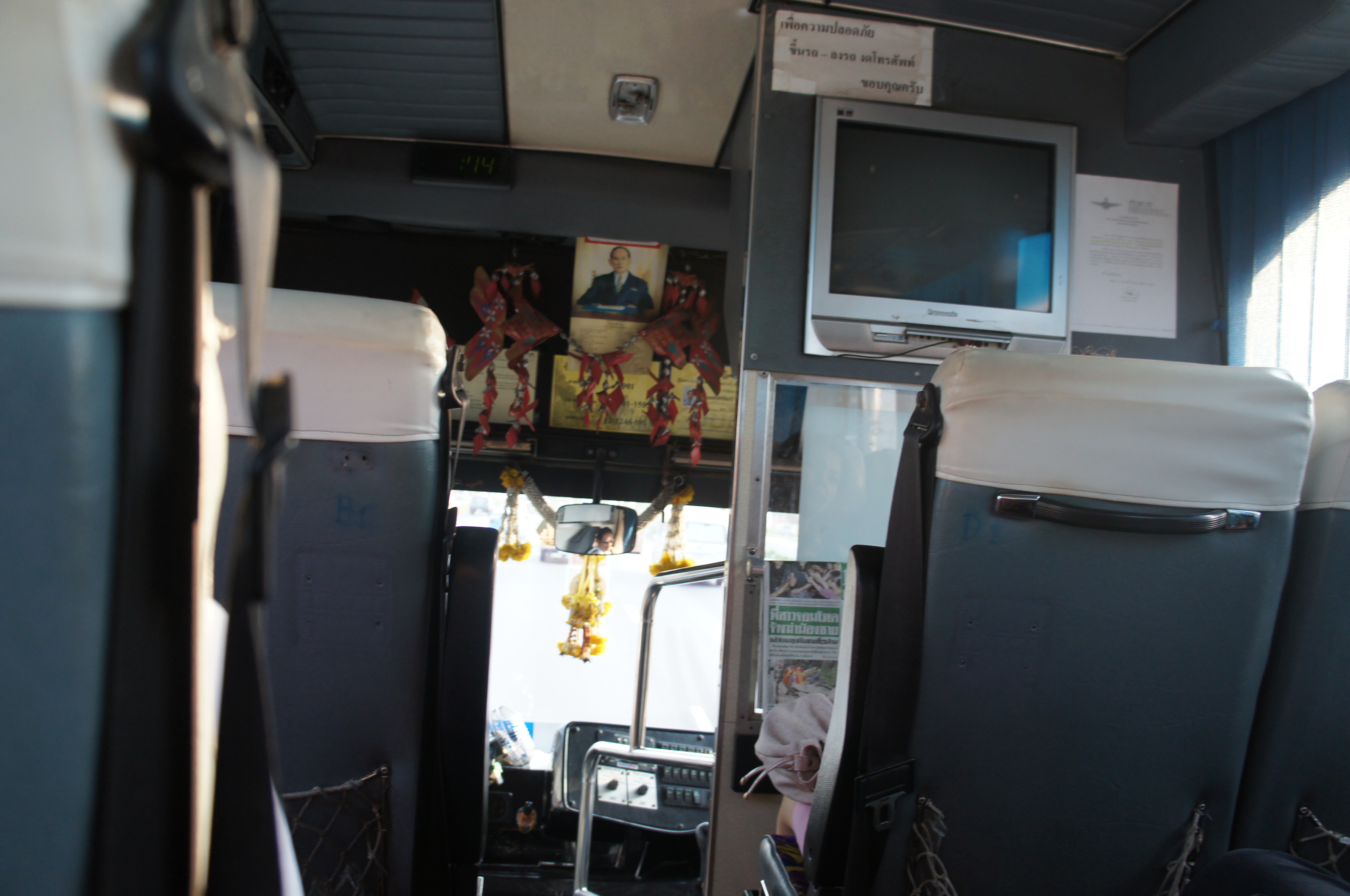
By this time we are ready for lunch and we want to go to a floating riverside restaurant recommended by our guide books, but we aren’t sure that we end up there. The spot that Tony drops us has a riverside view though and serves a nice Pad Thai, that you can season yourself with more sugar for sweetness or dried peppers for more heat. We decide to head back to Bangkok and Tony convinces us that the bus is the way to go. We are sure that Tony is getting a little something from the vendors he directs us to, but we are cool with it because he’s been a great guide and he hasn’t steered us wrong yet. So, we thank him with a few “korp kun hkas” or thank you’s and bows of the head, before we hop on a comfy air-conditioned bus for a mere $2 per person for the hour or so ride back to Thailand’s current capital city of Bangkok.

Bus to Bangkok

Water Taxis and Wat Pho

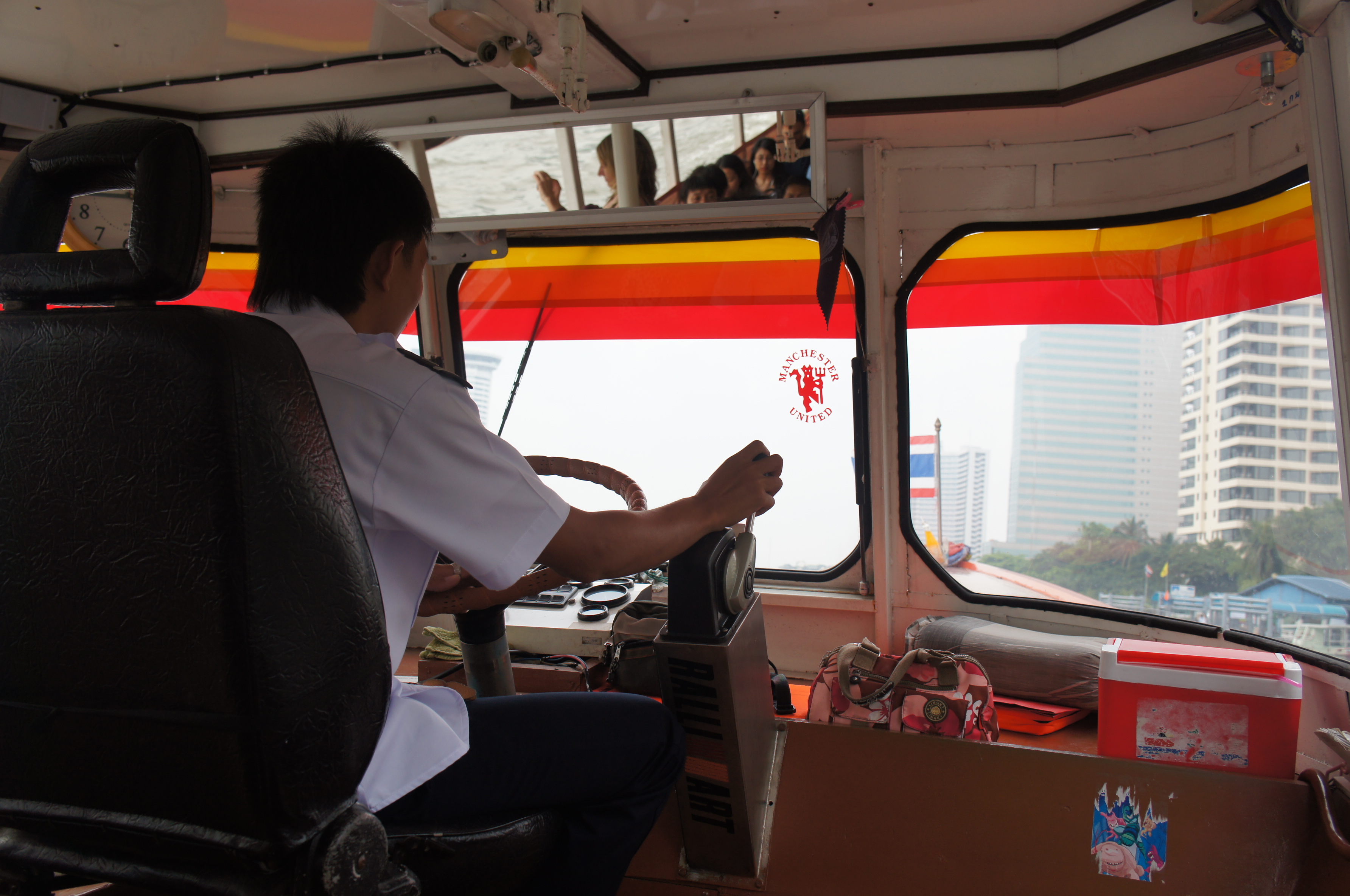
Water Taxi Driver

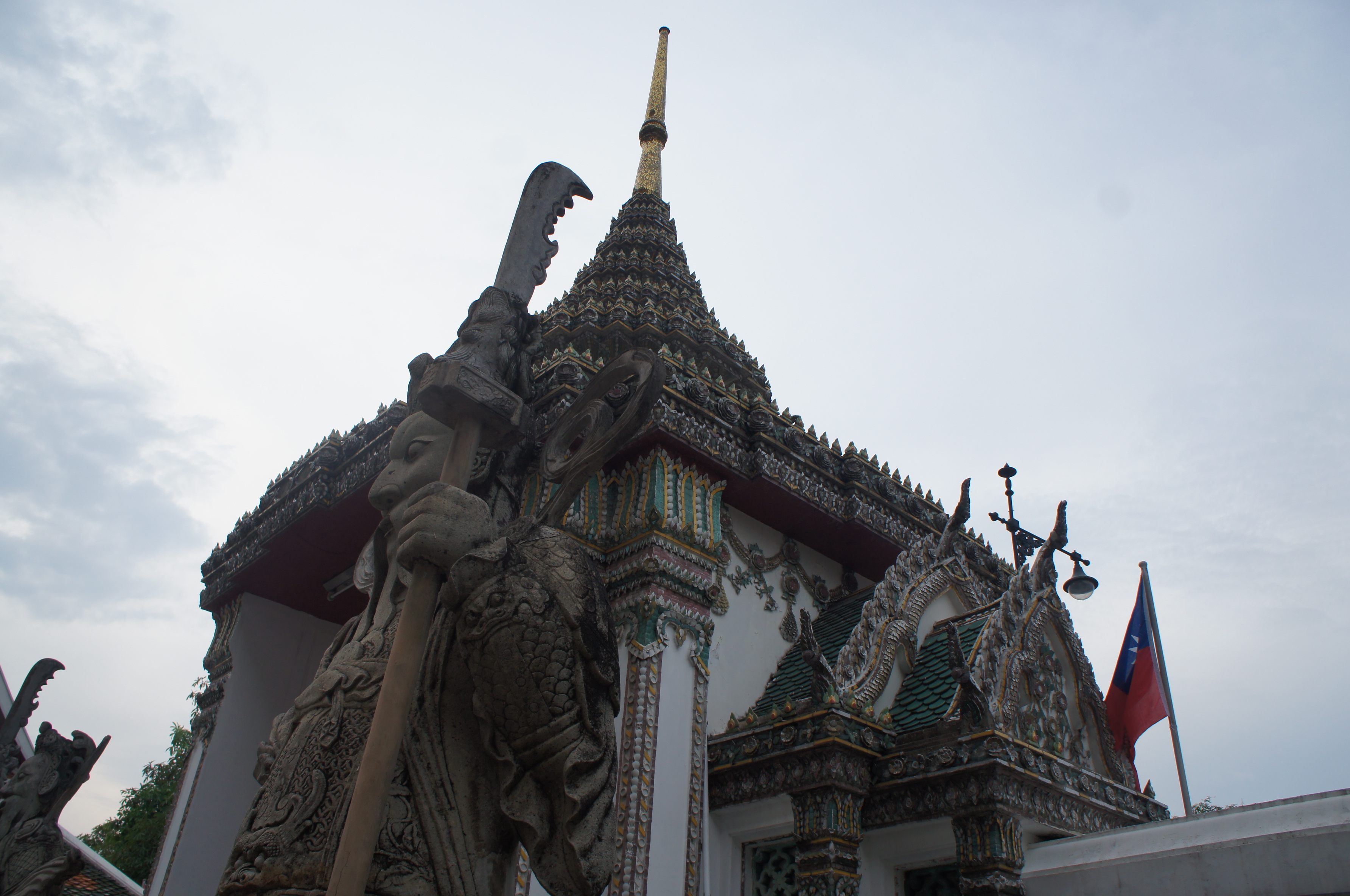
We leave our hidden oasis at the Jim Thompson House for another Thai landmark, Wat Pho, a temple dedicated to traditional Thai massage and a clear sign that the Thai take their massage seriously. But we must, literally, navigate another mode of transportation to get there–water taxi, which is way grittier than the Sky Train. The platform rolls under our feet as we climb aboard at Saphin Taksin. A woman shakes a tin can in the direction of new passengers to pay up in exchange for a small red and white paper ticket. It’s 15 baht, about 50 cents to ride. We spy long-tail boats for the first time on our trip, narrow skiffs with a small motor attached cruising Bangkok’s Chao Phrya River. We know we’ve arrived, about 5 stops later when an ancient conical tower appears amidst the skyscrapers lining the river. We think it is Wat Pho, but it is another temple, Wat Arun. The one we seek is just beyond a row of street vendor stalls, smelling of dried fish. But Wat Pho’s glittery gold roofs are beckoning. Once inside we are stopped by huge stone guards armed with swords. Nancee and Karen have to pose with them mimicking their menacing stances. But gangs of tourists have gotten beyond the guards pointing their cameras at whimsical multicolored spires stretching into the sky. Apparently one Indian tourist has lost their camera because there’s a man yelling through a bull horn for them to come pick up their camera from a tent in the middle of this crowded scene. We know the tourist is Indian because the man has looked at the pictures and is describing the people in them all over the bull horn. It’s a little distracting in what is supposed to be a sacred site.

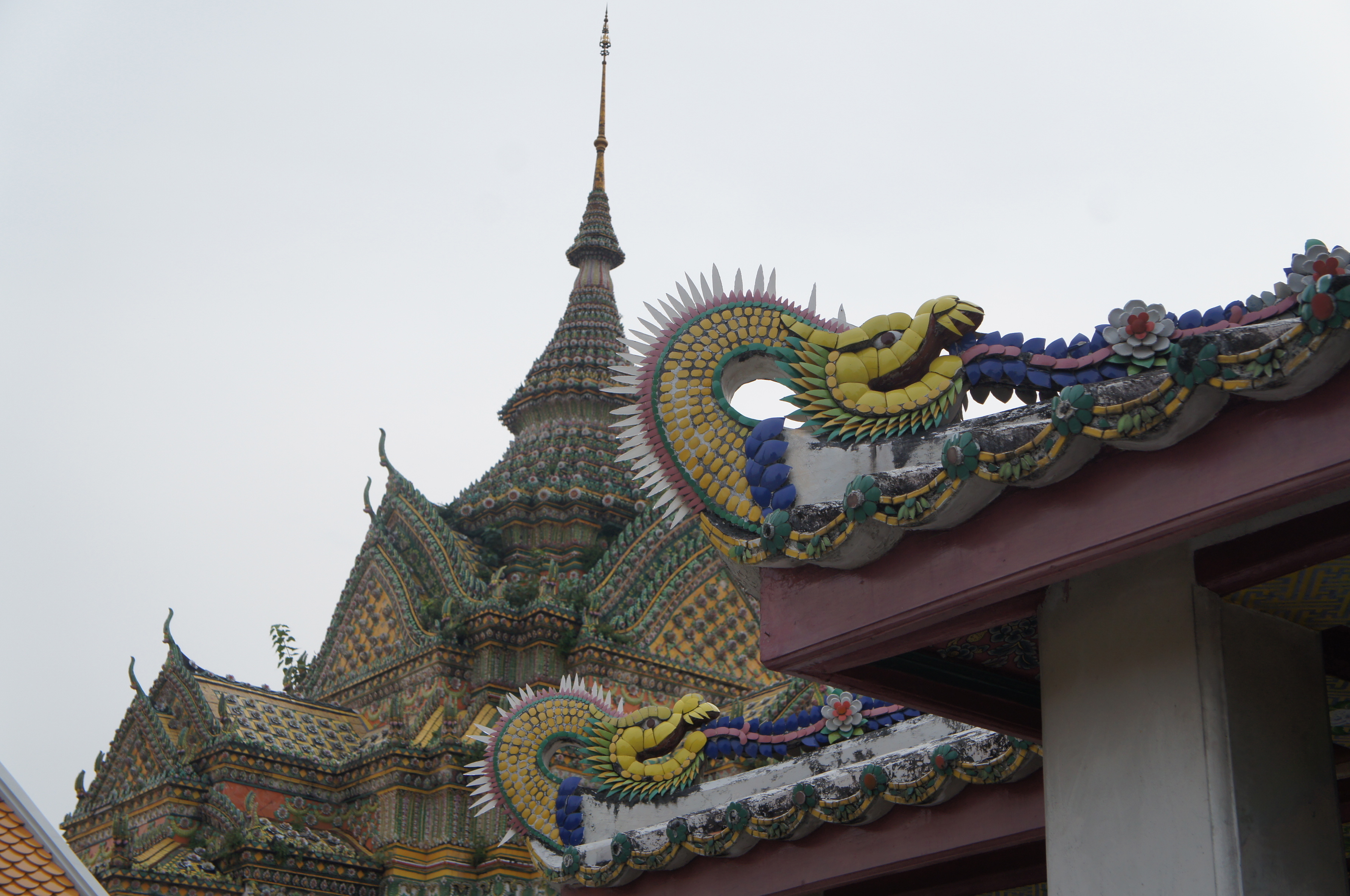
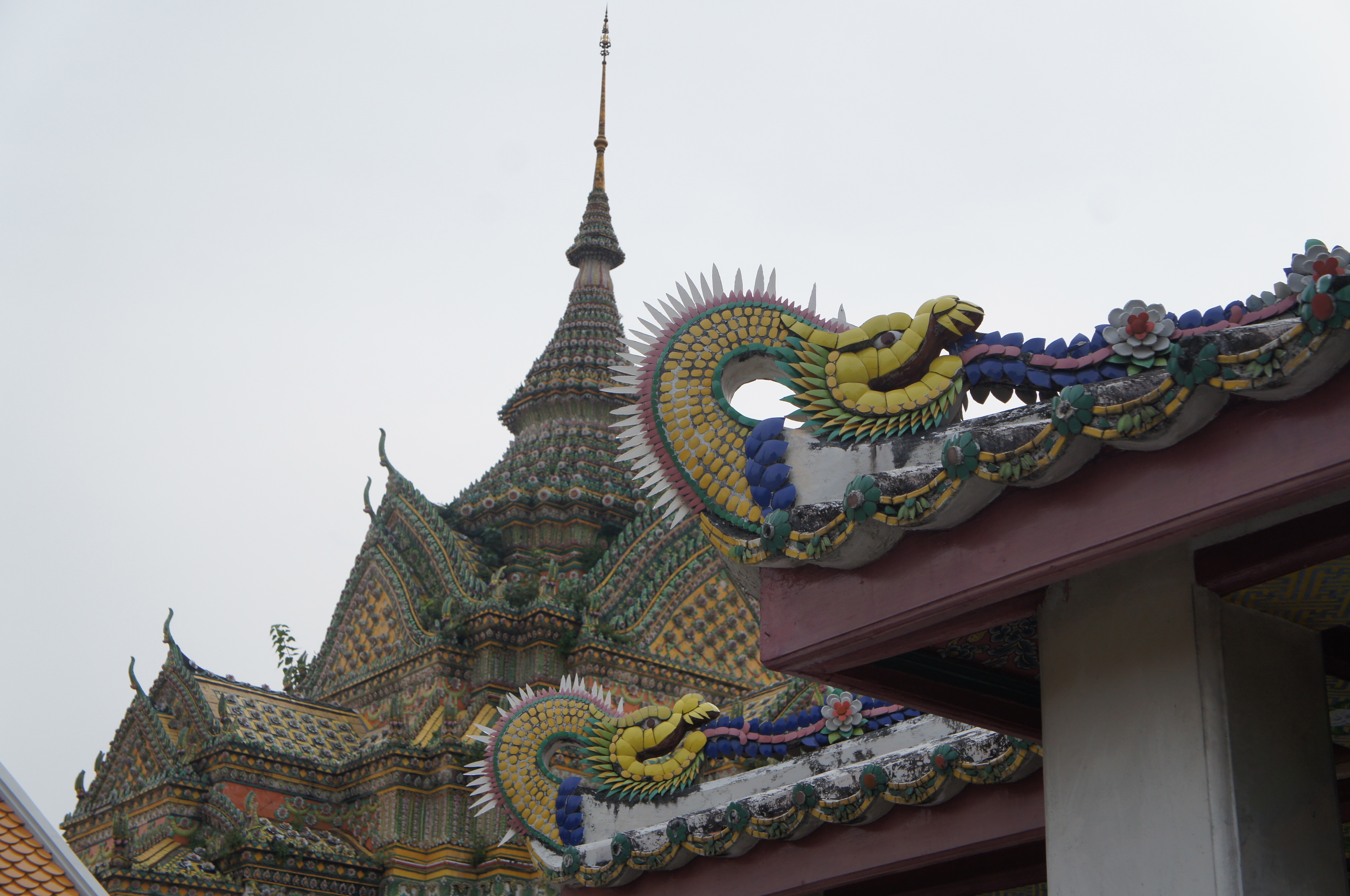
The roofs at Wat Pho
Wat Pho Guards

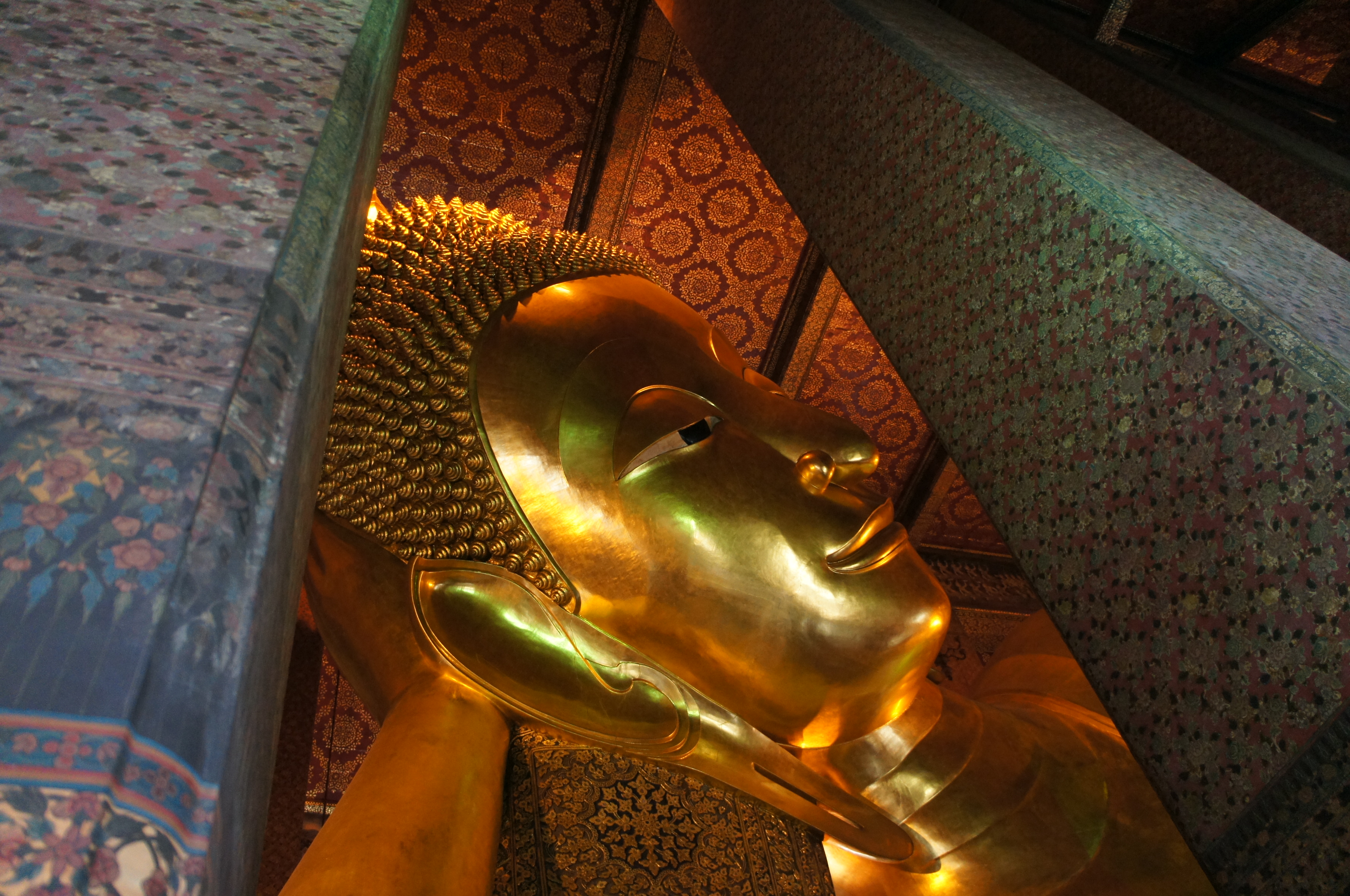
The main attraction drawing the crowds is a giant, neck-craning reclining Buddha, measuring 150-feetlong and 49 feet tall. The gold resplendent figure barely fits into its small temple and streams of people cluster at the entrance to get a photo its serenely happy face. It’s almost impossible to capture the Buddha in its entirety on one photo but everyone tries, while inserting themselves into a few frames themselves. His feet are a whopping 9 feet tall and 16 feet long, decorated with Mother of Pearl. He is to say the very least impressive and worthy of the adoration.

Wat Pho’s Reclining Buddha
Mother of Pearl encrusted Buddha feet

The size of this Buddha matches his surrounding at Wat Pho, which are expansive and just as fancy. The temple complex is huge and we split up to try to take in as much as we can. Spires print up from the ground and nested doorways invite us to explore courtyards lined with rows and rows of seated Buddhas. Chanting emanates from a temple at the center of the complex featuring a Buddha that seems to emanate light, it is so golden. This one is seated atop an ornate pedestal and monks in saffron robes kneel before it chanting without a breath. The chants envelop us and I believe this is what true devotion feels like.

Monks at Wat Pho

The sun is starting to set and we are about to leave when I remember that this temple is also dedicated to Thai medicine and massage and the home of the country’s first government approved school for massage. And, what better way to end of day of sightseeing than with a massage? Karen opts for a foot massage and Nancee and I go for the 30-minute full body Thai massage, costing 260 baht or around 8 bucks. An amazing value for a fully-clothed massage that starts from your calves, goes to your head and seems to force every muscle in between into loose submission. My masseuse, Ann, is small but she’s strong and uses her full weight to press tension out muscles and stretch limbs in ways you never thought possible. I ask Ann how long she has been doing this. She says 10 years. Her hands say it all. Karen seems content with her foot massage and Nancee says her massage was a bit too forceful for her tastes, but we are all pretty relaxed afterwards.

Wat Pho by night

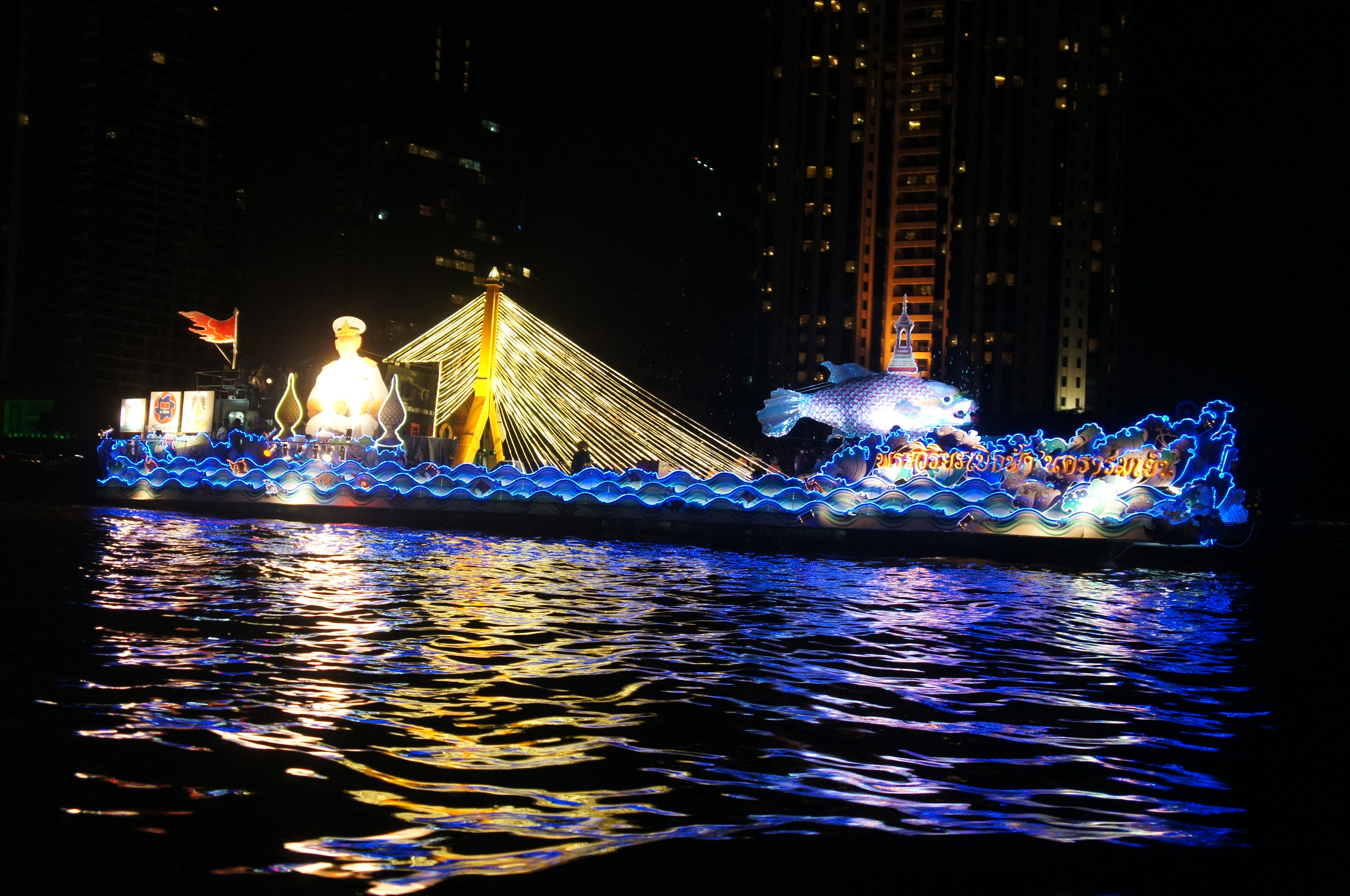
By this time it is nightfall and we make our way back onto the water taxi to head back to Lyle’s. Unfortunately we head in the wrong direction for about 30 minutes before the lady with the tin can asks where we are going and says we should get off and catch a taxi heading in the other direction. But it turns out to be good fortune because we’ve seen Thailand at night, a brilliantly lit bridge and skyline reflected in the river along with a special treat, barges festooned with colorful lights and themes featuring giant images of Thailand’s king and queen. One boat is blowing bubbles from its top and another boasts boldly, “Green Energy.” We learn later from Lyle that this display is probably a precursor to the upcoming Loy Kratong Festival to pay homage to the goddess of the rivers and water ways. Sometimes it’s good to take a wrong turn. You never know what you might miss.

Water Festival Boats on Chao Phrya River

We are famished when we return and Lyle suggests one her her favorite spots in the neighborhood, Puangkaew. Lyle says a friend of her’s travels across town from Chinatown to eat at this place and we can see why. I have the spiciest papaya salad I have ever tasted and a delicious Chee Choo Gong or prawns in red curry sauce. The prawns seem to be fried whole and drenched in a coconut curry cause with kick. I cool the spice with a Singha beer, Thailand’s official brew. We can barely keep our eyes open over dinner as we fight off the effects of jetlag and a really good Thai meal.

Chee Choo Gong

Sky Trains and a Spy Who Loved Silk

Author’s Note: I’ve been lax in posting from Thailand because there has been so much to see and do! So here are two posts from one day of adventures!

The third member of our traveling party arrived on Monday morning, albeit a tad later than expected. We expected Karen in on Sunday, but she miscalculated her arrival, failing to factor in a 7 hour layover in Frankfurt. But, now, all the players in this great Thailand-Cambodia adventure are in place: Karen, the Brooklynite who’s lived in London traveled to Peru, Tanzania, Madagascar and other far flung places and Nancee, my DC writing buddy, who’s studied in Spain and tripped about in the Caribbean. I know these ladies through a mutual friend who couldn’t make the trip. (We’re thinking about you, Kim). I mentioned that I was planning to go to Thailand and they all said they wanted to go, too. So, here we are.

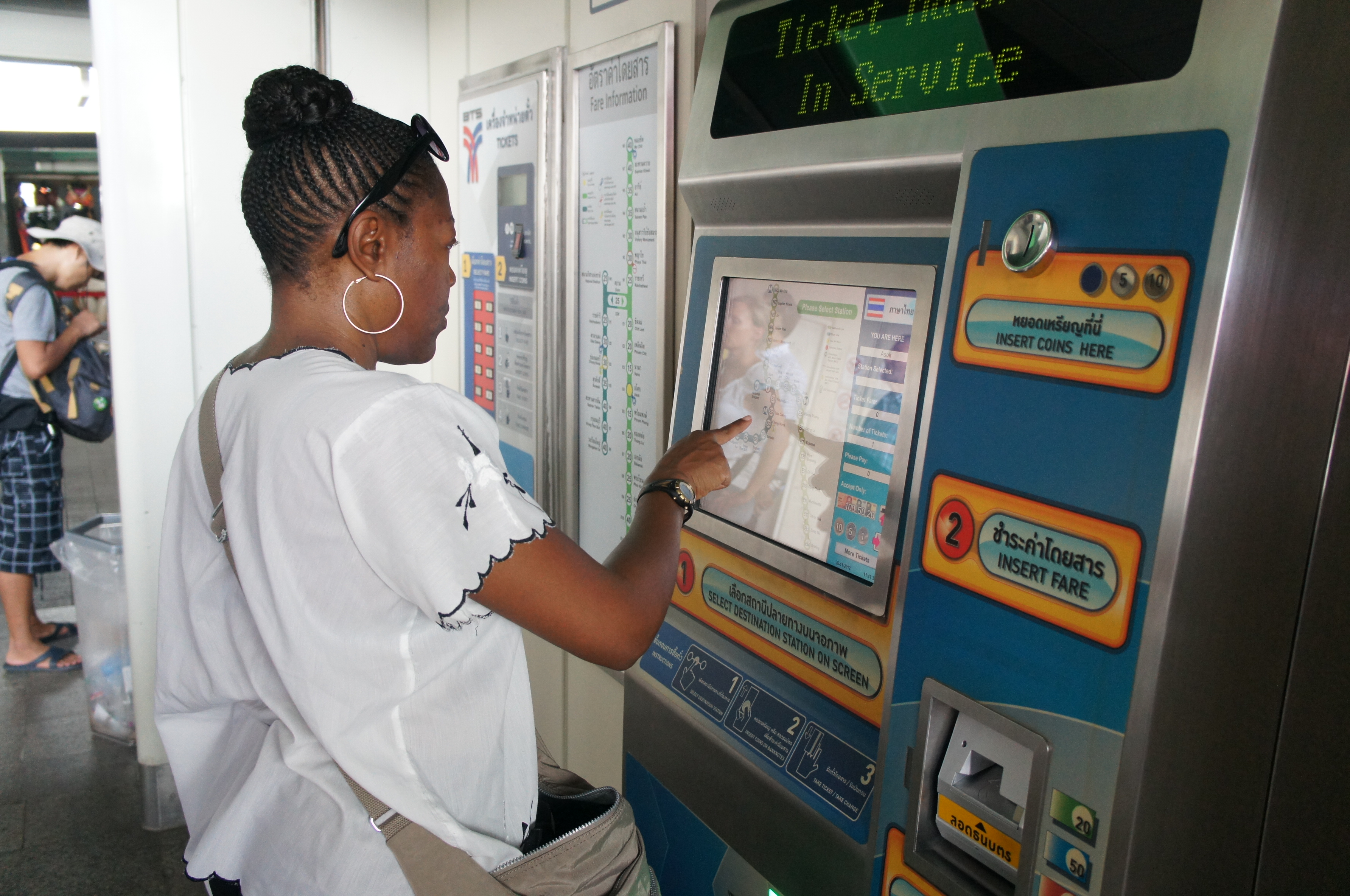
Buying a Sky Train ticket

On our first day together we decide to visit a couple of Bangkok’s major sites–The Jim Thompson House and Wat Pho. But not before taking on Bangkok’s Sky Train. At the Asok station near Lyle’s apartment, we weave through a steady and disorienting stream of Thais going about their Monday afternoon business, attempting to figure out one of their main modes of public transportation. And we actually take to it quite well. The ticket machines are brightly-colored and feature the system map along with each destination and the cost to get there from your current location. It’s pretty much idiot proof. Select the fare to your destination (in this case 40 baht or a bit over $1 to reach National Stadium), put in your money and the machine spits out a pretty blue ticket. The only thing is the machines don’t take bills, so you have to go to a booth to get change from a teller. At first we thought we could buy tickets from the uniformed teller in the station and were confused when we only got change back after asking for a ticket. The trains are absolutely immaculate, but they quickly become jammed with passengers depending on the stop. At our Siam transfer point we had to make a mad dash to get on a car that wasn’t overly packed with passengers. If this were NYC or even DC, there would be some unpleasant jostling for space or someone’s arm getting caught in he door. But not here; everyone manages to get on in a very polite and orderly fashion. The passengers are a mix of Thai society from well-dressed ladies with the latest designer handbags to the university students who must wear a uniform of white blouse and belted black skirt, a pairing that is actually quite cute. Lyle’s nanny Ngea was wearing the same outfit earlier today. She explained that younger students much wear longer skirts and older students have their choice between longer and shorter skirts. Ngea is studying eco-tourism and has been preparing for a big economics exam. I wonder what degrees the students on the train are pursuing.


Bangkok’s Sky Train

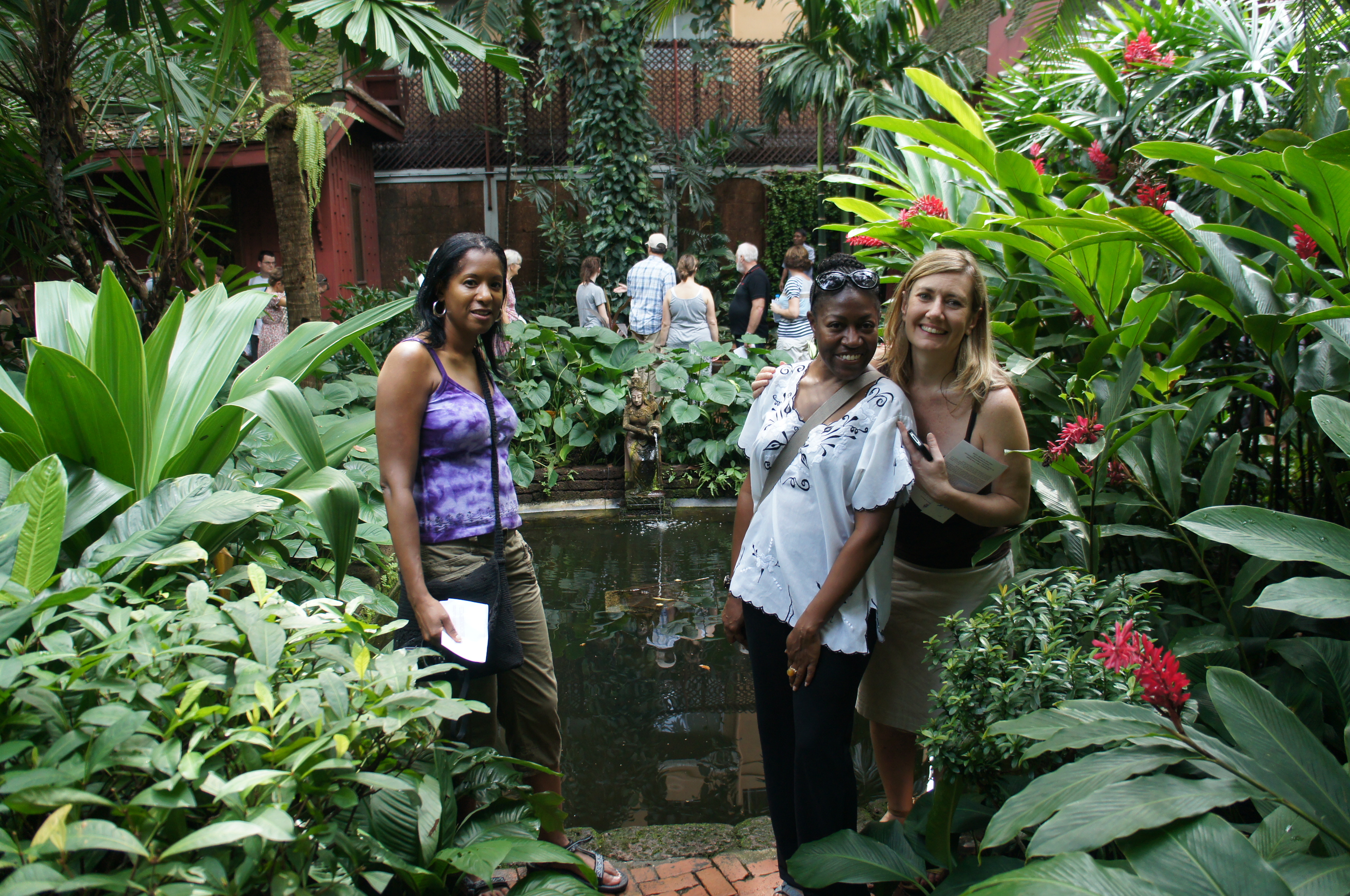
Before we know it we are at our stop and follow the flow of Thais from the Sky Train onto the busy street below. The Jim Thompson House feels like an oasis in the chaos that is Bangkok. It feels particularly serene after our adventure on the Sky Train. In the courtyard of the The Jim Thompson House (admission 100 baht, $3.25), there is a Thai man spooling a thin tread of silk from and steaming bath of silk worm cocoons. The man appears to be a representation of Jim Thompson’s passion for silk. Thompson, an American, was an officer in the Army’s Office of Strategic Services, a precursor to the CIA, when he lived in Bangkok in the 1940s. He fell for the place as many Americans do. Lyle’s husband, Peter, told me that Thailand has the most American expats after China. Thompson eventually left the Army to become an entrepreneur in Thailand’s silk trade and his home became the center of Thailand’s expat scene, a lovely complex of 6 traditional Thai homes in one.

The Jim Thompson House
Nancee, water-pouring god, me and Karen

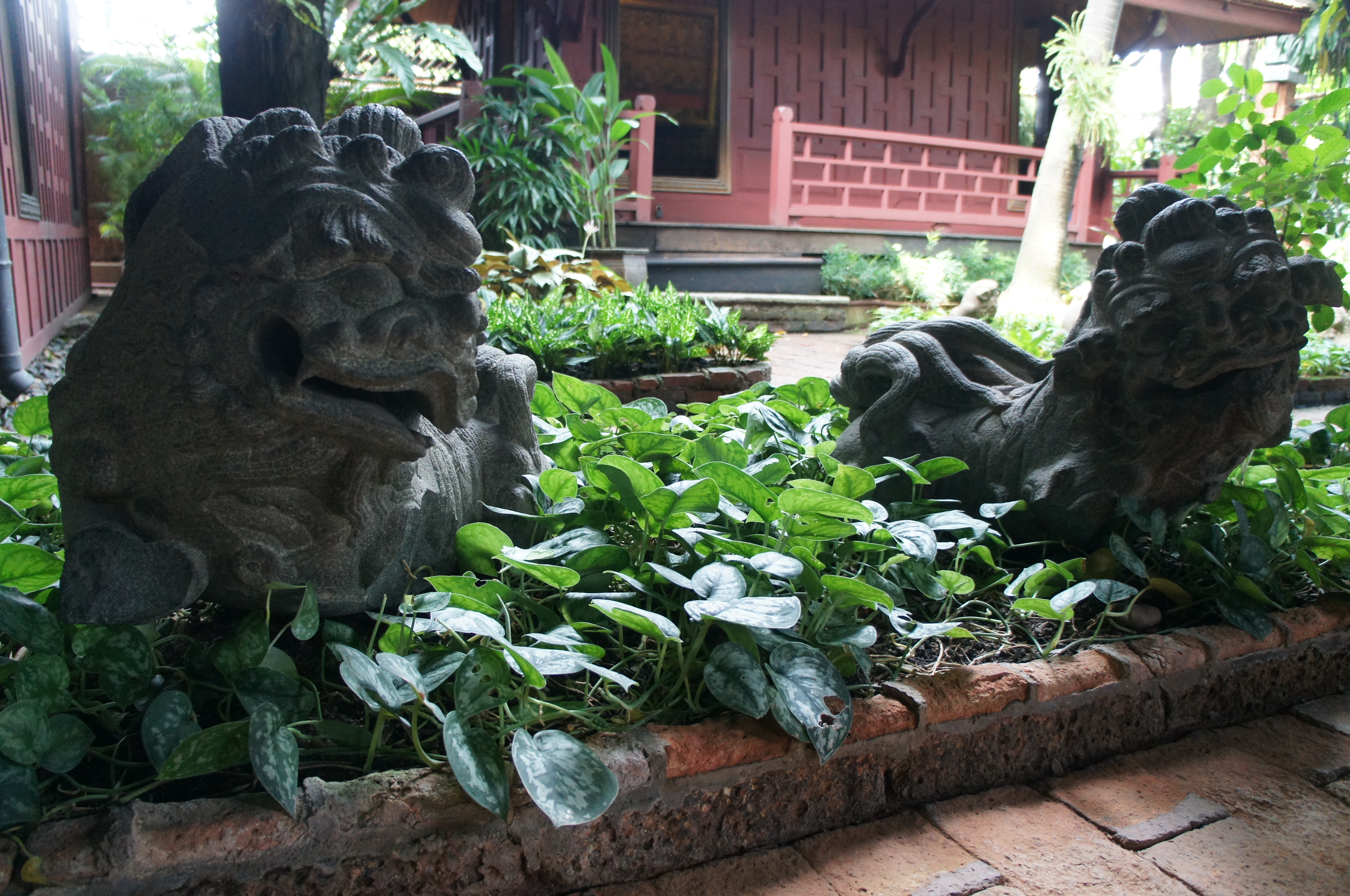
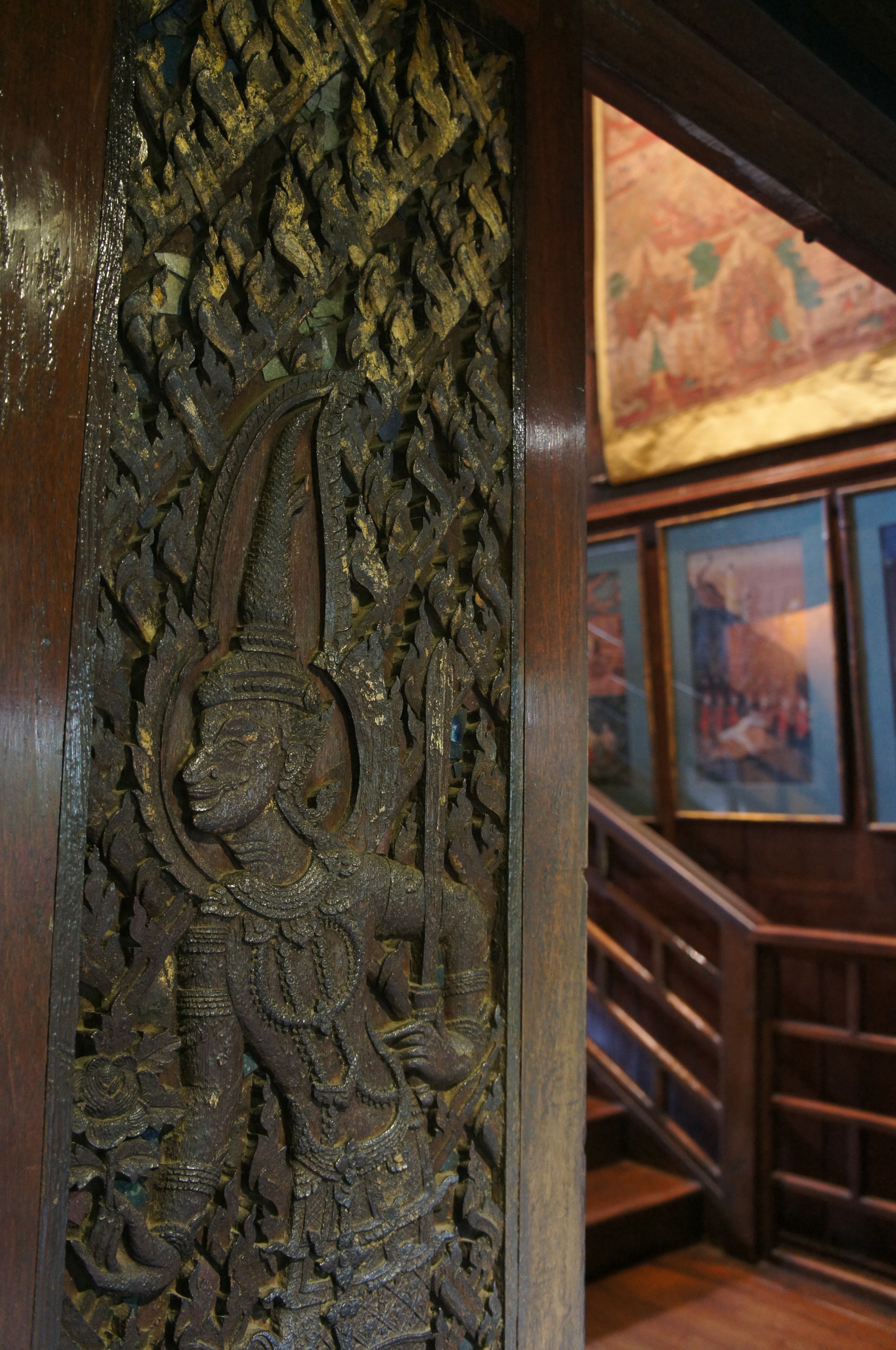
We explore Thompson’s urban tropical jungle, featuring water-pouring gods and other mythical creatures lurking in leafy green foliage, as we wait for our guided tour of the place. We already can tell that Thompson must have had an incredible green thumb and an impeccable sense taste for Thai art and design. Our guide explains that he added some western touches from the Italian marble in the western-style foyer of his home to the addition of a ceiling, where most Thai homes had none. Nancee, Karen and I love the furnishings throughout the house from the mahjong, turned dining table in the dining room to the lamps made from ancient drums. We spot plenty of pieces we’d want in our homes. Our guide tells us that Thompson disappeared mysteriously from a vacation with friends in Malaysia in 1967. To this day, no one knows what happened to him. Some people believe that a wild tiger ate him while he was on a trek alone. Karen asked the guide who got Thompson’s estate. She says that it was his nephew. So, we devise our own theory: The nephew offed his uncle for this amazing house. But the more likely scenario is that he was hit by a truck and the driver hid his remains.

Glimpse of interior of Jim Thompson House

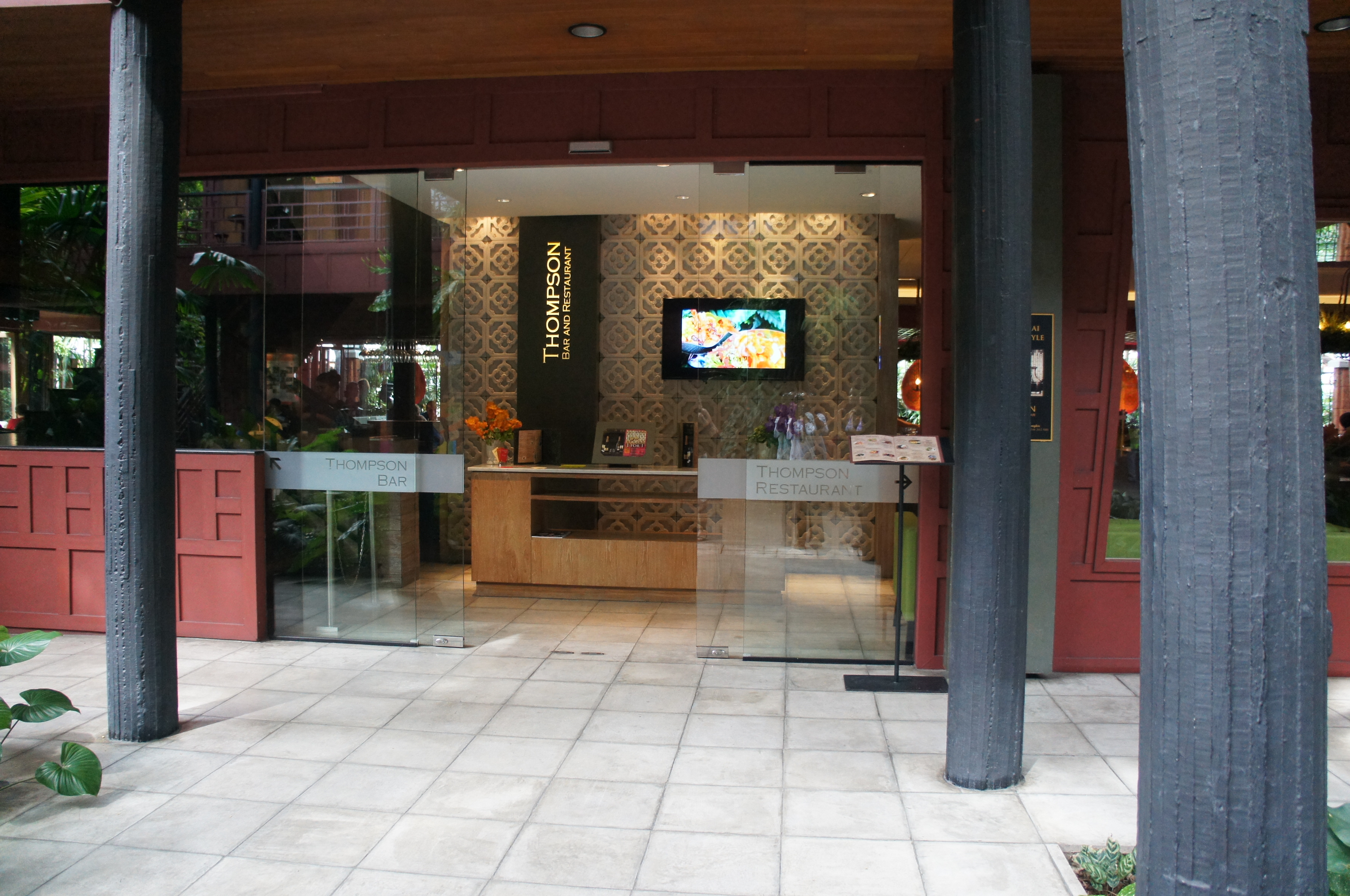
At the end of our tour we have lunch at the Thompson Bar and Restaurant on the premises, which is still a local hang out. The restaurant is chic and minimalist, bordered by a Koi pond. I have a tasty Pad See Ew and my second fruit smoothie since arriving in Thailand, a lychee lemongrass mixture. Fruit smoothies or shakes seem to be big here, coming in a variety of tropical fruit flavors like watermelon, coconut, mango and pineapple. These aren’t like our smoothies or shakes mixed with yogurt, milk or ice cream, these are blended bits of real fruit and deliciously refreshing on a hot Bangkok day.

Thompson Restaurant and Bar

Read on for part 2 of this day’s adventure: Water Taxis and Wat Pho.