Travel Inspiration & Flights of Fancy by Robin Bennefield
Author: Robin
Robin Bennefield is the author of the blog Robins Have Wings, which is not just a blog; it is a travel manifesto, reminding her—and maybe you—to take flight and embark upon unexpected journeys near and far.
You’d probably think of a million tinsel-draped, twinkling-light places before you thought of Brazil as an over-the-top Christmas-is-here destination. Lapland, Finland always tops lists with its frosty Arctic Circle locale and all those real reindeer, then there’s Santa Clause, Indiana, the name speaks for itself. But Gramado, Brazil in the state of Rio Grande do Sul, promises to give these holiday hotspots a run for their money.
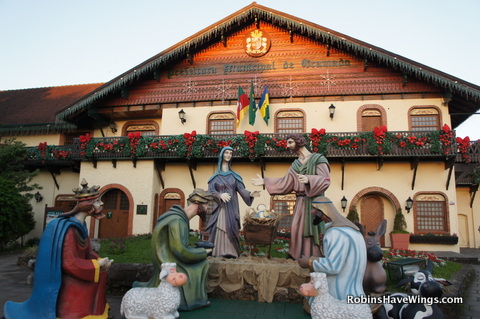
Gramado’s City Hall
I found myself in Gramado a couple of weeks ago as a guest of Embratur, Brazil’s tourism board, which is showing off the country in anticipation of next year’s World Cup. The Brazil most of us know is lined with miles of bask-worthy beaches, sultry and hot, and pulsing with a samba beat. But Gramado is something entirely different, I felt like I’d been dropped in the middle Grimm’s Hansel and Gretel fairytale and I forgot to pack my lederhosen. This probably has to do with the fact that many of the people in Gramado are descendants of German immigrants who’ve brought their flair for Christmas with them. The buildings, including the city hall, look like they are made of gingerbread with elaborate trim and ridiculously cute facades.
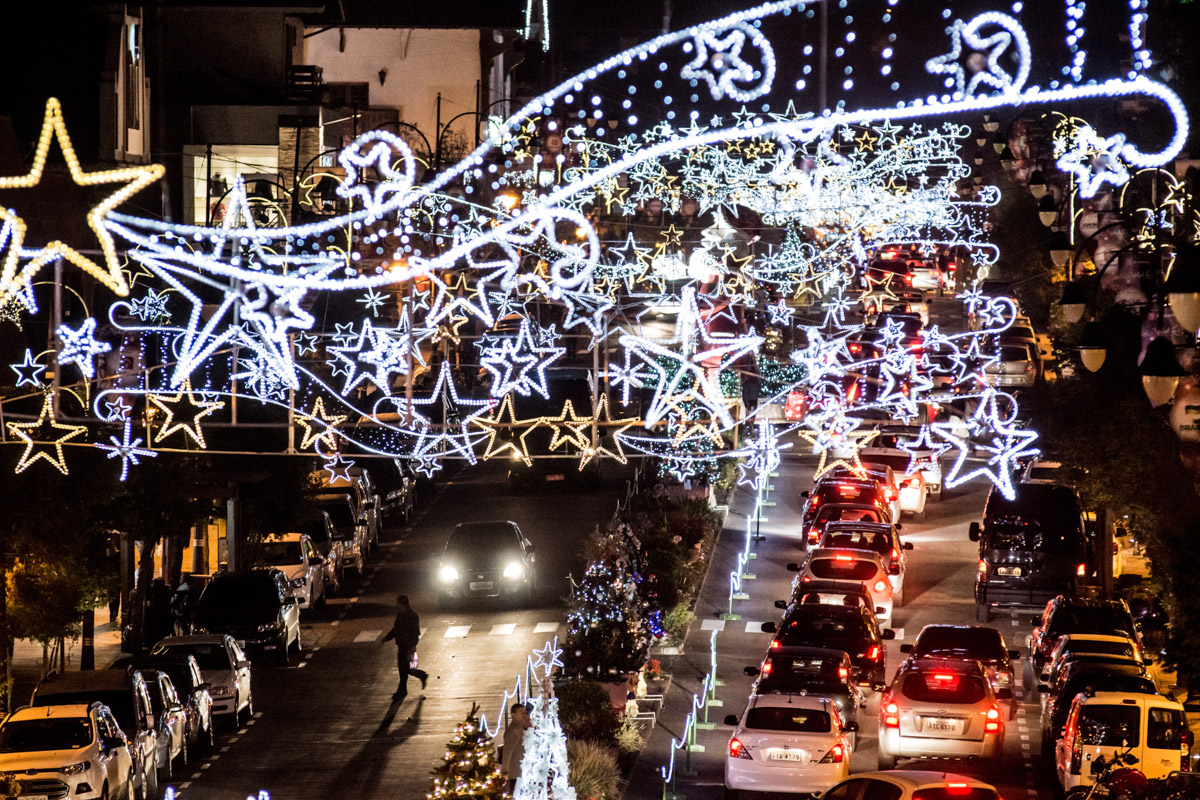
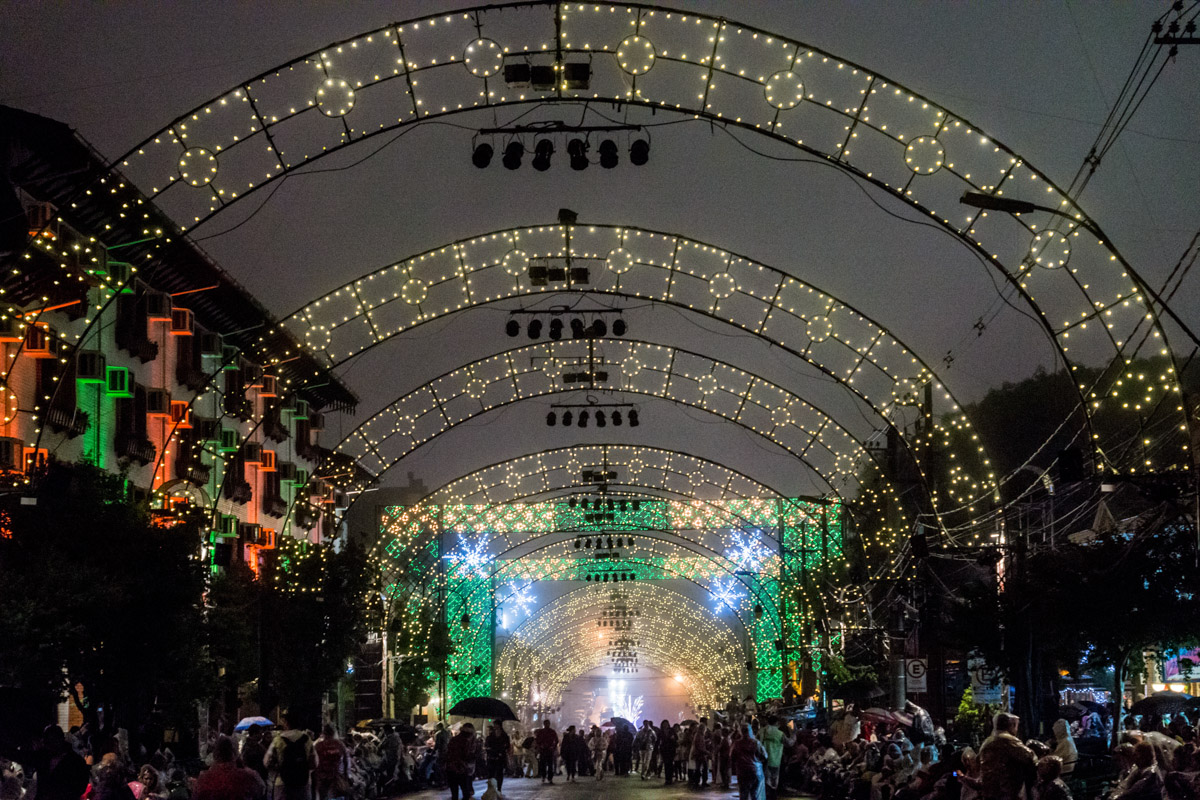
While we envy the sizzle of Rio and Salvador, some Brazilians crave colder temperatures especially around the holidays, so they flock south to Gramado where they can wear a hat and gloves on cool evenings, sip the hot chocolate that the city is known for and gaze at thousands of holiday lights framing almost every street for “Natal Luz,” Christmas of Lights.
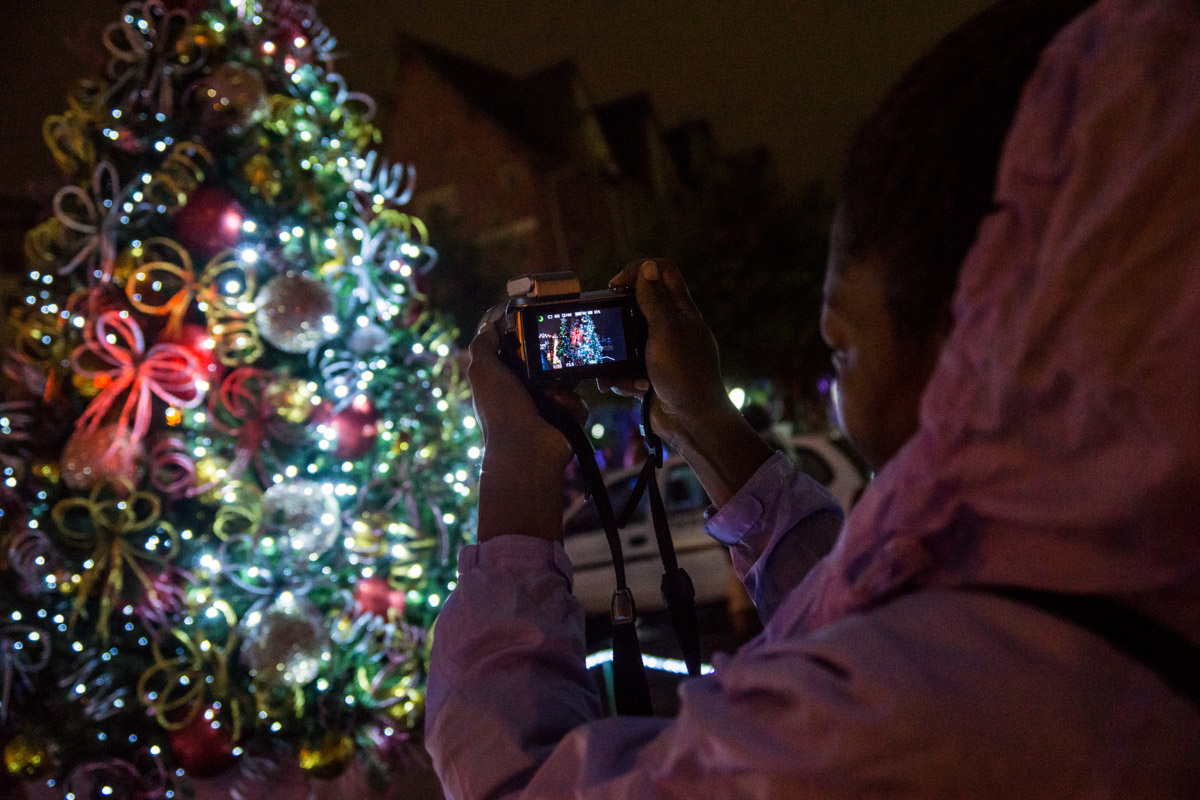
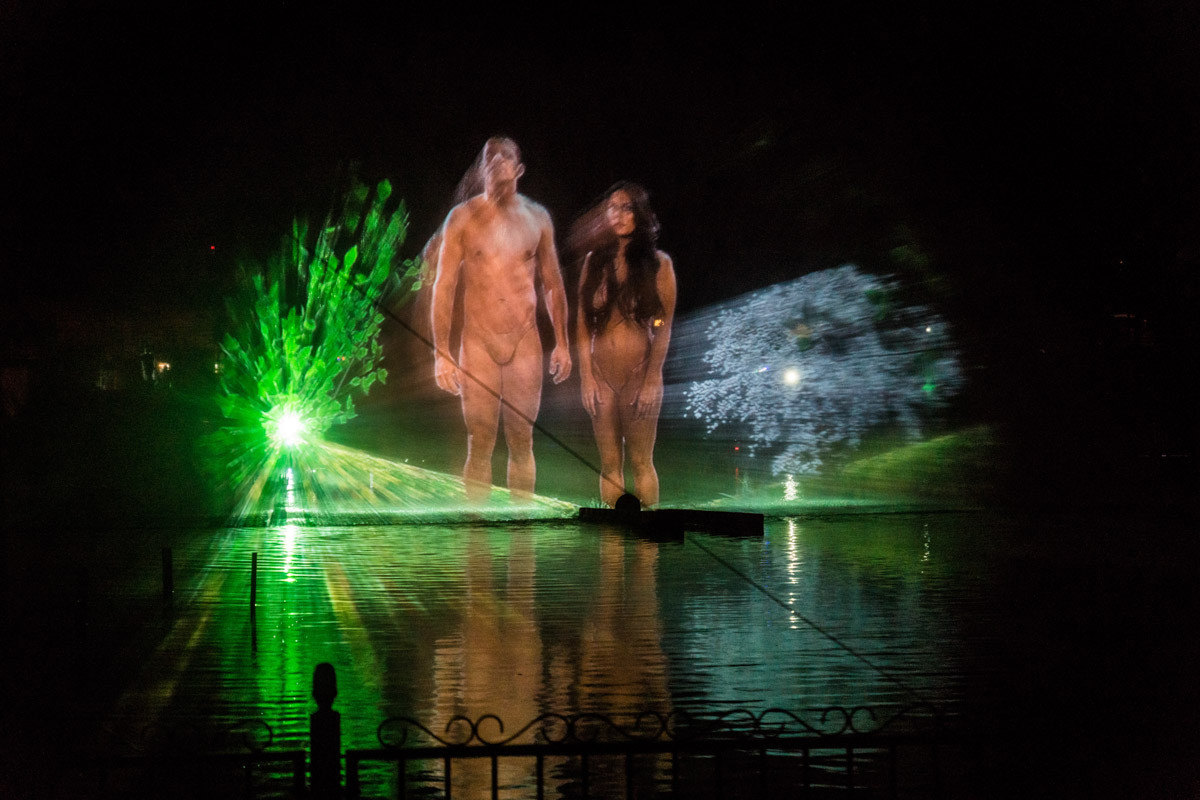
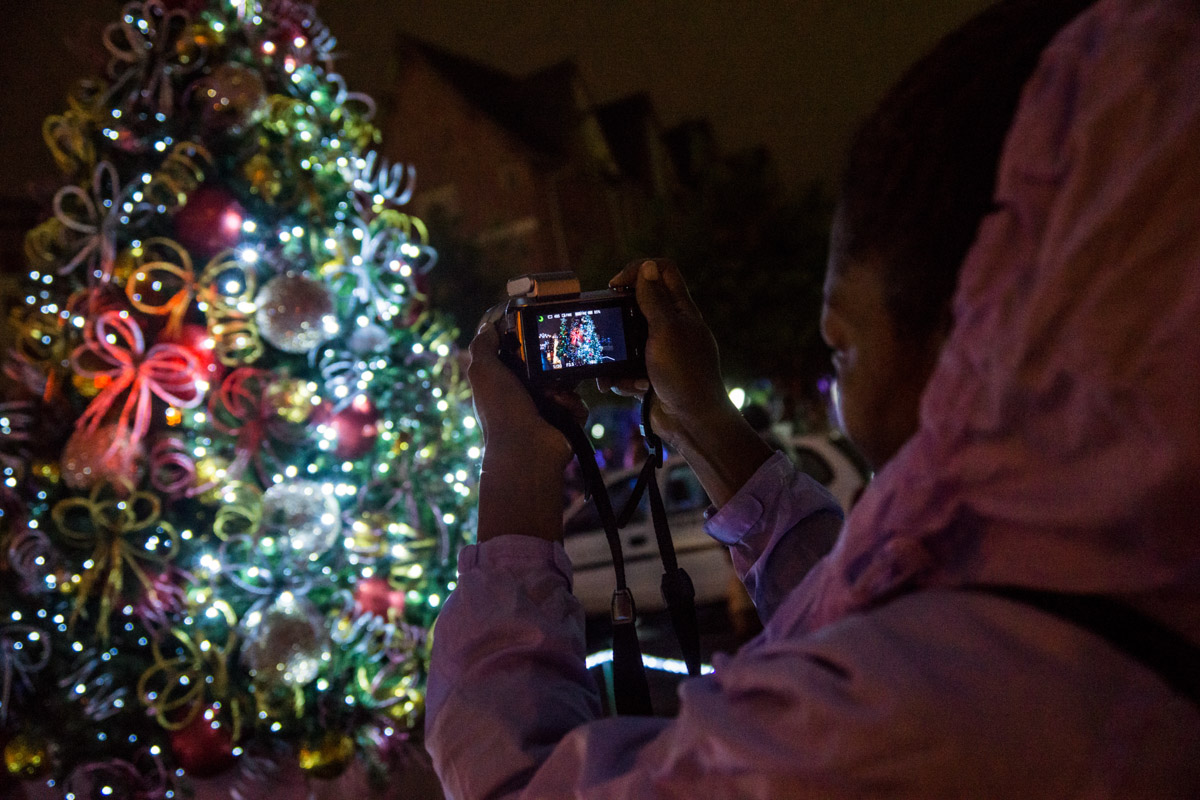
And, the holiday cheer here is palpable. Brazilians huddle together in front of nativity displays and smile widely for pictures in front of Christmas trees a blaze. If this were Whoville, they’d be singing the Fah-who-foraze song with hands clasped while encircling a ginormous Christmas tree. And, actually, I really heard them singing! While we were awaiting one of Gramado’s premiere holiday spectacles over Joaquina Rita Bier Lake, a family sitting nearby sang Christmas carols at the top of their lungs in English. Did I mention that we were awaiting a holiday spectacle? Well, we got it. Natalis, Gramado’s latest holiday showcase of floating lights and soaring music was just that. Huge sprays of water projected 3-D Biblical scenes from the creation right through the birth of Jesus to the crucifixion. This is when I knew they were serious about Christmas. John Lennon’s Happy Christmas plays as fireworks explode overhead with images of smiling Santas floating over a dark lake. You couldn’t get more festive.
Well, maybe you could. There’s the holiday parade complete with angels, toy soldiers, gingerbread men and Santa and his reindeer, of course. And, then there’s a Cirque du Soleil type production, telling the story of St. Nick with aerialists and acrobats. All told, there are 50 holiday shows and attractions lasting for 73 days from Nov. 1 to Jan. 12. Not feeling the holiday spirit yet? There’s still time my friends; go to Brazil.
Get into the holiday spirit, Brazilian style with these photos from the talented Embratur photographer that I was traveling with, Andre Maceira.
Avenida Borges de Medeiros twinkles with lights. Photo courtesy of Embratur – Photographer Andre MaceiraChristmas tree display on Avenida Borges de Medeiros. Photo courtesy of Embratur – Photographer Andre MaceiraHoliday parade route. Photo courtesy of Embratur – Photographer Andre MaceiraSanta! Photo courtesy of Embratur – Photographer Andre MaceiraAdam and Eve in 3-D at Natalis show in Gramado. Photo courtesy of Embratur – Photographer Andre MaceiraOne more Christmas tree photo. Photo courtesy of Embratur – Photographer Andre Maceira
So, the Traveling Brown Girls Blog Carnival has presented an interesting challenge: List 5 places that I’ve never been (and why I want to go). First, you may be asking, “What is the Traveling Brown Girls Blog Carnival?” It’s a blog party started by Tracey Friley of OneBrownGirl.com and hosted by other bloggers (AbsoluteTravelAddict.com, GirlGoneTravel.com, MoTravels.com and BrownGirlsFly.com) to promote the work of underrepresented travel bloggers and share their talents more widely with the travel world, and the World Wide Web. Thus, the reason for this post that’s got me thinking. You see, I want to go EVERYWHERE and I don’t travel with the goal of checking places off a list as some people do. I often get asked, “Where do you want to go next?” My answer depends on the moment and could change at the drop of a hat. I mainly travel when opportunity strikes or a place presents itself. For instance, Thailand wasn’t top of mind as a travel destination, but when my high school friend, Lyle, invited me to visit, I knew I was going. It was the same for my travels in Sri Lanka. I never would have considered the place, if I hadn’t met my friend Sid, a native Sri Lankan, at a New Year’s Eve party a few years ago. A Danish tennis partner sparked my desire to go Denmark. That being said, the following is a list of places that have captured my attention of late or have lingered in my travel consciousness for sometime. Will I make it to these places? Maybe. But it is more likely that I’ll wind up someplace totally unexpected, just the way I like it.
#5 Japan
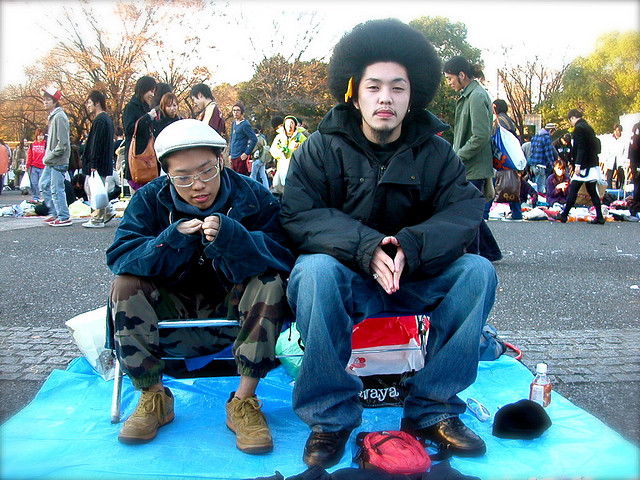
The reason that I am interested in going to Japan may be controversial for some. I am absolutely intrigued by the Japanese fascination with black culture. I’ve read pieces written by black travelers who have been there and find this fascination somewhat disconcerting. Is it a genuine appreciation or a cultural exaggeration of stereotypes that have seeped across the Pacific? I want to see for myself and getting a photo of a Japanese girl in a “Black for Life” t-shirt seems all too ironic. I’m already used to curious Asian folk, having been swarmed by Cambodians for a family photo at Angkor Wat recently and followed by Chinese tourists at the Forbidden City years ago. I’ve got that part down. I suspect that I’ll get to hear great music as I’ve heard that R&B musicians are beloved in Japan. On the food front, I am a big fan of sushi and even more so of tea. I’d be all over the tea ceremonies and I love ancient temples. Finally, I really want to stay in a capsule hotel. I’m all of 5’1, so I think I’d be snug as a bug in one of those things.
#4 Italy
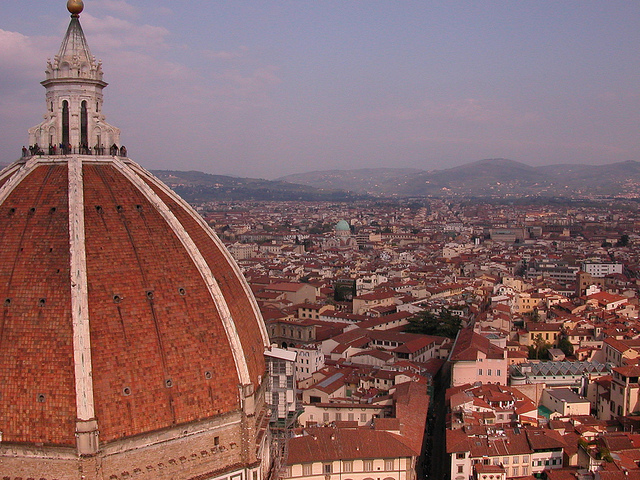
I took an art history class in high school that I absolutely loved. We studied the works of the great Italian masters like Titan, Caravaggio and Michelangelo, of course. Each spring our art history teacher, Ms. Batza, organized a student trip to Rome to experience Italy’s art and architecture. I wanted to go very badly, but it wasn’t in my parents’ budget. My friend Inez and a few others went and they came back with fabulous stories of cute Italian boys following them around the Eternal City. So, I still kind of harbor this high school longing to go and it flares up when I have a really good Italian meal or see some some pop culture reference to Italy. For instance, whenever I see Fabio, one of the chefs from “Top Chef,” I want to go to Italy. I wanted to go after I read “Eat, Love, Pray.” All of the recent pomp and circumstance for the new Pope at the Vatican is the latest reason why I’d like to go. When I do go, I’d be just as enamored of the historically-significant art found in Florence as the attractive men.
# 3 South Africa
Nelson Mandela is the biggest reason why I want to go to South Africa, but this is another place that has lingered in my travel consciousness for some time. Growing up in the Washington, DC area, we’d often drive past the South African Embassy on the way to school during the “Stop Apartheid” demonstrations. Later in the day we’d learn some big celebrity like Steve Wonder had gotten arrested for protesting. I took a History of South Africa class in college and during a college internship with Time Magazine, I got to cover Nelson Mandela’s first visit to the United States after his release from prison. So, I feel like I have a connection. And, as an African-American child of parents who lived through Jim Crow, there is definitely a cultural solidarity to be explored. Last year, I met a woman named Lerato from Pretoria through my friend Sid. He introduced us because she is a travel blogger and journalist, too. Her blog is called Madam Africa and she is making it her mission to travel the entire continent. I snagged a photo from her blog post about a South African musician that she’d seen perform at the Cape Town Jazz Festival. This is the South Africa that I want to see.
#2 Peru
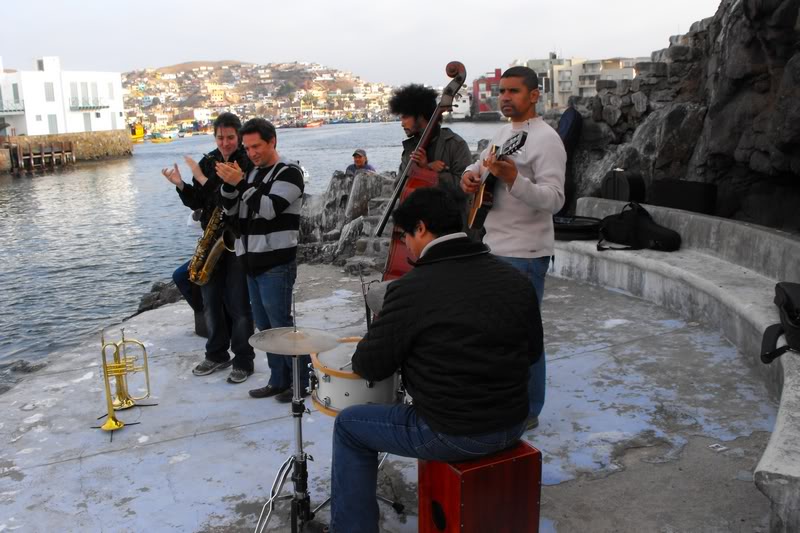
Mystical Macchu Picchu makes many traveler bucket lists. The journey is arduous, maybe even more than most realize as Boyd Matson wrote in his story “The Best Worst Trip Ever” in April’s National Geographic Traveler, where he talks about the grueling trek that left him questioning his preparedness. But he, like everyone else who’s been, says it’s all worth it. I have no doubt that it would be the same for me who especially loves to contemplate ancient civilization and architecture rivaling most modern creations. And while, Macchu Picchu is reason enough to want to go to Peru, something else has piqued my interest–Afro-Peruvian culture. While traveling in Thailand, my friend Karen mentions that there is a New York Afro-Peruvian Jazz band that arranges group tours to Peru to learn about Afro-Peruvian musical traditions from local musicians in Lima. This sounds more and more like the best trip ever. Any tour that allows me to feel immersed in a culture that few have experienced is going to be a winner in my blog.
#1 Seychelles
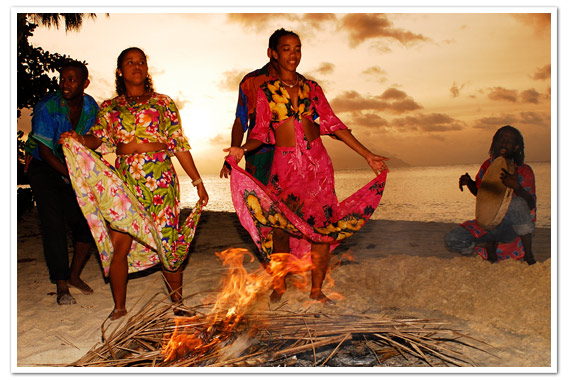
This group of islands off the coast of Tanzania has become a bit of an obsession of late. I, like most, heard of the islands when the royal super couple, William and Kate, went there for their honeymoon. But I was really keen to go last year when I learned that Ethiopia Air introduced new flights to the Seychelles with an amazing airfare sale. I was going to make it happen until other travel opportunities intervened. At this year’s Travel and Adventure Show in Washington, DC, I met a member of the Seychelles Tourism Board and I asked him what I needed to know about the place besides the fact that William and Kate honeymooned there. He told me of the county’s early beginnings as a pirate stopover and a point along the Spice Trade, which brought about its mélange of French, British, Indian and African cultures. He bragged about the creole cuisine and the country’s commitment to preserving the environment. This guy was really good at selling his country, because now I really want to go there. It sounds like the perfect combination of beach getaway, eco-friendly adventure and authentic laid-back culture. So, it makes the top of my ever-shifting list, for now.
Do you have a travel bucket list? Where do you want to go?
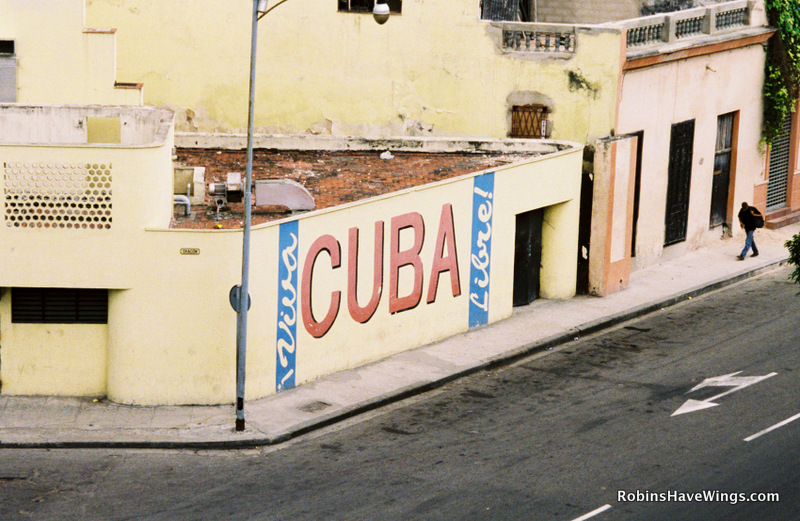
An opinion piece about racism in Cuba in Sunday’s New York Times brought back memories of my visit there in 2003. I traveled with Global Exchange for its Salsa and Afro-Cuban Dance Tour, where I learned Afro-Cuban dance, drumming and salsa from professional dancers and drummers. I think it was probably one of the most immersive and eye-opening trips I’ve ever taken for the very reasons that Mr. Roberto Zurbano states in his piece. He talks of how Afro-Cubans have less property and money than their white countrymen and face pervasive racism.
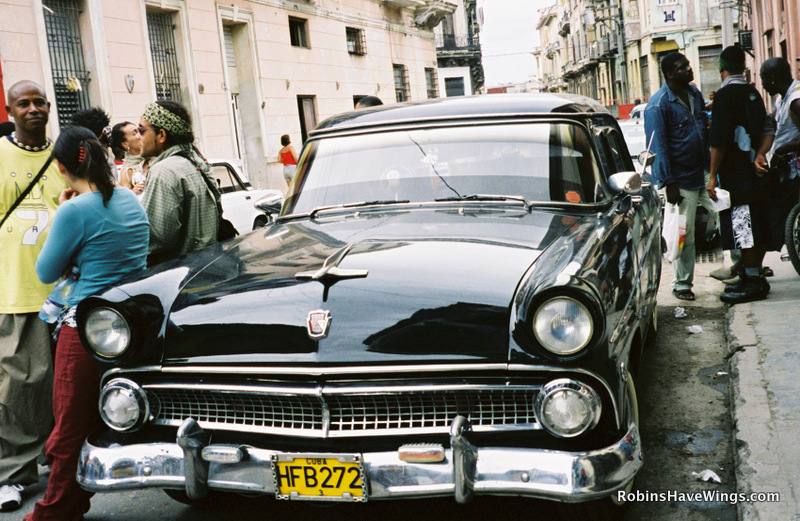
Classic car outside Callejón de Hamel, an alley known for its Afro-Cuban jam sessions.
Sadly, I witnessed this first hand one night in Havana when a few of us went to Hotel Florida, known for its salsa dance parties. There was a group of well-dressed black men standing outside trying to get into the hotel. When I say well dressed, I mean these guys were clean as a whistle, modeling jackets and shoes that could have been in the pages of GQ. My friend Ruth and I asked what was going on and they explained that they couldn’t get in because they were black. It sounded absolutely ridiculous to my ears in a country where almost everyone is black and they seem to embrace and celebrate their African heritage. How could Southern-style racism be at work in a place as brown as this? But there they were. They explained that the only way they could get in was if they were with a tourist, so Ruth and I told the hotel gatekeepers that the guys were with us and they reluctantly let them inside. They were thrilled and we all salsa danced until we couldn’t anymore.
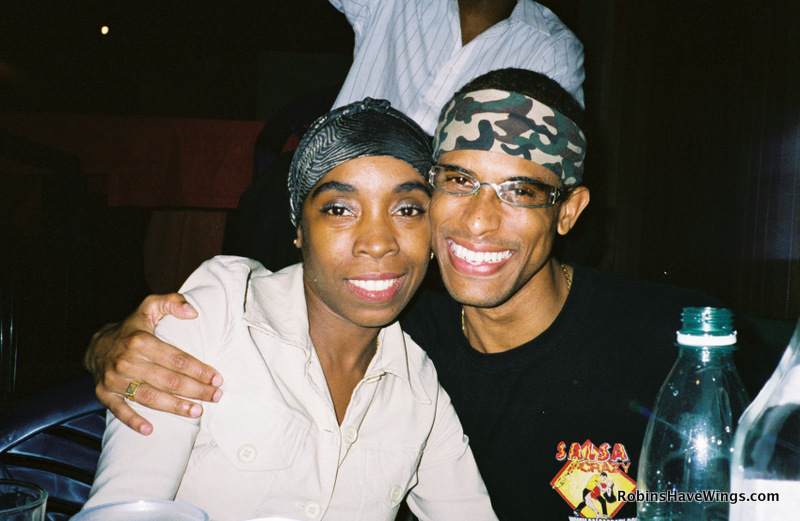
These gentlemen would be welcome at my dance party.
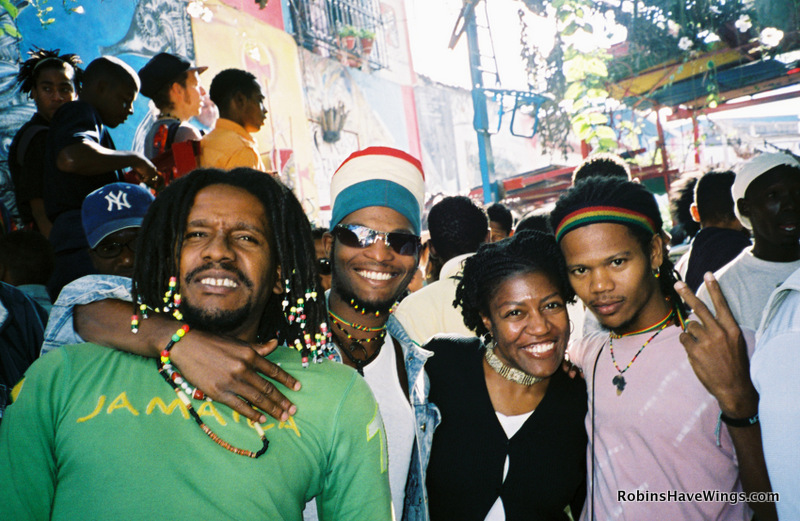
I heard more stories of discrimination from new-found friends at Callejón de Hamel, the Sunday afternoon hangout spot popular with Afro-Cubans and curious visitors. One dreadlocked Cuban who spoke impeccable English with a British accent told me just how hard it is to survive. His name was Franjoles and he spoke of people being afraid to talk about what life is really like for fear of repercussions. I had a similar conversation with a taxi driver who revealed that he’d left his wife and children in Santiago de Cuba to make more money in tourism in Havana. He was a trained engineer, but he said his salary wasn’t enough to make ends meet. Franjoles said that government rations last only five days, if that, and on top of this, black men face constant harassment by the police, often stopped for no reason.
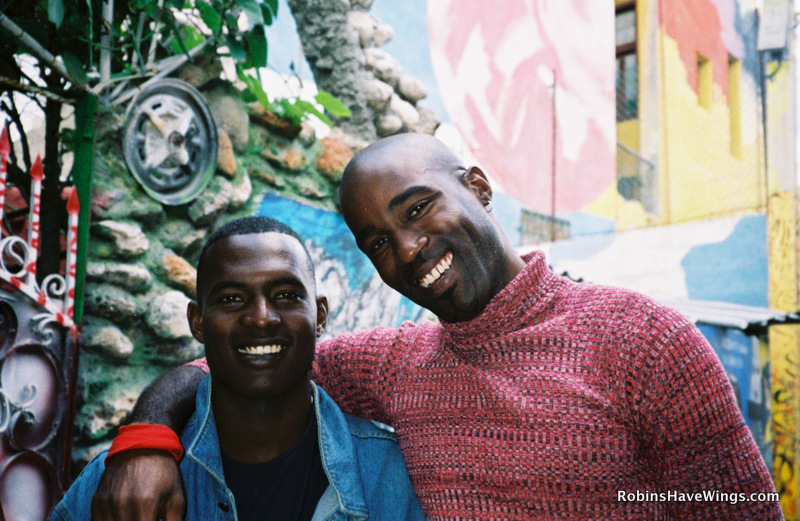
My new Cuban friends who revealed the real Cuba.
It was downright disheartening to hear in a country where revolution was supposed to even the odds for the poor and downtrodden. Now, it seems race determines who gets what scraps are left. I hope, along with Mr. Zurbano, that when economic change arrives, true equality will prevail for Cubans of all races. Everyone deserves that, especially the warm, hard-working people who were kind enough to share their secret truths with a curious stranger.
More of the real Cuba…
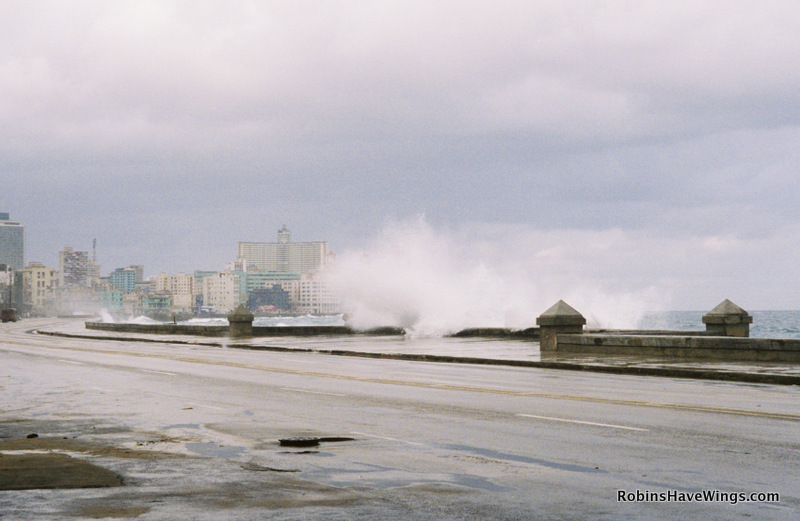
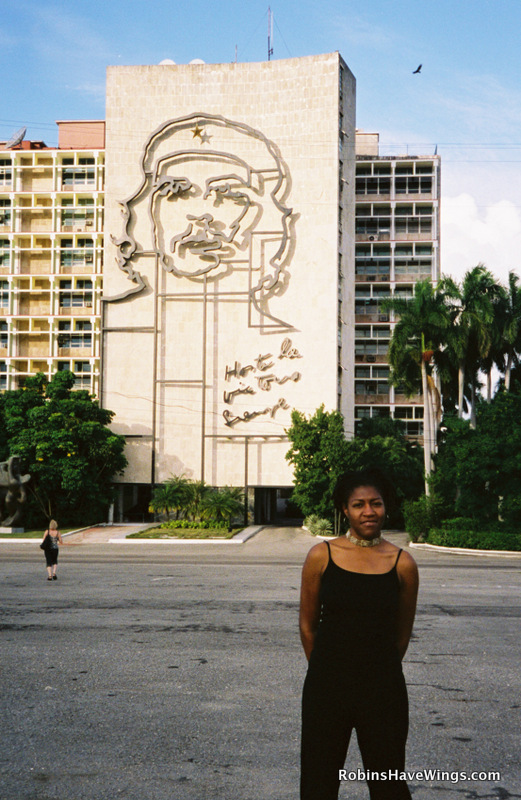
Our Afro Cuban dance instructors, Margarita and Jaime.Havana’s Malecon, or seawall.Me and Ché
Exactly one month after traveling to Argentina with STG Tours, the Vatican selected its first Argentinian pontiff, Pope Francis I. How perfectly relevant. Seems like a great reason to reminisce on a great trip with a few good pics. These aren’t mine, though. I’m sharing my fellow travelers’ favorite photos from Argentina. It’s cool seeing the trip and the country from perspectives as varied as the people on our trip. Enjoy!
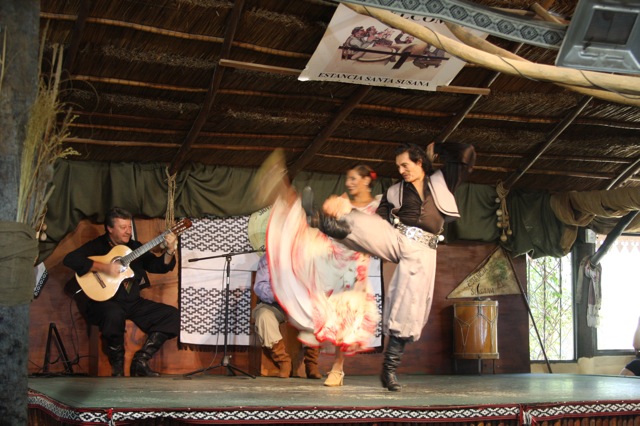
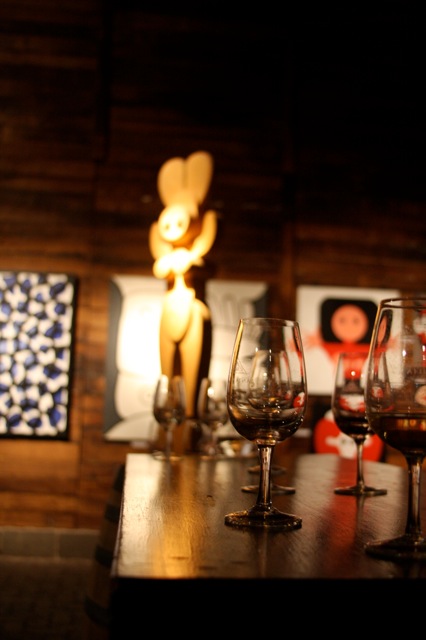
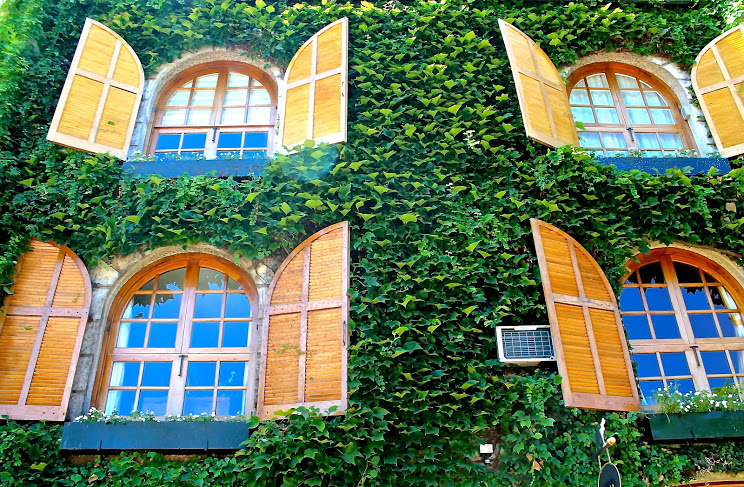
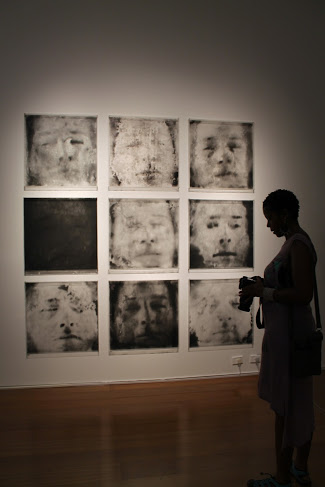
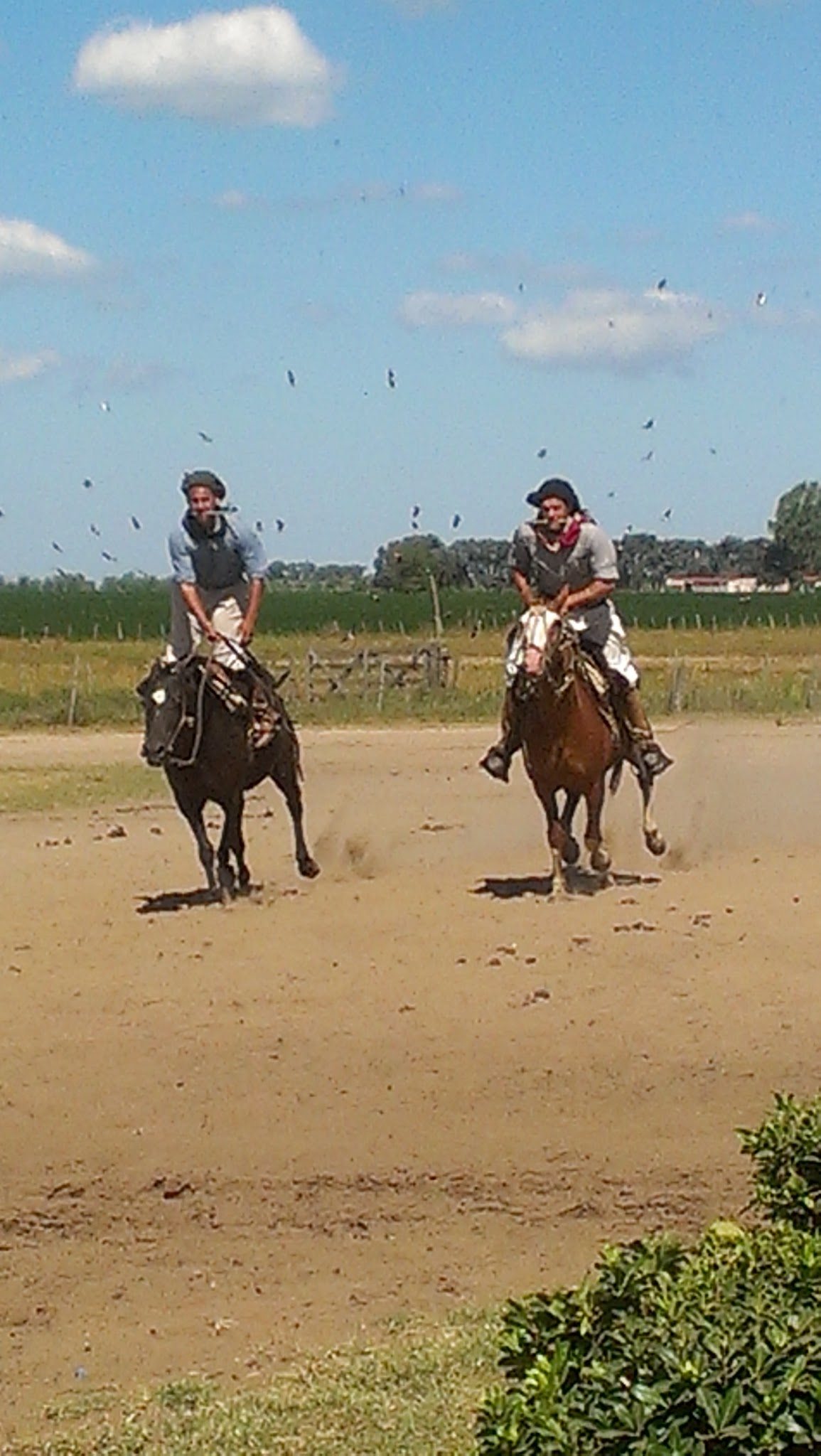
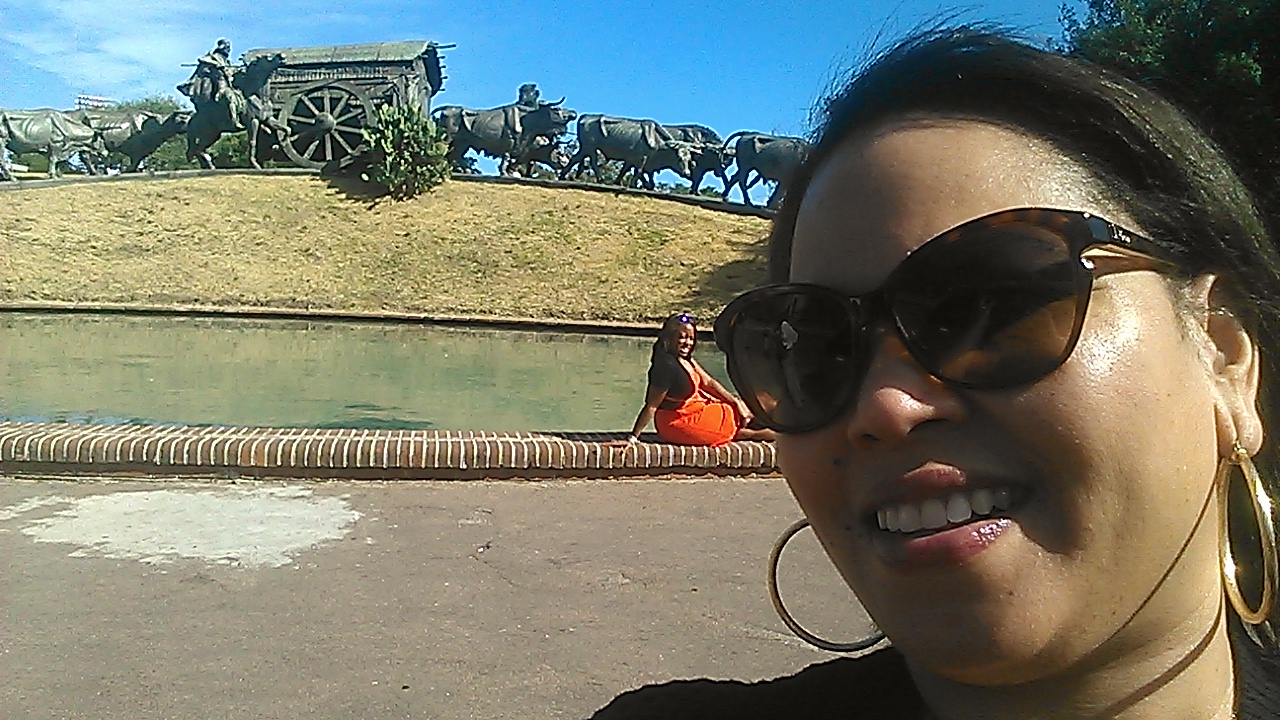
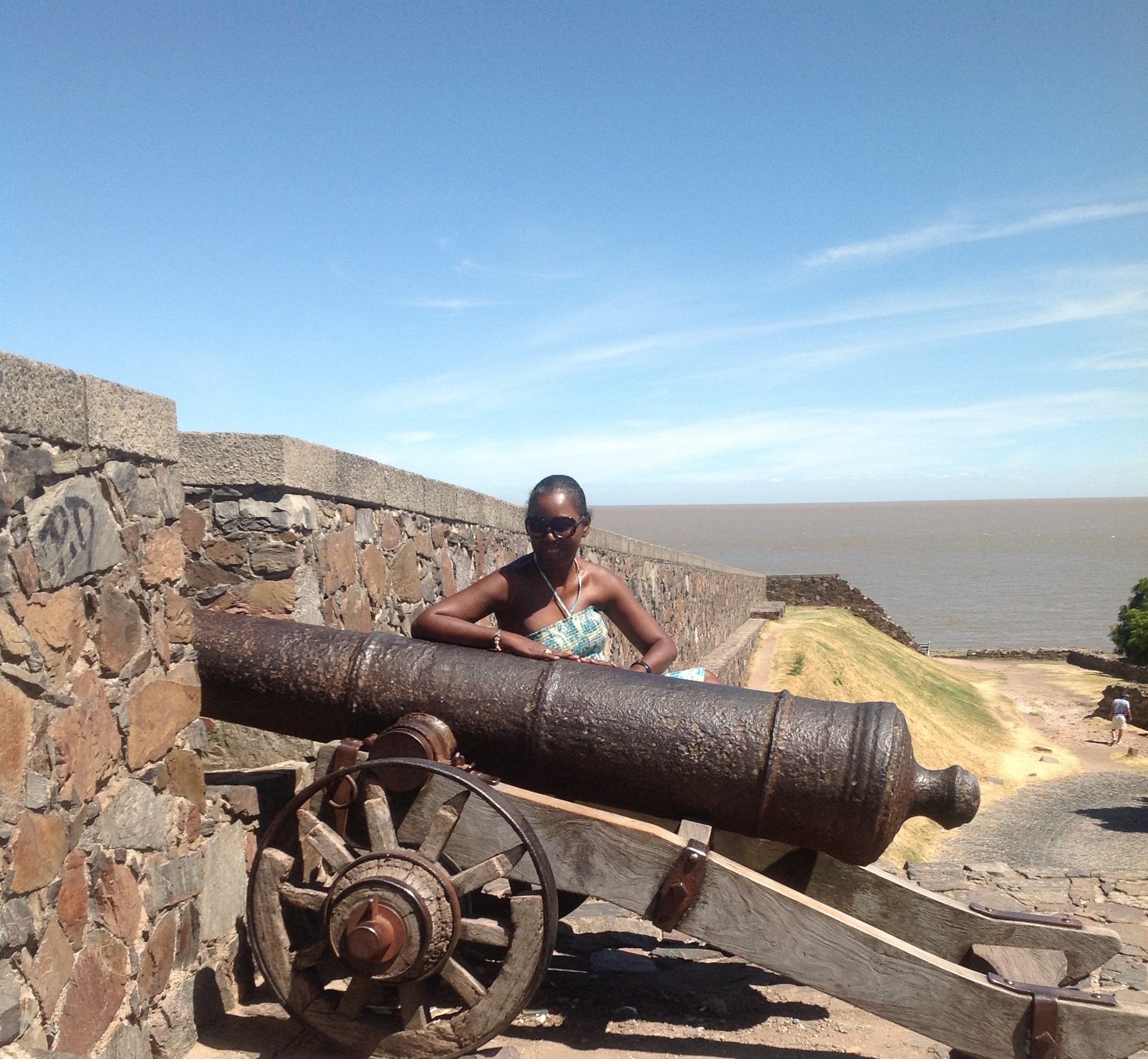
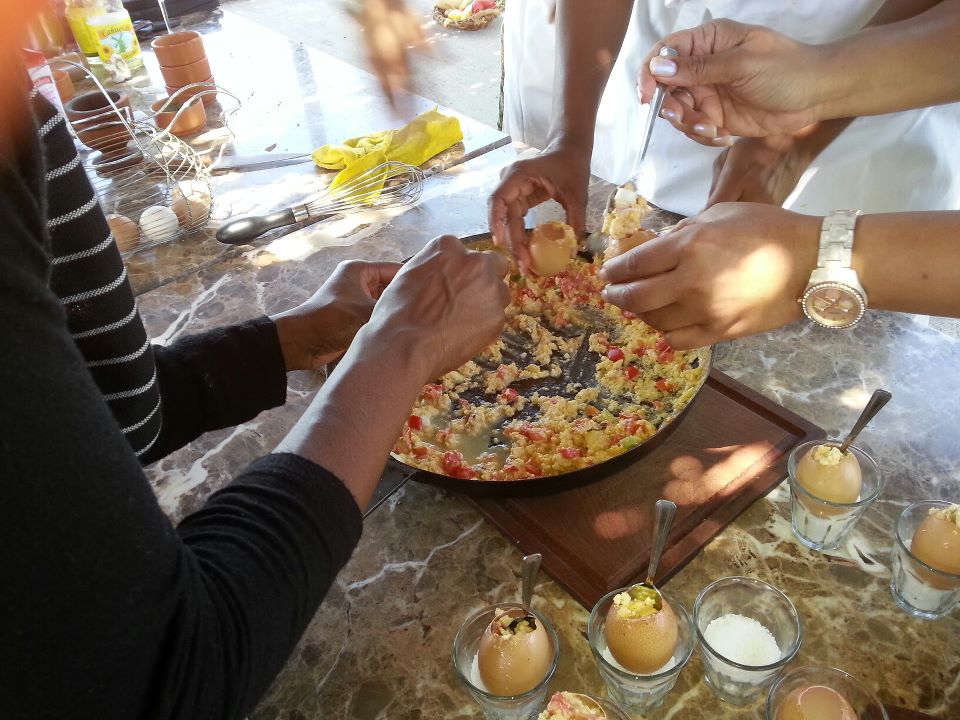
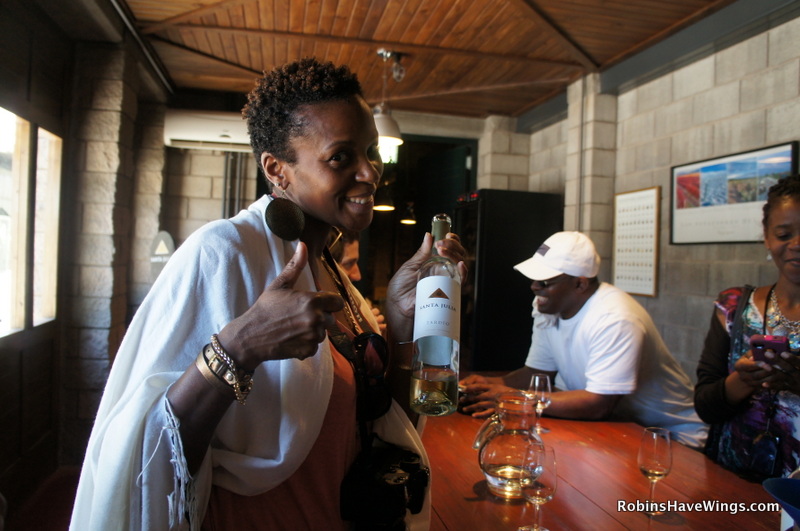
Sheneekra took this photo at the Familia Zuccardi Winery in Mendoza. “The wineries in Argentina are a perfect blend of art and wine. I really gained a better appreciate for artistry for wine making while in Argentina”Here’s another photo from Sheneekra. “I enjoyed the show at Estancia Santa Susana. Dancing was amazing.”This is another from Sheekra. It’s a photo of her with Kenitra, her roommate during the trip. “Kenny and I at Parsai Olive Oil plant. I’m glad she told me about the trip. I had a great time.”This photo was taken by Kenitra. During our group trip, we had a couple of days to wander on our own. These beautiful shuttered windows must have caught her eye on one of those days.Kenitra and Sheneekra visited Argentina’s museum of modern art, MALBA, during their free day in Buenos Aires. This is a lovely shot of Sheneekra in one of the exhibits.Gia didn’t bring a camera on this trip, but she got this great shot of racing gauchos on horseback at Santa Susana with her smartphone.Gia took this picture on our side trip to Montevideo in Uruguay at its monument La Carreta. She’s kind of photobombing our trip leader, Gai, in the background. Gia, Gai. Gai, Gia. Cute, right?Presleith fell in love with Colonia on her side trip to Uruguay. It’s an hour-long boat ride from Buenos Aires and the city is a UNESCO World Heritage site. She and fellow traveler, Carmen, climbed to the top of this lighthouse, even though Presleith is deathly afraid of heights.Presleith found some of the most interesting places to pose for a picture on this trip. Here she is in Colonia at an old fort.Our fearless trip leader, Gai, took in a Bocca Juniors soccer match while in Buenos Aires. She and fellow traveler, Floyd, survived the crush of soccer-crazed fans.Gai got this picture with her cell phone during our cooking class at La Tupina in Mendoza. This scrambled egg dish may be one of the best tapas we made and ate that day. The presentation was the coolest, too. Scrambled eggs served in its shell. Yum.
There are some pretty sad statistics out there about the disparities between the lives of boys and girls; women and men. The World Bank reports that, in developing countries, an estimated 3.9 million women die unnecessarily each year. Many are never born because of preference given to boy children in some societies. So, it’s particularly inspiring to see the women around the world that do make it, and survive against incredible odds. As Beyoncé sang, “Who runs the world? Girls.” Here’s my tribute to the girls of the world in photos:
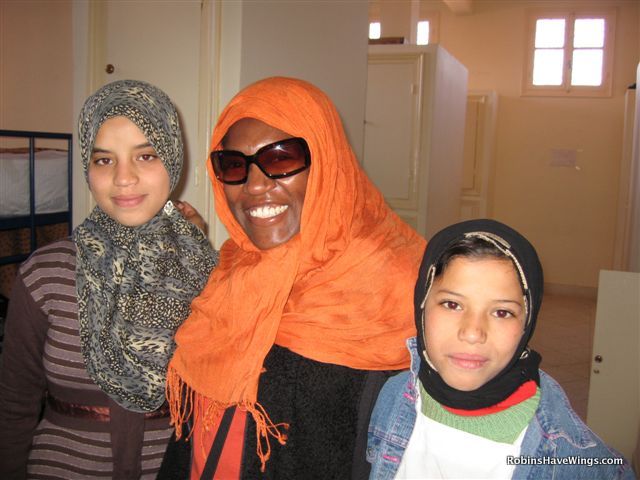
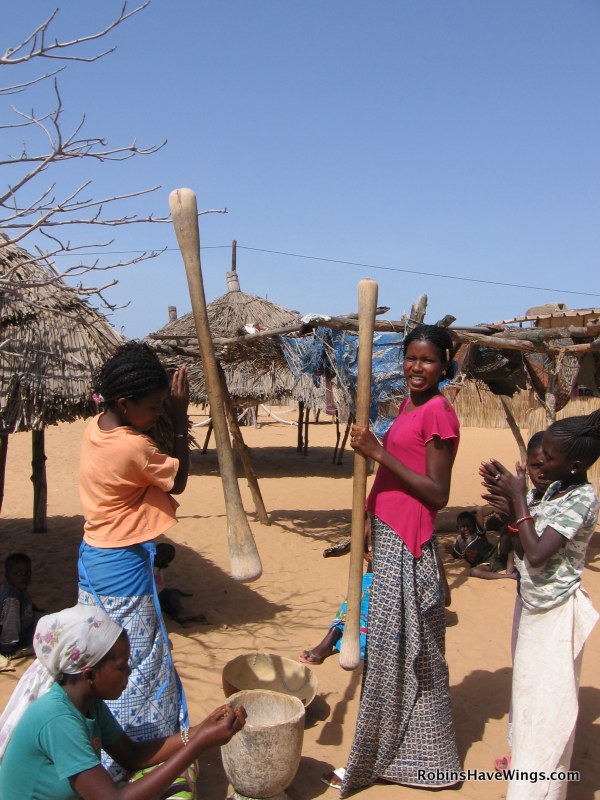
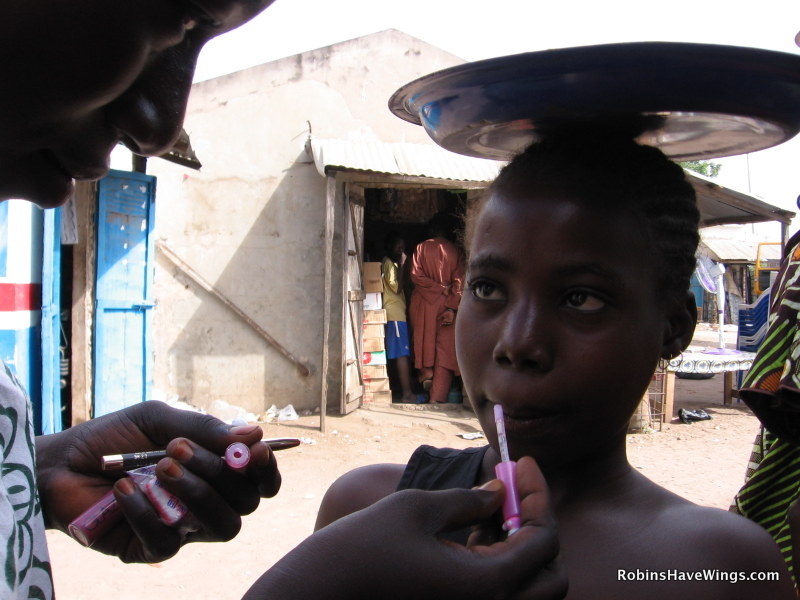
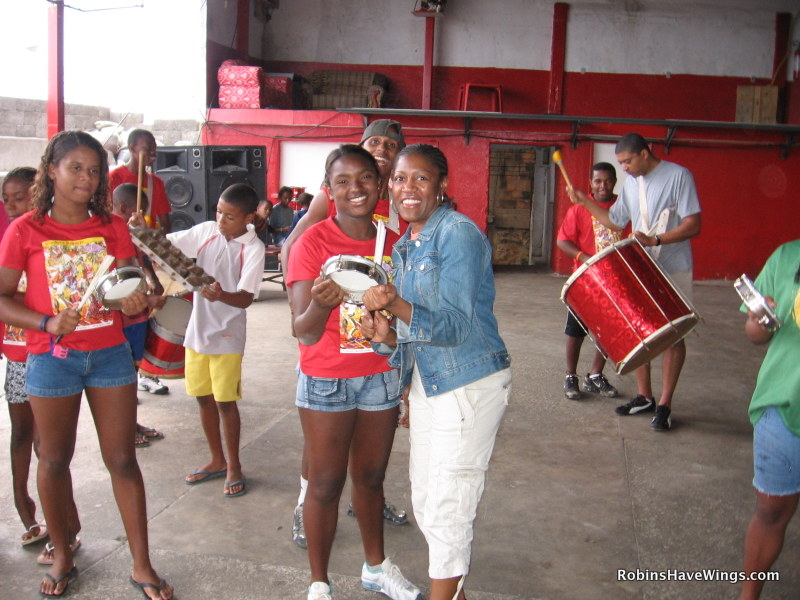
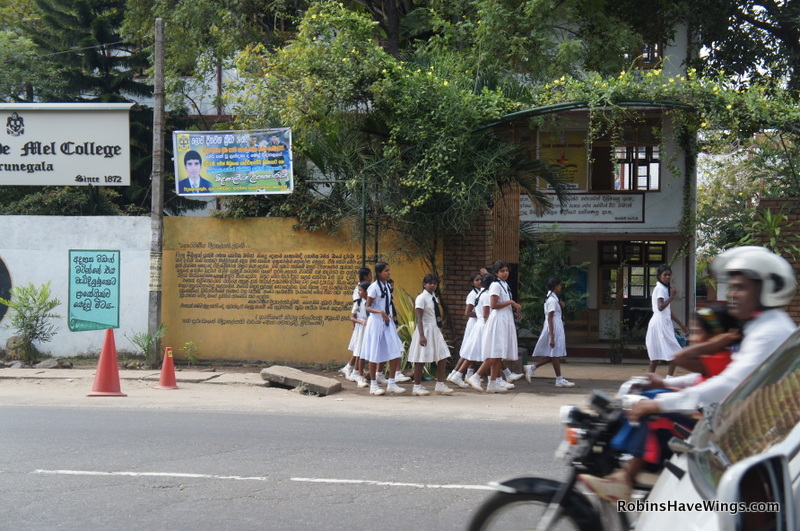
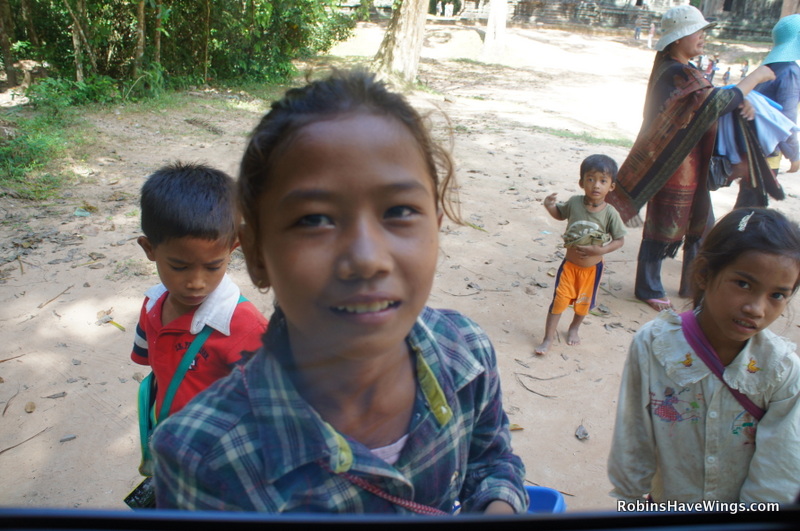
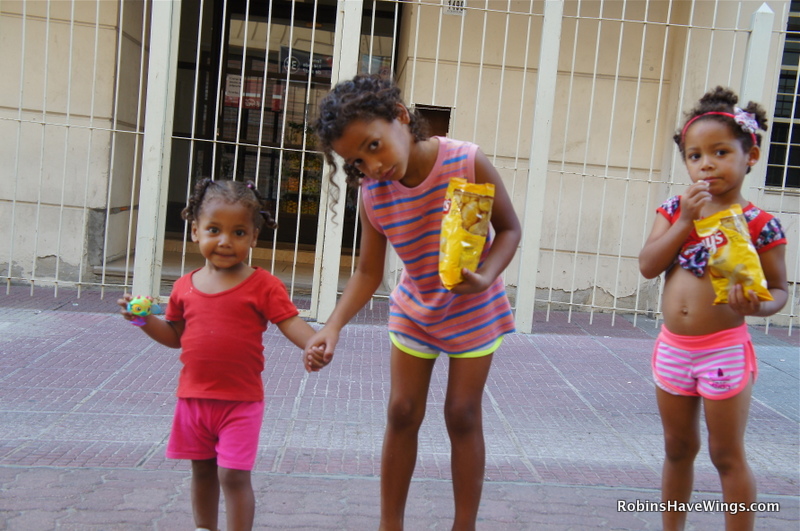
Girls in a Fulani village in Senegal in 2006. They were making a game of mashing millet. The Fulani are a nomadic, herding tribe spread out across West Africa. Typically, Fulani men have more than one wife.Who doesn’t like lip gloss? I packed lip gloss and candy to give to kids on my trip to Senegal and Gambia in 2006 and these girls loved it. I think I’m going to do this on more of my trips.I visited Cantagalo, a favela, or, as they prefer, a communidad, in Rio. We were watching a young street band, or bloco, perform when I got a pic with this girl. (See that boy photobombing us?)While traveling in Morocco in 2007, we visited an all girls school where the students taught me how to style my Hijab.When I was in Sri Lanka last year, I loved seeing groups of girls walk to school in their uniforms with braids swinging.The fiercest sales girls you’ll ever meet are in Cambodia at Angkor Wat. This girl laid it on thick. She told me that I looked like Michelle Obama and that she liked my hair. I bought a bunch of bangles from her.I was strolling down a street in Montevideo, Uruguay when these girls, having a snack, started to curiously follow. They were shy at first, but then they posed for me.
So, let’s hear it for the girls around the world and the girls that want to travel the world this International Women’s Day. Speaking of girls that want to travel the world, check out The Passport Party Project, one blogger’s mission to arm young girls with passports and empower them with a sense of wander. If you know a girl that wants to travel, get her started here. It just might change the world.
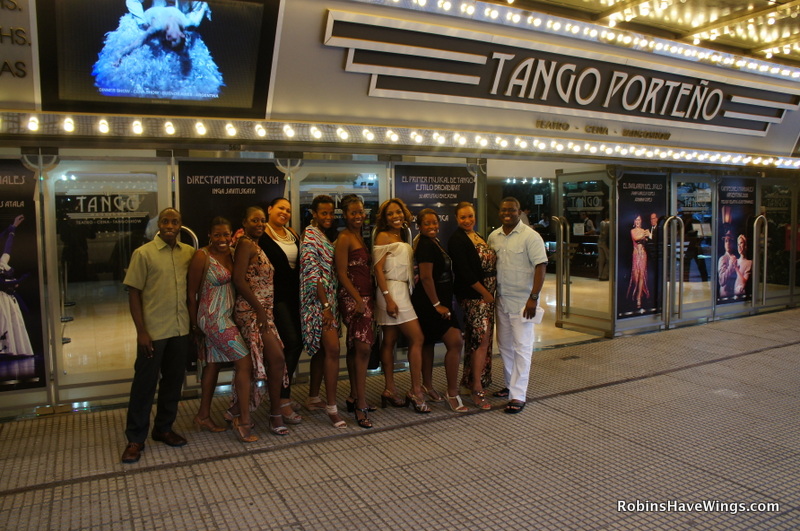
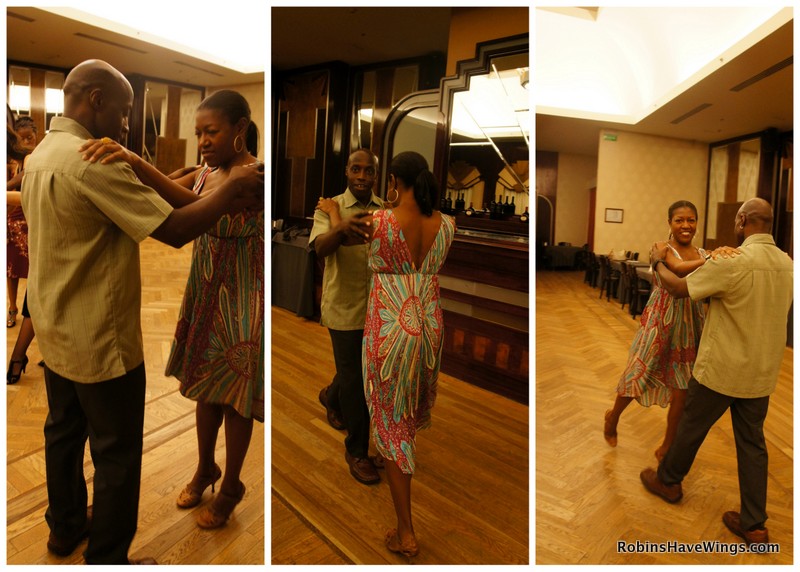
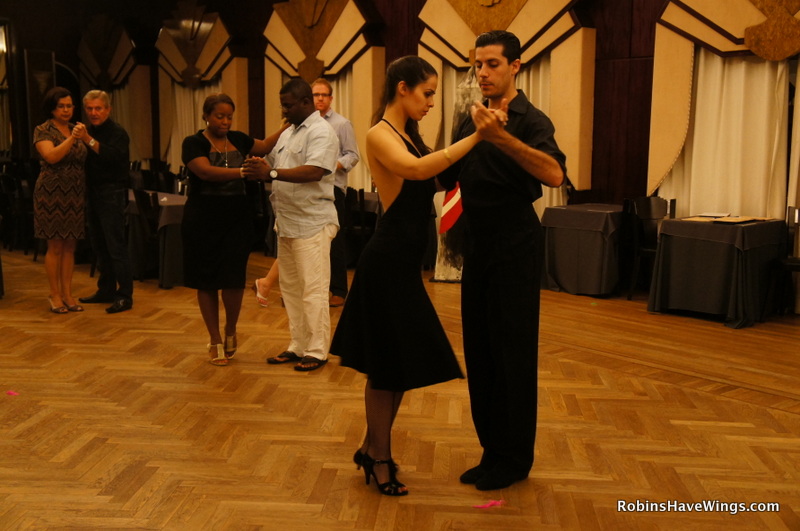
It’s the morning after our tango class and show at Tango Porteño in Buenos Aires. Gia dubs Alan and I Mr. and Ms. Tango, sharing how well we danced together with Luis, who is at our hotel to escort us to the airport for our return trip to the U.S. Luis gives a naughty gaucho laugh upon hearing this, because as everyone knows, tango is a very passionate dance and his Argentinian mind leads immediately to naughty thoughts. The tango has definitely awakened something in Alan who is making it his mission to take more tango classes when he returns to the states and I have to say I’m pretty excited, too. I’ve always been a fan of dance, taking ballet and tap as a kid, African dance in college and traveling to Cuba to learn salsa and Afro-Cuban dance. And, anyone who knows me knows that I’ll get on a dance floor in a minute, so this tango thing is right up my alley and apparently Alan’s too, so we turn out to be excellent partners.
It takes 10 to tangoMr and Ms. Tango work the dance floor
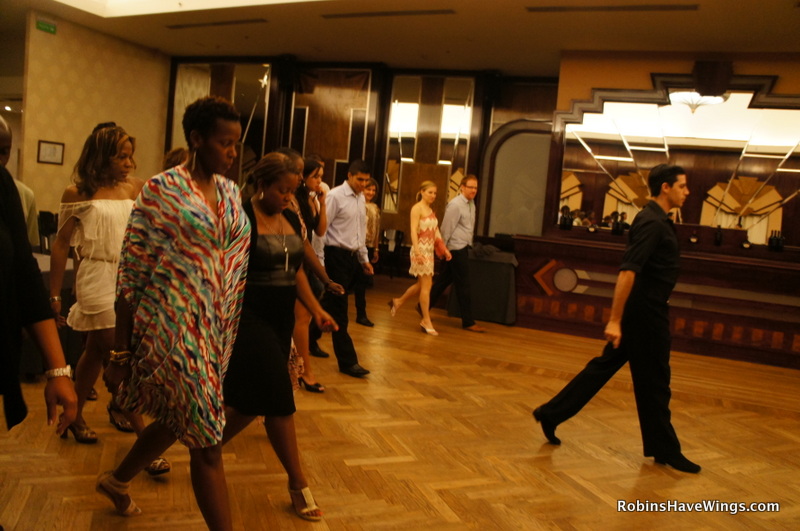
First, we all start by learning how to walk tango style by sliding our feet forward and then backward. We pair up to practice how this back and forth works in the dance. Finally, we move on to a more complicated box step which involves stepping backwards, to the right, then backwards again with the woman extending her right leg backward dramatically, and then to the left where the woman does a sweeping leg swirl to the right and then the left before the couple moves back and to the left again. When we see our instructors do it, it looks effortless. They glide like they’ve got butter on their shoes. Alan and I look at each other incredulously, not sure we can do it. But we embrace the challenge and after a few fits and starts, we get it and we smile approvingly at each other when we do. We even get a few words of approval from our slender instructor, Juan. We aren’t exactly gliding, but we get it and we can follow the music and we are having a blast. Our travel friends are having a blast, too. Some take turns dancing with the instructors and with each other, giggling wildly with each misstep or well-placed move. We are so glad that we were able to have this experience after it was first thwarted by the flash flooding a few days ago.
Practicing our tango walkGai and Floyd learn from the tango experts
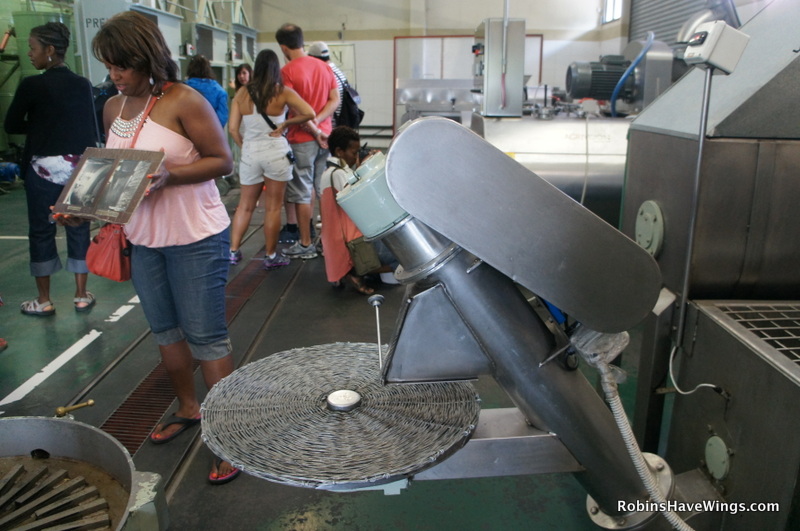
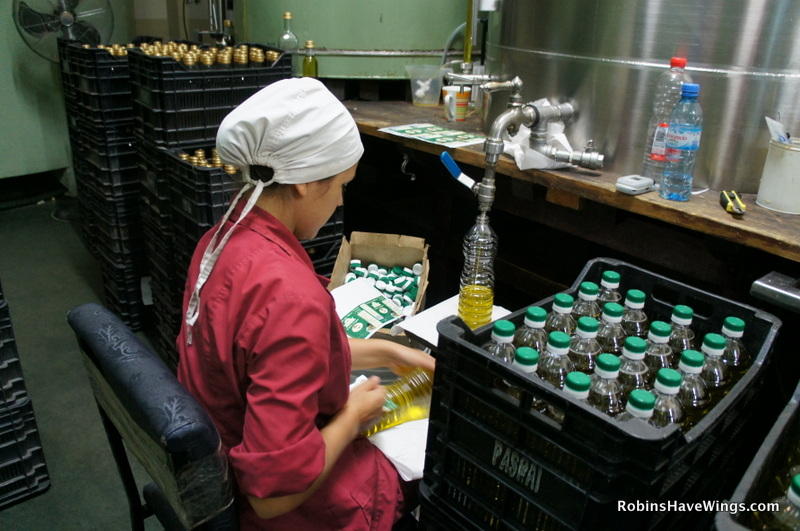
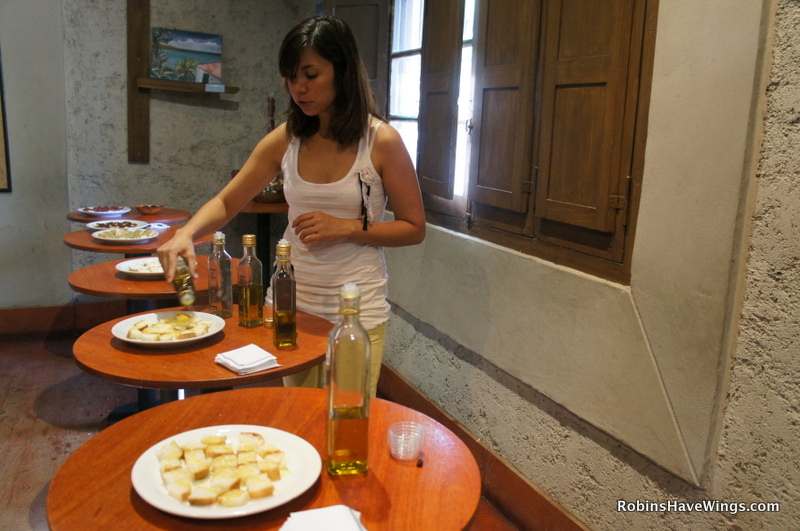
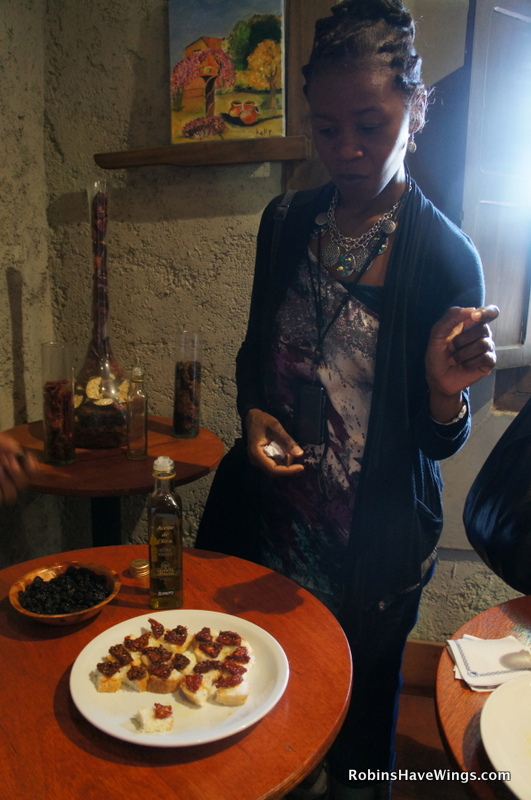
Just one day ago we were still in Mendoza tasting wine and something new, olive oil. At the Pasarai olive oil factory in Maipú, a small vineyard town outside Mendoza. It’s at this factory and olive vineyard owned by a family of Yugoslavian heritage where we learn exactly how extra virgin olive oil is made. Our guide describes the process of stacking up to 17 plates of olive oil paste (hand-washed olives crushed with pits and all), then pressing the plates together once to extract its oil. Other processes take the paste after its been pressed and find other ways to extract more oil, but the resulting product is not extra virgin olive oil. We also get to see the oil hand bottled and labeled. But the best part is the tasting. Our guide pours several flavors of Pasrai’s olive oil over bread, plain bread, bread with olive paste and bread with sun-dried tomatoes. The fan favorite appears to be the rosemary-flavored olive oil drizzled over the bread with sun-dried tomatoes, leading to a purchasing frenzy at the counter. We also learned a bit about olive oil as a beauty product packed with antioxidants and we are immediately sold on Pasrai’s pure olive oil body oil after rubbing it onto chapped hands.
Gai holds a picture of the olive oil press process in front of the olive oil paste platesA woman hand labels olive oilThe olive oil tasting beginsCarmen grabs a bite
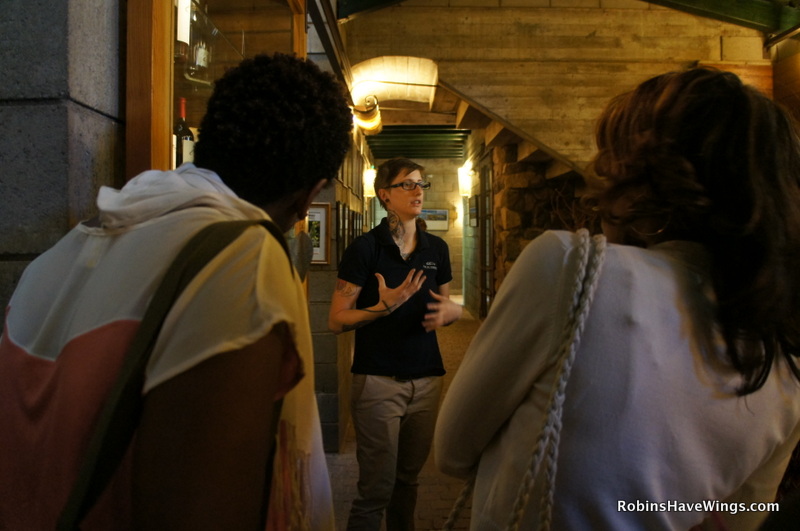
Pasarai’s small courtyard of flowers inspires a frenzy of photography for Carmen, Presleith and Kenitra and it’s here we spy a group of young girls in pink with white sashes across them. We wonder if they are pageant girls. Back on the bus, Leticia tells us that the girls are competing to become Maipú’s harvest queen. Local vineyards select young women to represent them at Mendoza’s annual harvest celebration, a tradition started years ago for fun to honor the prettiest vineyard pickers. Today, the winner becomes an ambassador for tourism in Mendoza. If we could pick an American ambassador to Argentinian wine, it would be Kayla, our guide at the Familia Zuccardi winery in Maipú. It’s always cool to meet fellow Americans while traveling and we’ve bumped into quite a few in Mendoza. There was a family from Boston at the airport, a mother and daughter from Oregon at Plaza Indepencia and a couple from New York staying with us at Finca Andalgisa. We are all just passing through, tasting wine and taking in the sights. But it was especially cool to meet Kayla, an intern at Familia Zuccardi. She came to Argentina by way of Chicago specifically to work here. She heard of the winery’s reputation and its wine-making innovations and knew she had to find a way to get here. We all admire her gutsiness and her sense of adventure. She’s pursuing her dream of becoming a sommelier head on. She hopes to open a small, unpretentious wine lounge in Chicago someday and after being on a tour of Zuccardi with her, I’d be happy to be one of her first customers.
Familia Zuccardi
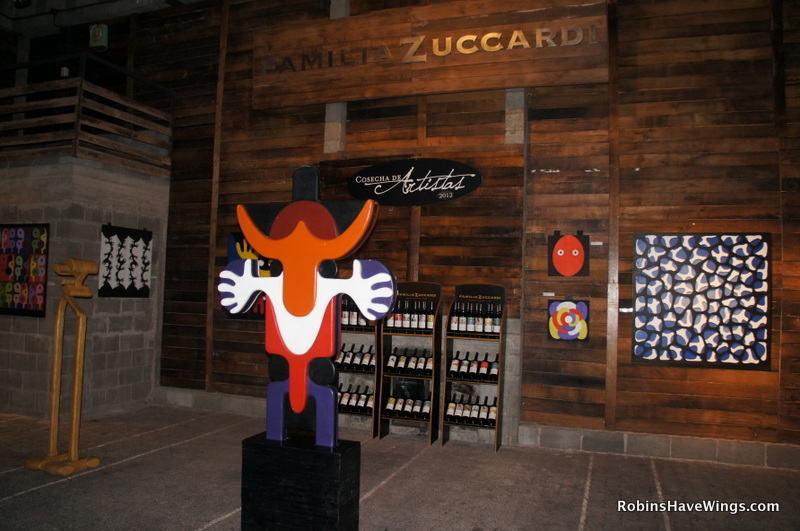
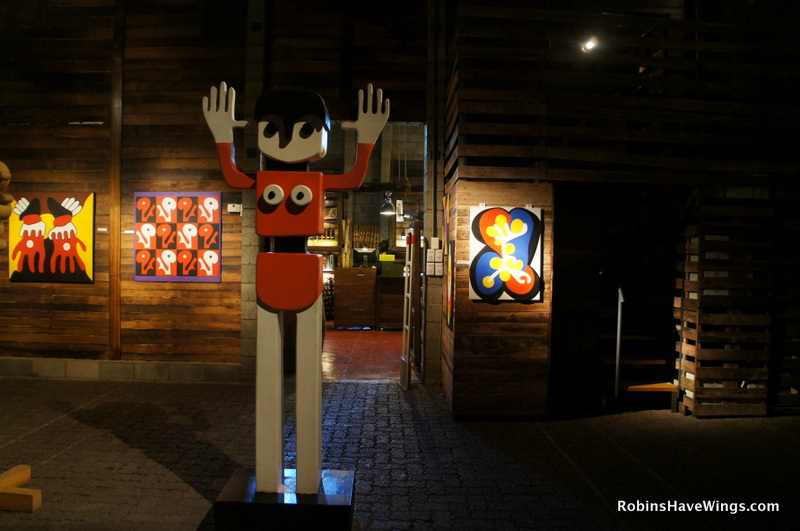
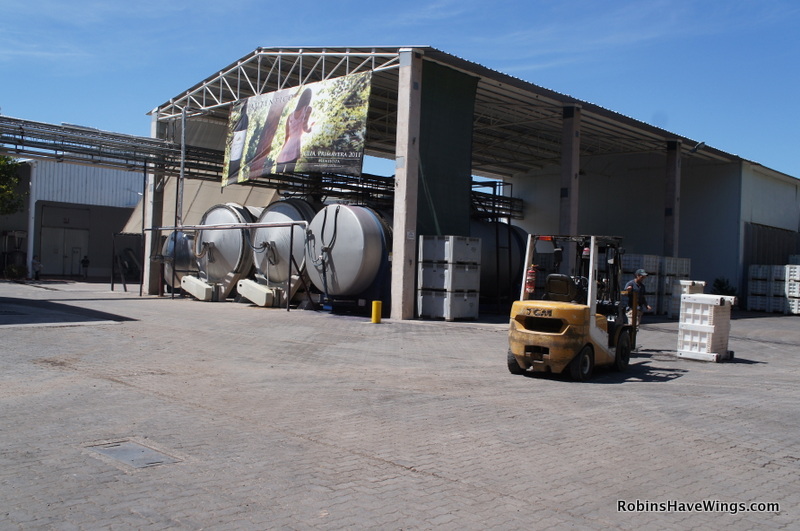
First off, the main Zuccardi wine tasting room is just plain funky. It catches our eye as soon as we enter the winery. Bold rounded figures and colors are displayed in paintings on the wall and as sculptures around the room. I’d later learn that this is an installation from an annual event that the winery hosts called the Harvest of Artists or “Cosecha de Artistas,” where artists are invited to participate in their harvests and be inspired to create art based on the experience. This artist apparently saw yellow and red bird-like figures and round-eyed people with fingers spread wide. We love it and a photo-taking frenzy ensues. Kayla is able to capture our attention and talk about wine, explaining the unique history of this place started by an Argentinian of Italian ancestry who came to the region to improve its irrigation system. To prove that his new system of irrigation worked, he created a winery and fell in love with wine and the process of making wine. The family-run Zuccardi winery is especially known for its experimental blends. Beyond the artsy wine-tasting rooms and shop, there’s a massive wine industrial complex operating in hyper drive out back. Small fork-lifts drive by, trucks back in and out to pick up precious wine cargo and huge machines churn, doing what we don’t know.
Harvest of the Artists exhibit at Familia ZuccardiKayla discussing Zuccardi wine brandsWine-making uncovered at Familia Zuccardi
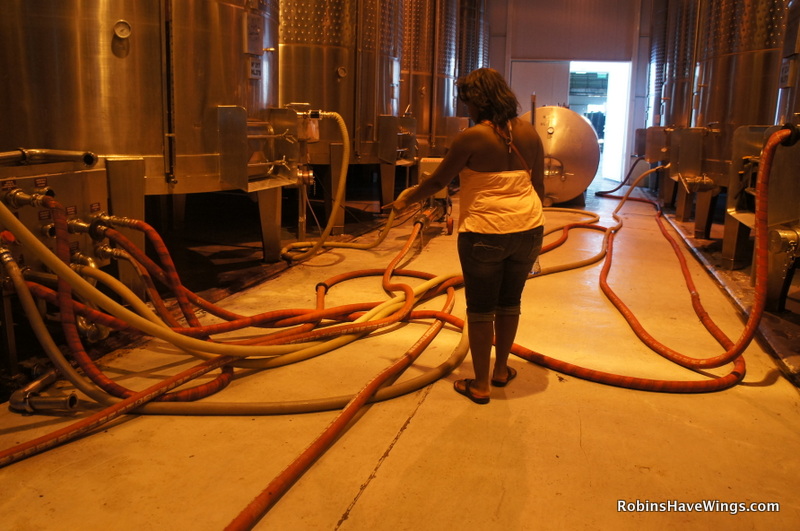
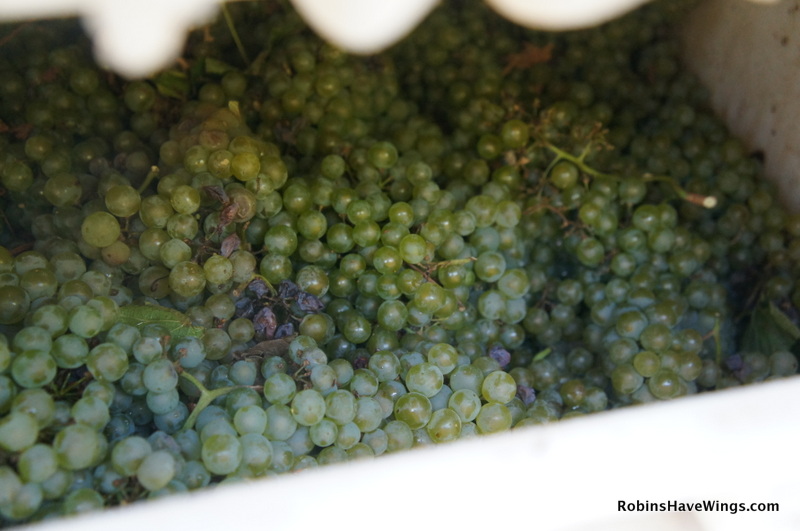
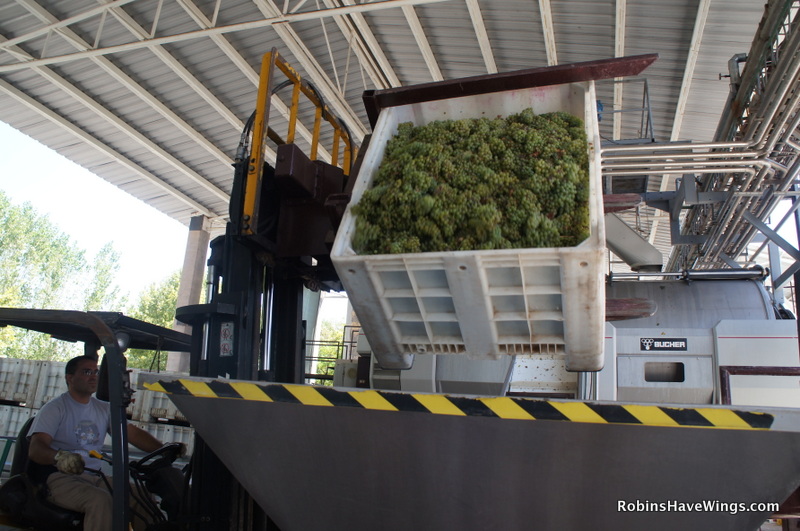
It’s a stark contrast to the wine tour at Bodega Saletein the other day, where the fermentation rooms were like works of art themselves, pristine and unmoved. Here, Kayla takes us into small warehouses where hoses snake from its steel vats of Pinot Grigos and Chardonnays. She let us taste the Chardonnay grapes, not from vines, but from plastic crates, where they sat awaiting the next part of their journey to become wine. In the Zuccardi’s french oak barrel room, Kayla expertly explains the process of toasting the interior of a barrel to impact taste and we see a barrel that had been freshly emptied. There is definitely wine-making being done here. When Kayla asked me how I liked the tour of Saletein, I told her that the setting in full view of the Andes couldn’t be beat, but here, it was like the covers were being ripped off the wine-making process and that was pretty cool, too. In fact as we left one fermentation space to head to another, we saw those Chardonnay grapes being dumped by forklift into a huge de-stemming machine where they moved up a conveyor belt to be plucked. Super cool for those old school Discovery Channel buffs who love shows like “How It’s Made.”
Gai tracks snaking hoses of wineChardonnay grapes before de-stemmingIt’s about to start raining grapes
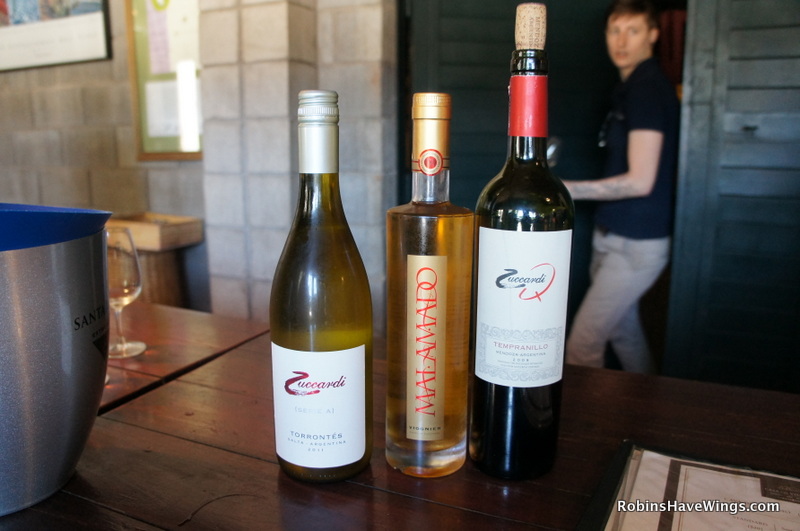
Back inside for our wine tasting, the group seems to gravitate to Zuccardi’s sweeter wines especially their Santa Julia Tardio and the Zuccardi Series A Torrontes, a blend of Criolla and Muscat grapes popular in South America. The tasting ends with the Malamado, Zuccardi’s version of a port wine, but since it’s not made in Portugal, it’s called a fortified wine. This one has got kick. It’s smooth with a slow burn. It reminds me of Cognac and Gia thinks this would be good with a good cigar. Sensing this may be our last chance to shop for gifts before returning to Buenos Aires the next day, some go on a spending spree in Zuccardi’s gift shop, including Floyd who after collecting perfume, t-shirts, caps and wine, can’t resist $5 two-packs of sparkling wine, going back several times for this bargain item. Don’t let anyone tell you that men don’t shop.
Sheneekra likes TardioZuccardi’s premium wines for tasting
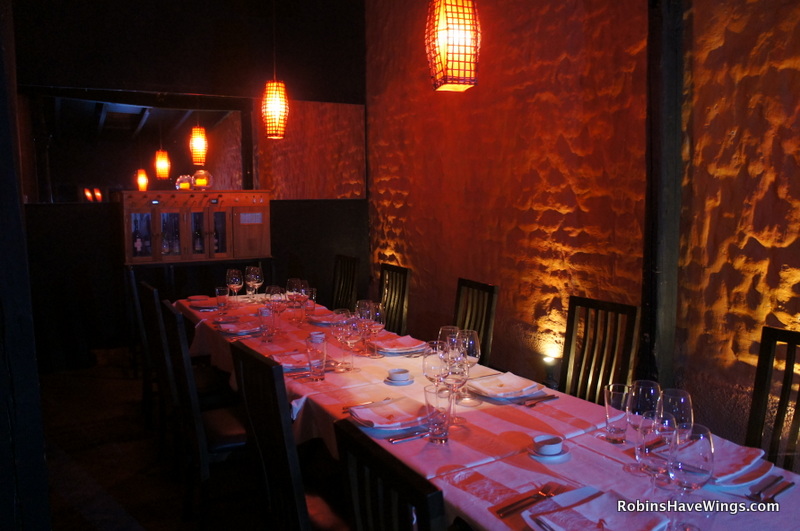
Knowing that this is our last chance to have a great meal in Mendoza, several of us head to Nadia O.F. for dinner later. It’s considered the best restaurant in the area. When Robyn and I mentioned that we were going to Nadia’s to a couple from Israel staying at our hotel, they raved, saying it was one of the best meals they’ve ever had. Leticia mentioned it as one of the best, too, noting its 6 courses. We are excited to have a real foodie experience. When we arrive, we have the place to ourselves. It looks befitting of a foodie experience with our dining space bathed in a warm red glow.
Our table at Nadia’s
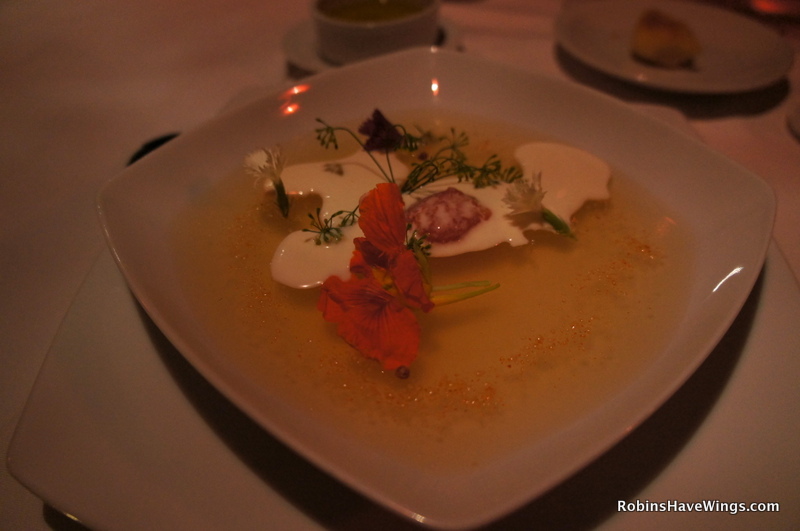
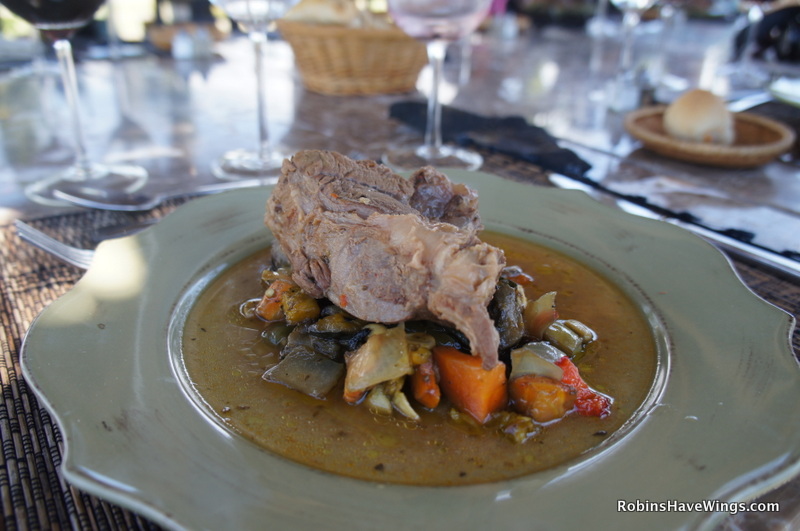
We have only have the option to choose our starter and entree, but everything else is decided by the chef, including the 2 appetizers, a watermelon and fig salad with herbs, blue cheese and syrup dressing and the sweet potato with green aioli and eggplant ashes. Both of which were wildly creative and deliciously complex. But the star of the meal was my “Gazpacho” jelly with cold almond soup. It arrives in a Jello consistency with flowers as a garnish and the almond soup drizzled on top. It’s almost too pretty to eat and it definitely doesn’t look like gazpacho, but one bite brings all the cool tomato, onion and cilanto flavors to mind. It’s completely baffling and delicious. Sadly, my rib-eye, known as bife de lomo in Argentina, can’t even hold a candle. But desert makes up for it, a refreshing and creamy orange mouse followed by pears soaked in Argentina’s Torrontes wine and seasoned with black pepper. If I’d chosen the ossobuco like the other Robyn, the meal might have been pretty close to perfect.
Gazpacho flavored Jello
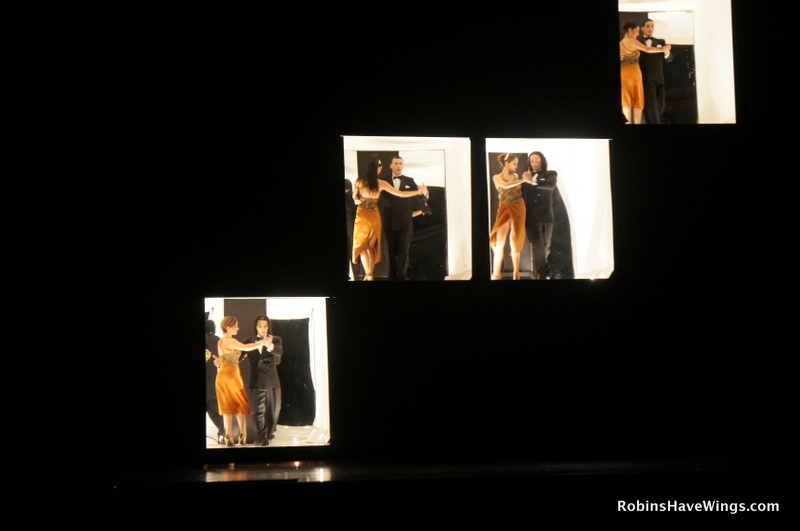
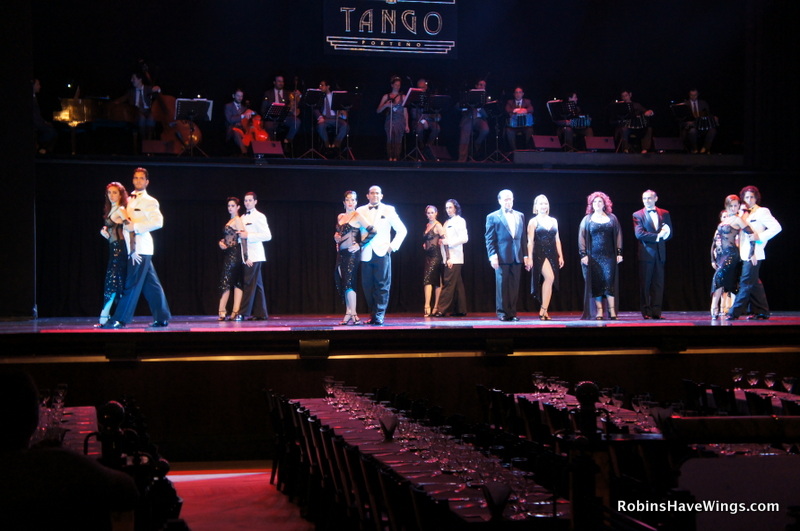
Back in Buenos Aires, folks continue the mad last-minute shopping dash with just a few hours to spare before our tango show on our last night in Argentina. It occurs to me that I haven’t seen Alan buy one single thing during this entire trip. Maybe the photos and the experience are gift enough for him. The tango certainly is. As we sit down to dinner at Tango Porteño, he makes a point of going to Gai to thank her for arranging the tango class and expressing how much he enjoyed it. In the darkened art deco theater, we see how tango is really done with dances that harken back to its heyday in 1940s Argentina with a live orchestra. At times, the dances are productions with the full cast of dancers telling a story of the times on the busy grand Avenida 9 de Julio or at the sultry Dragon Rojo bar. At other times, a pair of dancers display the tango’s inherent eroticism with open-shirted men lifting lingerie-clad women in the air or holding them tightly in passionate embraces. And then there was the traditional tango that we all know with fast-flicking legs that look like they could do damage to a partner’s calves and thighs. We are glad we didn’t try those moves in class. We leave Tango Porteño to see lights ablaze on today’s Avenida 9 de Julio. It looks like Buenos Aires’ version of New York’s Time Square.
This was one of our favorite performances from the show. Kinda of looked liked Tango Hollywood SquaresApplause for the stars of Tango Porteño
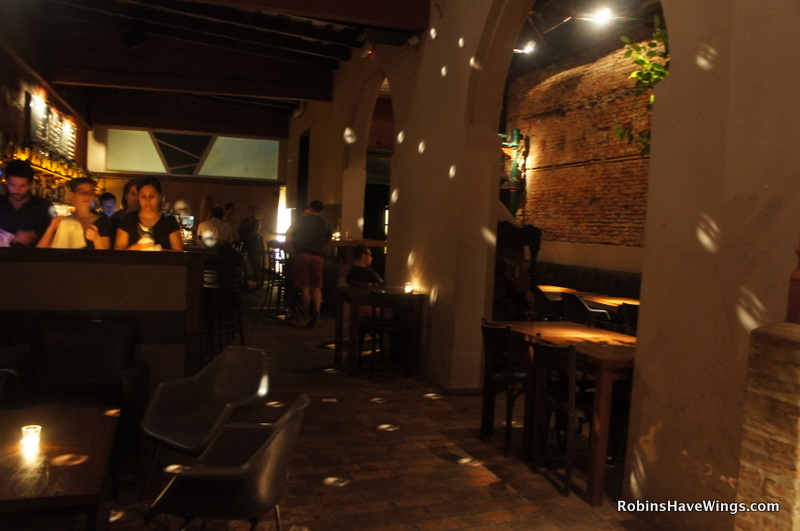
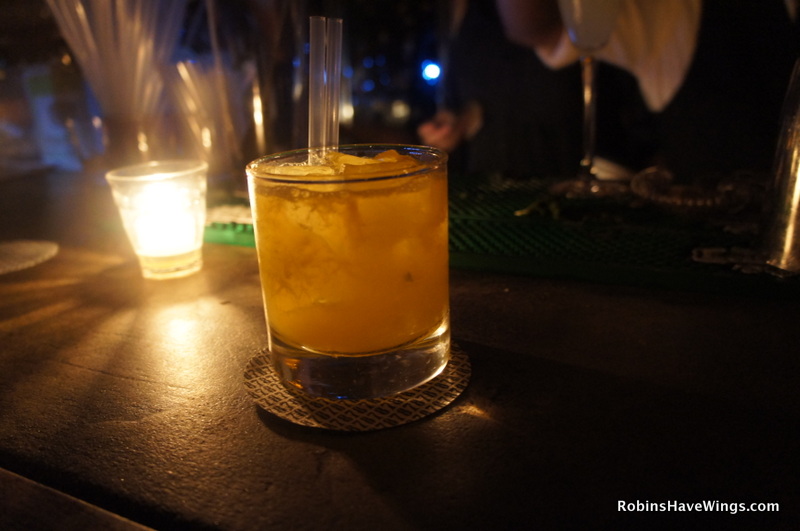
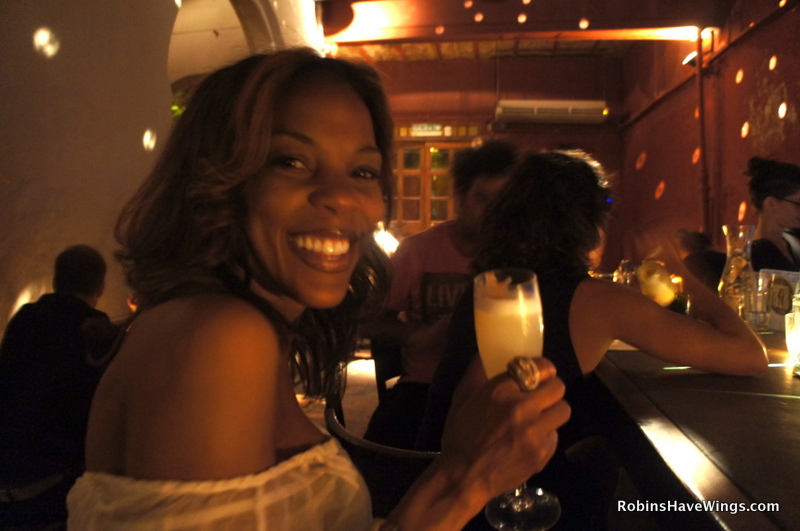
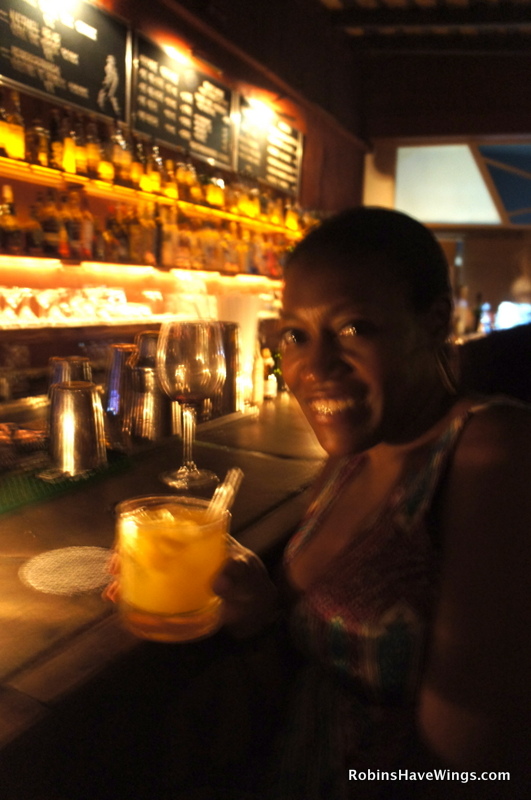
Gai takes this opportunity to thank all of us for joining her STG Tour. She says she really enjoyed traveling us and the feeling is mutual. She hopes that we’ll join her on her other group trips. I’m sure she’ll see most of us again. Alan is a veteran and has already been on 5 trips. This is Presleith’s first, and she is definitely planning to travel to China in October with STG Tours. The bright lights of Avenida 9 de Julio twinkle behind us and they are enough of a farewell to Argentina for most of our group, but Kenitra and I decide to end the night with a night cap. The hotel night manager at our trendy hotel, Esplendor, in Palermo Hollywood, suggests a spot simply called 878. We hop in a cab to give it a shot. We come to a place that we are sure most tourists don’t know about. The wooden double doors even look like they hold a secret. Inside is a dimly-lit bar and lounge playing moody eclectic American music like an early Madonna song and what sounds like indie Argentinian music. Our bartender is Mario. He doesn’t speak much English, but I ask him about the “Lola,” a drink advertised on its menu over the bar. I make out that it’s like a caipirinha but with a rum called pamero instead of cachacha. It’s got mango, lime and ginger in it, too. Kenitra opts for the Pisco Sour, which Mario says is best, if you don’t like sweet drinks. We like the vibe and the drinks are good. We toast Argentina farewell.
Inside 878The Lola at 878Kenitra toasts ArgentinaYo, tambien. Adios Argentina. Me gusta mucho!
Coming Soon: I asked my new Argentina travel buddies to send me their favorite photos from the trip, so I’ll be sharing their highlights and favorite travel memories here, too.
*Disclosure: STGTours provided me with housing during this Argentina tour.
When we land in Mendoza all memory of flash flooding and a leaky hotel is erased instantly with one glance at the Andes Mountain range. The mystical mountains greet us outside the Mendoza airport and seem to carry a quiet and calming presence. It’s like we are getting a fresh start with the fresh mountain air. Our guide, Leticia, introduces Mendoza to us as the land of sun and wine and we are ready for both. She also explains that what we’ve just seen are the pre-Andes. I can’t wait to see what the full mountain range looks like. On the way into Mendoza city, we get a bit more background on this naturally dry and mountainous desert region where it only rains a few times a year and is somehow amazingly fertile at the same time. Mendoza is not only known for its wines, Malbec, in particular, but also olives, apples, pears, plums and apricots, all because of an irrigation system built by its indigenous inhabitants and built upon by its more recent European residents who added dams to redirect water to dry areas as needed.
Meeting Leticia in Mendoza
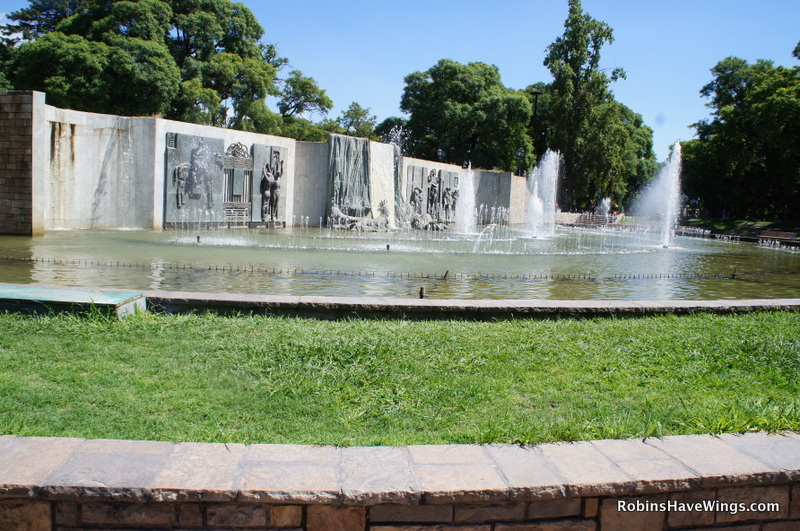
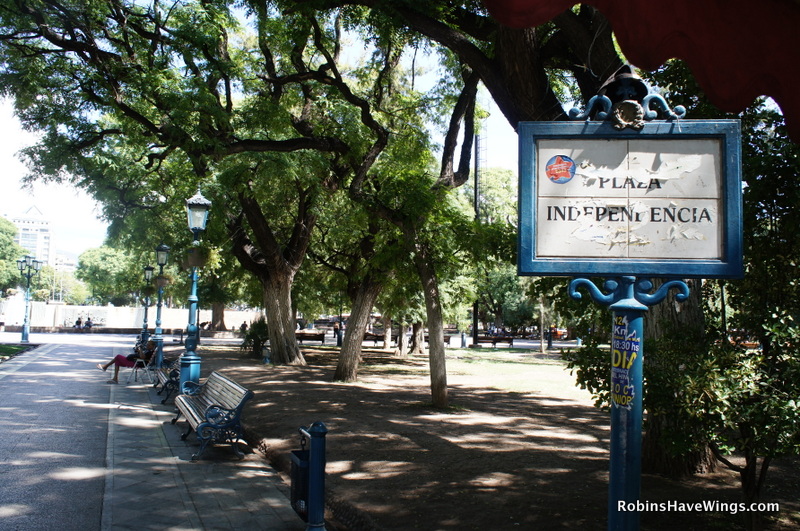
We see the system of narrow cobbled ditches as we wander around Mendoza City, which is the antithesis of Buenos Aires. You want to go slow here. Strolling is definitely in order in Independence Plaza, its main square which is surrounded by park benches and centered by a beautiful bursting fountain. We find a few vendors here on a Monday afternoon and wonder what this place would be like on a weekend. Gai and Carmen are drawn to belts made by one mate drinking vendor. Mate is Argentina’s green tea, made popular by the gauchos. Kenitra and I study handcrafted jewelry with local stones by a local woman. Beyond the square is a wide promenade of shops and restaurants. Kenitra and I take Chile street to see if we can start our wine tasting immediately, but when we reach the lovely shop simply called The Winery which looks more like an art gallery with wines and wine accessories artfully displayed in rooms under chandeliers, we learn that they aren’t doing tastings at the moment. By this time we’re hungry, but we don’t have much time and bemoan the fact that there doesn’t appear to be quick street food in Argentina. I guess it is because of its European roots in Spain where you take your time with food whether eating or serving it. We duck into a neighborhood bakery hoping to snag a quick empanada and end up standing around in the hot narrow shop for about 30 minutes or more along with a few local patrons who seemed like they wanted their food fast, too. But I guess that was fast by Argentinian standards. It was a good empanada. Juicy as it should be.
Mendoza FountainPlaza Indepencia in Ciudad de Mendoza
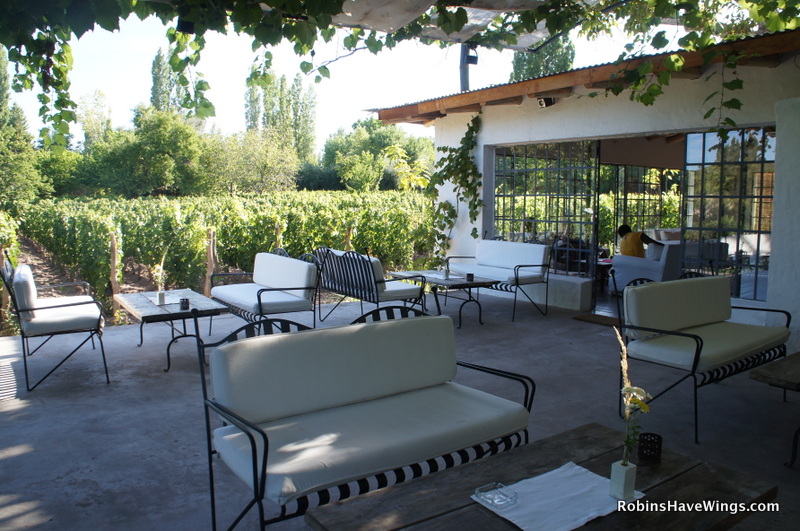
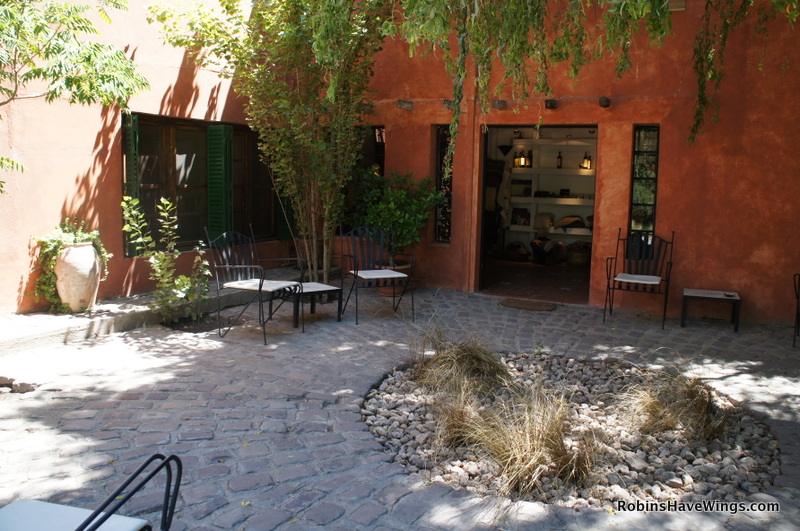
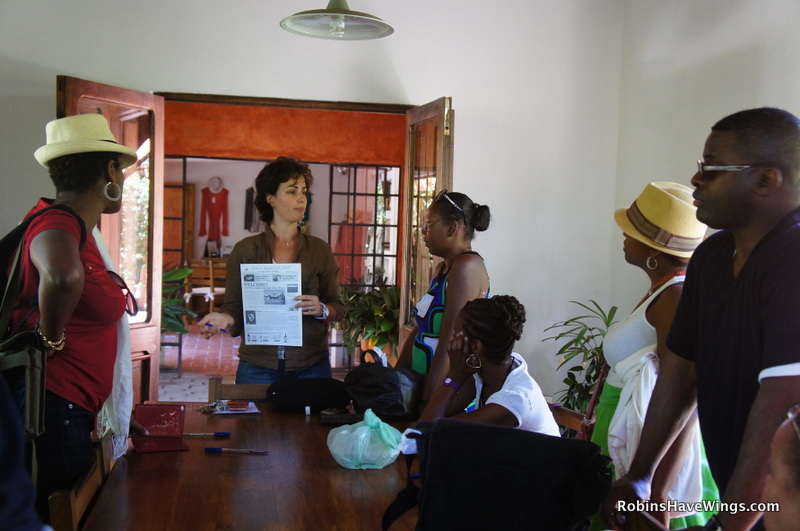
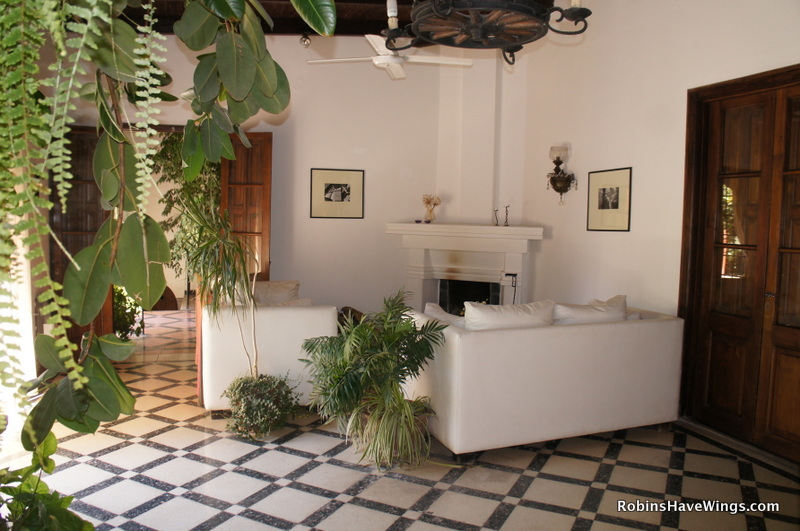
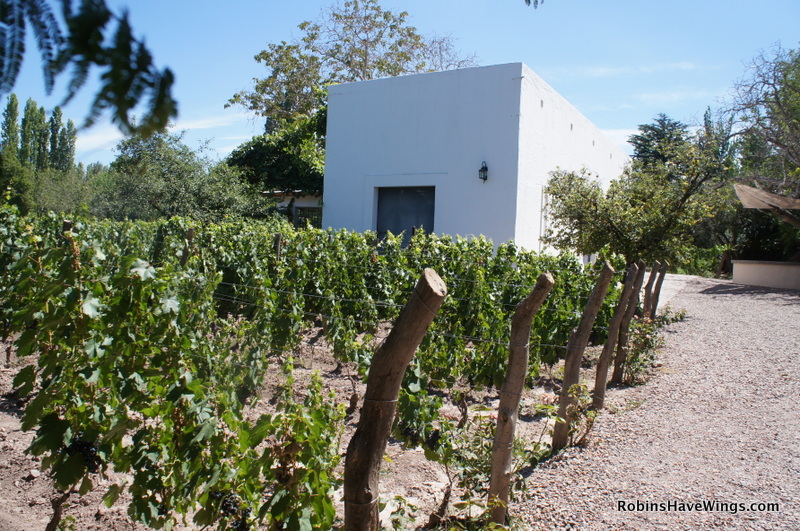
If just getting a glimpse of the Andes was enough to make us forget the unfortunate flooding in Buenos Aires, Finca Adalgisa makes it seem as if it never happened. Walking through the gates of the property feels like we’ve awoken from a bad dream and everything is right with the world, especially one where you live in an 80-year-old vineyard with a gorgeous pool surrounded by lush grounds. We are greeted warmly by the hotel manager, Theresa, who gathers us for a tour of our new home explaining its history as the winery of the Furlotti family, run to this day by its grand-daughter Gabby. The library features sepia photos of its familial founders along with worn leather seats and books for the taking to read there or in a hammock outside your room. We perk up when we learn that there is a happy hour every evening at 6 pm where there are free tastings of Adalgisa wine in their wine bar and lounge. We decide to pass the time until happy hour lounging by the pool nestled amongst rows and rows of grape vines.
Finca AndalgisaFinca OrientationMy favorite room at Finca AndalgisaView of the vineyards
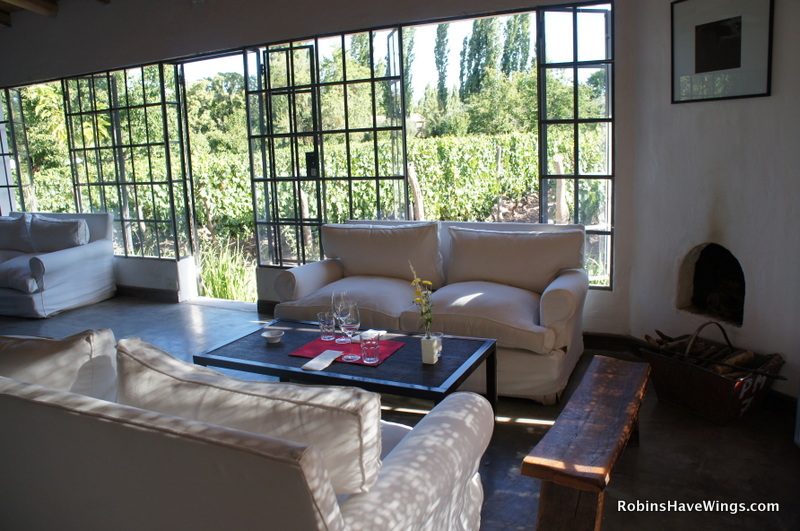
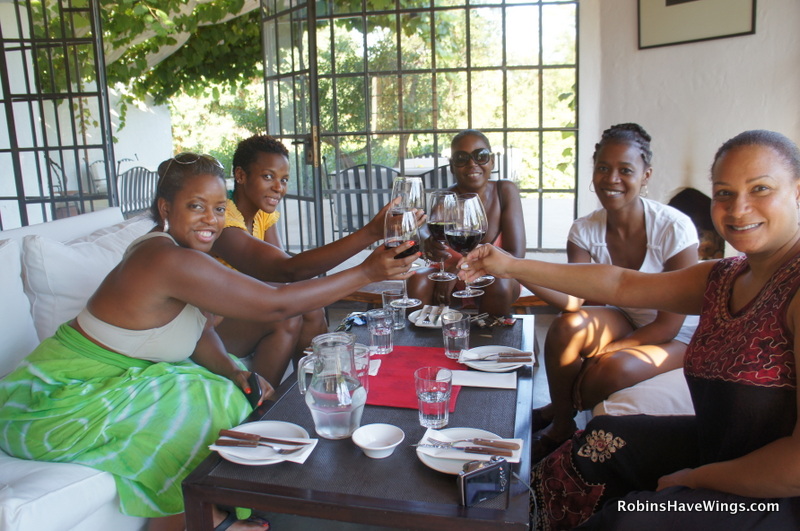
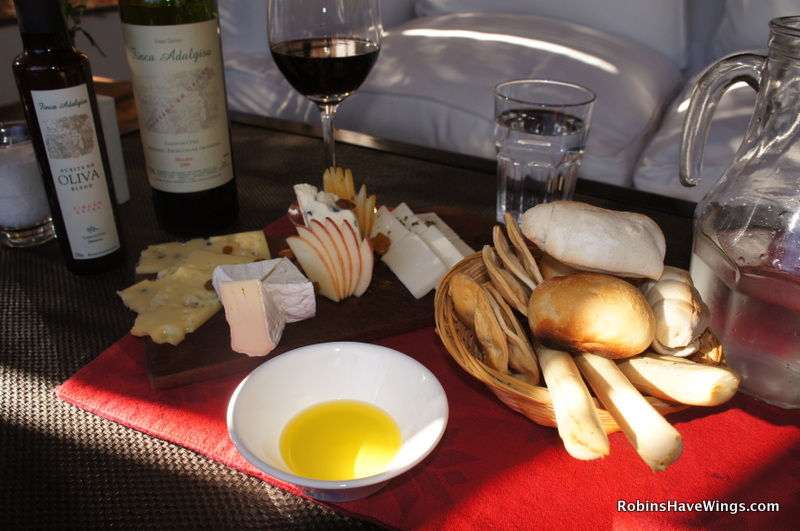
It’s the ultimate in relaxation and we think it can’t get any better until we actually go to the happy hour, which looks to be in a simple white stone building from the outside, but the interior looks like we’ve stepped into the pages of Architectural Digest. A tree grows from the center of the room through the ceiling and plush white couches surround it with a 180 degree of the vineyards beyond. It’s stunning and cozy at the same time. The patio offers an unobstructed view of the sun setting over the vineyards and then the wine arrives. We are drinking a 2008 Malbec from our new home and it’s delicious as are the olives, cheeses and breads served. With the arrival of the wine comes a new level of relaxation and our group bond deepens. At first it’s just the ladies and we drift into conversation about relationships, not just with men but with each other. We learn more about each others histories and uncover our common interests beyond travel. When the the men join we are all laughing, recounting great moments so far on the trip as if we had always been the best of friends. Gai says this is her favorite part of her trips. She knows the bond will happen at some point and for us it was over wine in the middle of a Mendoza vineyard.
Our happy hour settingMore of our happy hour settingA toast before the happy hour bondingThe Finca Andalgisa spread
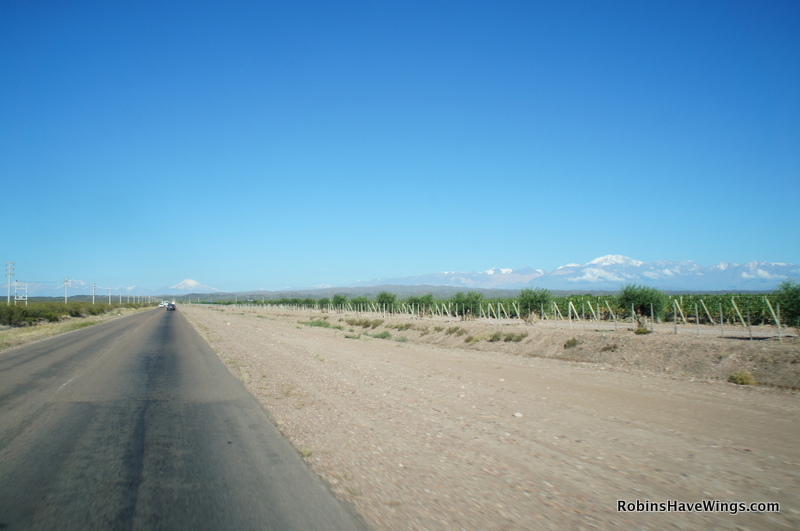
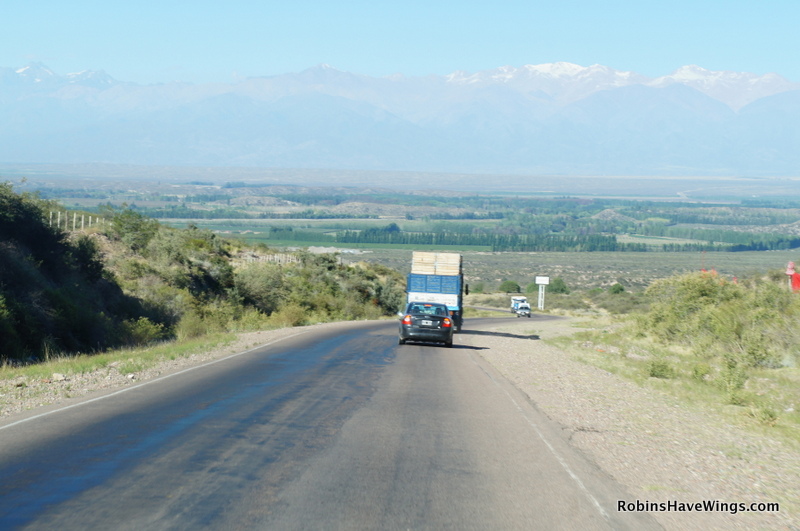
The wine continues to flow and the bonds continue to deepen the next day as we head out for our wine tasting tour an hour outside Mendoza proper in Tupungato which also shares the name of a long dormant volcano in the Andes. In fact, it is the third highest mountain in the Andes. Speaking of which, the Andes are following us on our drive or maybe we are following them. They first appear on the right and Leticia tells us that we’ve left the pre-Andes behind. Then they rise before us on the way into the Uco Valley known for Argentina’s finest wines, grown at about 900 meters above sea level, the highest altitudes in country. At times the mountain range is bright and sparkly and at others distant, under a heavy haze. Either way we can’t take our eyes off the approaching peaks and valleys, one of which is Aconcagua, the tallest mountain in the Americas. We struggle to capture them through the window of our van with our cameras zoomed as tightly as they will go.
The Andes on the road to Tupungato
We ride over the parched Mendoza River, sucked dry of all its water, which has been rerouted to the city for drinking water, bathing and watering its crops. We also pass Route 7 which was to take us to the Chilean border the next day but an avalanche blocked part of the road leaving a long queue of cargo trucks to wait for the only road into Chile to open. We’ll have to make another plan.
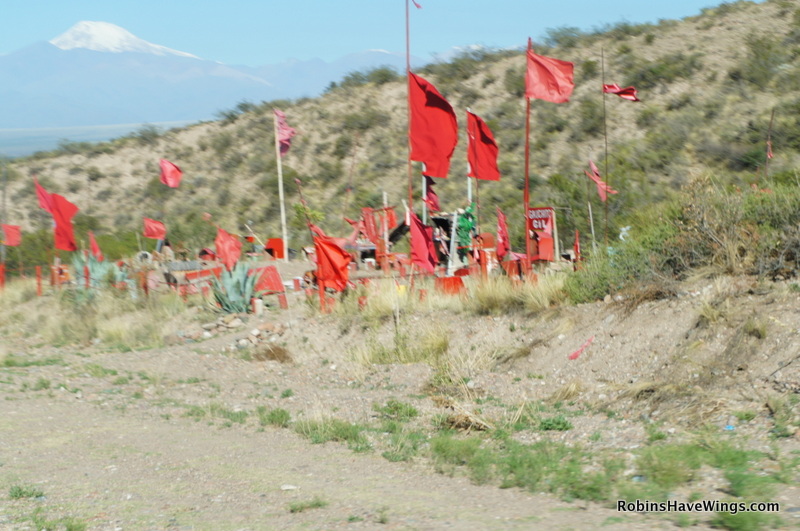
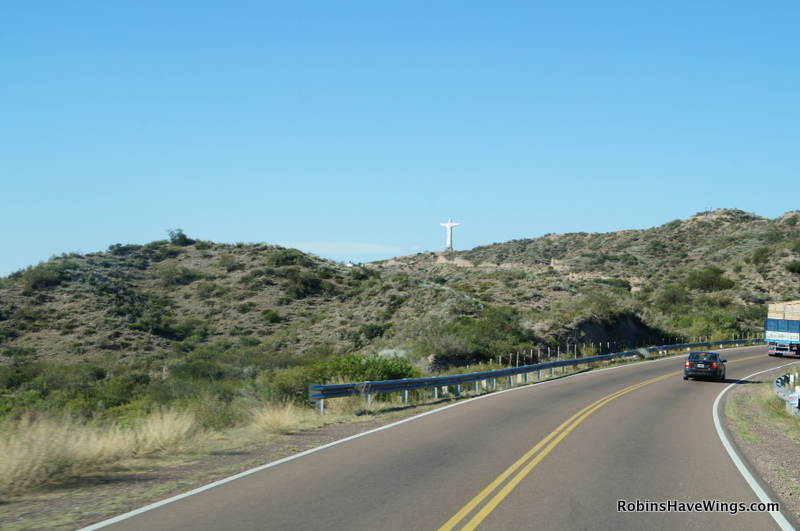
The terrain continues to get more rocky, blanketed in a low-lying brush. Leticia tells us that not much else can grow in a place this dry. Every few miles, a patch of red flags stand at attention in the low dry grass or a small alter surrounded by water bottles appears. Gia is the first to notice them and ask about their meaning. The red flags are planted for Argentina’s Robin Hood, a man named Gauchito Gil, Leticia explains. He dressed in red and stole cattle from rich ranchers, sharing his booty with the poor. He was eventually caught, but he told his executioner that if he were buried, the man’s son, who was gravely ill would survive. The executioner buried Gauchito and the man’s son miraculously recovered. From then on people have sought good luck and blessings from Gauchito, especially truck drivers hoping for a safe journey. The other roadside saint is Difunta Correa, a mother who wandered the desert looking for her husband forced to fight in the civil war. Sadly, she died of thirst before she could find him and her child survived by suckling at her breast. So, today people leave bottles of water for the fallen woman. After passing these unofficial monuments, we spot a real one on a hill, Argentina’s Christ the Redeemer in the same arms-outstretched pose as the one in Brazil. This one looks towards the Andes and maintains peace between Argentina and Chile.
A roadside shrine asks for blessings from Gauchito GilChrist the Redeemer faces the AndesThe Uco Valley straight ahead
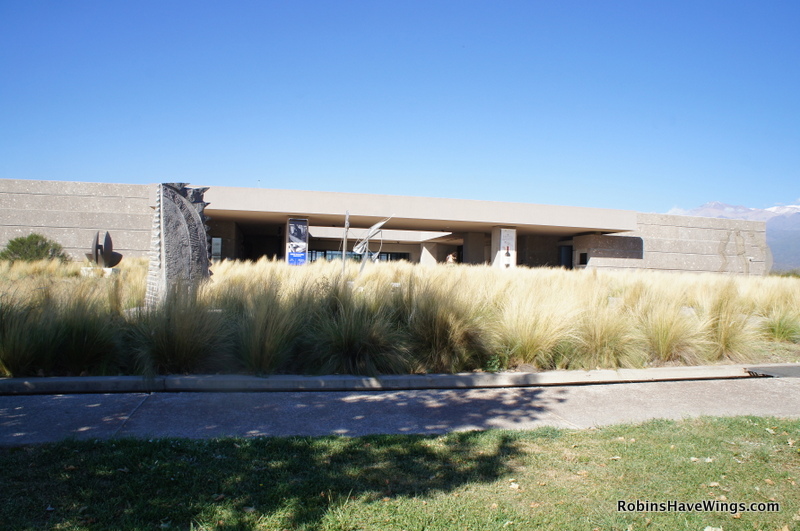
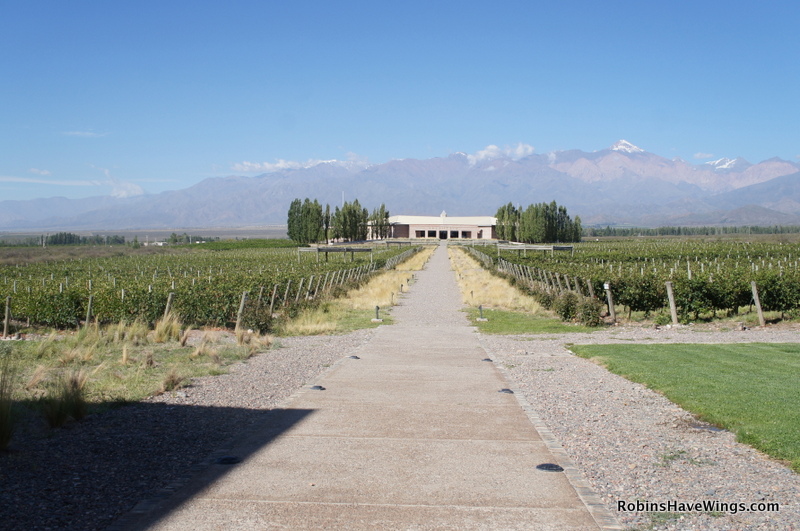
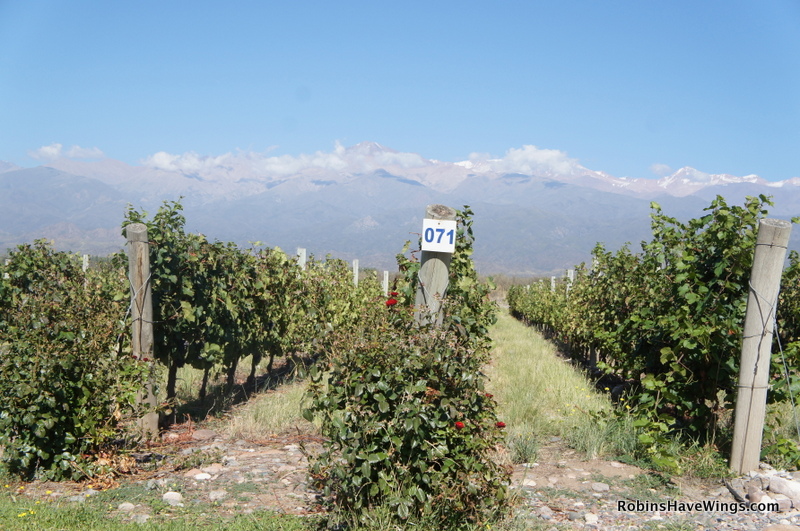
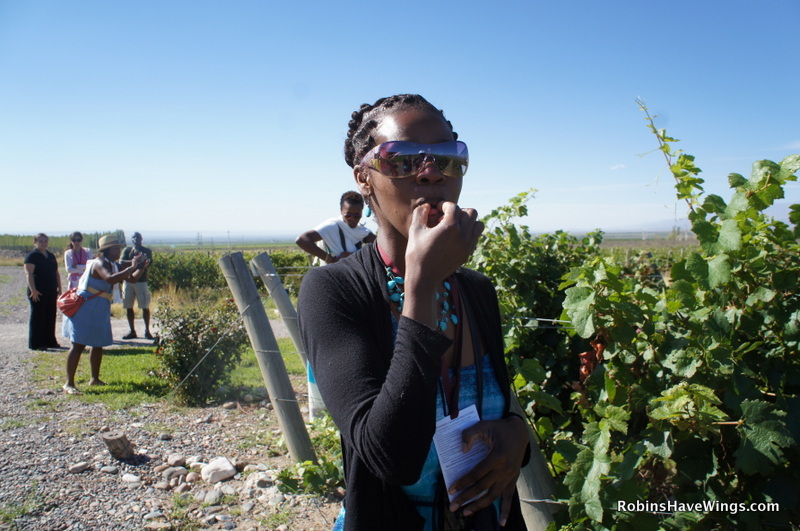
Just past the Christ statue, the Uco Valley unfolds before us like a verdant throw rug. It’s truly an oasis after the rough stretch of land we’ve just seen. It isn’t long before we pull up in front of Bodega Saletein. Could this really be a winery? It looks like a modern art museum rivaling MOMA with sculptures posed in the shadow of the Andes. Alan says they look close enough to touch. We are all wowed by the surroundings. Everyone has words like amazing, stunning and gorgeous to describe what they are seeing, but these words really don’t do it justice. This really is one of those times where you just have to be there. Rows and rows of vines seem to mark a series of straight paths to the mountains. Our vineyard tour guide takes us right up to the vines and asks us to pick a grape and taste one. We are stunned. Gia incredulously says, “You want us to pick them?” The guide is steadfast, so we head to the vines on the right to taste the Pinot Noir grapes. They are small, sweet and tart with a crunchy seed. Then she tells us to taste the grapes at the left. These have tougher skin and seem more bitter. Those grapes make Merlot. A few of us have been to wineries before and we were always told never to touch the grapes. But here at Saletein, our guide tells us that these grapes are grown just for the tasting.
Bodega SaleteinCould wine tasting take place in a better place? If you’ve got enough money, you could stay in one of the 4 luxurious suites on the property.The vineyards for tastingCarmen tastes a Pinot Noir grape
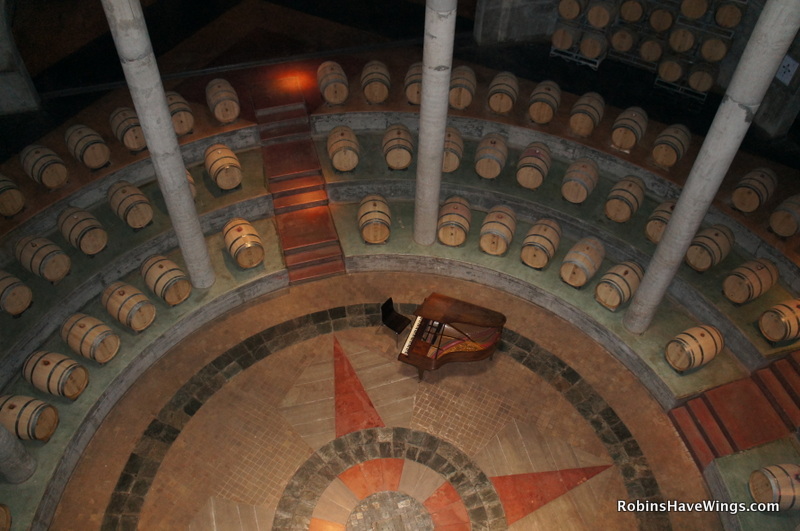
That’s not the only thing that impresses us at one of Argentina’s 10 largest wineries with possibly the best backdrop in the world. Deep in the recesses of this almost monumental building are steel vats in the most pristine of settings fermenting what we hope to be delicious wines. Our guide leads us to a circular railing in the center of this fermentation room and directs us to look down. French oak barrel upon French oak barrel sit respectfully in a circular theater surrounding a solitary grand piano as if waiting for a concert to begin. The room actually doubles as a cellar for its Primus wines, the winery’s most select label, as well as a concert hall, used for classical music concerts and tango performances once or twice a year. Depending on who you ask, the vibration from the music may actually add to these wines’ flavor, our guide explains. Once in the room, Gai, Carmen and Presleith decide to serenade the oak casks with “America the Beautiful” to test the room’s enveloping acoustics and spread some of our group flavor into the listening barrels.
Saletein’s fermenting room doubles as a concert hall
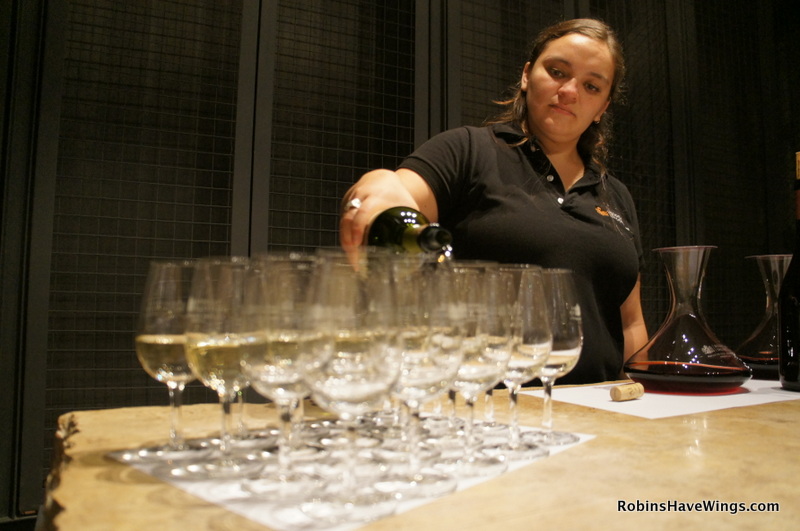
There were so many breathtaking details of this winery, including an eye-catching metal winding staircase and a tasting room built around a massive solid stone table. But it’s the wines that we’ve come here to taste and they don’t disappoint either. We start with a 2012 Sauvignon Blanc, a light, citrusy white liked by all, even Carmen who doesn’t drink at all. We end with another popular wine, the 2007 Malbec. It was a tad dry for my taste. I’m a fan of fruit-forward Zinfandels. But I get a bottle for my father who loves dryer reds and the rest of my travel compatriots proceed to almost clean out the winery’s shop before we head to our next destination.
A healthy pour of Saletein’s Sauvignon Blanc
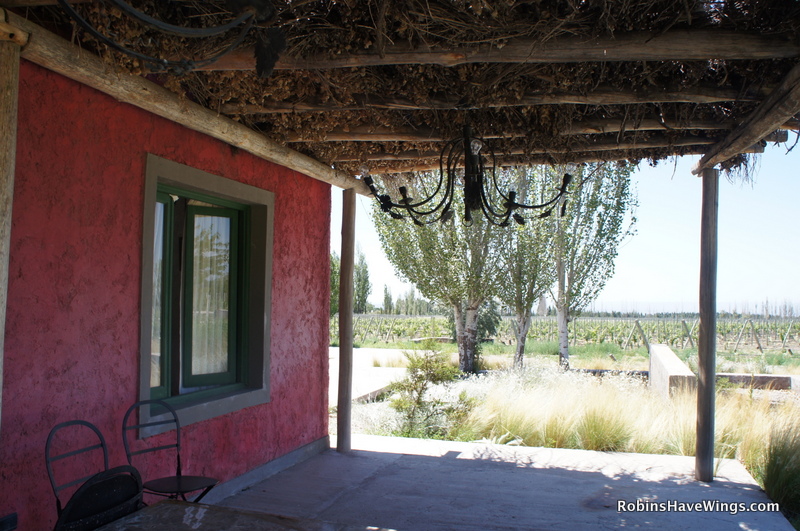
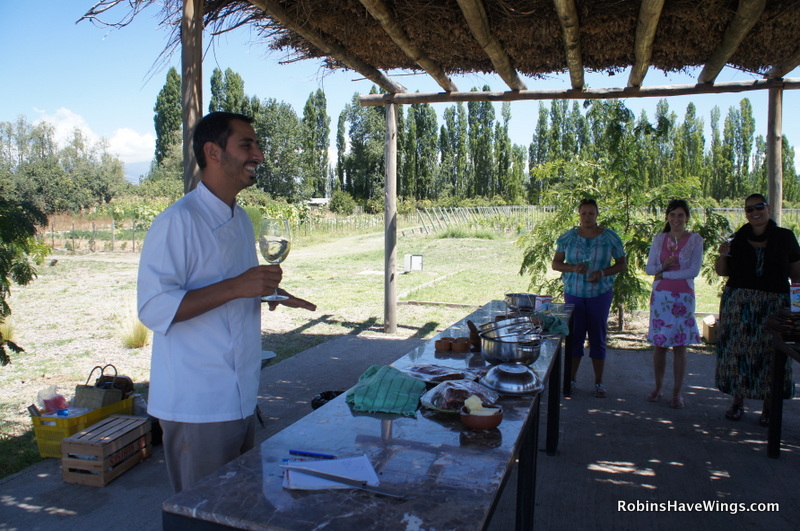
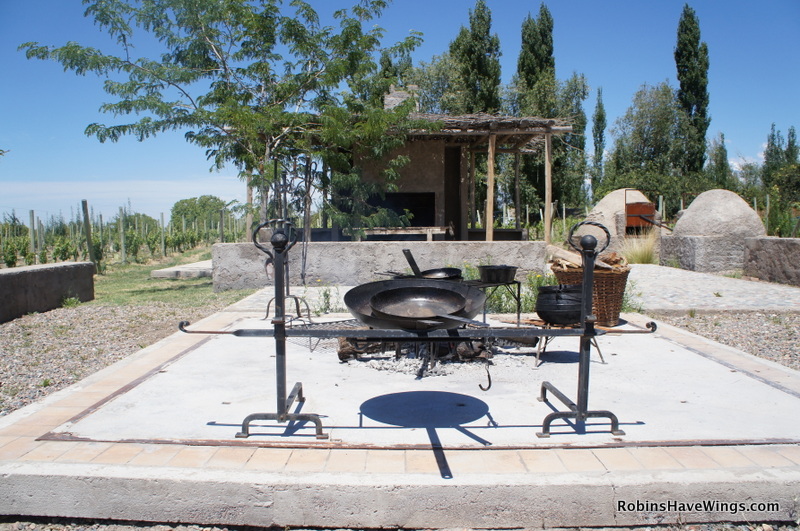
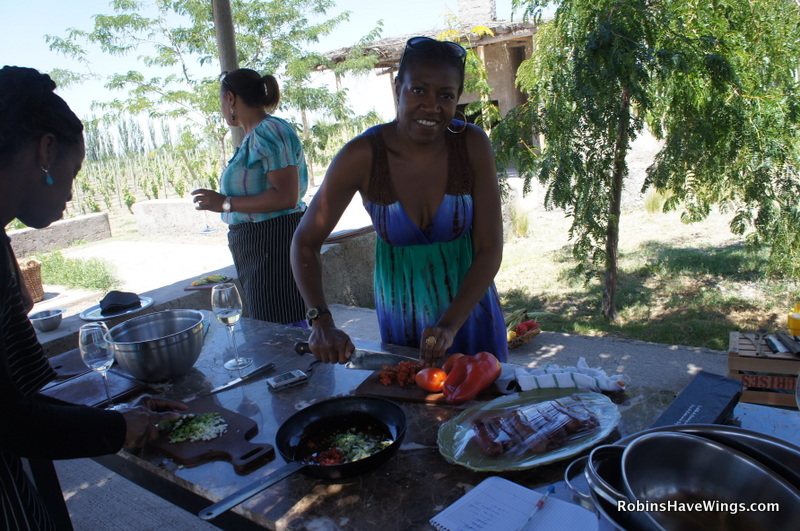
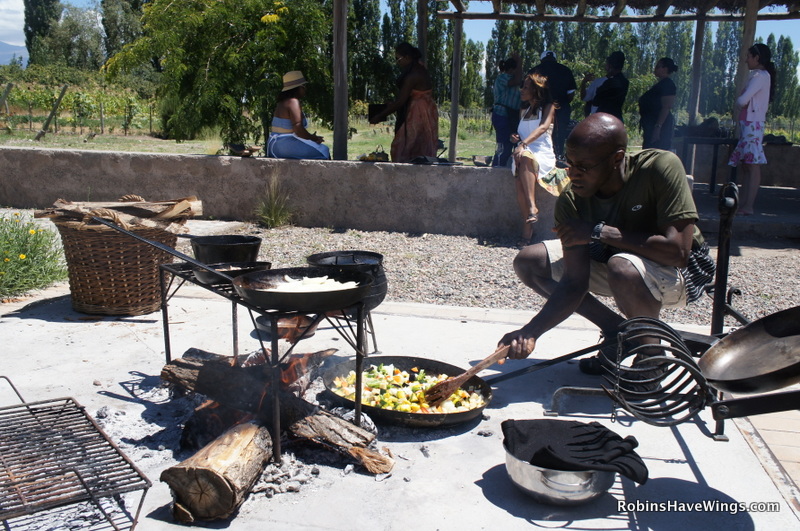
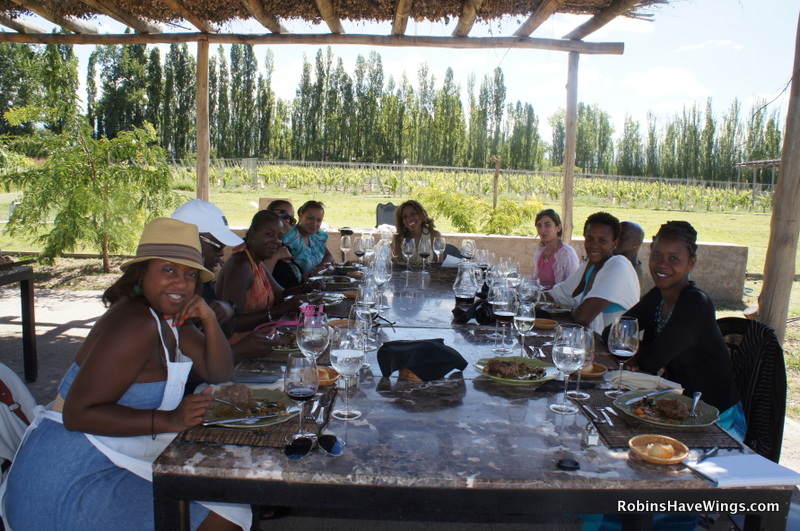
Somewhere down a very long and very, very bumpy gravel road, we find ourselves in a small mountain village called Gualtallary, named for a native chef that once ruled there. We turn into a small dirt driveway beyond a green wall to see a modest, salmon-colored stucco home with green trim. It seems to be the only house for miles on a well-farmed piece of land backed by a row of slim poplar trees and the Andes mountains. This is where we will be learning to cook just as the people who live here and the people who came before them. We immediately meet Michaela who has a quick and easy smile and runs La Tupiña Bistro, the family home turned restaurant of chef Lucas Bustos, who greets us as well. He’s in his chef’s coat just as a chef trained in French cuisine would be, but I notice that he is also wearing bombachas and alpargatas, the pants and shoes of a gaucho. A clue to his Argentinian background and formal training and a clue to the kind of cooking we’ll be doing. After having a glass of wine and meeting the staff under a shaded wooden canopy, we start to realize that we really will be getting our hands dirty. Gai says, “Oh, we aren’t play cooking, we’re really going to be cooking!” Some who have done other cooking classes may have imagined a class where you may chop a few things or toss some ingredients into a bowl while the chef does the real cooking, but that’s not what happens here. Lucas explains that every ingredient we will be using is local and grown on the farm and that we will be cooking like the locals do, everyday, with a wood fire on an open pit of hot coals.
La Tupiña BistroChef Lucas BustosThe wood-burning open pit
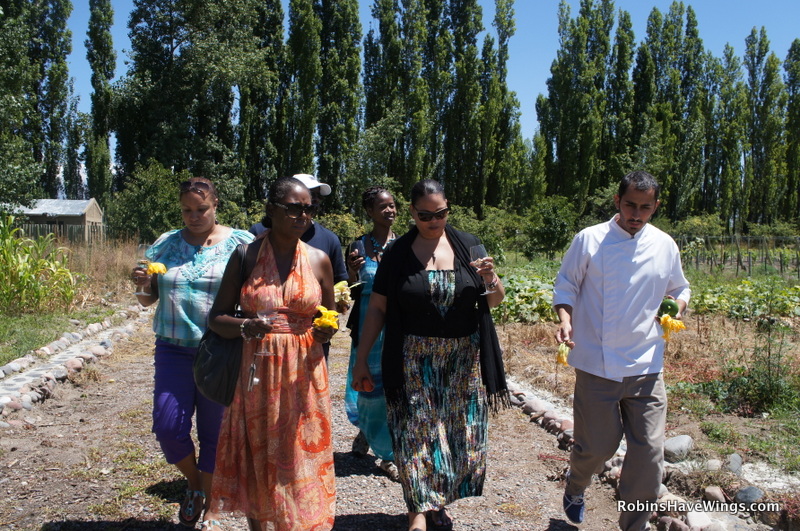
Everyone has kind of an excited “let’s do this” attitude and can’t wait to get to work. Lucas divides us into teams, some of us will work along side him and some will work alongside Michaela. We are all working on the tapas that we will have before the meal. I’m on Lucas’ team and he takes us out onto the farm to select the produce for the meal. He explains the process of keeping the soil shared by the Altus vineyard fertile; how to tell if a piece of corn is ready for picking and introduces us to squash blossoms. You can tell he is at home here in these fields, but he’s also at home feeding world leaders like Hillary Clinton. We learn that Lucas spent some time in Washington and cooked for the Clinton’s and an organization that former President Bill Clinton chaired before Hillary became Secretary of State. He raves about the Inn at Little Washington in the Washington area, which I have yet to visit and ask him if he’s been to Volt, one of my favorite restaurants. He hasn’t but says he’ll check it out the next time he’s in D.C.
Freshly picked squash blossoms
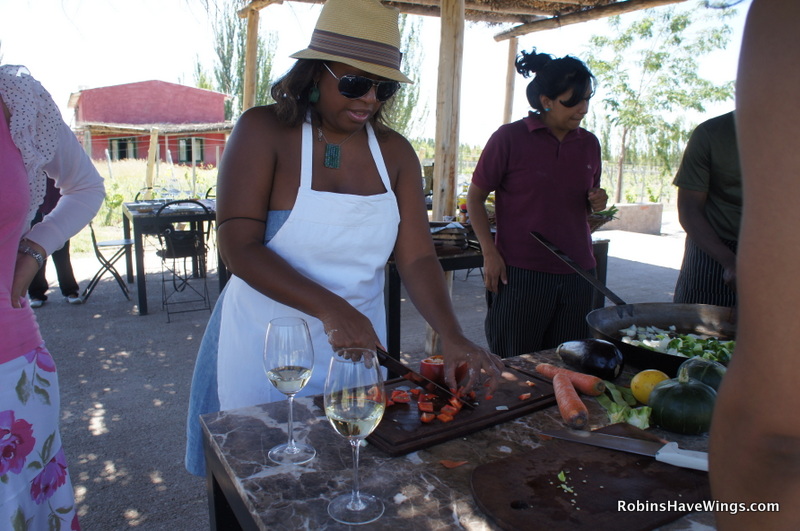
Armed with our produce, yellow and white corn, tomatoes, pumpkin and squash blossoms we return to our rustic cooking area, where Team Michaela is chopping more vegetables (carrots, zucchini, squash, peppers and onions) and putting them into a large cast iron skillet that will be placed on the fire to cook simply with salt and olive oil. Floyd chops the onions and minces meat for our empanada filling. Carmen and I chop red peppers, green onions and tomatoes for a salsa. Gia and I stuff squash blossoms with a local cheese to be dredged in a batter made with egg, flour, salt and oregano. We join Lucas near the fire and we watch him coat the blossoms and put them in a skillet of hot oil to cook until golden brown. During this process we learn more about Lucas, who tells us that after he finished training and cooking all over the world, he came back to Argentina to open a French restaurant in Buenos Aires. But he soon learned that no one was interested in French cuisine. Not the Argentinians and not the tourists who want to eat Argentinian cuisine when they arrive. So, he came to the Mendoza region where he is from to reconnect with Argentinian cooking.
Gai chopping vegCarmen and I chop veg
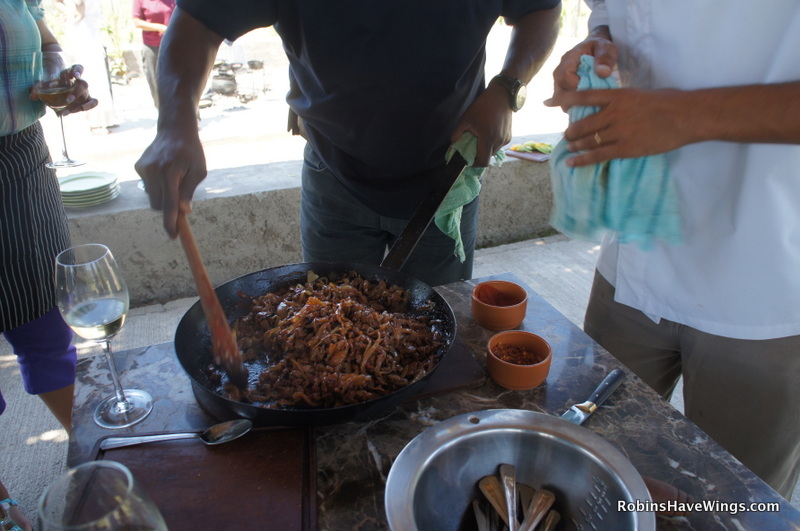
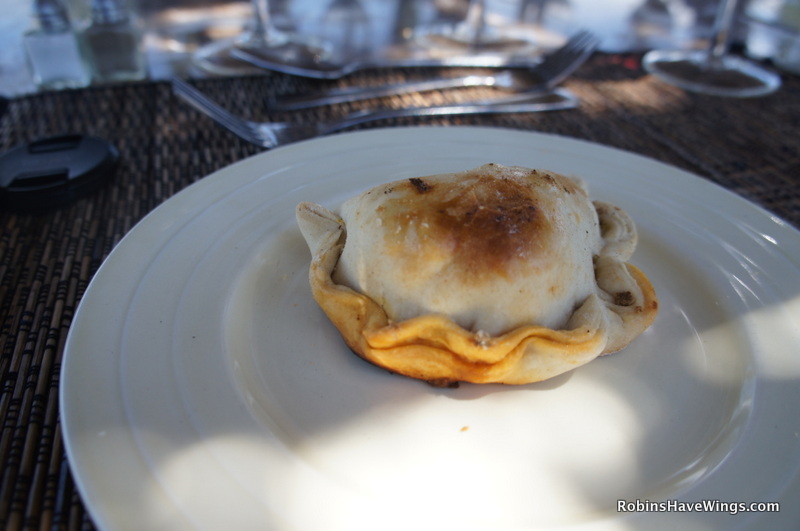
We are glad he did because those squash blossoms were delicious as was an egg scramble placed neatly back into its cracked shell for serving. Then there was the chorizo served on a flavorful twisted bread made by Team Michaela, topped with the salsa made by Team Lucas. Gai, Gia and I swoon over the taste. Gia has already declared her love for Lucas, even though he is married. And, then there were the empanadas, which Lucas shows us how to eat by folding a napkin around the bottom to keep the juicy contents from spilling out onto your clothes. Team Lucas, or rather Floyd stirred and stirred the meat, onion and lard filling until dry and Team Michaela used the mixture to stuff round flour dough shapes to make the tasty treats. The lard melts all the ingredients together while cooking to make the empanadas juicy. It’s cool to know the secret to the original hot pockets, but we are mostly proud of what we made and how good it tastes.
Floyd stirs the empanada fillingOur empanada
We don’t stop at the empanadas there is a full meal coming, including a hefty piece of beef known as “vacio.” It translates as empty, but it is definitely not that. It falls apart like stewed beef even though I’ve seen Lucas simply salt the cut of meat and lay it on a grill over a bed of coals to slow cook for about an hour. Carmen says that Lucas explained that this cut of meat can be found around the cow’s abdomen. Where ever it came from it was good and sitting on a bed of sautéed vegetables stirred and stirred by Alan who seemed not to mind the heat emanating from the nearby coals. Finally, there is desert, a small cup of a creamy dulce de leche, a kind of caramel-tasting confection loved by Argentinians, mixed with almonds, along with a slice of baked pear, piece of cheese and queen’s jelly. A queen is a fruit from the region that looks like an apple on the tree, but is inedible and must be cooked, typically into a jelly or spread.
Alan stirs the vegVascio on veg
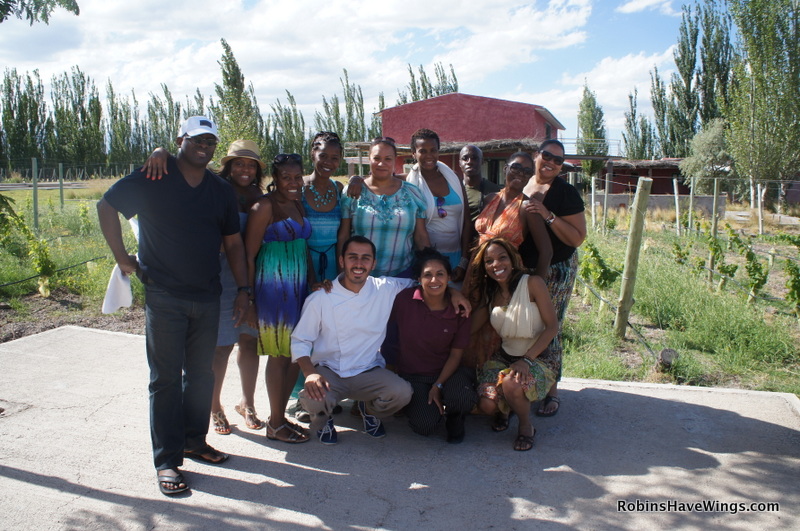
We’ve eaten and enjoyed the wines from the Altus vineyard until our stomachs say uncle. To say that we are content is an understatement. It’s been a perfect day minus the flies that were determined to dine with us. We try to express how much we’ve enjoyed the experience with words like “phenomenal” and “incredible,” again and again. Presleith says this is the best meal she’s had on the trip so far and that it reminds her of grandmother’s cooking in the Bahamas. Robyn toasts Gai for organizing such a fabulous day. But again, it’s one of those experiences that you have to have for yourself. It turns out that cooking together forms a bond, too. Not just amongst our group but with Lucas, Michaela and the wonderful people we met at La Tupiña Bistro. We won’t soon forget them or the meal that we shared.
Contented travelersOur friends at La Tupiña en Gualtallary
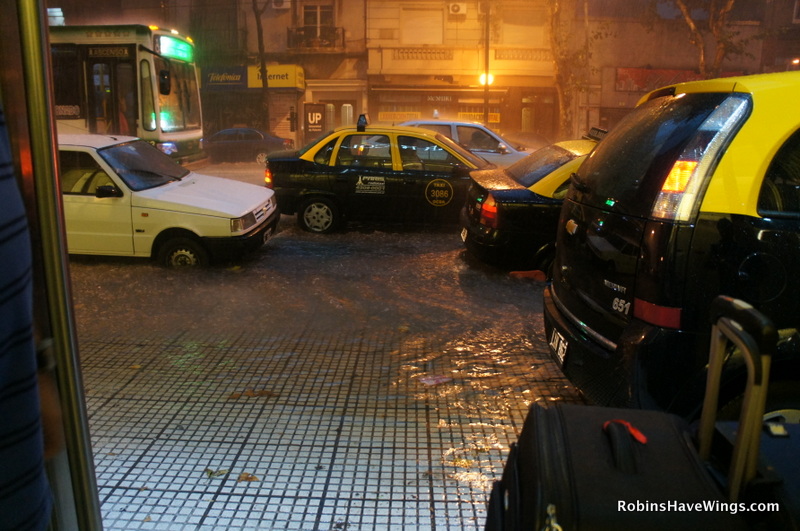
Actually, funny probably isn’t the right word, freak might be better. Our trip was rudely interrupted the other night by a freak flash flood that created a fast-moving surge of water down the street in front of our hotel, just as we were planning to leave for a tango lesson and show.
Water rising outside the Dazzler Towers Recoletta
The surge didn’t stop at the street, it forced its way into our hotel lobby sending guests scurrying in every direction. This video pretty much captures the scene.
What strikes me in this video is that folks are surprisingly calm and I have to say the members of our traveling party were pretty calm, too. Dressed in our tango show finest, we went to check that our belongings hadn’t been drenched in our rooms, using the stairs since we heard what we thought was water rushing down the elevator shaft. Seeing that all was well at the moment, we regrouped and Gai told us that she was going to work on getting us out of the hotel as soon as possible. We’d reschedule the tango show for another time. She sent us upstairs to pack while she worked on our exit strategy. We had already planned to leave the Dazzler Tower Recoleta ahead of schedule because of a day-and-half-long power outage. So, we packed in almost total darkness leaving our doors open to get light from the hallways which were still well lit.
The process of getting 10 people out of one hotel into another on short notice during a unpredictable weather event at the start of carnival season in Buenos Aires on a Sunday night is more than a notion. Gai who happened to be the calmest of all of us reminded us that there is always what she calls an “X factor” in travel, the thing that you never thought would happen until it does. If you are a seasoned traveler like many of us on this tour, you know that you kind of have to go with the flow, in this case literally. She also said this is another good reason to have trip insurance. I bought some for the first time on my trip to Thailand through WorldNomads.com and I’m glad that I had the presence of mind to get some for this trip, too. You can bet I won’t travel without it from this point forward.
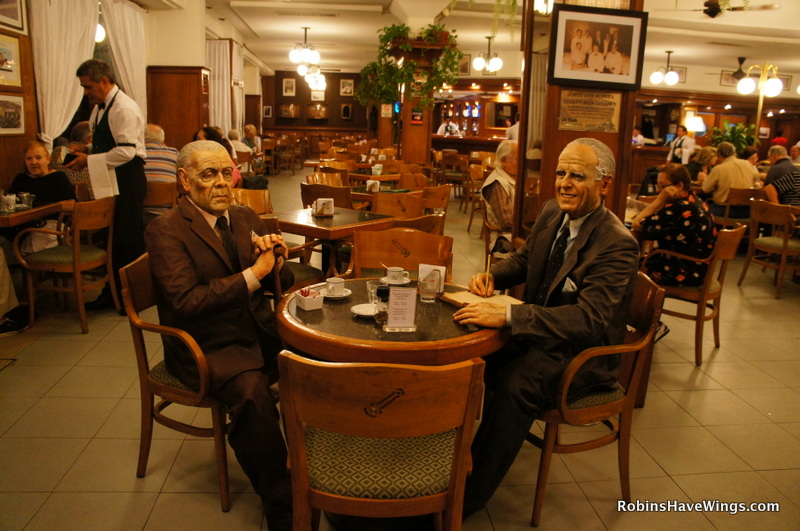
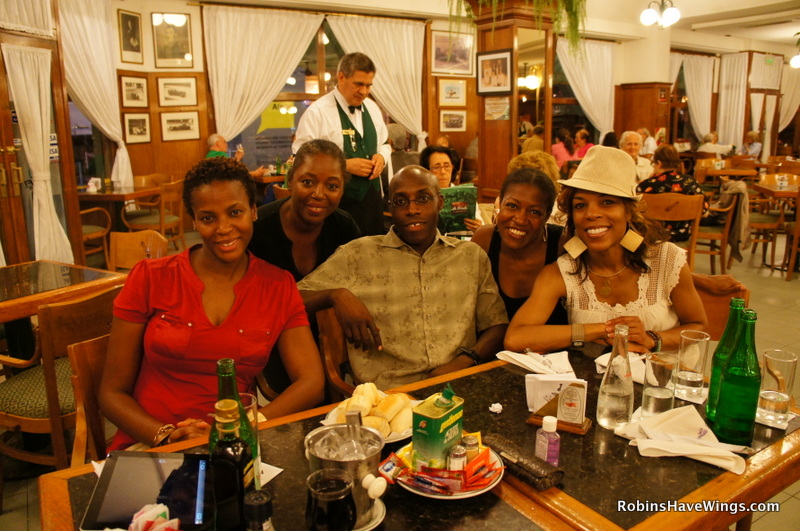
Seeing as there wasn’t much use in sitting around in a soggy hotel during the rebooking process, Gai sent us off to dinner. We chose a place that Lonely Planet calls an institution in the Recoletta neighborhood, La Biela. Sitting directly behind the Cemetario de Recoletta, La Biela definitely looks like a neighborhood institution, the place generations and generations of Buenos Aires residents have been going to for good food and familiar faces. No one in the place looked to be under 65 for starters and a waiter in a green vest with a towel hanging over his right forearm greets us immediately. An older woman seated by the window catches my eye and asks in Spanish if we are Colombian. That’s a new one for us. We’ve been mistaken for Brazilians during our trip so far. I tell her where we are from and ask what’s up with the statues of two men seated at a table nearby. They are famed Argentinian writers and friends Jorge Louis Borges and Adolfo Bioy Cesares, who dined here along with other important and upper class Argentinians known as portenas. My new friend offers to take a photo and tells me that she is very pleased to me meet. I like this place already. It turns out to be a great place to take our mind off our unfortunate travel circumstances and enjoy some good food.
Borges and Cesares always dine at La BielaLa Biela makes us feel like locals
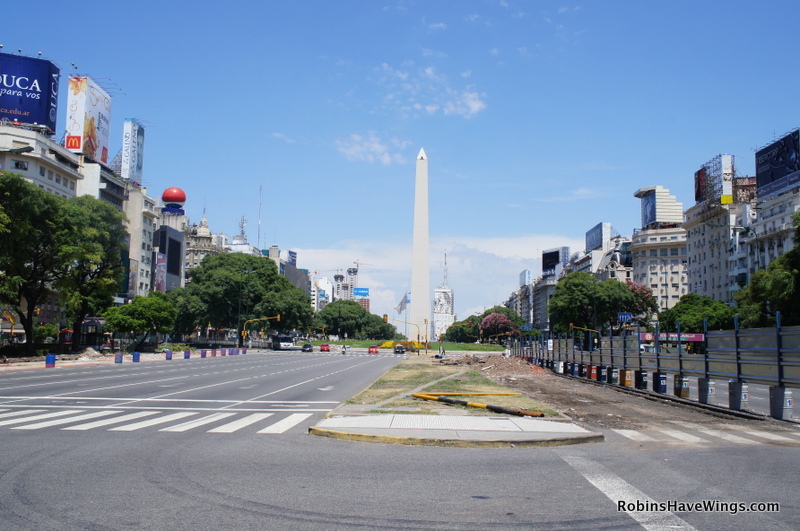
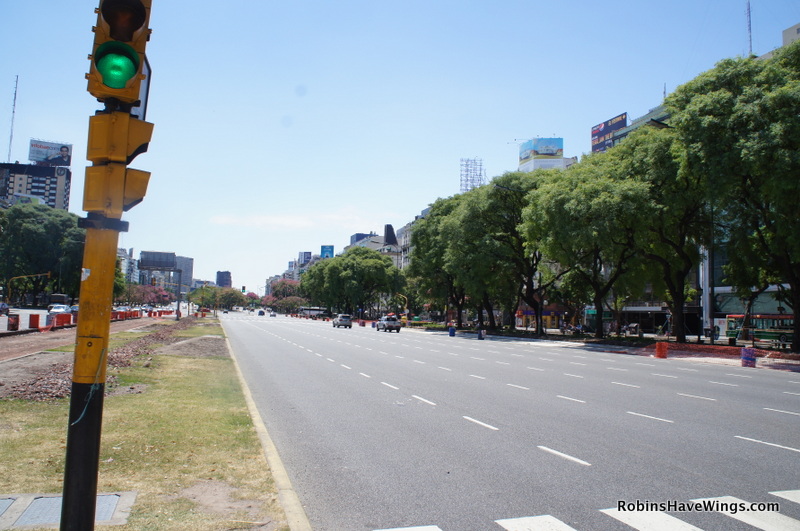
Before our travels were so rudely interrupted, the group split up to explore the city on our own. Kenitra, Sheneekra and I decide to leisurely walk to San Telmo’s well-known Sunday market from our hotel. At first the journey is pretty unremarkable as we pass through what looks like the Buenos Aires business district. All the shops are closed and there is almost no foot traffic. But I’m excited with we reach Avenido 9 de Julio, the widest avenue in the world, commemorating Argentina’s independence from Span with 9 lanes of traffic. You don’t realize house massive the street is until you are standing on its center median watching traffic whiz by on either side of you. If you are a pedestrian who likes to dart across the street to beat the traffic, you’d be toast here. If you don’t have the slightest clue where your are going when you are driving, you may want to avoid the street, too. We saw a taxi turn too soon almost running into oncoming traffic. He realized his error, quickly self-corrected and took off in the right direction. (By the way, we’d later learn from our guide, Luis, that this grand thoroughfare was completely submerged by the flash flood, too.)
That obelisk on the widest avenue in the world looks mighty familiarDon’t try crossing without waiting for the walk sign here
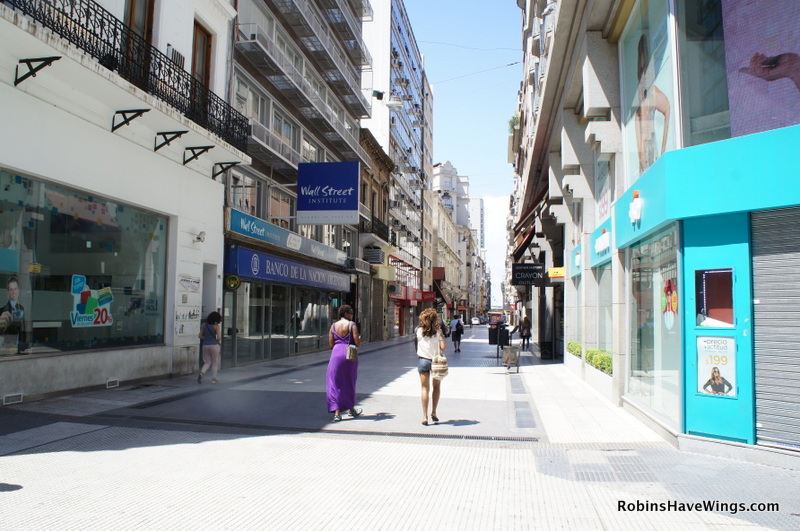
Off 9 de Julio, we wandered upon Lavalle Street a narrow pedestrian-friendly shopping street. It’s heard to describe. I’d call it oddly interesting. The shops were a miss mash of cheap clothing stores, record stores, restaurants and movie theaters. It was clear that this is where the locals come on a Sunday afternoon. There was also a huge bingo hall that looked like it belonged in old Vegas. But the street itself was interesting to us because it seemed to offer good photo ops with is narrow-tunnel like appearance sandwiched between tall buildings.
Sheneekra and Kenitra explore along Lavalle
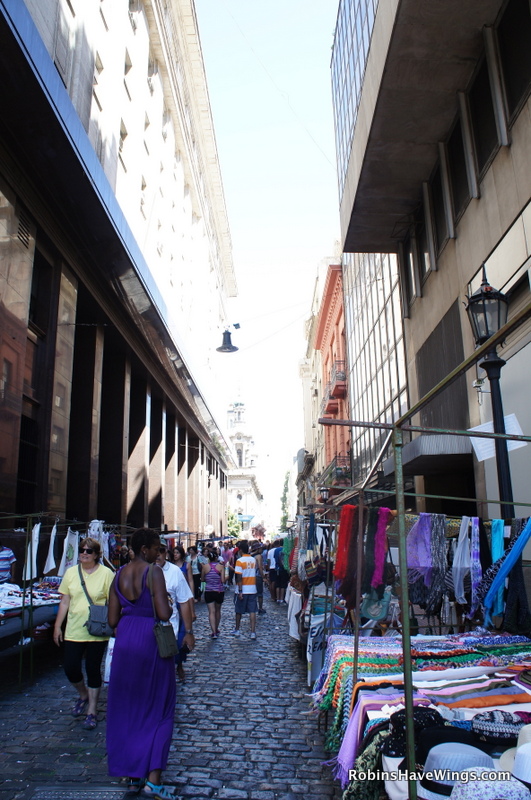
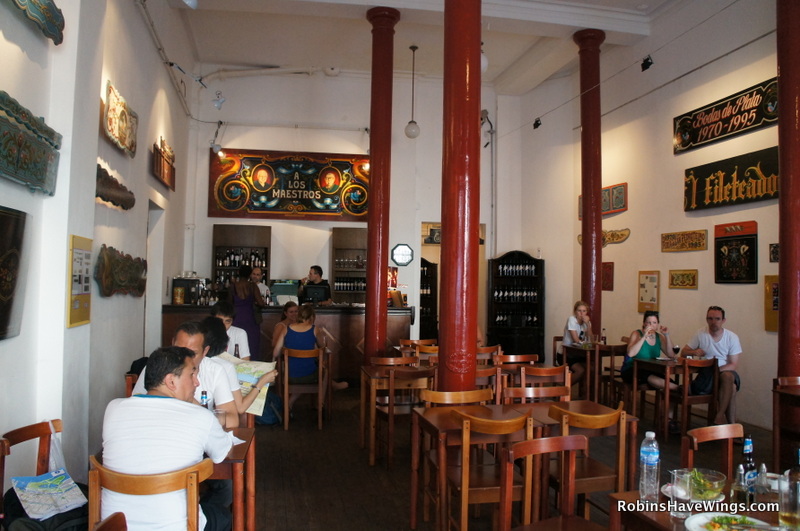
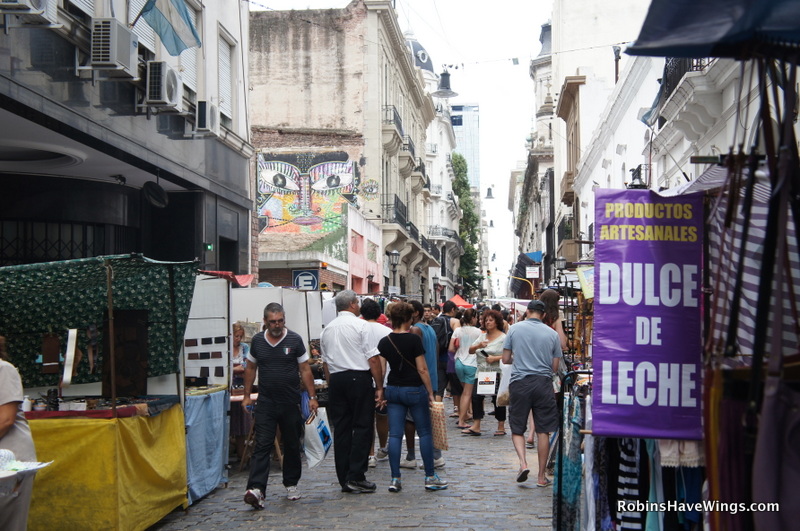
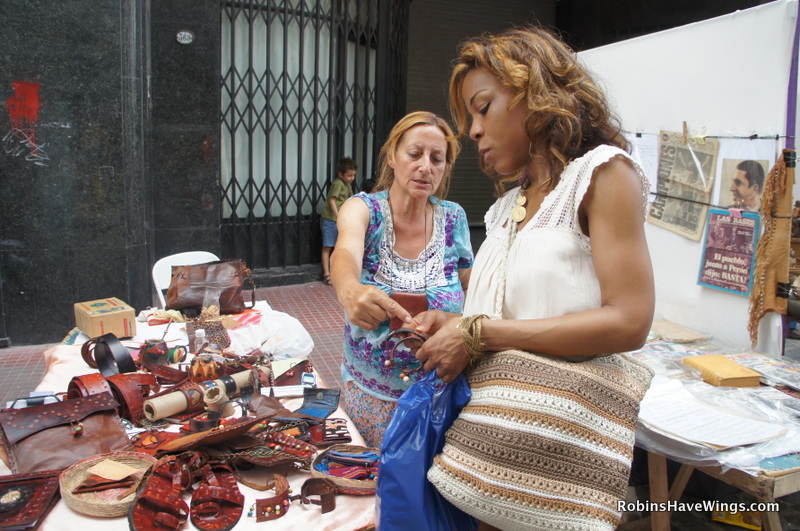
We hit another stretch of uninteresting road on Leandro N. Alem until we make it to Casa Rosada, where Argentina’s president, Cristina Fernandez de Kirchner, conducts all her business. By this time we’ve been walking for a couple of hours, we are hot, thirsty and not sure how far we have left to go to get to the market. We imagine it’s more blocks that we want to walk until we ask a police officer where Defensa is, thinking we’ll need to catch a cab from there. As we walk a short block down Defensa we realize, to our relief, that we are the start of the market. It’s sidewalk is almost invisible, taken over by vendors and artisans of all sorts selling Argentinian crafts from jewelry and leather work to art and antiques. But before we can dive in we have to eat. I spot a really cute restaurant just across from the Convento de San Francisco called Museo de Filete. It’s got a modern yet traditional feel and it is here that I decide to try milanesa, a popular Argentinian dish, very similar to chicken-fried steak where the meat is pounded out and fried. It’s pretty good and I ask for my new favorite condiment, chimichurri to go with it.
The San Telmo marketMuseo de Filete is a convenient and tasty stop in San TelmoSan Telmo is the place to be on a Sunday afternoon in Buenos Aires
During the rest of our shopping adventures in San Telmo we’d learn several important helpful Buenos Aires travel tips:
1. You can use American dollars in Buenos Aires at some places, but especially at the market where the dollar is worth more than the peso and vendors can exchange dollars for the peso on the black market at a 6 percent rate. If you bring dollars you can get the same exchange rate if you need pesos and know the right people.
2. If you plan to use pesos, make sure they are crisp bills with no marks or tears. Kenitra tried on a couple of occasions to pay for souvenirs with dollars and vendors wouldn’t accept her torn bills. The vendors can’t easily trade marked bills on the black market. Even when she did pay with a pristine bill the vendor ran a couple of stalls down from her stall to have some guy check to make sure it wasn’t counterfeit.
This vendor checked to make sure Kenitra’s American dollars weren’t counterfeit
3. Possibly the most important tip of all is to wear your purse across your shoulder and in front of you at all times because San Telmo is notorious for pick pockets as the locals will happily tell you. Presleith was accosted by two men who she thought were out to get her bag. But they were only very eager to tell her the proper way to wear her purse. As Kenitra brought a pair of earrings, the vendor practically scolded her for wearing her bag loosely on her shoulder.
So, to recap, what important travel lessons have you learned in today’s blog post? Tell me in the comments and add your own.