Leaving England: Llama Talk and a Fete

Helen’s neighbor Susan is ebullient. She bursts forth with conversation like a shaken carbonated water. The Brits call it fizzy water, except Susan is not British, she is Canadian. We’ve joined her and her family for dinner to celebrate her niece Megan’s master’s degree in archeology from Oxford. Susan pops in on topics from American politics (She’s afraid of a possible President Sarah Palin) to her wacky in-laws, who actually happened to be dining with us. Cousins on her husband’s side of the family are llama whisperers of sorts and train 8 llamas and an alpaca, which have been taught to jump through hoops and do other odd tricks. Sadly, the llamas have stage fright, so no taking them on the road.

I am back in Oxford and Ugo has come along to see another part of England. After a few hours of navigating the streets of Oxford crawling with tourists and doing a bit of shopping, we enjoy an entertaining evening with Susan and family. Her brother-in-law’s name is Robert, but the family calls him Robin for short. We dine on the delicious pub food at Helen’s neighborhood pub, the Anchor, and wish Megan well on the next stage of her life. Susan is still bubbling with conversation and invites us back to her house to see what an original Victorian home looks like. She is proud that her home maintains its original footprint in stark contrast to Helen’s landlord’s home, which caused a stir in the neighborhood with the addition of a pvc pipe and plastic porch construction or monstrosity, if you ask Susan. She is somewhat of a neighborhood historian and tells us that Hayfield Road was where Oxford’s poor lived. Susan’s home has two of the original fireplaces that would have been in each room of the house and the french doors in her living room overlook a narrow 18-foot yard where families would have kept their pigs and chickens. Susan’s yard boasts two bushy trees bending with apples and other flora. We chat late into the evening about books, being a working woman in the 1960’s and having the freedom to choose your career path in 2011.

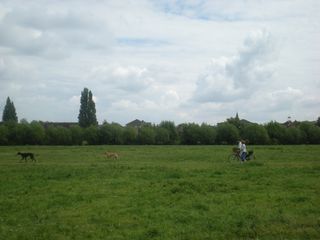
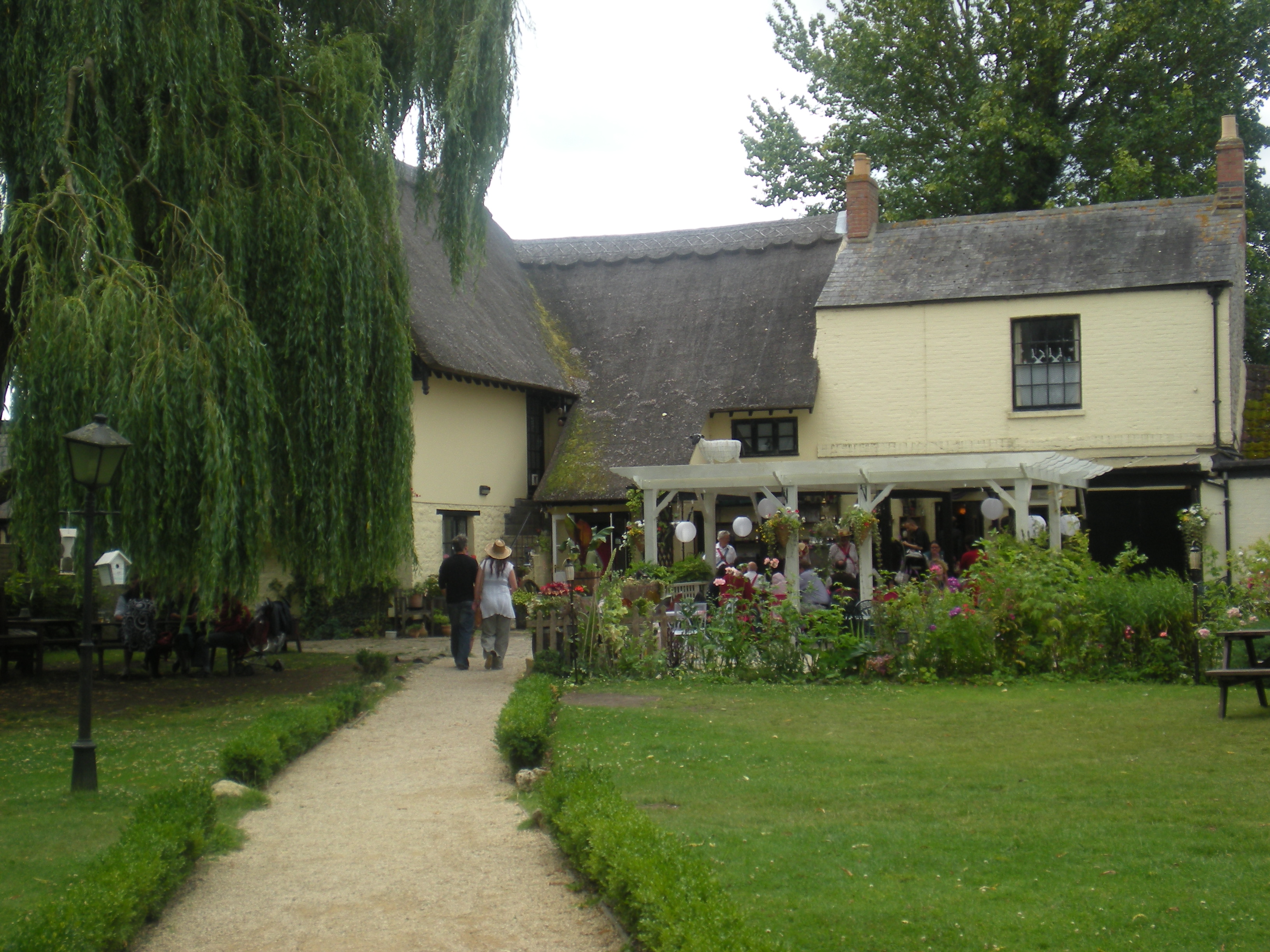
The next morning Ugo heads back London and Helen and I embark upon another pub walk, this time to  to The Perch. It is a mere 25-minute walk through Port Meadow in comparison to the hour-long trek to The Trout the week prior. Port Meadow is still scenic. This time we see more fishermen and horses than cows along the way. But what is really beautiful is the pathway to The Perch, lined with trees and vined greenery. It seems that we could be walking in an enchanted forest and The Perch magically appears before us, a rustic hutch surrounded by picnic tables. It looks to be the perfect place for Lewis Carroll to perform his first reading of “Through the Looking Glass” per local lore. Inside, The Perch is still rustic but quite sophisticated as we are greeted by a well-dressed, pony-tailed maitre’d. Helen and I decide on the Lazy Sunday Lunch, because, well, it’s a lazy Sunday. She has a deconstructed nicoise salad as her starter and I have the gazpacho, which is smoothly pureed and refreshing. We both opted for the pork roast as our main course and could barely finish the savory meat and perfectly roasted vegetables, which were the true stars of the meal.

After capping the meal with espresso and coffee Helen spots an Oxford colleague and fellow Swarthmore grad named Tia who specializes in Chinese political science. We go out to the garden and meet her husband Tom also a Swarthmorean. They are having beers with a few other Oxford academics, a typical Sunday activity. We move on to check out the Binsey Fete. We saw signs for it along our walk and decided not to miss this bit of local culture. The Brits have eschewed the French pronunciation of fete for something that sounds like fate or fait. We aren’t sure why. The Binsey Fete was akin to something like a country fair meets a neighborhood block party in an open field. There were moon bounces which they call bouncy houses, tractor rides, bales of hay for climbing and you could guess the prized chicken. Each chicken was inventively named making it hard to choose. Kate and Naomi were named for the models, a mohawked chick was named for Sid Vicious and an aging but impressive chicken was named for Methuselah. But the thing that gave this party its truly British feel were the Morris dancers. They were young and old, tall and stout, male and female and each had a spring in their step. Bells attached to their calves jangled as they waved white kerchiefs in the air. Helen didn’t quite know the origins of this quirky tradition, but according to Wikipedia, if you count it as a reliable source, Morris dance may have originated in Spain as a dance celebrating the defeat of the Moors. Moorish may have evolved to Morris and is now a traditional British dance performed on holidays like May Day and the day after Christmas. Whatever its origins, it is proof that Brits can be sprightly and spry at times, particularly when silver mugs full of beer are involved. I think it’s the perfect way to end my time in England, seeing and experiencing something so authentically British. I wonder what surprises Denmark holds. I look forward to finding out.

Place Where the Cows Cross the River

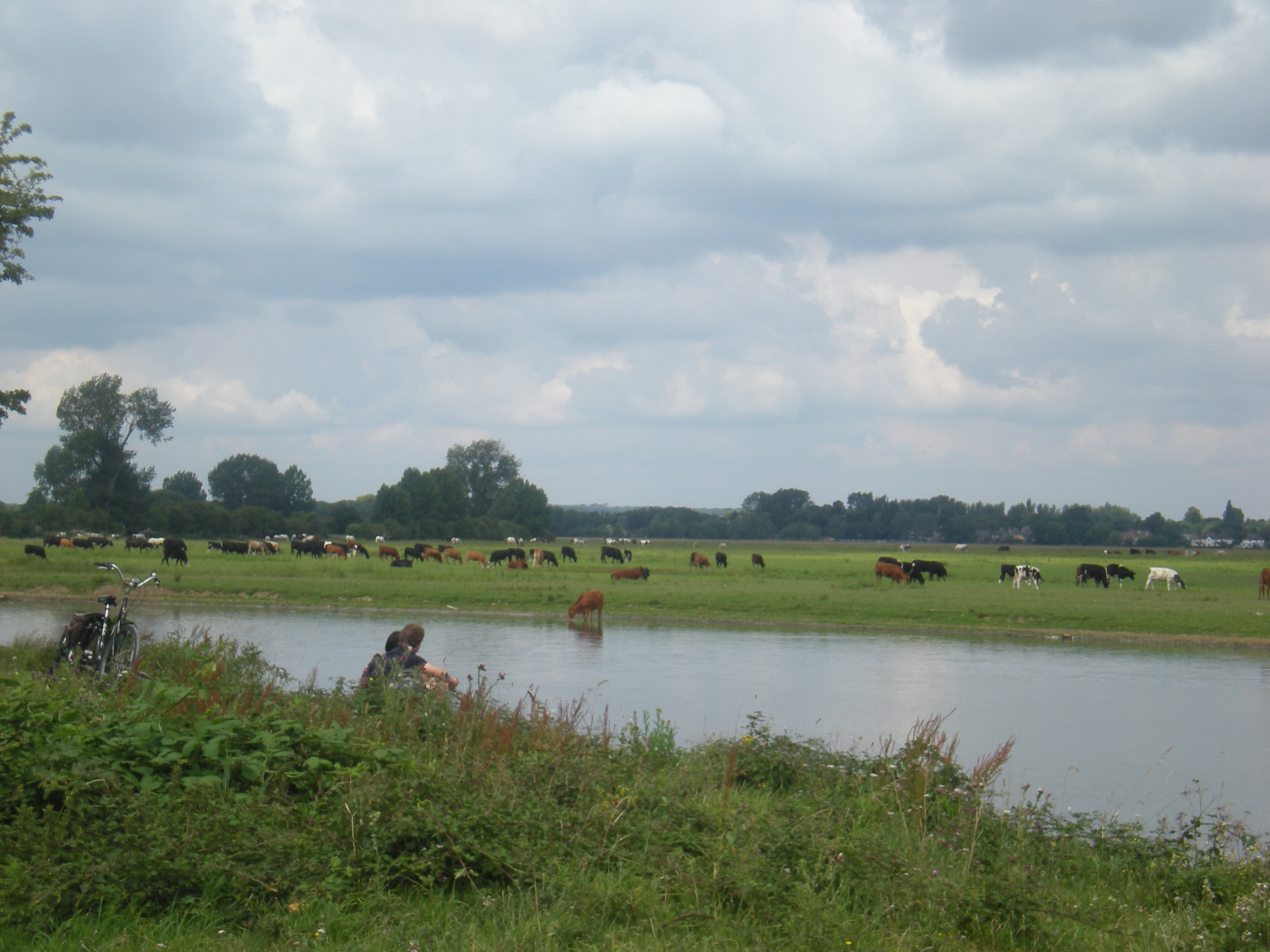
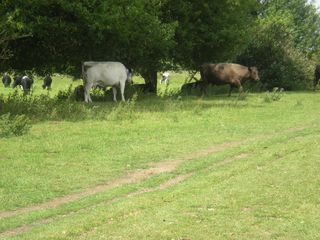
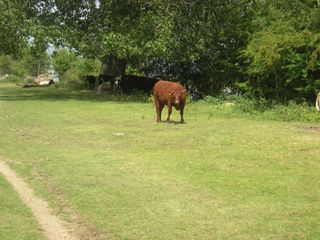
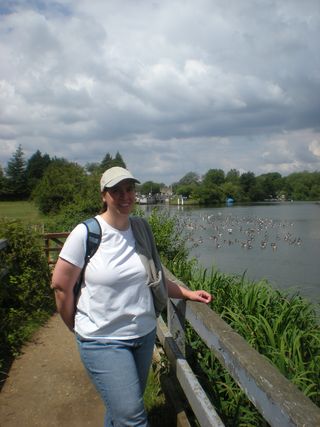
We are in the process of walking through a herd of cows when Helen mentions Oxford’s etymological origins. Oxford means literally ox fjord or ox passage way. It makes sense in the current situation. She also says the cows won’t bother us if we don’t bother them. I just take a photo or two or three. I’ve never walked through a herd of cows before and it’s pretty smelly as you might imagine. We are again doing something very British and taking a walk through Oxford’s Port Meadow on our way to a proper British lunch at The Trout. We’ve already passed another cow gathering on the other side of the Thames, two women who seemed to be fine with being surrounded by a gaggle of geese and a man with a piece of grass in his mouth like an old Huck Finn. It is the most beautiful day of my stay in England by far and I’m overdressed. You just never know how to prepare for the weather, so you over prepare. I’m wearing a scarf, black long-sleeved shirt and and a thin black jacket during what appears to be a heat wave. I wore a scarf and a jean jacket yesterday and kept my umbrella half open to ward off intermittent rain showers.
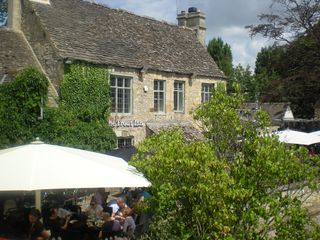
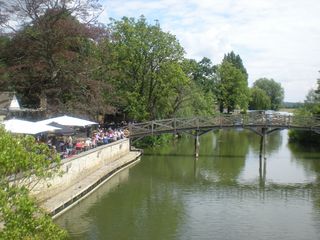
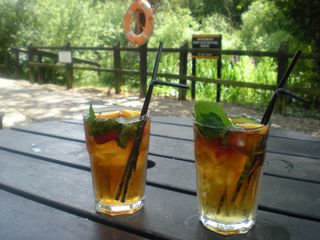
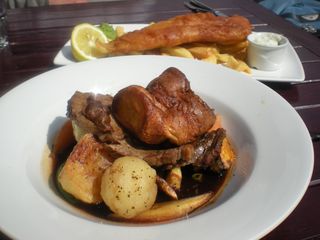
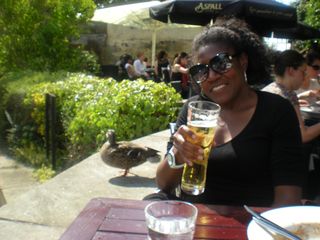
 After successfully walking through a herd of cows without incident, we continue along the Thames as Brits breeze by on bikes and paddle past in canoes on a gorgeous Sunday. When we reach The Trout, it’s an oasis of umbrellas with mellow happy Brits under them. I look forward to joining them. We start with a refreshing Pimms on the patio overlooking the Thames. This time I get a picture of the fruit-filled beverage. Helen and I just take in the lovely day and when we get to our table we order traditional British dishes, fish and chips for Helen and beef rib roast with Yorkshire pudding, also known as pub roast, for me. There is a lively group of women sitting behind us. Their conversation ranges from eHarmony to a date with a DJ who was cute but as short as a midget. I am reminded of an episode of “Sex in the City.” As we wait for our dishes, a very bold duck visits the diners from time to time, eyeing each patron and table for tasty scraps. He even lingers at our table for a bit in a staring contest. Luckily, we’d finished our appetizer of bread, olives and vinegar and oil. When our main meal comes, it looks amazing. Helen’s fish is perfectly battered and golden brown. A fluffy puff pastry, which is also known as pudding, sits atop juicy slices of beef, covering roasted parsnips, carrots, cauliflower and broccoli with golden potatoes that taste like they’ve been roasted in apple juice. Gold star for The Trout.
 

Churchill’s Palace of Wonders

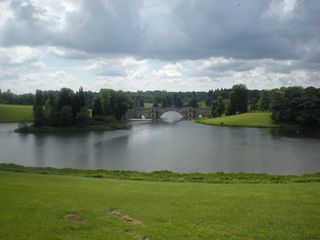
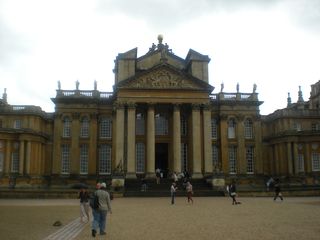
Blenheim Palace grandly emerges from a cluster of verdant trees. Its amber walls appear to glisten in the English sunlight. Helen has recommended that we enter the back gate of the palace for just this view. It is stunning. To the right of the palace is a great stone bridge crossing a serene lake with ducks and swans lazily paddling past. We make our way across lush, yet closely cropped grass to the main entrance just beyond rows of tour buses which mar the reverie that one could be approaching the palace on important business. It’s still pretty grand though.

 

Blenheim Palace is the home of the current Duke of Marlborough, the 11th of a long line dukes carrying the same title, and was most notably the birthplace of Winston Churchill. In 1705, the first Duke of Marlborough, Sir John Churchill, a distant cousin of Winston, was given the property and funds to build a palace by Queen Anne after winning a crucial battle at Blenheim. A copy of the note that he wrote to the queen announcing his victory is on display in one of the many ornate state rooms. It was written on the back of a pub bill. The tapestries in that same state room tell the story of the victorious battle. A 110-pound silver centerpiece in the Salon shows the duke riding on his horse on the way to share his news with the queen. An American, and a Vanderbilt to boot, was a Duchess of Marborough in the 1940s. Her portrait appears throughout the house and in one of the state rooms is a carved golden bassinet, a replica of one that her mother saw in an Italian museum and insisted that her grandson sleep in something similar. Just down the hallway is the room where Churchill was born and exhibit featuring his letters, writings, family portraits and his water paintings. Did you know that his art has been featured on Hallmark Cards? Me, neither. I love learning random facts like that, which made this an enjoyable tour. The tour guide looked like he could have been one of the previous dukes, old and stately. One of the most impressive rooms inside the home was the library, said to be the second longest library in a private home in the UK. Not a bad statistic when you can also boast that you have the largest organ in a private home in that same library. It’s a large grey pipe organ sitting at the opposite end of the library from a marble statue of Queen Anne. Also, in the room are photos of past presidents and dignitaries who have visited Blenheim like Ronald Reagan and Bill Clinton, along with clear signs that a duke lives there such as an invitation to the wedding of Charles and Diana.

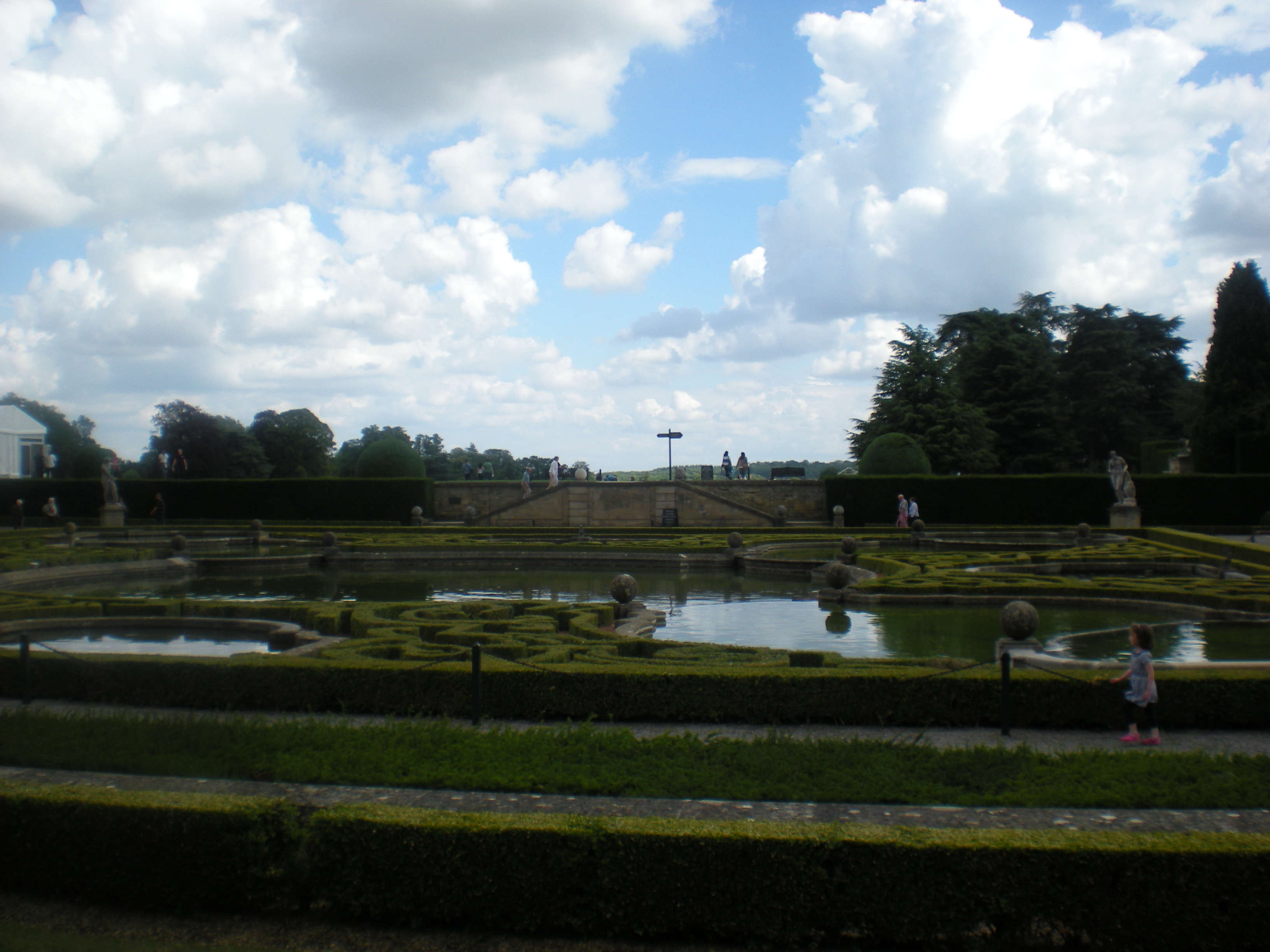
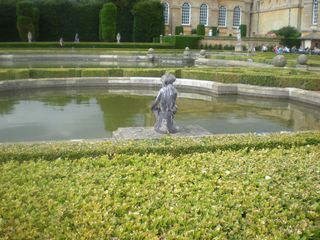
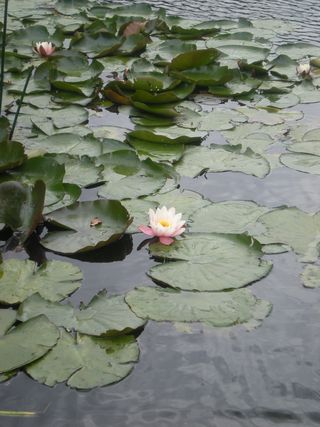
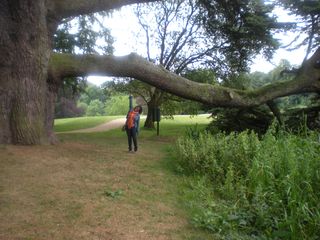
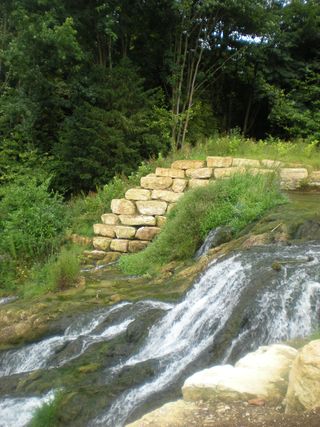
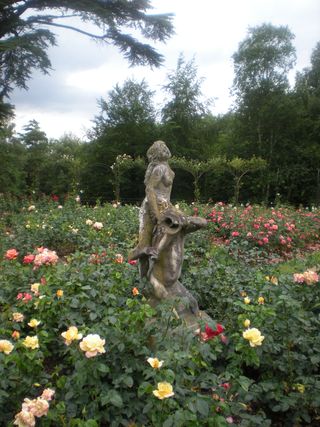
And, as impressive as the inside of the palace is, the outside is even more so with gorgeous grounds and gardens. Helen and I decide to take a walk, a common British past-time, and plenty of others have the same idea. Apparently, locals like to spend their weekends at the palace, packing a picnic or just strolling its paths. We start at the Water Terraces at the back of the palace where little cherubs balance on the edge of still pools lined with precisely cut bushes. It’s the perfect day for a walk and we need to walk off the bacon sandwiches and cream tea that we had for lunch earlier. It is cool with a slight breeze and moments of brilliant sunshine. We walk along the lake and spot an interesting tree with a sturdy low hanging branch and wonder how it grew without snapping. We stop to take photos of dainty waterlilies a few steps away, then walk on to pass a water cascade and into a beautiful rose garden with at least 10 varieties of roses ranging in color from coral to red and yellow to white.


elen and I could have spent even more time exploring the grounds, but we had to make our way back to Oxford to meet one of Helen’s friends for dinner. On the 25-minute bus ride from Woodstock back to Oxford we sat in the front row at the top of the double-decker bus for a fun view of a poppy field and a plane flying into the Oxford airport. Our first stop in Oxford was the Turf Tavern, apparently the place to stop for a beer in Oxford. We enter through a narrow cobblestone alley way and find ourselves in a crowed courtyard of rosy-faced students, older academics and familes with kids. We can’t find a seat outside, so we duck inside the stone-walled pub with low ceilings and mismatched wood furniture and banquettes. We finally find a spot to sit and save a spot for Helen’s friend Duncan, a writer for Newsweek, covering China. Helen sends me off to get some beers and while at the bar, I remember that she said that I had to have a Pimms, so I order one and get a cider for Helen. The Pimms is my new favorite drink. I failed to take a picture of one because I liked it so much. Basically, it is gin-based liquor, reddish in color, mixed with ginger ale and garnished with fruits and some vegetables. Mine had oranges, apples and cucumbers. It was so refreshing and delicious.

Duncan arrived with a ginger beer and snacked on potato chips, or crisps as they are called here, a common thing to do while having a beer in a pub. We started talking immediately about the journalism news of the week–the shutdown of the News of the World, Britain’s largest tabloid paper owned by Rupert Murdoch. NoW, as it is called, was at the center of a wiretapping scandal, alledgely tapping phones of celebrities, soldiers and missing children, in order to get private details and the first scoop on big stories. The scandal even touched the prime minister’s spokesperson, a former editor. Duncan and other British journalists suspect that Murdoch shotdown the paper to take any heat off his son in top management at the paper. We went on to talk about Weiner-gate and other topics surrounding the sad state of journalism before we all made our way to a quaint Bengali restaurant. We dined on mildly spiced chicken and lamb dishes as the conversation turned to China’s desperate desire to become more modern at the expense of its amazing ancient cultural architecture with skyscrapers and malls replacing gardens and old homes.We also laugh at ridiculously translated signs that we encountered while visiting China. Duncan recalls a sign on a drink vending machine recently, which was loosely translated into English: Don’t share cans unless you are lovers. Before we know it, it is almost midnight and we part ways on a clear, cool and pleasant evening. Honeysuckle blooms perfume our slow stroll home.


Smarty Pants on Parade

There are lots of smart people hanging around Oxford, in case you didn’t know. The place is lousy with them–the confidently smart, the unassumingly smart, the old and smart, the young and smart. My friend Helen is one of these smart people. She has just written a book, “Keeping the Nation’s House: Domestic Management and the Making of Modern China,” on the role of women and home economics in forming modern-day China. She’s a tenured Chinese history professor at Virginia Tech University and she’s a research associate for one of the leading academics on Chinese history. This is how I come to attend a lecture on western journalists covering China. It interests me too, given my journalism background. The panel is made up of two journalists and two academics who discuss the challenges of covering China accurately and trying to avoid spreading stereotypes about the nation and its people. Covering any topic honestly and accurately is the goal of any journalist, but covering a place as complex and with a history as vast as China’s appears to be particulary difficult, and few do it well, according to this panel. We are in a room full of equally smart undergraduate and graduate students from China who ask all the questions we want to ask and crowd the panelists as if they are rock stars once the lecture is over.

After the lecture, Helen and I join her equally accomplished friends and colleagues for Sichuan Chinese food in an building that looks like a lecture hall called The Old School. Her friends Amy, Jen, and Lily share her interest in China and they order from the menu in fluent Chinese. It is impressive and an impressive array of food arrives at our table. It is all spicy and delicious and we cool our mouths with Tsingtao beers.

It’s the end of a day full of marveling at the history smart people at Oxford. Earlier, I went to the Ashmolean, the oldest public museum in the UK, chock full of artifacts from early European, Asian and Middle Eastern cultures. I was stopped by Powhatan’s Mantle. Powhatan was the chief of the Powhatans when John Smith arrived at Jamestown. There is debate as to whether or not Powhatan’s mantle was a cloak or a wall hanging, but it reminded me of Aboriginal art, circles of beads surrounded beaded images of two animals, maybe deer, on either side of a man. The museum did a great job of linking the intersection of cultures, art and religion through trade and wars that brought these diverse peoples in contact. It’s why Spanish tiles look like Morrocan tiles, which also look like Turkish tiles. I couldn’t make it though the entire four floors of the collection. I found myself practically running though the exhibit rooms before I had to meet Helen for lunch in the museum’s cafe.

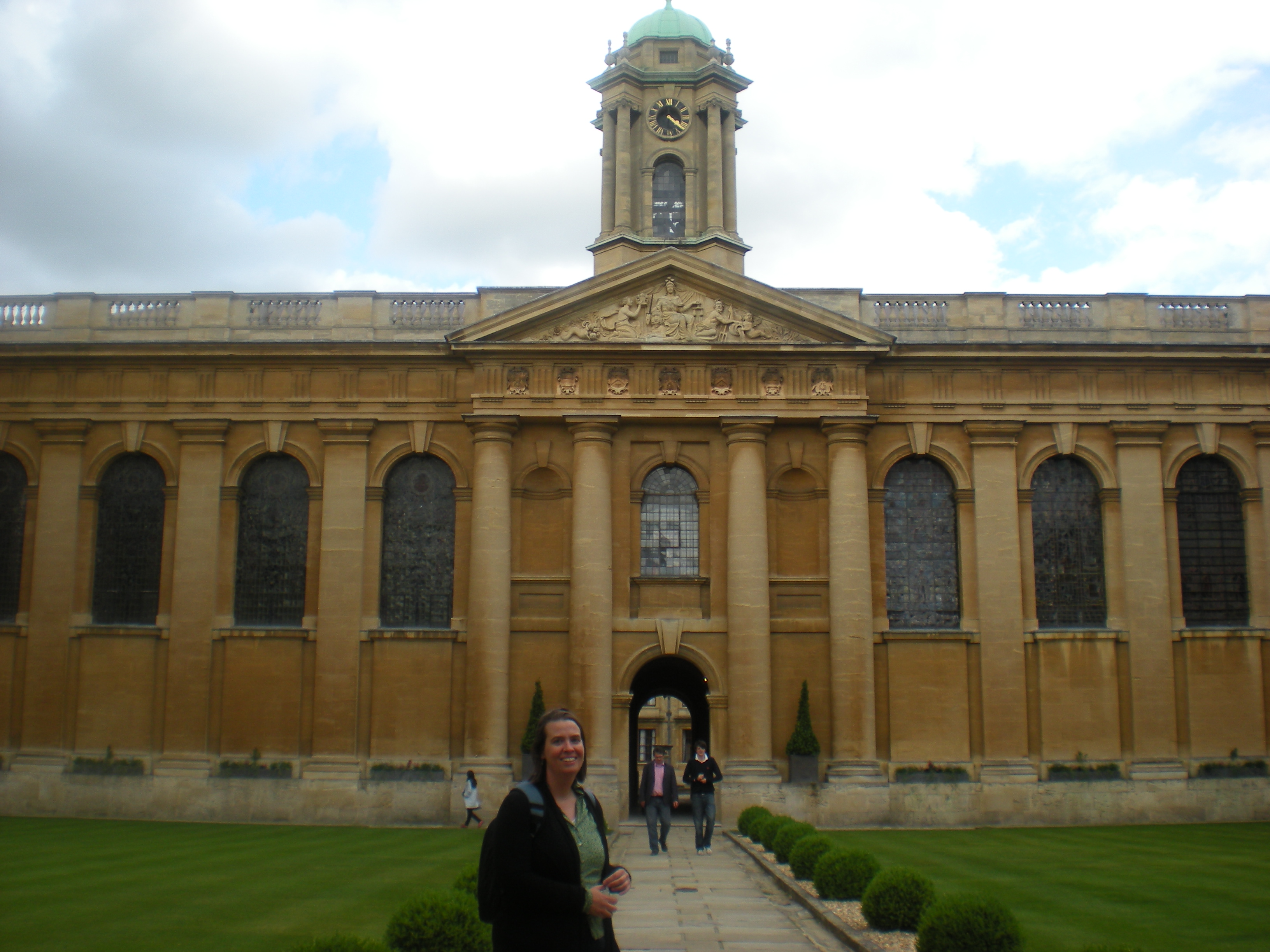
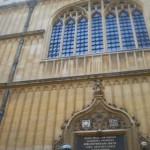
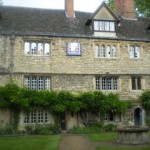
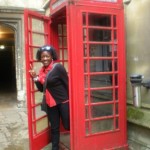
The smarty pants tour continued through a few more of Oxford’s colleges and sites. We wove our way through trongs of tourists and prospective Oxford students along the way, making our way to the courtyard of the Bodleian Library, one of the world’s oldest public libraries. At New College, we marvelled at its beautiful gardens. Due to a shout out from my former colleague Beth, we stopped at St. Edmund’s Hall, the last of the medieval halls, which actually looked quite modern and quaint at the same time. It reminded us most of our alma mater, Swarthmore, somehow. I think Magdalen College was one of my favorites of the bunch, its chapel boasted a replica of DaVinci’s Last Supper. The cloisters were bursting with white hydrangeas against a vibrantly green lawn. One of England’s famed red phone booths was a pleasant surprise along with a deer park, where the deer put on a little show for us. Legend has it that the deer here inspired C.S. Lewis to include the fawn character in his Narnia chronicles. We stopped for scones and a pot of tea at the country’s oldest coffeehouse, maybe the world’s first, Queen’s Lane, where apparently Tolkien, Lewis and other liked to have literary chats. And, we ended our tour at Queen’s College, site of the lecture, which had a very Baroque feel. It’s chapel featured a guilded eagle, chandeliers and a ceiling painting ala the Sistine Chapel. Having seen smartness through the ages and walked along the path of past smarties, I am now feeling rather smart myself.

Oxford: Old World Meets New

 Helen was sitting in Nero’s cafe with sheets of paper surrounding her like dining companions. It was great to see a familiar face after about 12 hours of travel and satisfying to know that I’d made it to Oxford. Helen looked like this is where she belonged, in a cafe grading papers, thoughtful and happy. I am looking forward to getting a peek at her professorial life.

I am bone tired. I didn’t sleep well on the flight due to a wailing baby and an older row mate who made frequent trips to the bathroom. I could barely keep my eyes open on the hour-and-a-half bus ride to Oxford, so I missed any scenery along the way. Helen vowed to keep me awake so that I could adjust to the five-hour time difference. We start by heading to the building where she works and dropping off my stuff. I meet a few of her research colleagues Kim, Lily, Leigh and Akiko and we grab lunch at Oxford’s covered market. Fruit stands, fish stalls and a butcher’s shop co-mingle with leather, paper and an assundry of other stores. Georgina’s, a funky cafe with pink walls, playbill and movie posters decorating its walls, sits in the middle and we decide to dine there. Helen and I catch up over salad and wraps and extoll the virtues of living lives without bounderies. She is contemplating taking on a third year as a research associate at Oxford because having tenure gives her that freedom, while I contemplate life after layoffs which gives me the freedom to travel and explore new opportunities. We count ourselves as lucky.

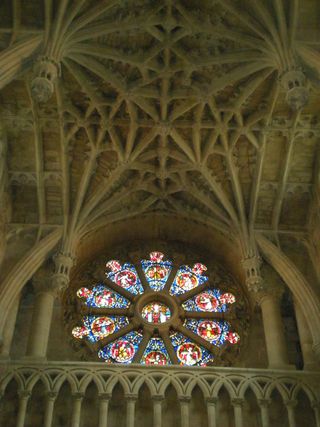
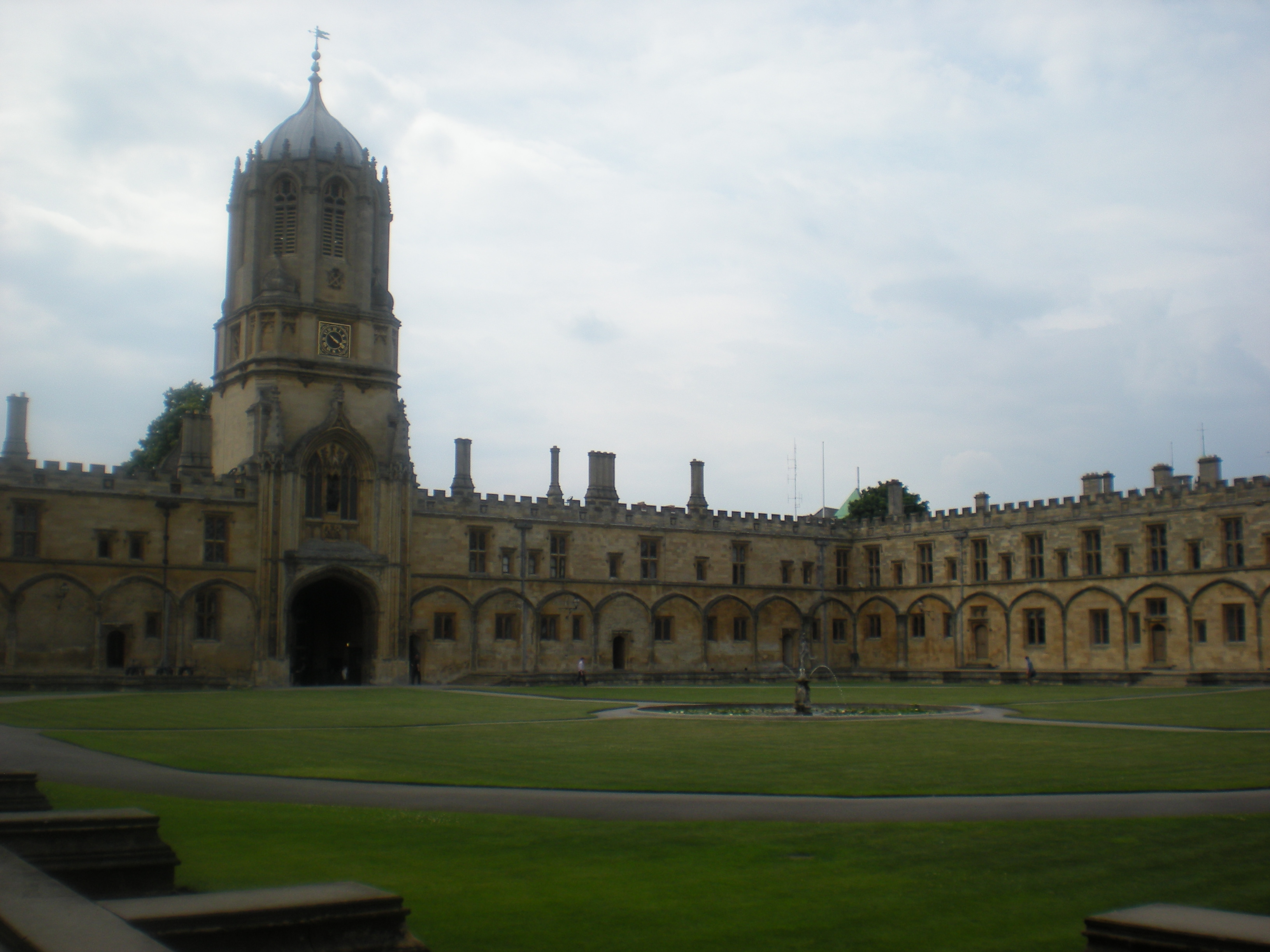
After Helen wraps up a few loose ends, we head to Christ Church College, which is engulfed with hoards of roving prepubescent teens, presumably fans of Harry Potter. There’s a tour that points out the hall on campus which inspired the Hogwarts dining scenes in the Harry Potter movies. But there is much more to see, including the goregeous stained glass windows and intricate ribbed ceilings of the Christ Church Cathedral, the smallest cathedral in England. We were reminded of our middle school religion class where we had to study the Washington National Cathedral’s bays. The courtyards are immaculate and men in derby hats are available to offer information and just add an air of authenticity to the place. Christ Church College is just one of 36 colleges dating as far back as the 11th century. What’s interesting is that they are surrounded by a modern bustling burg filled with shops, buses and taxis. I expected a sleepier place with men in graduate robes standing in a square having philosopical debates.


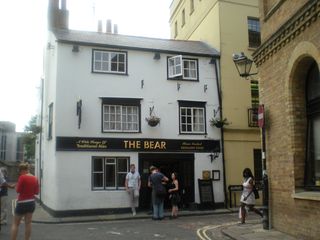
After touring Christ Church, we go to The Bear, a local pub where the tradition was for Oxford men to clip off their ties and leave them at the bar in exchange for a half pint of beer. We order half pints of cider, no ties clipped, and sit in the garden out back. The cider tastes stronger than any I’ve tasted in the states. I am looking forward to becoming a beer and cider conneisseur while here.

I am starting to fade, so we head back to Helen’s quaint flat that looks Victorian from the outside, but like a page from a 1970’s issue of Home annd Garden on the inside. She is renting the place from a woman who blends 70s chic with Asian design; a very ecclectic mix. Helen makes chinese dumplings, stir-fried green beans and a bamboo shoot and mushroom dish. Her friend Kim joins us and I learn more about the ins and outs of being a researcher at Oxford. There’s tea, wine, cookies and fruit. A nice end to a very long day.