Speed Boating and Sri Lankan Brothers

For the last couple of days, Sid and Uncle Emil have been asking me if I want to go on a ride in the speed boat. I’d say, “Sure!” They’d swim out undock the boat and gas it up. Sid would ask, “Are you ready?” I’d say, “Yes. Let’s go.” Then Uncle Emil would suggest a test drive first. After giving the boat a few smokey starts and moving slowly back and forth along the reef, they’d realize there was a problem with the engine or a part needed replacing. Uncle Emil would make a call and it would take a day or so for the appropriate fixes to take place. Today, after a watching Sid and Uncle Emil successfully skim along the waves of the Indian Ocean, I finally get to go on that ride.
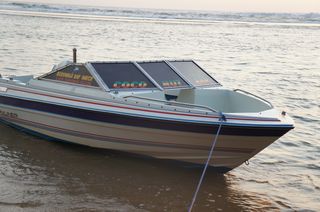
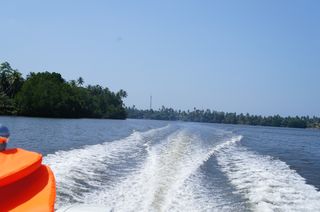
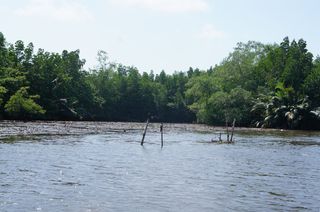
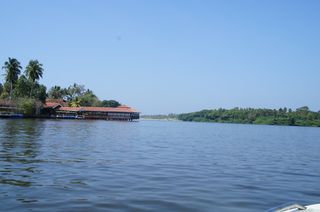
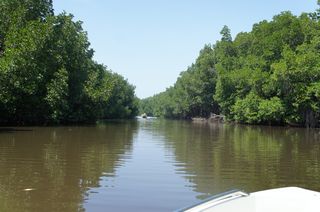
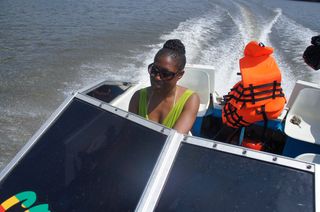
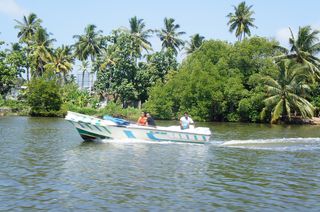
 Sid positions himself in the front of the boat and I take the seat next to Uncle Emil. Sid crouches in the front shouting directions to help Uncle Emil navigate past hidden rocks along the reef and then watches to help avoid rough waves pushing toward the boat. When a large wave approaches we have to circle back towards the shoreline and and try to beat the next big wave to make our way to calmer waters. It takes a couple of attempts and butt-bouncing bumps across choppy surf before we make it. Once we make it past a rocky outcrop that seems to form the opening between the reef, the beach and the sea, we are on the Black River. We cruise past other boats with tourists aboard and river-facing resorts touting their ayurvedic treatments. We make foamy trails through the flat dark water as leafy green trees seem to part before us. I imagine this place is like the Florida Everglades even though, I’ve never been. Sid and Uncle Emil talk of the crocodiles that inhabit the place and they point out the wooden tips of fishing traps with birds resting atop them, along with reeds jutting out of the water that Uncle Emil says is cork. We continue down the river, passing fishermen in small canoes and under a busy underpass carrying cars back and forth through Aluthgama, the sister town to Beruwela and Moragalla. We stop at a batik and leather goods shop on the river and wave at another one of Sid’s relatives who owns the place. As we go farther down the river, the trees start to drip and droop towards us and we have to duck entangling vines. The engine sputters and we pause to figure out the problem, floating in the quite mangroves. With more gas added and a few switches flipped we continue a bit farther and then start the return trip. Back out on the open river, Uncle Emil turns the wheel over to me and I’m thrilled. I’m tentative at first, gripping the wheel tightly and bearing straight ahead. There’s no pressing of the gas or breaking, just steering. Uncle Emil and Sid help me navigate the natural curves of the river. I start to enjoy weaving back and forth and the power of holding the wheel. I have to relinquish the wheel as we approach the place where the mouth of the river and the ocean meet, so that we can tackle the fast-crashing waves on our way back to the Coconut Bar. Sid is crouching again, looking like a horse jockey, shouting to watch out for the waves. It is much harder reentering the reef this time. The waves seem to be relentless, coming faster, rhythmically. We approach, then we are turned back by the foaming, pushy waves. The boat skips and makes hard bounces with each attempt to pass. We finally make it back safely to our lazy reef on about the fourth attempt.
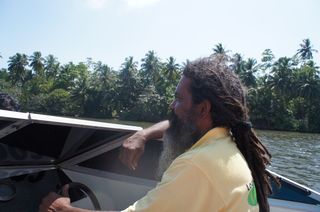
We leave the Coconut Bar boat to rest on the sand as we take to our cane chairs to share a drink and rest in the sun. Besides providing a little adventure, the boat is a part of another service that the Coconut Bar provides, lifesaving. The words Beruwela Bay Watch are tattooed on the side of the boat. No Pamela Andersons or David Hasselhoffs in this lifesaving club, only lifeguards that double as bartenders. Uncle Emil felt the service was necessary after watching one too many tourists get into trouble out on the ocean. He tells me that he wants to connect with other real bay watchers to let them know that there is a lifesaving team in Sri Lanka, too.

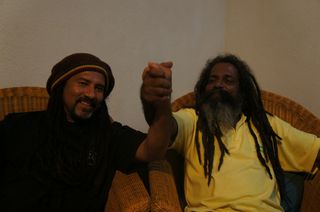
Uncle Emil gathers a few friends for lunch after our river journey. We are joined by his friend Susanna, a German woman who imports his gems and jewelry designs to Europe along with his best friend Bony and his wife who live in Switzerland. I learn that this is a big reunion for Bony and Emil who had a falling out sometime ago, over what, who knows. Bony says they are both very stubborn which kept them apart longer than it should have. You get the sense that these men have been through a lot together and they seem to fall back into an easy friendship with one another. Lunch is quite an international gathering, folks are moving easily from Sinhalese to German and English and we are having fresh crabs and prawns again. Bony has bought his own homegrown spirit for us to taste a mixture of banana, pineapple, mango and coconut wine and it’s got kick. It’s the color of dishwater and reminds me of the “jungle juice” that some guys in my freshman dorm made in a trash can. Having said that, I kind of like it. Bony tells me that he grew up together in nearby neighborhoods, one poor and one well off, but they were friends. Today, they both wear locs and prescribe to Rasta culture and tenets. They are real brothers. Bony asks if we can talk politics. He wants to know about President Obama. He told me that he felt that his election was good for brown people everywhere. He wondered why people in the US didn’t seem to be supporting him. I explain that there are a lot of people that want to defeat him in the next election. He hopes that Obama wins.
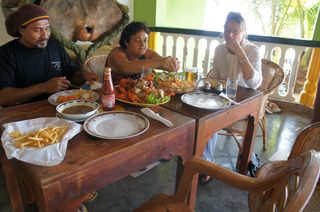
I end up spending more time with Bony, Uncle Emil, Sid, his cousin Mahesh, who also works at the Coconut Bar, and his Uncle Sucil. Sid and I wanted to have dinner with his sisters and nieces, but he let them know too late and then they felt they weren’t prepared to entertain. Sid says Sri Lankan women are very shy around strangers, so I hang with the guys. We are at Sid’s guest house, Uncle Emil has bought wine and food from Chuti and we add this to a few dishes that Iresha has prepared for us to make our dinner. It’s the first time that I dine Sri Lankan style, using my right hand to scoop and make small balls of food to pop in my mouth. Sid cranks the reggae, Bob Marley, Afro Blondie and others. I listen to them joke and tease one another in Sinhalese while Sid attempts to translate. I’m not sure that I’m getting the full translation, I’m sure the conversation is more laced with curses and other profanities that they’d like to keep from my ears. It’s cool being in the midst of their camaraderie, even though I don’t understand everything that they are saying. I am most intrigued by the stories of his Uncle Sucil. He’s ex-military and was on the front lines of fighting in Sri Lanka’s recent Civil War between the government and the Tamil Tigers. The Tamils, a minority group in the North of the country, wanted to cede from country and create their own country. Some have said that they are the originators of modern terrorism, employing suicide bombers and other surprise attacks. Sid himself just barely escaped an attack while he was a young student in Colombo. He was riding his bike when less than a mile ahead of him he saw a massive explosion. It turned out to be one of the worst suicide bombings during the war, killing over 300 people. He skidded from his bike and ran from the scene. It’s something he says he’ll never forget. But his uncle bears bullet scars from the country’s troubled past. As the story goes, he saw many members of his troop killed by Tamils and found himself sounded by Tamils along his remaining fellow soldiers. Sid’s uncle decides that he’s had enough and shoots his way out of the entrapment, getting shot himself in the process of escaping. The small man that I see sitting in from of me has the most immaculate manners that I’ve ever encountered in a person, saying excuse me directly to me when he leaves the table, and it is hard to imagine him fighting his way out of a northern Sri Lankan jungle. Uncle Emil says he fought his way out like he was Jean Claude Van Damme.

While Sri Lanka has survived a Civil War that ended in 2009, it still suffers from other small tragedies as we’d learn that evening. Sid’s cousin Mahesh received a call that one of his friends was horribly injured in a bus accident. Sid and I had already discussed how dangerous some of the buses can be. Drivers pack buses that don’t have doors and passengers hang outside in the line of reckless drivers. In this case, Mahesh’s friend was hit by a truck colliding with the bus. Mahesh was visibly shaken upon learning that his friend would loose his legs. The men come together to console Mahesh as best they can. Sid and Uncle Emil are angered that something like this can happen. It’s a sad way to end the day, but a reminder that Sri Lanka still has some growing to do.
Ayurveda and Aunt Chuti

A girl could get used to this Sri Lankan hospitality thing. Sid’s uncle Emil has arranged 6 ayurvedic massage sessions for me during my stay. Folks who know me know I love a good massage. I have a tradition of visiting a spa on New Year’s Day to start the year refreshed and relaxed, so this is exactly what the doctor has ordered. The ayurvedic and traditional Sri Lankan medicine doctor in specific.

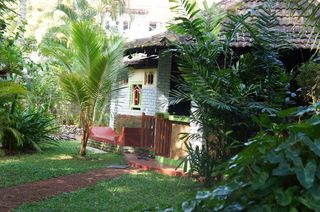
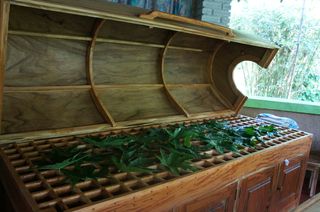
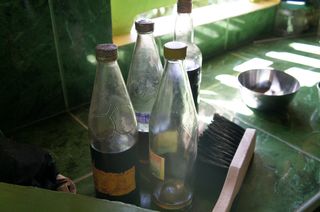
In Uncle Emil’s garden paradise sits a small tiled-roofed house that he’s dedicated to private spa treatments. There are two large wooden treatment tables that Sid says are from a special Sri Lankan wood and a wooden steam table. I watch as the doctor and her therapist carry large bottles filled with oils, dark brown and caramel in color. I hear all kinds of mixing and preparations taking place and it makes me anticipate this experience all the more. When I enter, the doctor, Princy and her assistant therapist, Narangela, are all smiles and dressed in traditional saris. They explain that I will have a head massage and face massage followed by a foot massage and a full body massage. I will end the treatment on a bed of herbal leaves on the steam table. When I ask about the ingredients instrumental in my massage, I get one response, herbal leaves. This is when I wish I had an interpreter in the spa with me. It seems that it’s hard to translate some of the herbs being used in my treatment from Sinhalese to English, but the doctor does a better job of explaining what the treatments do. The oils in combination with the steam bath will sweay away bacteria and toxins in the body and generally make me more healthy. I’m up for that.

 Narangela is tentative with my head massage at first. She isn’t sure how to navigate my hairstyle, but she gets into a good rhythm moving from head to neck and shoulders. The face massage includes a grainy scrub followed by something that feels like a waxy salve. The doctor handles my foot massage. As I’d learn later from Dr. Princy, the feet are very important in ayurvedic medicine. Pressing various points along the feet, toes, the fleshy parts and heel, influence the health of other parts of the body right up to the head. Both doctor and therapist go to work on me for the full body massage. I’ve never had two people give me a massage before, but I can see the benefits. It felt a bit like a symphony. The doctor was the conductor, she’d start the movement on one side, a vigorous stroke up and down left leg, the therapist followed until they were both in synch. This continued up to midriff, arms and back. When I am throughly dressed and drenched in herbal oils, it’s time for my steaming. Princy lifts the hood of the steam bed to reveal neatly arranged flat green leaves on a grid of wood and I feel the instant release of heat. She instructs me to lay on the leaves, leaving room for my head to jut out of my steamy enclosure. I imagine what a roast chicken must feel like. Then, she puts a towel between my neck and the opening of the steam bed and asks, “Is warm OK?” I nod, adjusting my legs inside to avoid extreme steaming. Princy and I chat for a bit and I learn that she has been a doctor of ayurvedic and traditional medicine for six years. She does treatments at the ayurvedic resort, Barberyn, next to the Coconut Bar, and works with private clients. She tells me that she worked with  Japanese ex-boxer who could no longer turn his head or walk without a cane and after several days of treatment she improved his range of motion. She said there are no side effects with all natural medicine and I feel  all of the holiday food fixins drip from my body and onto the hot stones below me. I look forward to several more days of this as I wave good-bye to my natural healers.

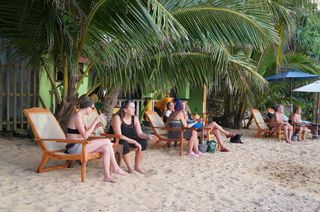
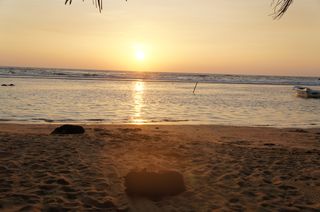
I return to the Coconut Bar for a post-spa refreshment, coconut water straight from the coconut, followed by a breakfast of Sri Lankan breads, including a crocodile bun sprinkled with brown sugar, strawberry jelly filled pastries and mini banana muffins. More Indian Ocean bathing and lounging ensues. A stream of Coconut Bar fans flow through the bar for a drink, meet friends or just say hello to the proprietor. I meet a German woman who splits her time between Germany and Sri Lanka, embarking upon a new career as an ayurvedic therapist. A trip to Sri Lanka years ago inspired her new profession and she studied at the Barberyn resort next door, known for its ayurvedic programs and institute. It sits on property that Sid and Emil’s grandfather used to own. I’ll continue that story in a bit. I also meet Sonya from Scandinavia and I tell her that I traveled in Denmark this summer. She grew up in Denmark, but lives in Sweden now. She’s made Sri Lanka her new winter vacation spot after she soured on winters in Spain. She said after the she’d been robbed three times by roving Russian gypsies, she’d had enough. I told her I’d seen them at work in Barcelona myself. After a pleasant conversation, I fondly remember the hospitality of my Scandinavian friend Aneliese this summer. As the sun begins to set the cane chairs at the Coconut Bar begin to fill. Uncle Emil boasts that his place is the best place to watch the sunset. His guys are busy getting a drink in every hand as Germans, Brits, Swiss, Scandanivians, Sri Lankans and an American settle in to watch the sun’s slow decline. Uncle Emil, Sid and I take a tour of the construction atop the bar which will become an extension of his guest house, featuring three floors of apartments with stunning views of the Sri Lankan sunset. Uncle Emil and Sid point out the sprawling Barberyn estate next door and tell me that their grandfather used to own the land and sold it for nothing, which they say was for about $1,000 years before Sid was born. They are angered that someone else owns the land they still see as theirs, but it seems to solidify Uncle Emil’s determination to make the Coconut Bar compound into a feel-good destination. He often says, “I just want to be happy and I want to make other people happy.” I want the same for him as we all stand on the top floor of his dream and look out at the ocean.

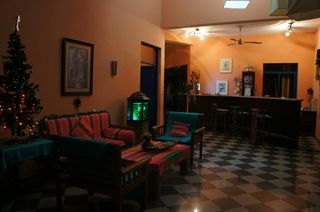
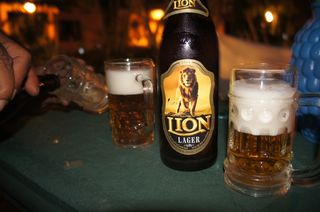
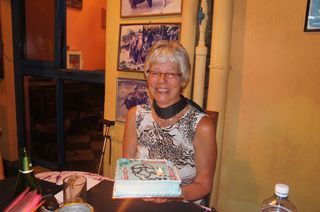
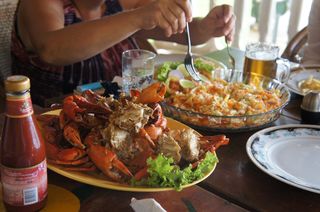
Earlier in the day, we told Uncle Emil that we wanted crab for dinner. They were caught just up the beach, delivered to us straight away and dropped into a boiling pot in the back. By the end of the day, they had been sufficiently cooked and it was decided that they would be taken to Uncle Emil’s sister Chuti for their final preparations. Stories of Sid’s Aunt Chuti border on legendary. She’s also a hotelier, owner of theBavarian Guest House with her husband Denis. Back in the day, she ran a discotheque at the guest house and Sid at the ripe age of 15 was the DJ. Apparently, Chuti has quite a temper, but I later learn that this is only if you cut up and act a fool. Not unlike a strong African-American aunt, and it seems Sid and his uncle have been on the wrong side of her temper more than once. When we arrive at the Bavarian Guest House there’s a nativity scene still ablaze at its entrance and a Christmas tree twinkles in its lobby. Uncle Emil takes me to meet his sister in the kitchen where she’s hard at work amidst cooking pots, preparing dinner for her paying guests. She greets me kindly, but seems to have a few choice words for her brother who has dropped in at the most inopportune time. We sit at a table in the hotel’s courtyard and have a Lion, a Sri Lankan beer, and I hear more stories of how Aunt Chuti can so nice and so mean at the same time. We notice that Sonya from Sweden happens to be staying at the hotel and she is celebrating her birthday. She told me on the beach earlier that she was celebrating her 71st. I go over to say hello and take a birthday photo for her. She seemed ecstatic and living life as a “pensioner” or retiree to the fullest.

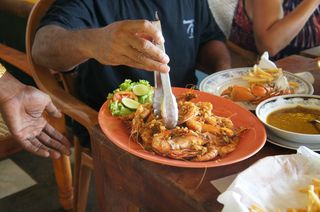
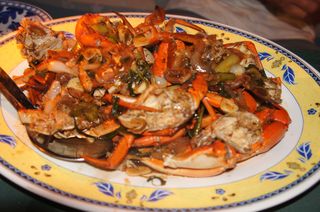
 Soonafter, Chuti delivers a feast of potato salad, mixed salad, chips and the most flavorful crab ever. She said that she essentially stir fried the boiled crab in soy sauce, leeks, garlic and ginger. The sauce was a perfect compliment to the sweet crab meat and we sit in silence for a bit, aside from the sound of cracking crab legs and the sucking of succulent meat from its shell. Finally, I was able to get Chuti’s side of the fabled tales about her. She explains that when Sid and Uncle Emil show up they’ve already had a bit to drink and can get rather loud, which is when she has to put them out. It turns out that Uncle Emil may be a poor influence on her husband, too. When the two of them went out one night they returned without the front bumper of the car. Everyone has their limits and tomfoolery is Aunt Chuti’s. She and I hit it off famously though and  she tells Sid to bring me back for a traditional Sinhalese breakfast. I can’t wait.

Blessed with Sri Lankan Hospitality

Boarding Sri Lanka Airlines feels like I’ve already landed in Sri Lanka. A flight attendant dressed in a traditional sari greats me with a bow and the words “aayu-bowan,” which I later learn means “be blessed”in Sinhalese, the national language. Each attendant wears a low bun, flawless make up and the most pleasant demeanor. I have the good fortune of sitting next to Vishaka on the 10-hour plane ride. She guesses that I’m American and that this is my first trip to Sri Lanka. She explains that she’s returning to her home country after visiting her eldest son in graduate school in Fargo, N.D., and she immediately offers up her home and a tour around Colombo. Vishaka is the perfect example of Sri Lankan friendliness and hospitality. I’m visiting Sri Lanka because my friend Sid, known as Sujith in his birth country, has been hospitable enough to invite me for a visit, put me up in his family’s guest house and take me on a tour of the island, about the size of West Virginia.

I met Sid almost exactly a year ago on New Year’s Eve at a party while standing in line waiting for the bathroom. I don’t remember exactly how the conversation went, but he told me that he was from Sri Lanka, he thought I was nice and wondered if we could hang out sometime. Since then, he’s been my unofficial ambassador to Sri Lanka, making the only Sri Lankan dish he knows how for me (biriyani), giving me a lesson in cricket at the only cricket field in D.C. near the Tidal Basin. I still don’t get the game, which isn’t at all like baseball by the way, but I appreciated the effort. Sri Lanka was host of last year’s cricket world championships, an extreme honor for the country’s national pastime. Sid also made sure that I got a taste of Sri Lanka when I traveled to London last year and I met his sister Iresha, who made me a delicious dahl.

So, when my plane touched down in Sri Lanka’s capital, Colombo, I had some sense of the culture that I’d encounter and friendliness was a given. I ran into Vishaka again at baggage claim where she made sure that I was OK and reminded me to call her to visit while I was in the country. Then, I hopped into a white minibus with Sid and his cousin Pradip, who was driving.  Pradip is what you might call a defensive and maybe a slightly aggressive driver. But you kind of have to be here. The two-hour drive from Colombo to Moragalla was an exercise in dodging and darting to avoid buses, dump trucks and other large vehicles that insisted upon driving on the center line rather than choosing the left or right lane. Honking is necessary to express “get out of the way” or what the “heck are you doing?” A man on a small motorbike looked at us incredulously after we honked at him for hogging the road. Shortly thereafter we spotted a trio of cows meandering down the median of the busy thoroughfare. Sid said we weren’t even driving during rush hour.  Then there are the tuk-tuks, small three-wheeled, open vehicles that Sid said were like mosquitos. “They’re everywhere.” Some of them are pimped out with airbrushed photos inside or festive lights on the outside. We were driving so fast that I didn’t get a picture of one, but I’ll make it my mission when we go back to Colombo later in the week. The tuk-tuks were in full force on Galle Road along Colombo’s main open-air market, which was already bustling around 5:30 in the morning. Lights were a blaze in stalls selling cell phones and sim cards, while coconut vendors set up their carts on almost every corner. School children wore pristine white uniforms as they waited for buses to take them to school. The girls wore bright colored neck ties with their crisp white uniforms.

When I first spot the Indian Ocean, an early morning haze rests over it. We are still on Galle Road and people are walking and jogging alongside it like Chicago’s lakefront. An open-air train follows the ocean North or South with its conductors dripping from its doors and people jostling, arm to arm inside. I’ve been reading Paul Theroux’s Ghost Train to the Eastern Star, where he takes a train in Sri Lanka from Colombo to Galle. A ticket teller tells him that he doesn’t need a ticket to board the train, or a seat assignment, just push. I can tell that Theroux was right on with his description.  I ask Sid about low-lying shacks on the side of the road. He tells me that this is like Sri Lanka’s projects. The traffic starts to thin, the road narrows and the houses and yards get larger. Soon we are in the town of Morgalla where Sid’s family lives. I’m staying in the guest house just behind the family home, a cozy 5 bedroom bungalow with a raised pool, surrounded by mango and coconut trees. The time difference between Sri Lanka and the US is insane. By now it is about 8 am Tuesday in Sri Lanka, but late evening Monday in the US. I consider taking a nap, but we decide it’s best to nap on the beach and we head to Sid’s uncle’s beach bar, guest house and gem shop.

Much of Moragalla seems to be home to the da Silvas–aunts, uncles, cousins or just people that you call cousin. It definitely has a Southern small town feel. As we take the 10 minute walk to his uncle’s place, Sid greats all manner of first and second cousins along with some people that have known him since childhood, but that he struggles to remember. He points out the homes of aunts, uncles and even his brother-in-laws family home. Everyone seems to live within a 10 block radius of one another. We pass some modest low-lying homes with tile roofs and other colorful two-story homes with gated entryways. Almost all homes have expansive yards. Sid says most of the people here are well-off because they are in the hospitality business as much of his family is.

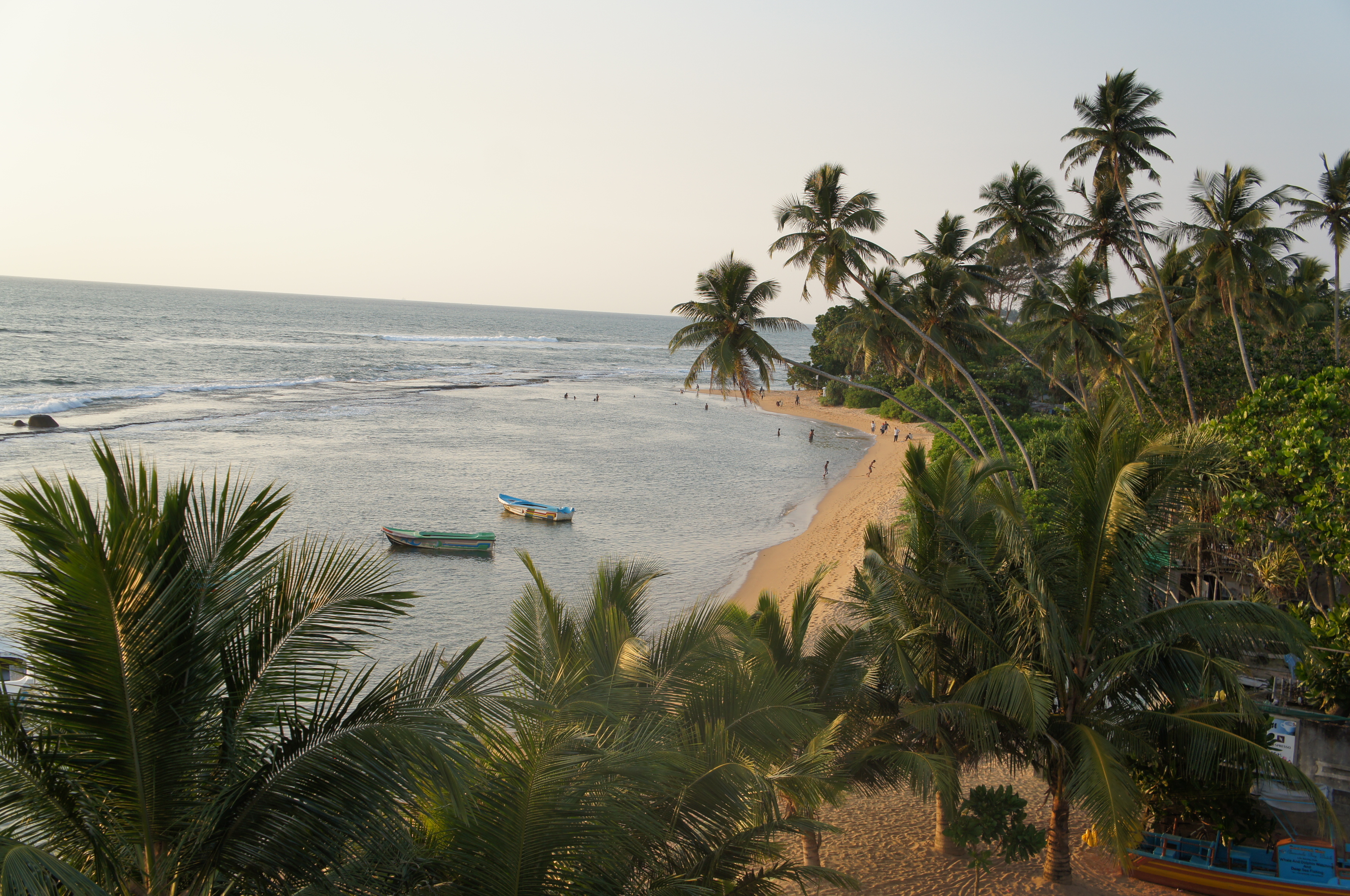
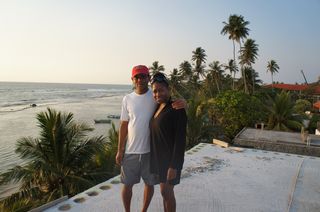
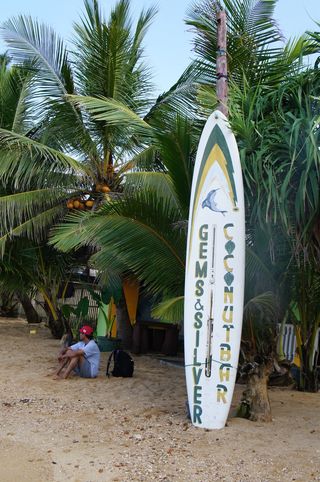
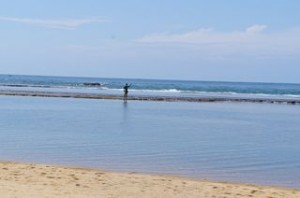
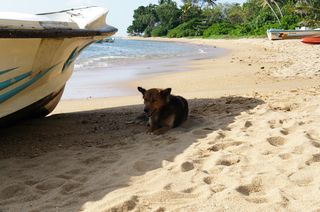
Sid’s Uncle Emil has created a small paradise for himself. As we enter the grounds of his home and guest house, we are surrounded by lush tropical foliage broken by gravel pathways. His home is painted in festive pastels and surrounded by a veranda, we pass through a building under construction and Sid explains that it will be the hotel of yet another uncle, then we are on the beach. His Uncle Emil’s bar, known as theCoconut Bar, is situated on a lovely patch of sand facing the Indian Ocean. His uncle isn’t there when we arrive, so we take a stroll down the beach for a bit, along an even stretch of calm water. The rougher waves of the ocean crash over a reef, creating a natural pool along the beach with water that feels like a warm bath. On our walk we’ve been joined by a couple of Uncle Emil’s dogs, the leader being Beru. He’s a brown and black fuzzy mix of something and has a tail with a curl on the end. He almost marches confidently a head of us, stopping when we stop and looking back to be sure we are still following his lead. Sid points out small rocky outcrops peaking out from the ocean. Some are small islands to be visited. Small hotels and guest houses line the beach, some are under construction or in some level of repair. This stretch of Sri Lanka was hit fairly hard by the 2004 tsunami, particularly the Coconut Bar as I’d later learn.


When we return from our walk, Uncle Emil still hasn’t returned so Sid leaves me on the beach for a bit to go find him. As I sit, a number of Sri Lankans pass by and look at me curiously. They all smile and nod, but I am sure my cornrowed hair is something they rarely see and they aren’t sure what to make of me. Finally, a trio of guys walk by and one calls out, “Good morning.” I greet him in return. “Where are you from?” I reply. “Oh, you look Jamaican,” he says. And, then asked as if I’d dropped out of the sky, “What are you doing here?” I explained that I was visiting my friend Sujith and asked if he knew him. He nodded and the trio continued on its way. I’ve noticed the curious looks since I boarded the plane for Sri Lanka. Fellow passengers stole looks as I made my way to the bathroom. On the ride to Morgalla, a group of students stared outright. I waved and they smiled. It’s a friendly curiosity. Sid explained that Sri Lankans don’t see many African-Americans or Americans in general. They are used to the Brits, Germans, Dutch and now Russians who vacation there regularly.

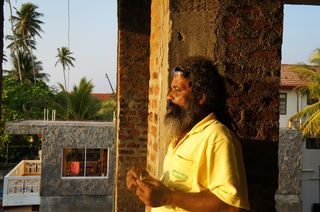
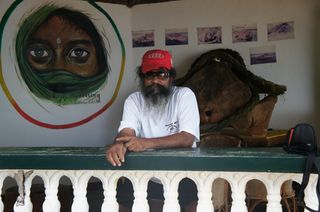
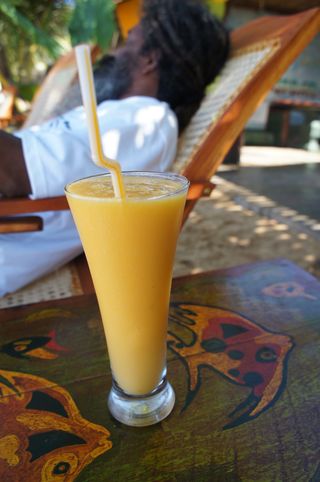
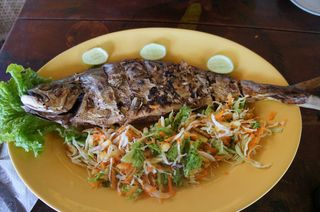
When I finally meet Uncle Emil, I can understand why the trio of guys may have thought I was from Jamaica. Uncle Emil sports locs and a long beard peppered with grey. The Coconut Bar has hints of a Jamaican decor with yellow, red and green accents. Uncle Emil has an easy smile and greets me with a hug. I can see why he’s Sid’s favorite uncle. We eventually settle into cane chairs with drinks. I have a fresh mango juice. I’d already had coconut water straight from the coconut earlier. It seems the current Coconut Bar is a shadow of its former self, suffering a direct hit from the 2004 tsunami. Sid’s uncle explains how on that day he was sitting in a cane chair just as we are now when he saw the ocean recede and a massive wave approach. He said it happened in an instant. He was engulfed and tossed about as if ina washing machine and left to live atop the coconut tree next to his decimated bar. His bar, guest house and diving school suffered a million dollars in damages. He left the experience determined to rebuild and rebuild bigger. Uncle Emil is something of a renaissance man. His main business is as a gem exporter and jewelry designer. He also has a young tea plantation. And, then there’s the hospitality thing. He proceeds to offer up drinks and food. I have a pina colada with fresh coconut milk, I have a whole grilled golden mackerel for lunch with a delicious mixed salad containing sweet bits of pineapple and later a fruit salad of mango and banana. All of the ingredients recently plucked from the sea or a tree.

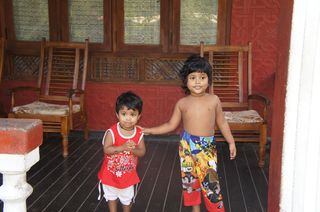
After a full day of napping, bathing in the ocean and eating. There is more eating to be done. We head back to Sid’s home where I greet a bevy of aunts, sisters and nieces. They parade through the door of the home and onto the porch shyly, and I kiss each on each cheek. Iresha, Sid’s sister who I visited in London is one of them. I try chatting with one of Sid’s nieces studying English in school and she shyly talks about her recent trip to Australia before darting back into the house.

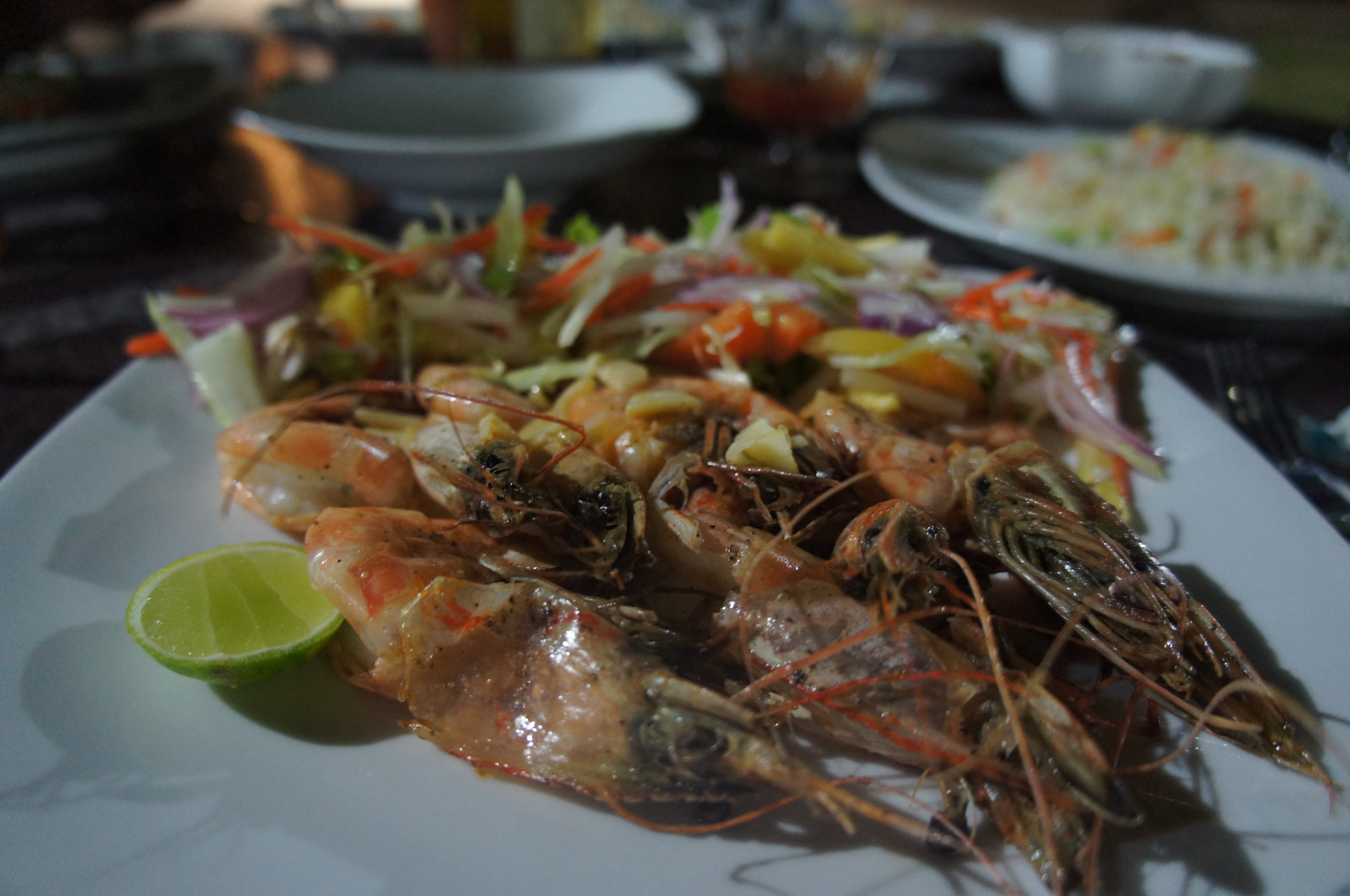
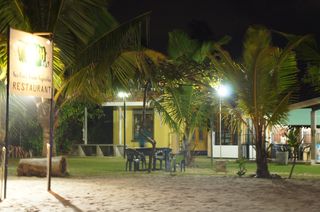
Uncle Emil picks us up for dinner and we head to another family outpost, the Fresh Restaurant, where we meet more of Sid’s cousins, a pair of brothers. The eatery is a part of a hotel and sits on expansive piece of beach. It is is the epitome of beach casual with plastic chairs and rounds and strings and we sit where we like. Uncle Emil orders a bottle of white wine, and fresh french fries, or chips as they call them here, are delivered to the table. Sid, his uncle and cousins start the story telling and joking in Sinhalese, with classic Sinhalese tunes playing in the background. The songs sound like salsa at times, then Bollywood and even tinges of reggae.  Maybe the salsa sounds come from the country’s Portugese heritage, Bollywood from the proximity to India and reggae, just because Sri Lankans love reggae. After a couple of drinks one of Sid’s cousins breaks into song and we polish of plates of prawns the size of my hand and tasty fried rice made with basamati and vegetables. More wine is poured and I’m pretty sure that I’m going to like this place.