My Top 14 Travel Moments in 2014

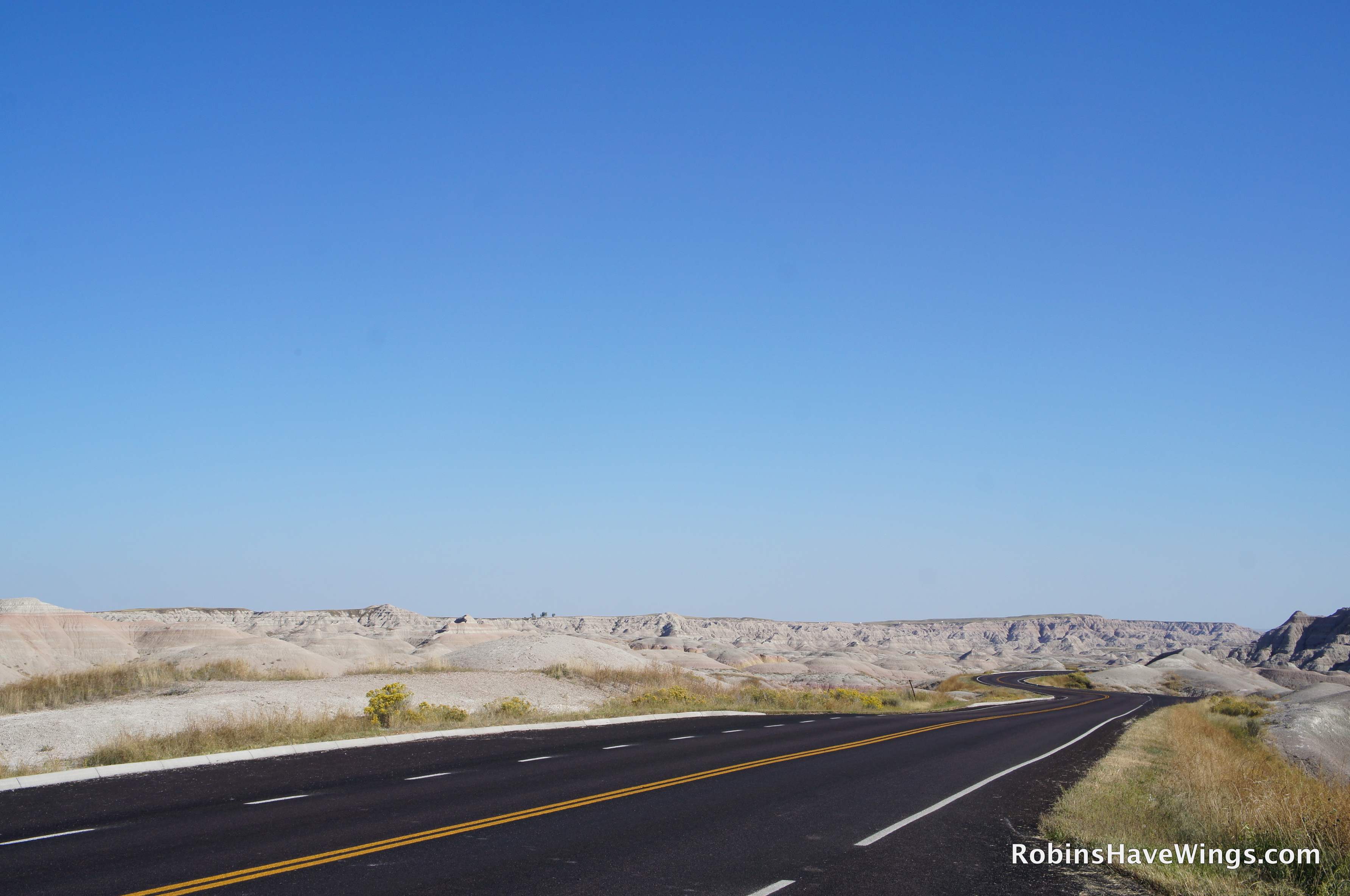
The Badlands, South Dakota


While I rang in 2014 in New Zealand, an incredible trip well documented on the blog, I spent the rest of the year exploring beautiful places right here in the good old US of A. And, in a year that showed our country’s ugly divisions, I met Americans in unsuspecting places who were warm and eager to share their pride in the America they know and love.

14. Natural Bridge and Monacan Village in Southwest, Va.

This spring, I took a road trip to visit a dear friend living in Blacksburg, Va. I decided to take the long way around, stopping in cute downtown Charlottesville to lunch with another friend. I picked the Brookville Restaurant for its bacon chocolate chip cookie, which didn’t disappoint. Neither did my next stop at the Natural Bridge nestled in the Blue Ridge Mountains. Thomas Jefferson was the biggest pitchman for this natural wonder and in the 1800’s the Natural Bridge was one of the hottest destinations in the US, along with Niagara Falls. After winding down a steep staircase alongside a bubbling stream, the bridge kind of surprises you with its majesty. It’s more like a giant keyhole, revealing the forest beyond.
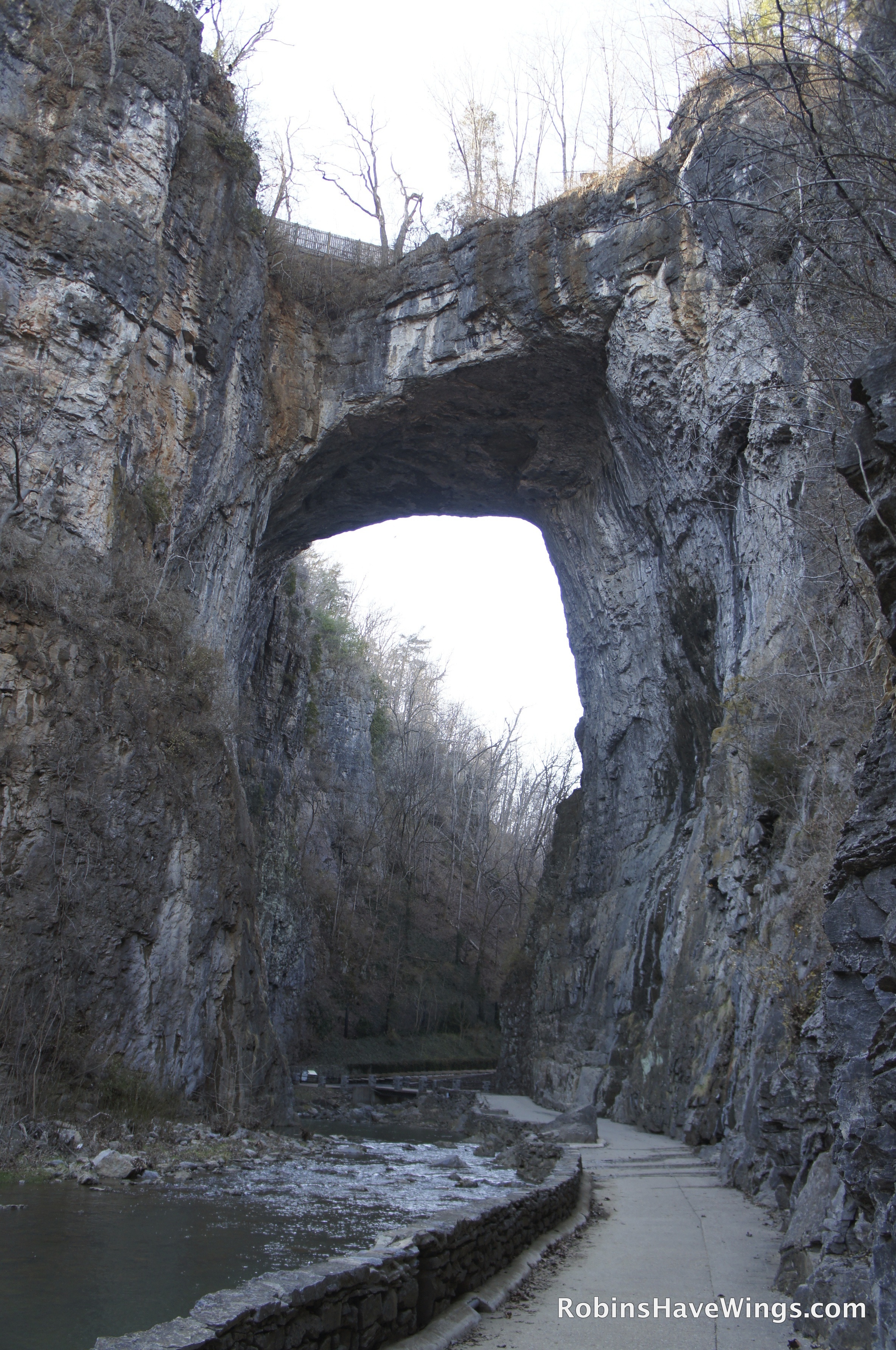
Natural Bridge in Southwest, Virginia

On the trail, I met a descendant of the people who first discovered the bridge, created when a cavern around it collapsed. Victoria Ferguson is 7th generation Monacan and can trace her lineage back to the 1700s when her great grandfather participated in the Battle of Yorktown. She manages the Monacan Living History exhibit at the Natural Bridge and was constructing the intricately woven palisade or fence to protect the village recreation from animals and intruders. We spent a long while talking about America’s difficult past and the systematic erasure of the history of indigenous people around the world. She’s doing her part to make sure that we don’t forget in this part of the world.
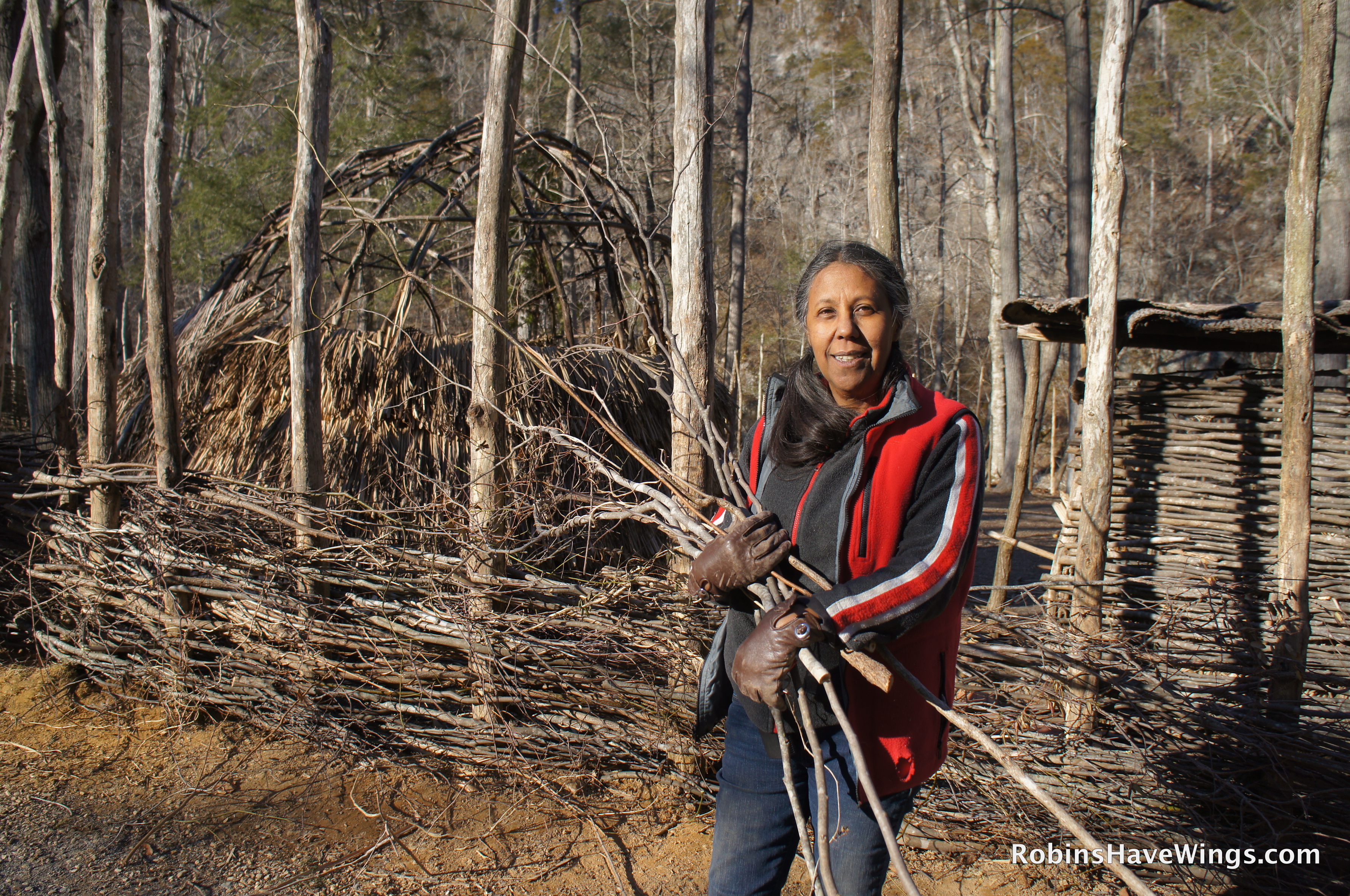
Victoria Ferguson, 7th generation Monacan and director of Monacan Living History exhibit at the Natural Bridge

13. Country Music Beginnings on the Crooked Road in Floyd, Va.

Hippies and country folk converge in Floyd, Va. – a small town with no stoplights and kitschy charm. Pottery and turquoise-filled jewelry shops stand across from the Floyd Country Store, a mecca of bluegrass and country music along The Crooked Road, Virginia’s heritage music trail. My friend Helen and I decided to take in the live music here that started with reverential hymns like “Amazing Grace” and turned into a foot-stomping jam by nightfall.

I was one of two black folk in the spot and it’s when you are a rarity that people want to make you feel at home. I had an interesting chat with Donald Coines, who started by saying he didn’t want to offend me but explained that he learned how to buck dance from a former slave he befriended as a child. He had a far-off look in his eye as he shared. It’s one of those moments that you realize how closely intertwined our histories are. Bluegrass is the child of African music and Irish/Scottish musical traditions. The banjo can be traced directly back to Africa. So why wouldn’t I be at home in a place like this?  Donald and his son joined the jam by playing wooden spoons and a Jew’s harp, which, by the way, has nothing to do with Judaism and makes a springy sound like rubber band being plucked.  I also met Shirley and Alice of the Old Dominion Cloggers. Shirley has been at it for 50 years and shows no signs of stopping. By the end of the evening Helen and I found ourselves stamping our feet on the dance floor, too.

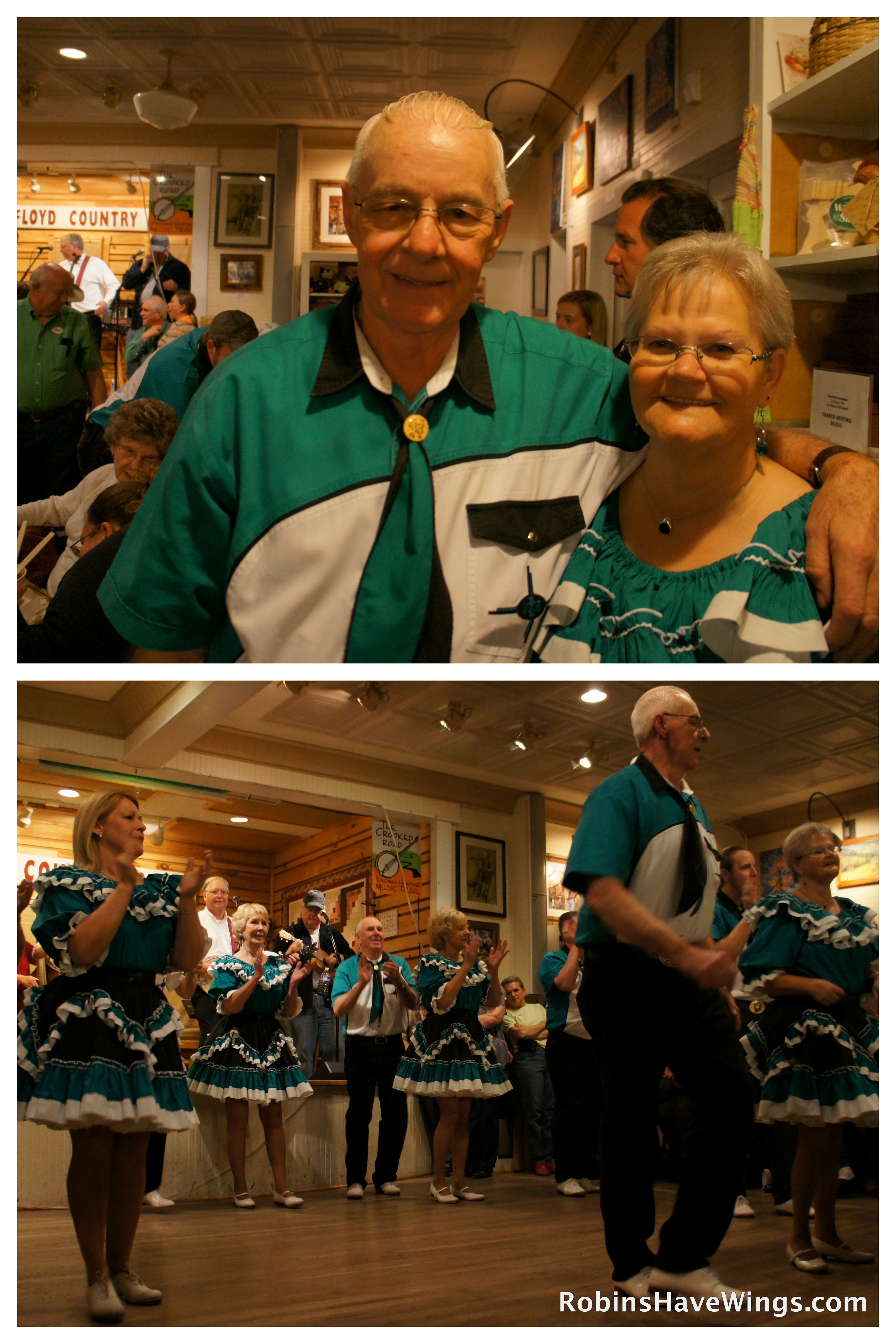
Donald Coines and son at the Floyd Country Store

12. Key Lime Pie Tasting on the Overseas Highway in the Florida Keys

I might be inclined to make this the top travel moment of the year, but I’m doing this list chronologically. I suggested to my friend Lorenita that we drive to Key West from Fort Lauderdale for our friend Kim’s birthday festivities. She was game and it is then that we learned of our shared love of Key Lime pie. Our course down the Overseas Highway was marked by Key Lime pie stops recommended by residents, TripAdvisor or Yelp. In one day we tasted three key lime pies. Our gluttony knew no bounds as we searched for the best. Our top three are as follows…

#3 Kermit’s Key Lime Shoppe in Key West. Great tart lime flavor, but the graham cracker crust was kind of generic. But you should still sit with a slice on the porch and people watch on Duval Street.

#2 Ma’s Fish Camp in Islamorada, Fla. You have to really make the trip here. It’s not near anything, nor particularly scenic, but its Key Lime pie is worth the turn off the highway. The graham cracker crust is buttery and the filling had the tang we like. They have a deep-dish version with whipped cream and a version with merengue. We thought this was our favorite until we went to…

#1 Blue Heaven in Key West. This pie looks like it was sent from heaven, topped with a cloud-like pillow of merengue. We’d never seen anything like it. Luckily, the taste lived up to the presentation. The graham cracker crust was just as delicious as the lip-smackingly tart filling. One would expect the merengue to be cloyingly sweet, but it wasn’t, serving as a show-stopping compliment to all the ingredients below.
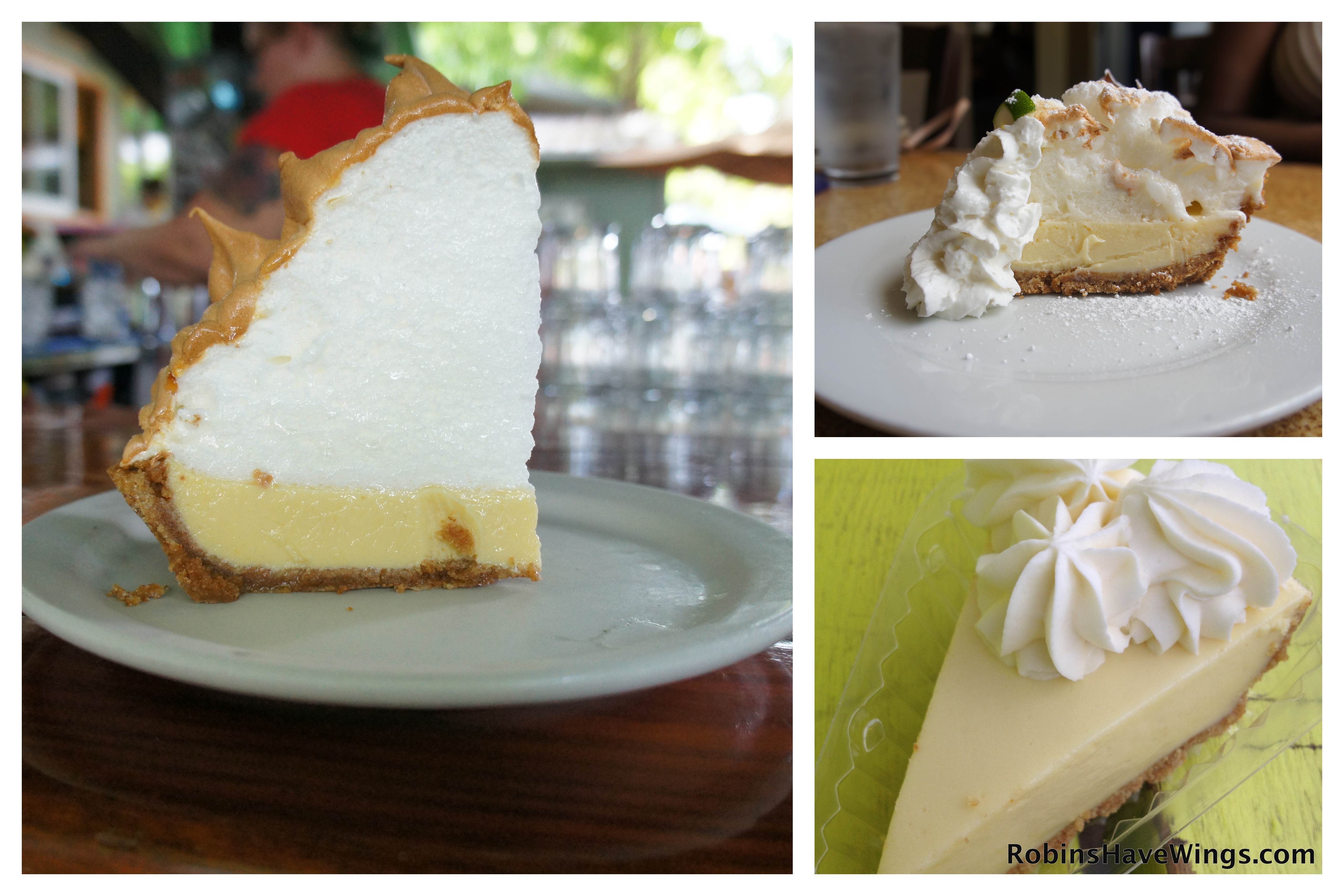
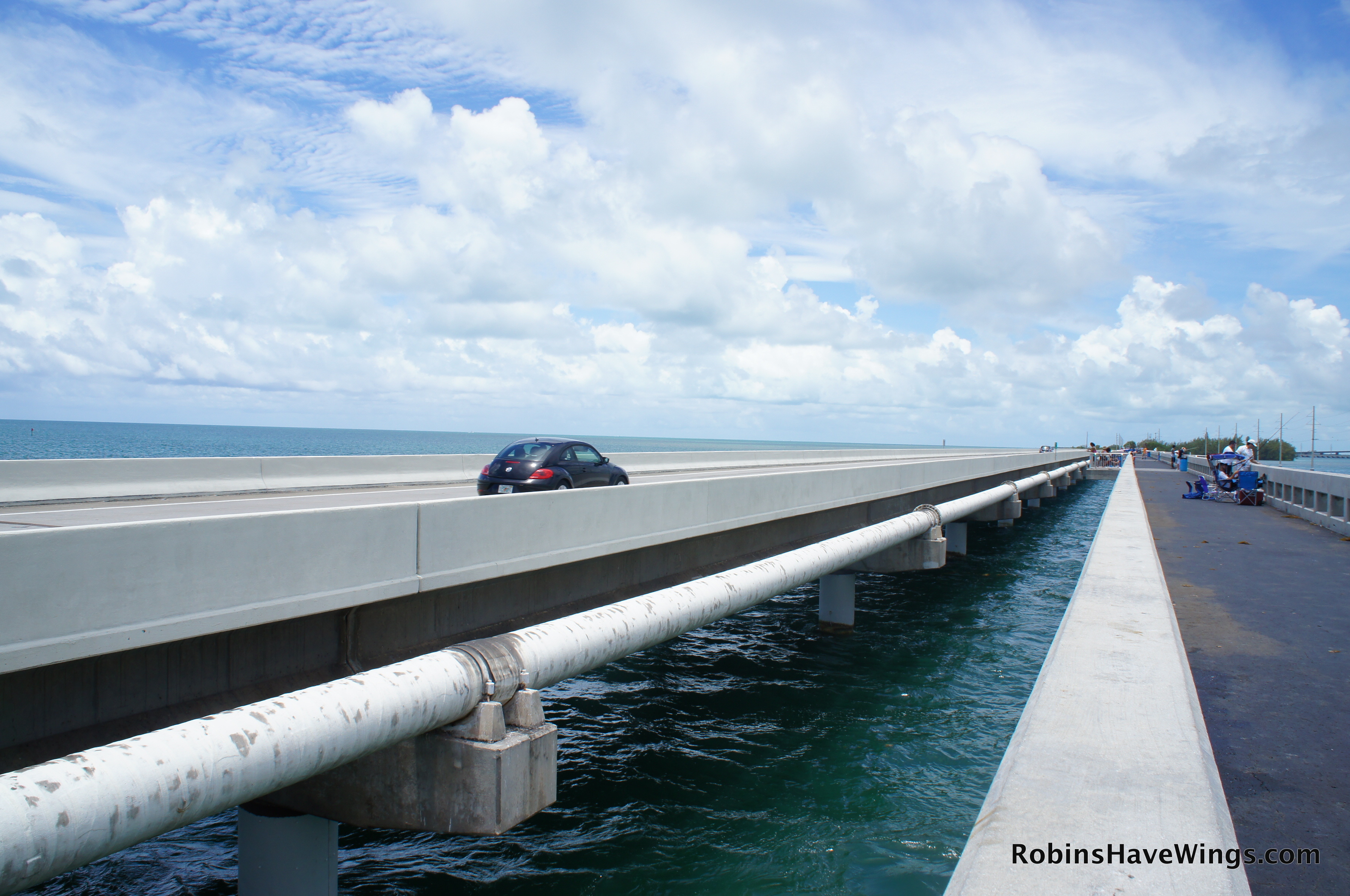
Overseas Highway in the Florida Keys

11. Johnson’s Grocery in Key West’s Bahama Village

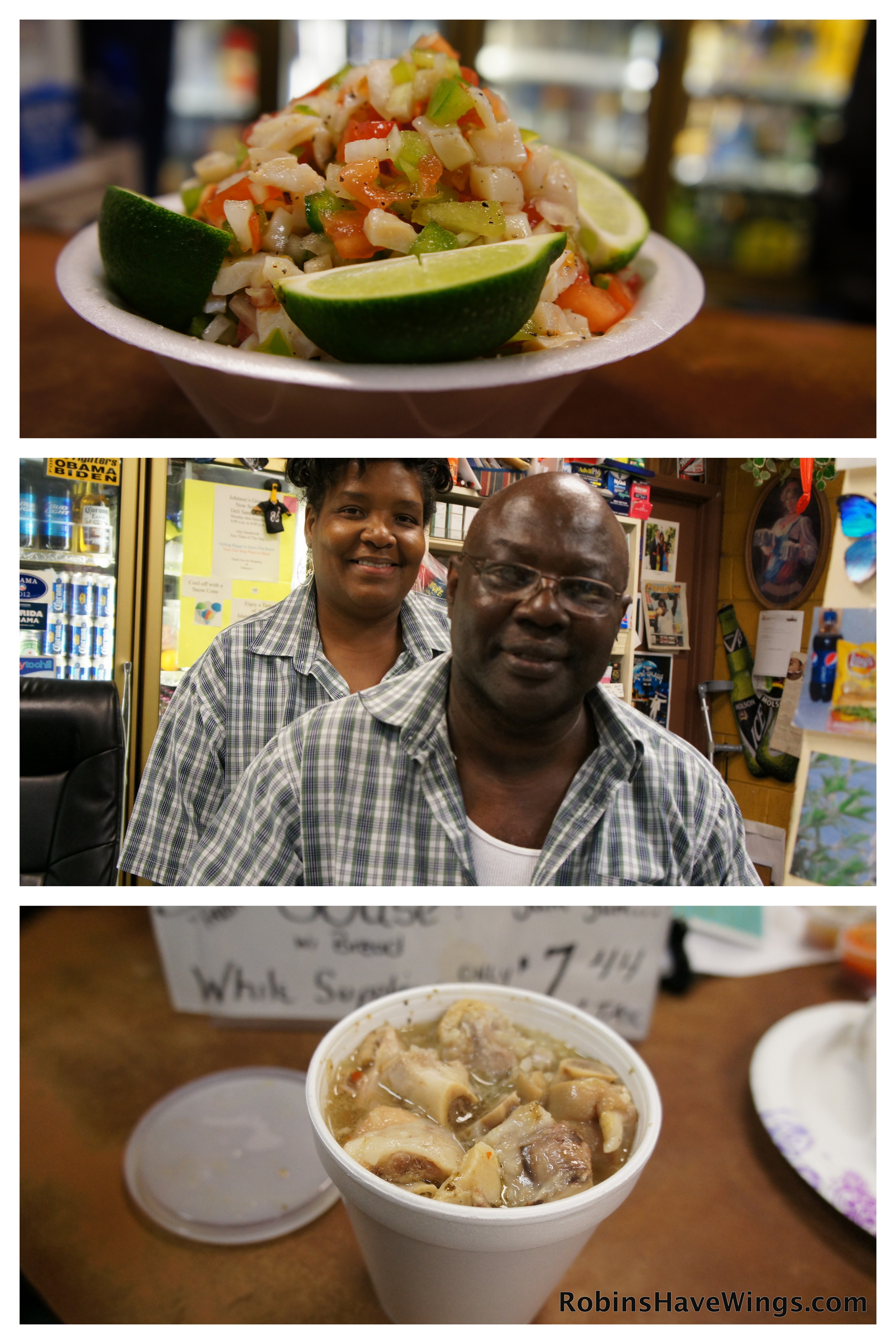
You might walk right past Johnson’s Grocery Store on Thomas Street in Key West. It’s a non-descript blue building with refrigerator flaps for a door. But you’d be making a big mistake. Mr. B. Johnson and his wife Brenda are a delight and serve the best conch salad in the Keys and probably beyond. They are 5th generation owners of the grocery and deli that also serves a mean souse, according my friend Wanda. Souse is a Caribbean soup of pigtails and other bits. They also sell pigs feet, pickled eggs and “slide off the bone” ribs.
10. Sipping Wine on a Schooner in the Keys

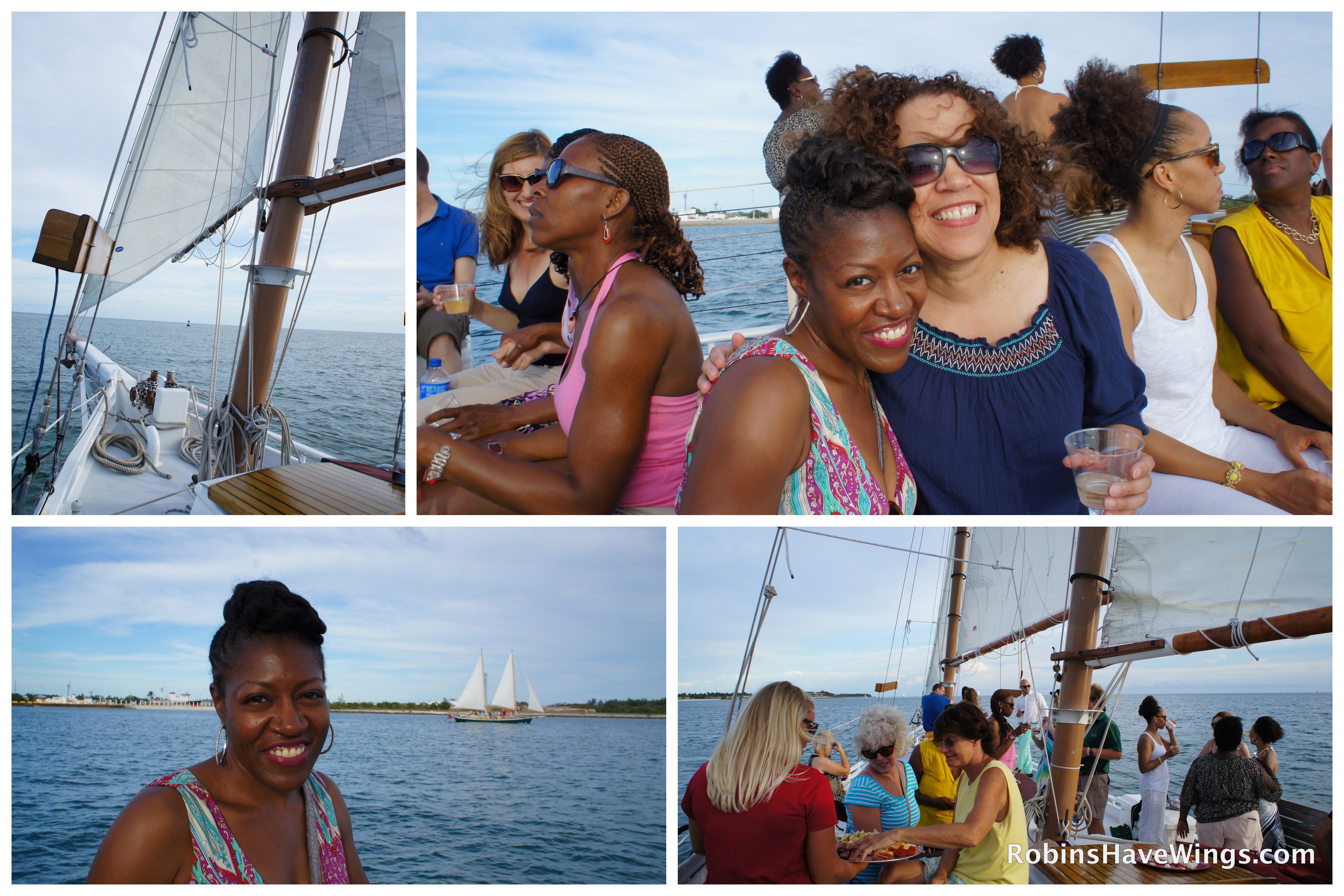
Being on a boat with wine and cheese is fun. I realized that I don’t do this nearly enough aboard a Danger Charters schooner with a well poured tasting of wine.  This was my friend Kim’s fabulous idea and one of the highlights of her birthday festivities in Key West. I think the pics tell the story.
9. Karaoke and Live Music in Key West

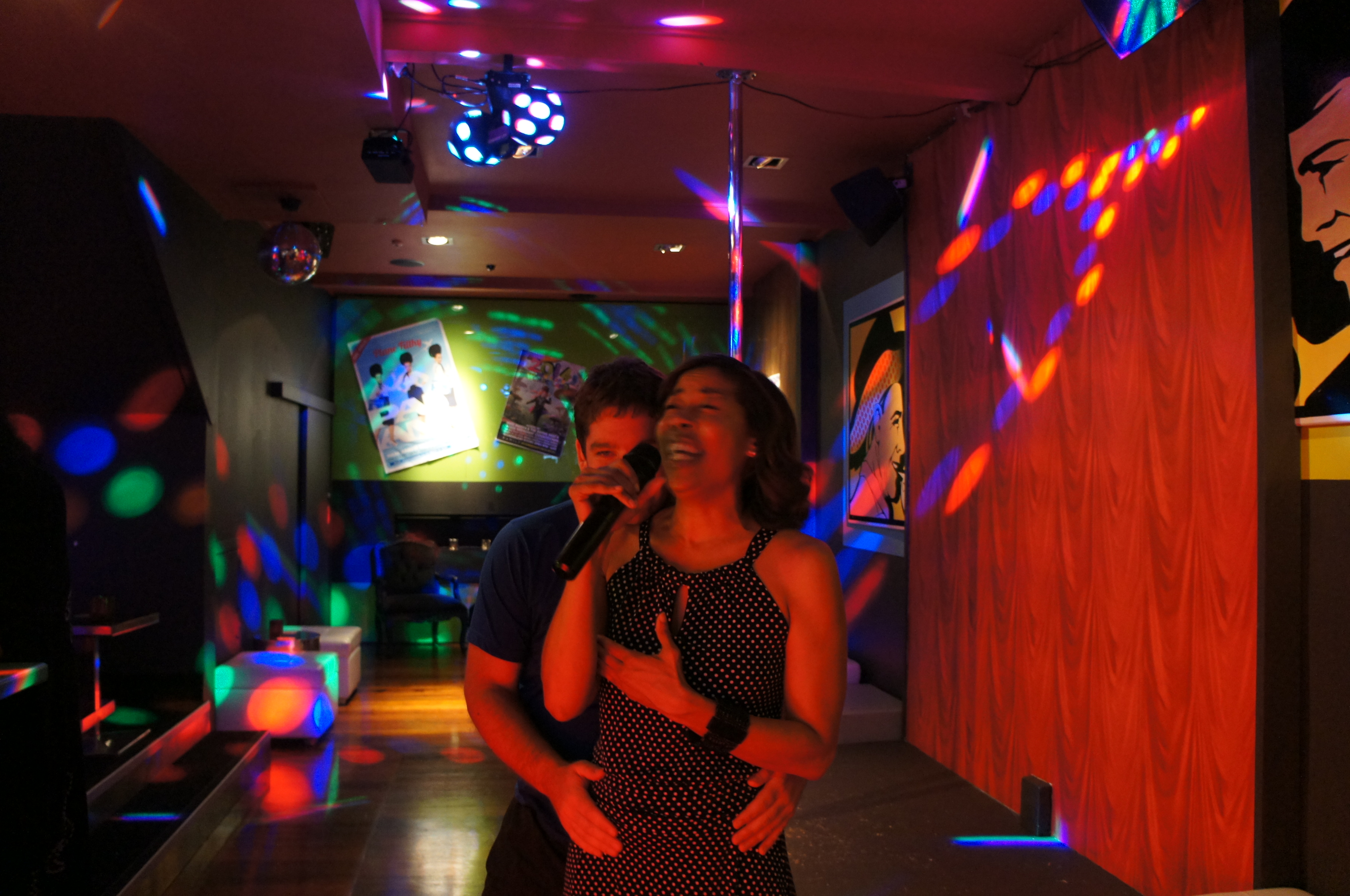
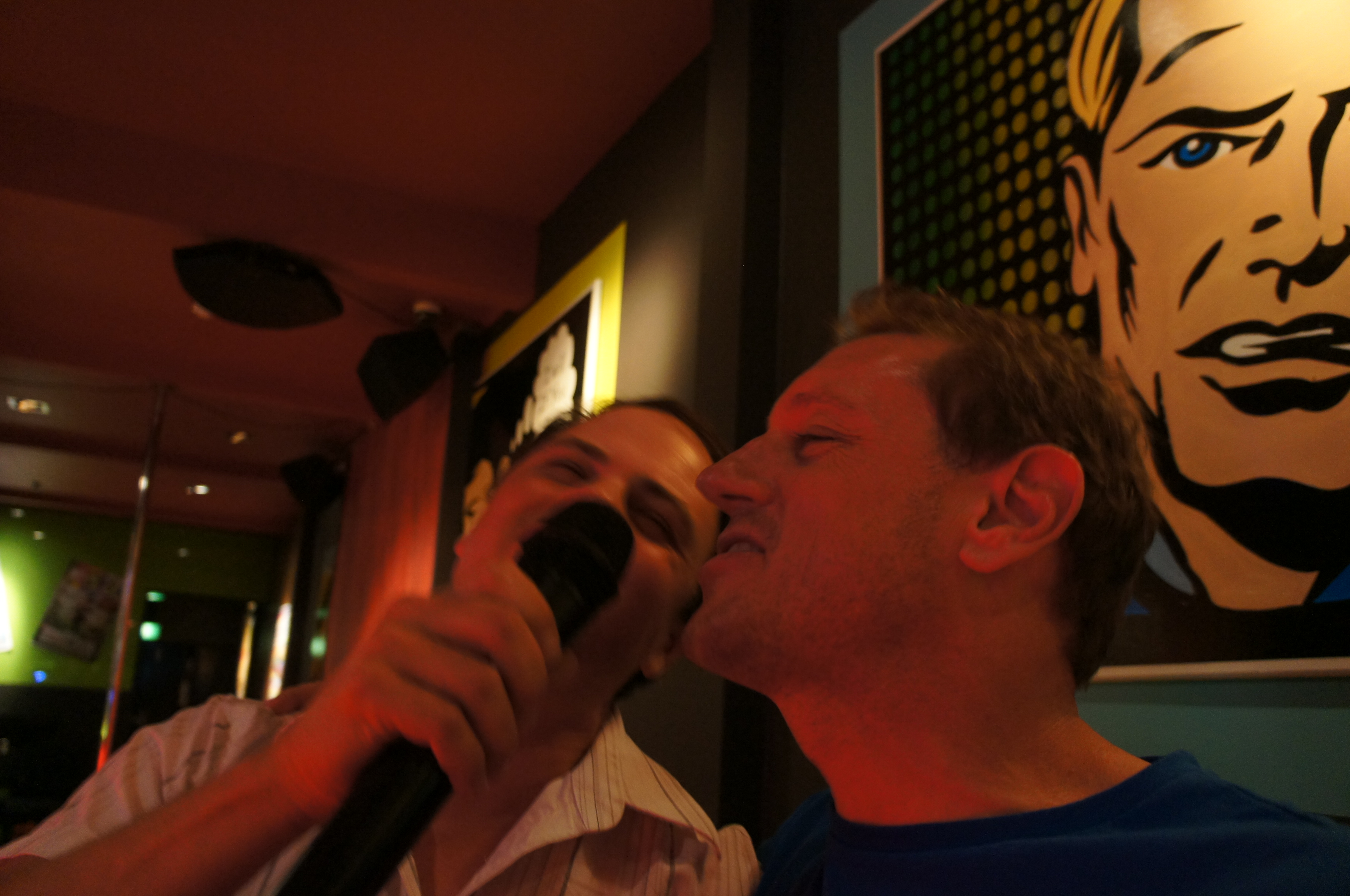
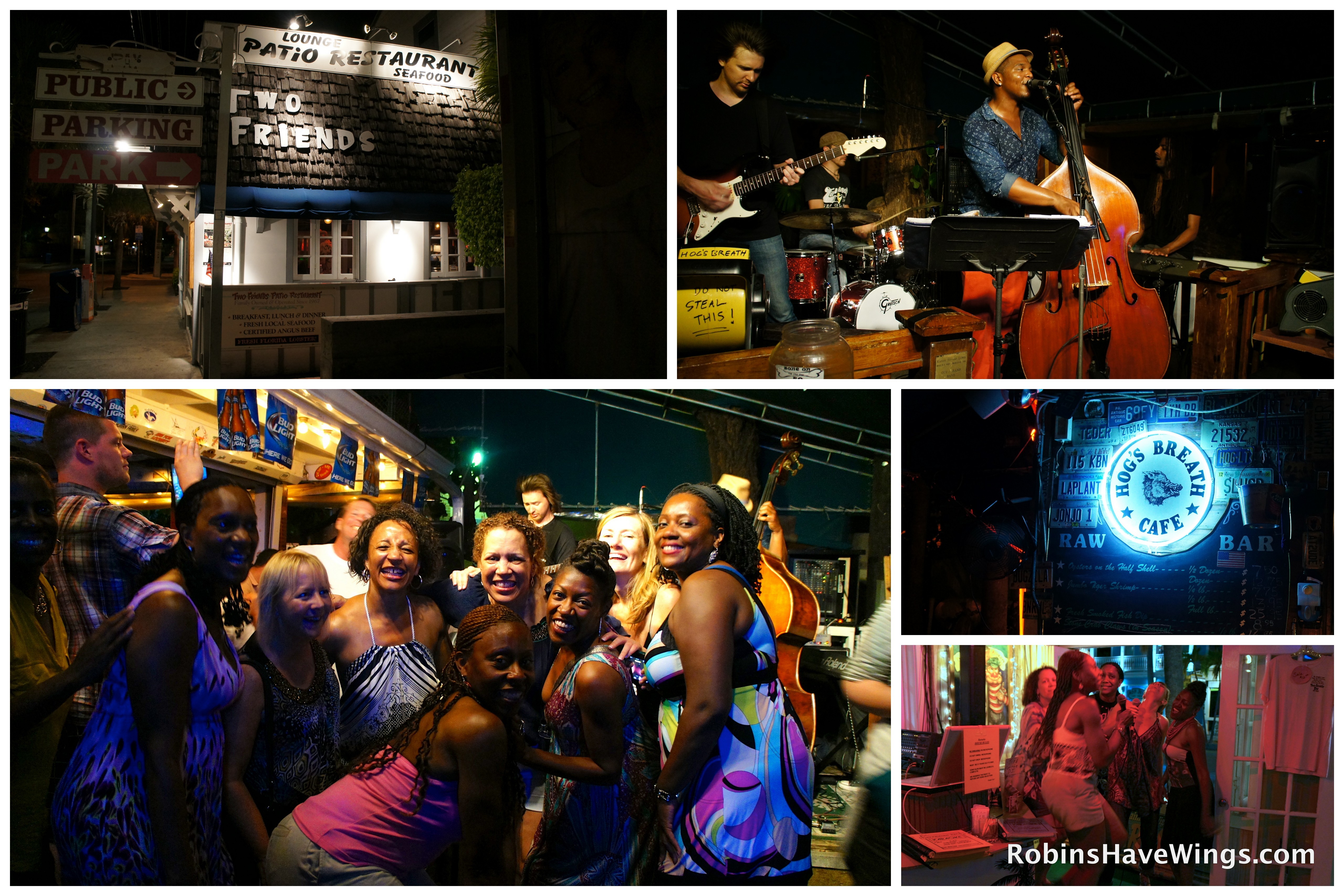
Karaoke is also fun, especially at a bar called Two Friends in Key West. We picked the wrong version of “It’s Raining Men,” but we killed it, nonetheless. And, we were back up for a blonde twentysomething with amazing rap skills on Young MC’s “Bust a Move,” which we did enthusiastically. I suspect many places in Key West offer just as much over the top revelry, but we also enjoyed the Hog’s Breath Saloon with an amazing band, The Reggie Sullivan Band, with the most inventive covers of pop songs mixing reggae or salsa where one would never think. We danced and danced until we couldn’t any more.
8. Miami’s Art Scene

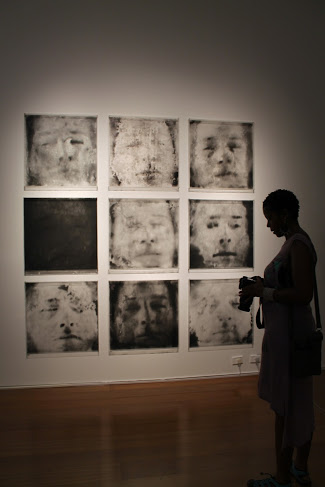
What do you do on a rainy day in Miami? Check out its galleries showcasing the vibrant hues of Cuba and the Caribbean. I was determined to go to South Beach even though the clouds looked pregnant with rain. Moments after leaving my Airbnb pad the skies opened up. I ducked into the ArtCenter/South Florida, an enchanting maze of art galleries, including the hyper-realistic work of Tony Chimento. His work reminds of another realist painter, Chuck Close, and I told him so. He said he was definitely an admirer. Later, after lunch with a friend in Little Havana, we contemplated the Afro-Cuban faces of Santeria gods and goddesses at the Molina Art Gallery and met artists-in-residence Annie M and J. Ubaldo Arias in the Futurama Building, the epicenter of Little Havana’s Viernes Culturales, an artsy block party held the last Friday of the month in Miami.

7.  Gator-Spotting on the Mobile-Tensaw Delta in Mobile, Ala.

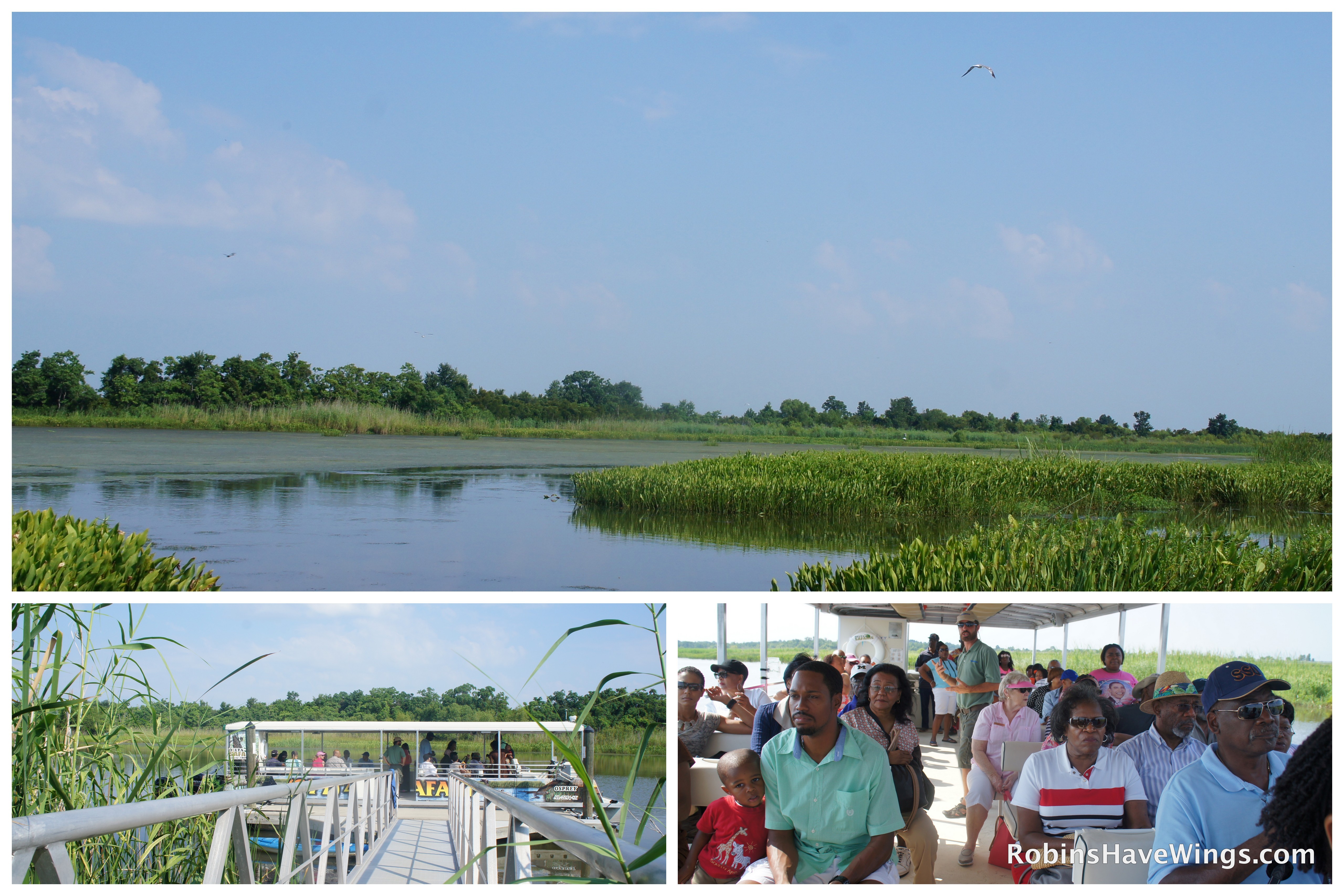
Family reunions aren’t just for reconnecting with family; they are also great for reconnecting with a place that you’ve left or once had meaning in your childhood. That was my feeling while touring the Mobile-Tensaw Delta. I’d spent summers in Mobile as a child and had fond memories of my 6th or 7th birthday aboard the USS Alabama in Mobile Bay, but floating on a pontoon hosted by Delta Safaris and getting close to its wildlife left me with cool new memories.
6. Nantucket

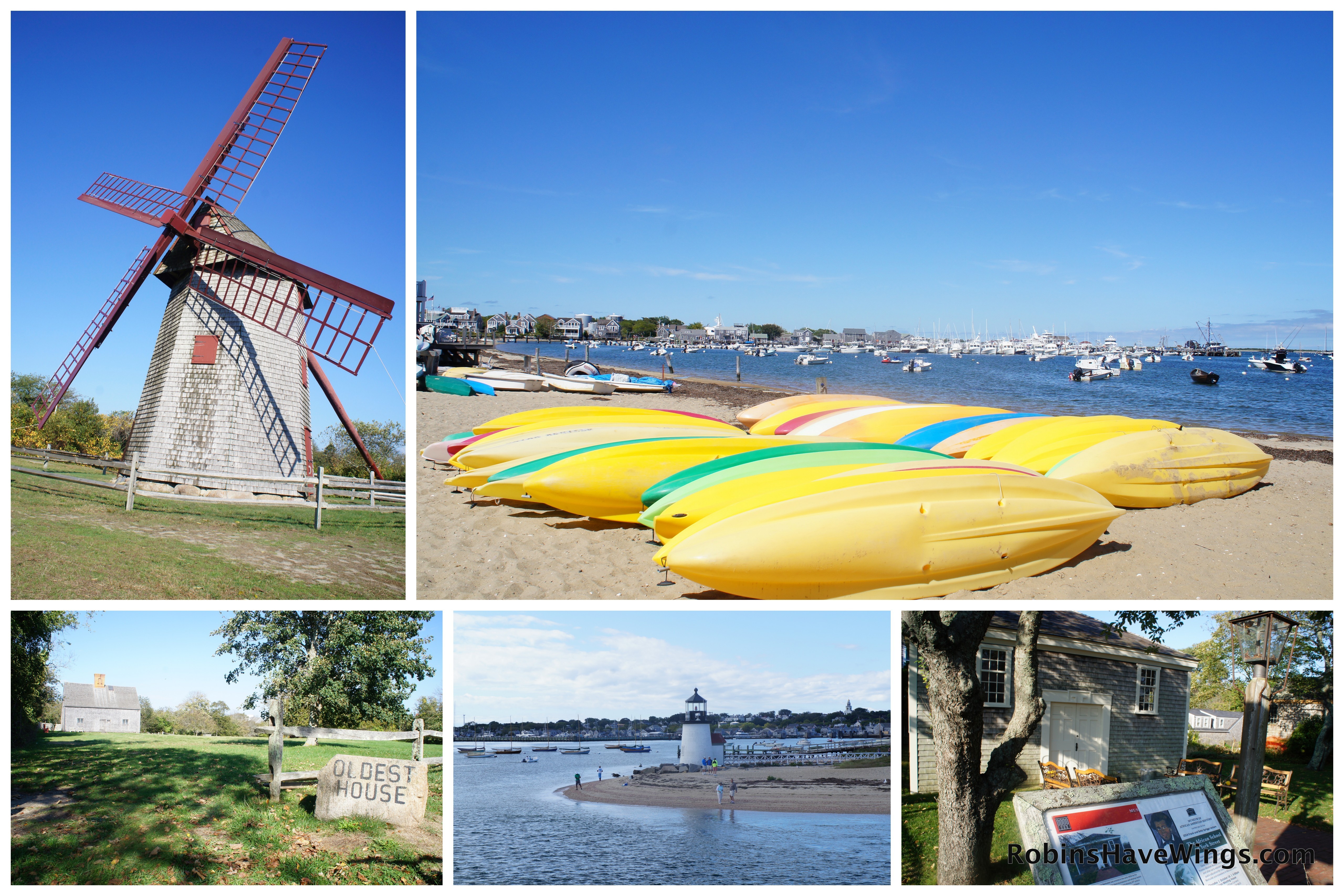
I spent more family time in Nantucket and its beauty is simple and grand at the same time. Renting a Lilliputian fisherman’s cottage in Sconset overlooking the Atlantic could set you back $500 per night. But the island’s simple pleasures don’t have to cost you. Bike the 33 miles of bike path crisscrossing the island past impressively old structures like the oldest windmill in the US, Nantucket’s oldest house, the old African Meeting House and graveyards dating back to the 1700s.
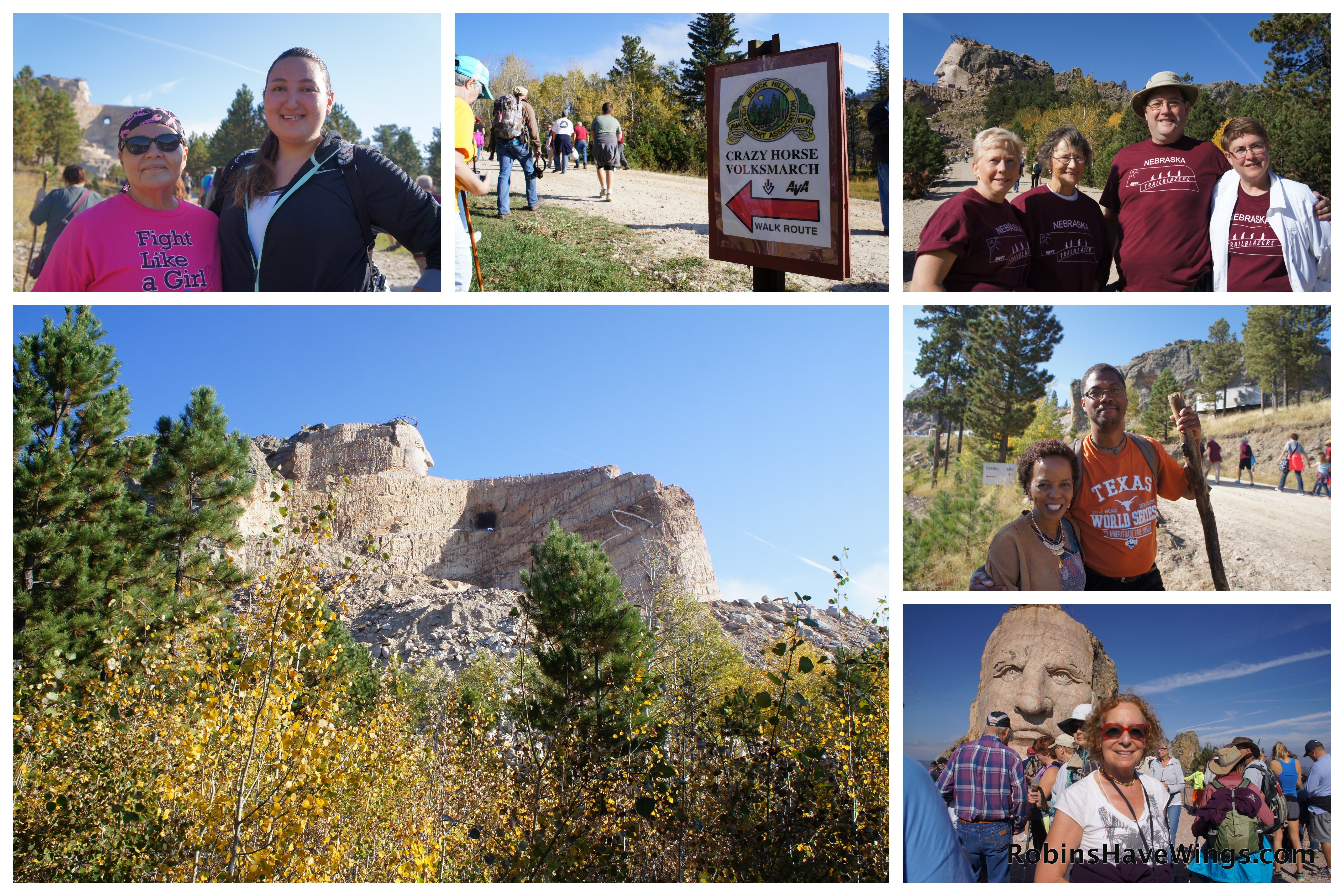
5. Crazy Horse Memorial Volksmarch in Crazy Horse, SD

I’d never heard of a volksmarch until I did one at the Crazy Horse Memorial in South Dakota. There are organized walks sponsored by local walking clubs all around the world. They walk past cultural sites, along cultural routes and scenic paths. I was told this one was a big event and the second time it was being held in the fall. A larger walk takes place in June. I thought it would be a great way to take in the memorial, an ongoing labor of love to commemorate the Lakota Sioux chief that took a stand to keep his people’s land. It turns out that it was great way to meet a few South Dakotans and other folks who just like to go for a walk.

Verna and Tommi were a mother-daughter pair from the Cheyenne River Sioux Tribe who have made this walk a family tradition and testament to Verna’s strength as a breast cancer survivor. I fell in step with a Nebraskan walking club and met a fit Jill Champley who has walked 51 capitals in 51 days. She’s in her 80s. Sheila and William White live in Houston, but loved their walk here so much they decided t come back. And, I can’t forget Fredda Seidenbaum, a real spitfire from New York City who teaches Zydeco dancing and took my triumphant photo with Crazy Horse himself.
4. Road Trippin’ Through South Dakota’s Black Hills

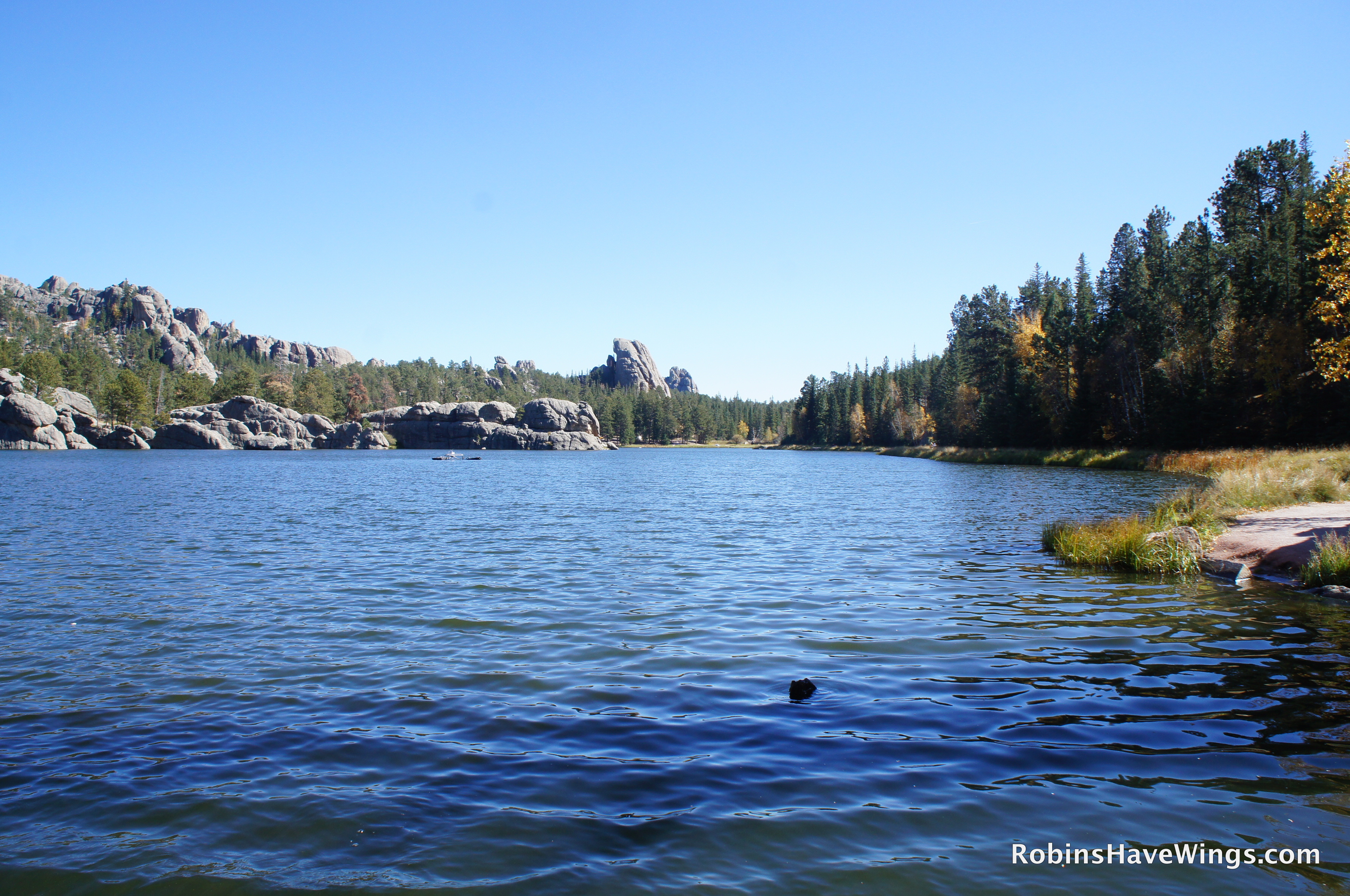
I wrote about my fall drive through South Dakota’s Black Hills for TravelChannel.com, but I wanted to share more of my photos here. Sylvan Lake in Custer State Park is an absolute stunner as is Spearfish Canyon.
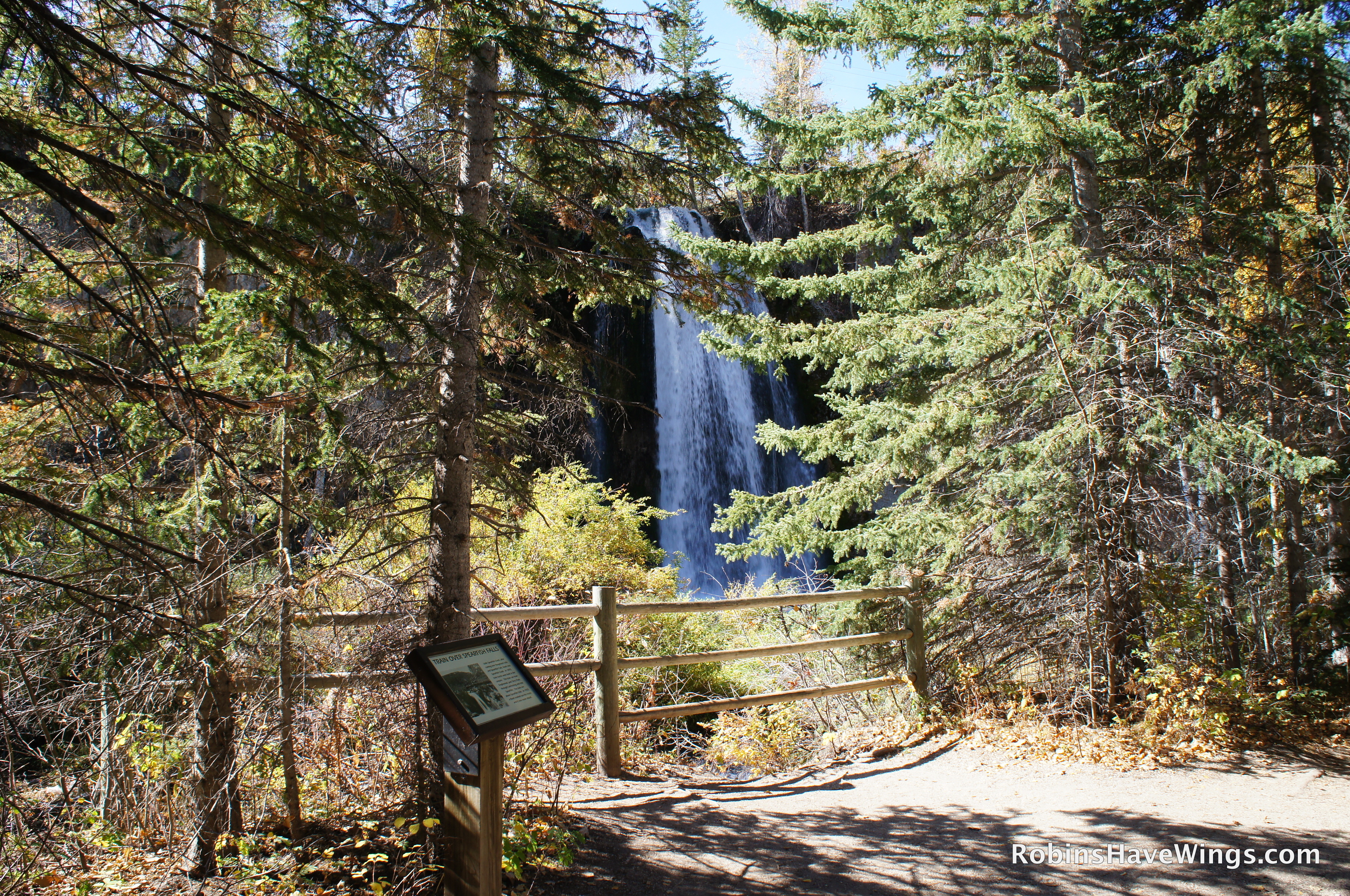
Little Spearfish Falls in Spearfish Canyon
South Dakota’s Black Hills
Sylvan Lake in Custer State Park with the Needles in the distance.


3. Mount Rushmore and Blondell, Dot, Coco and Francine

When I was invited to visit South Dakota, I knew I wanted to see Mount Rushmore if I didn’t see anything else. You get great glimpses of it while driving the Iron Mountain Road. Seeing it up close makes you wonder, how in the world is this possible? It’s an absolute marvel of modern engineering, featuring complicated pulley systems and perfectly placed packs of dynamite. I highly recommend the audio tour to get all the trivia or touring with a park guide. I was walking right under the presidents’ noses when I met Blondell, Dot, Coco and Francine who were driving across country. They were having a blast photographing Mount Rushmore and themselves with their iPads. They teased each other mercilessly like sisters. Mount Rushmore was the highlight of their trip so far, along with the Corn Palace, celebrating every variety of corn known to man. Their zest for life was so infectious I almost wanted to hop in their car and keep driving across country with them.
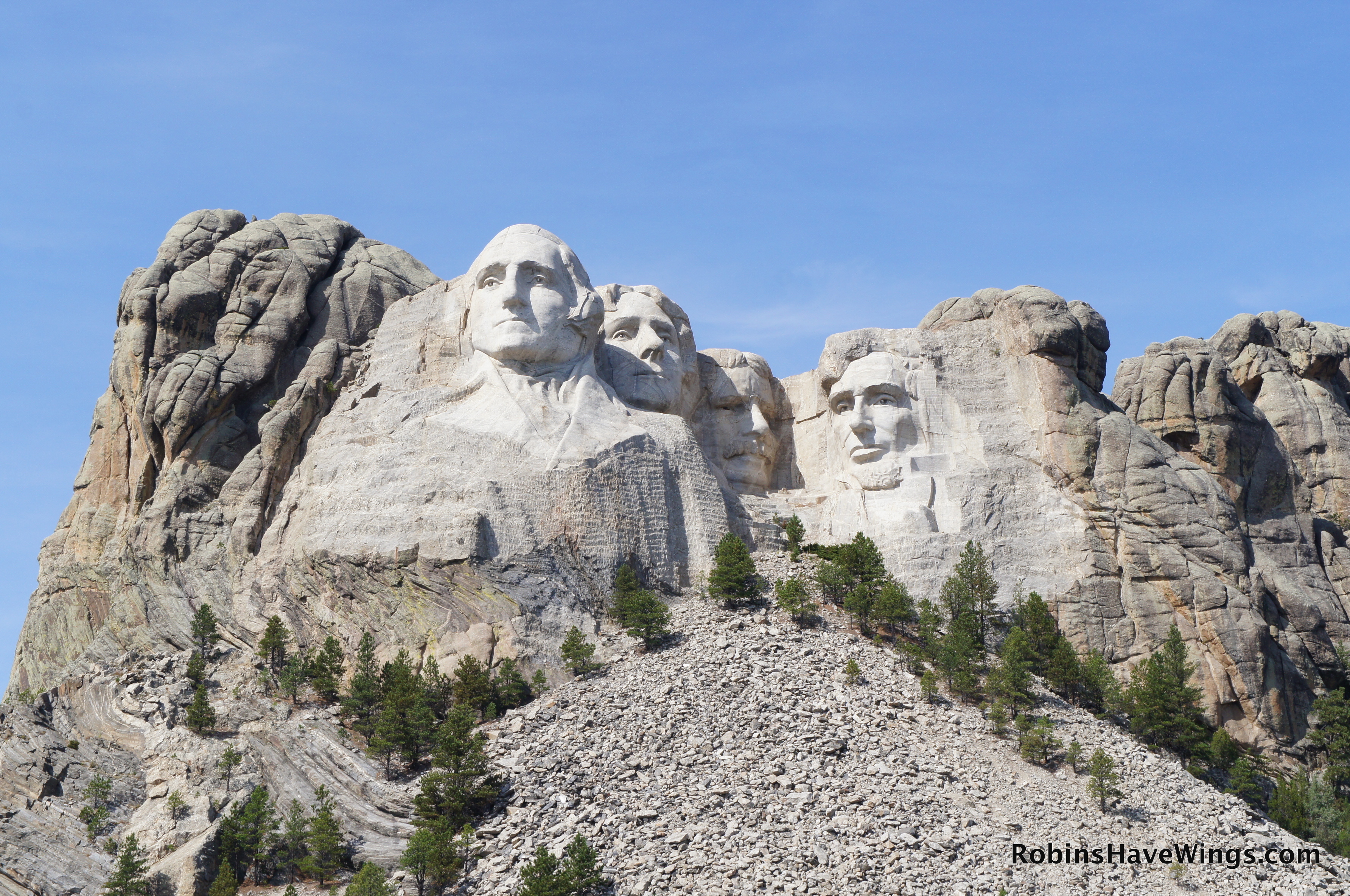
Needs no description

Road Dawgs: Blondell, Dot, Coco and Francine

2.  A Buffalo Close Encounter and Making Friends at the Buffalo Roundup

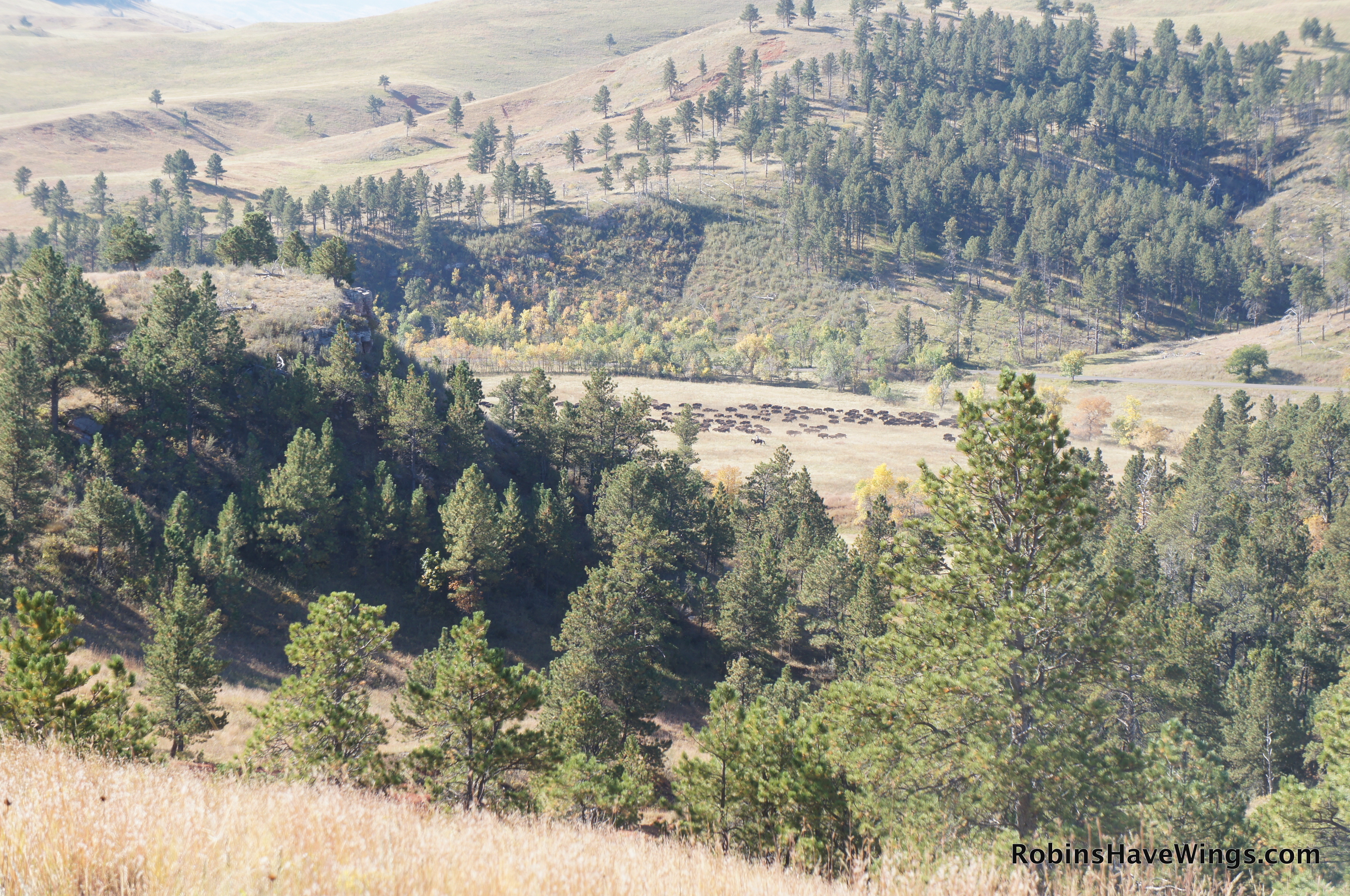
I’d never been so thrilled to come to a complete halt on a roadway before. A buffalo decided to cross the road and stop right in front of my car. I could see the whites of his eyes and it was awesome and scary all at the same time. Wouldn’t trade it for anything. A park policeman drove up with sirens blaring to scare it off the road. I guess that’s part of their job description. I was on my way to the Custer State Park’s annual buffalo roundup where spectators gather to see 1,100 descendants of the last original buffalo herded for their annual vaccinations or sold for breeding. This year marked the 100th anniversary of the reintroduction of 30-35 buffalo to the park after their near extermination.

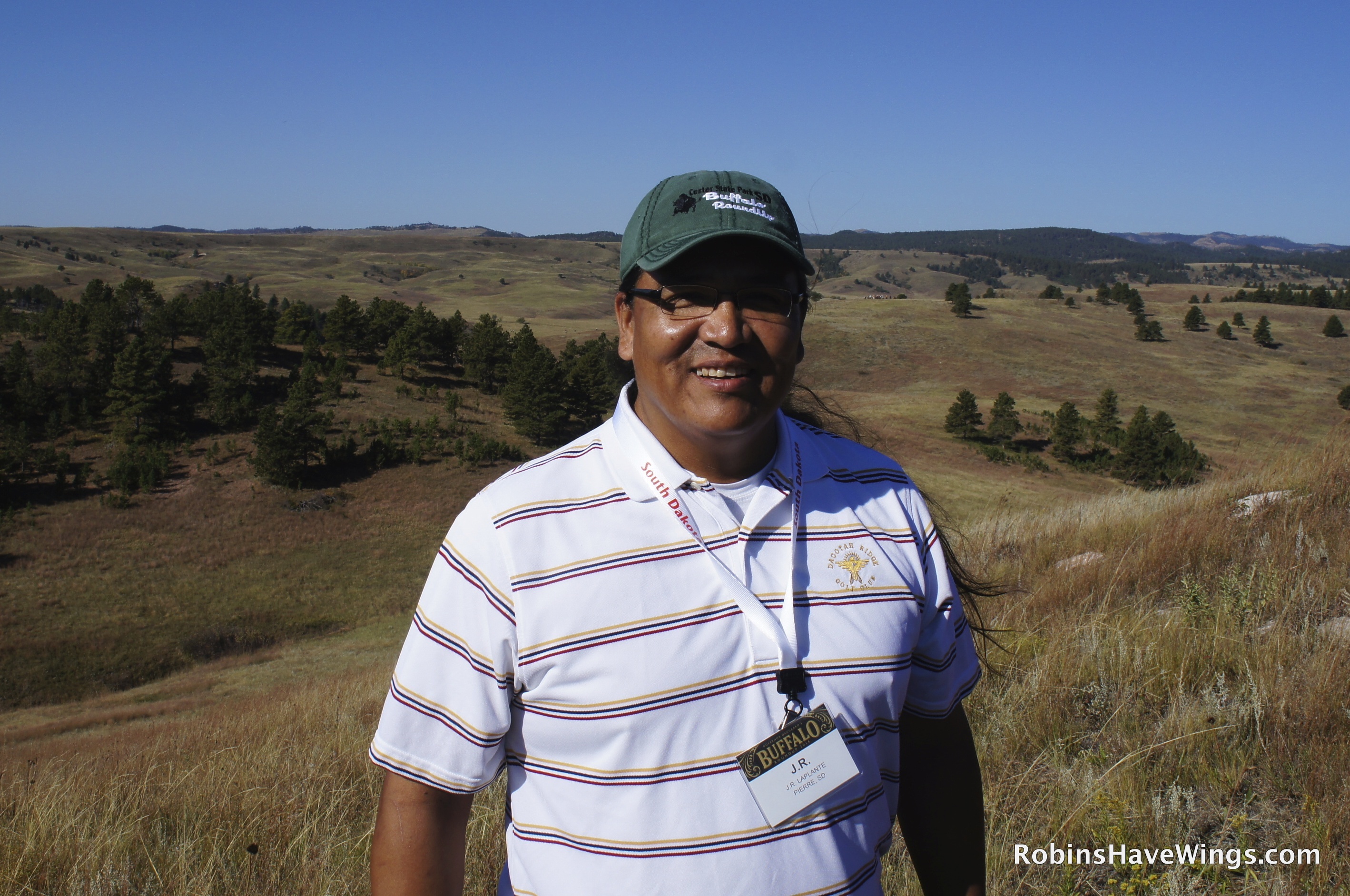
Casey Peterson once herded these buffalo himself and was my personal guide to the Roundup, explaining that you have to keep an eye on their tails. If it’s flicking, you better back up. He was surrounded by behemoth bison once and had to ride out before getting trapped and thrown off his horse. Casey has a kind and easy-going way about him and was eager to share his love of South Dakota with me. He introduced me to JR LaPlante, the cabinet secretary for tribal relations in South Dakota and a descendant of the Sioux tribe that were caretakers of the last buffalo. Meeting Casey and JR put a face on the entire event and made it much more memorable. Casey brought it full circle as we watched buffalo bound through a valley in the park.

“It’s a ritual that represents fall, like gathering of the harvest. It represents something that you can’t see in a lot of places,” he said. “It’s important to preserve things that are natural and rare.”

Couldn’t agree more.
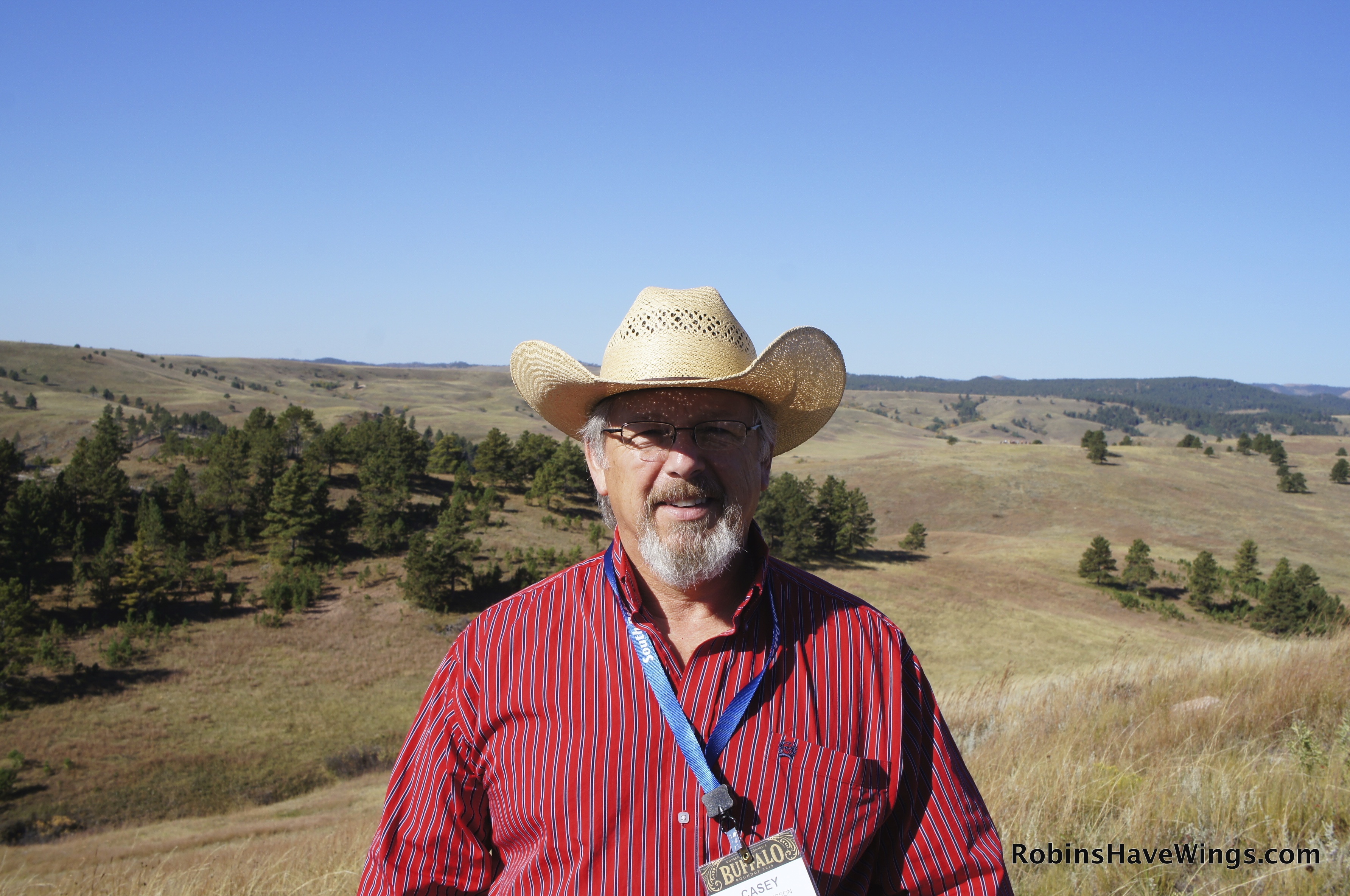
Cowboy, CPA and wise South Dakota Philosopher, Casey Peterson
JR LaPlante, cabinet secretary for tribal relations in South Dakota
Buffalo rumble through Custer State Park

That picture doesn’t do this event justice. Check out the video and hear the rumbling yourself. As a bonus, an antelope gets into the act.

Buffalo post roundup

1. The Badlands

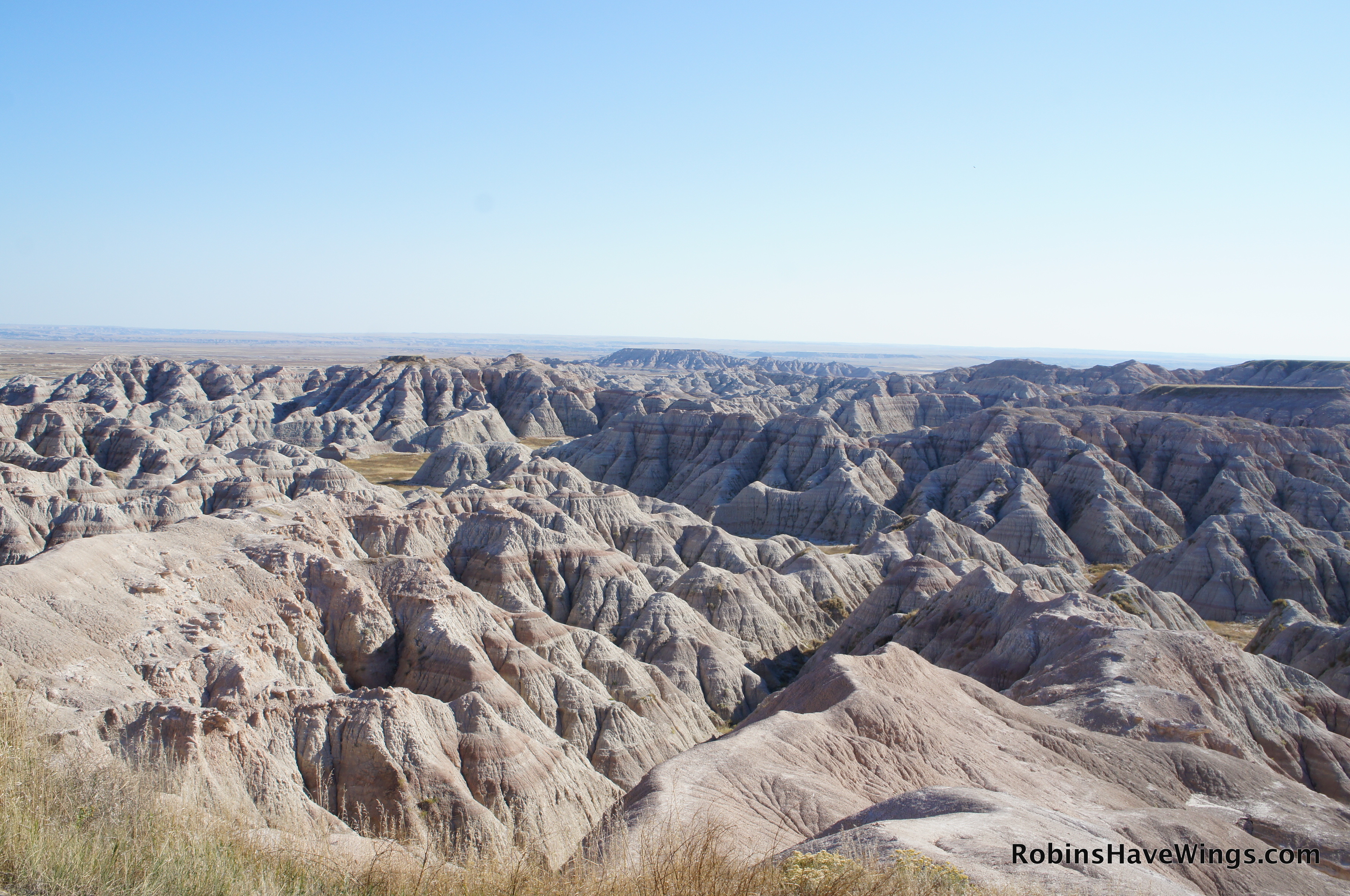
I’ve never been to a place more otherworldly. I imagine that The Badlands must be what the moon looks like, or maybe Mars. Ridges of rock rise and fall all around you, including rounded mounds in ombre shades of orange, pink and yellow. They were once at the bottom of a vast sea, which might explain the tufts of low-lying vegetation. Millions of years of erosion and changing climates did this. Stand still at one of the many overlooks and hear absolute and utter silence broken only by the sound of a winged insect buzzing past. Striking.
 

I start 2015 with a trip to Puerto Rico where I plan to party in the streets for its San Sebastian Festival, akin to their Carnival, and visit Puerto Rico’s sister islands, Vieques and Culebra. I’m not sure what other travels will unfold, but you know robins have wings and they can’t stay grounded for long.
 

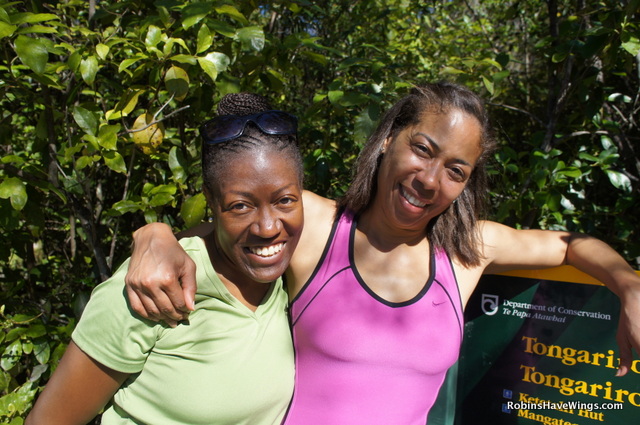
Taking on New Zealand’s Tongariro Alpine Crossing

The other passengers on the HotBus to Tongariro Crossing ask us if we want to play a game. Tanya and I say, “Sure.” It’s a two-hour ride from Rotorua toward Taupo and it seems like a good way to entertain ourselves. Rachel, originally from New York, but currently living in Germany, asks if we’ve played “Contact” before. Neither of us has.

The way Rachel explains the game, it sounds like a word game of tag. Someone starts by thinking of a word beginning with a certain letter. Other players have to guess the word by asking a question. If other players know the word that the player asking the question is thinking of, they have to say, “3-2-1, Contact!” and say the word at the same time as the player asking the question. If they’ve said the same word, the original player starting the game has to reveal the next letter of the word they are thinking of, helping to generate more questions and guesses. It was a bit confusing in the beginning, but once we started playing, it was tons of fun especially when you are playing with brainy people who choose words like barnacle and mitre, which happened to be the name of my high school year book.

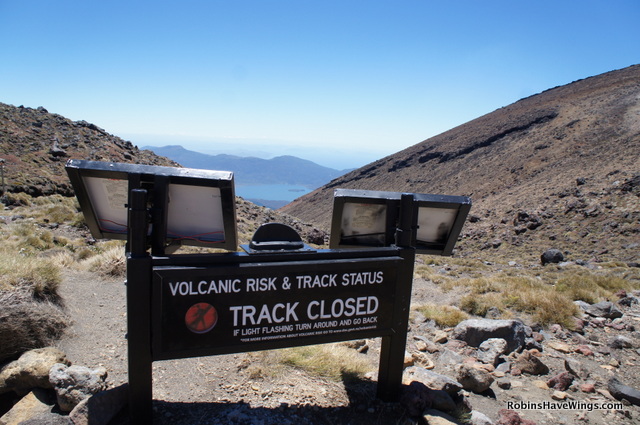
Rachel is visiting her sister Alyssa and her father Brian who now live in Rotorua. Kent and Jo from Massachusetts are visiting, too. They have the same plan to climb Tongariro and are just as worried about whether or not they’ve dressed appropriately. It’s a chilly morning and it seems to be getting colder. By the time we arrive at 8 am, the winds have picked up and I’m a little nervous about what lies ahead. It isn’t made any better by the fact that our driver handed us information on what to do in the event of a volcanic eruption with a picture of an ashen and quite dead victim of Mount Vesuvius. Not very comforting at all. The instructions are even less so, urging us to stop and look for burning ash and flying rocks before running and then giving the opposite instruction not to turn away from flying rocks until you are sure they will hit you.


View Tongariro Alpine Crossing, Tongariro National Park in a larger map

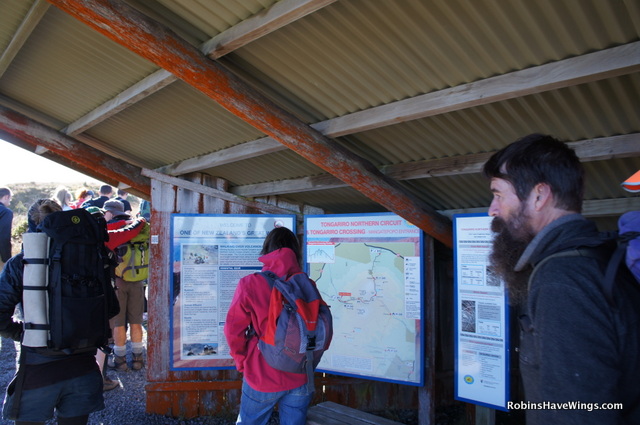
(This was our Tongariro route. We traveled from the lowest point on the map, Mangatepopo Road, to Ketetahi Road at the top.)

With these notes in mind, we part ways with our new American friends and meet our guide Mel from Walking Legends Tours. She guides us over to another van to pick up lunch and snacks for the trip up, along with rain jackets that we put on immediately to shield ourselves from the wind. Mel has an easy-going way about her. She tells us that this is our trip and that we can go at our own pace. It’ll be a full day hike, about 8 hours covering 10 miles. While we can go at our own pace, we’ve got to be back by 4 pm to catch our bus back to Rotorua. Mel also gives more comforting instructions on what to do should Tongariro or its volcanic neighbor, Mt. Ngauruhoe, also known as Mt. Doom in “Lord of the Rings,” decides to erupt: Grab hands, turn and run. Sounds like a plan.

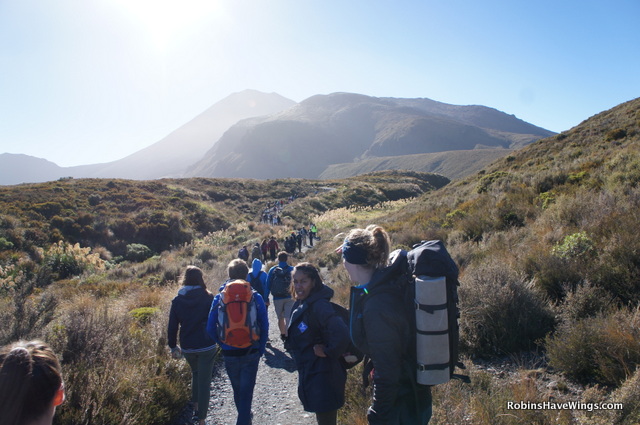
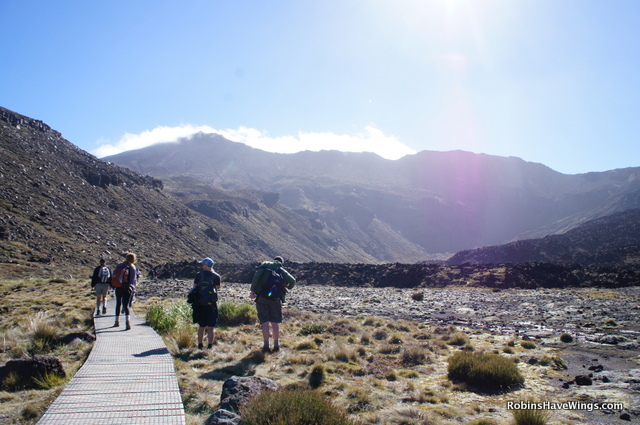
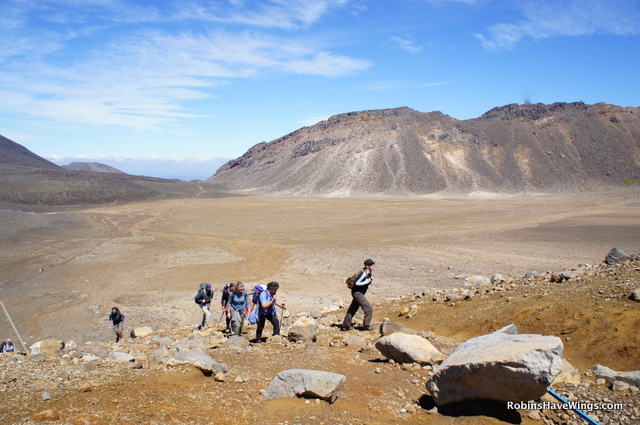
We aren’t the only ones making the Tongariro ascent. There appear to be at least a hundred others making the same trip and we start along with them single file up a modest dirt incline. Mel says it can get even more crowded during the summer months with as many as 3,000 people attempting the climb in a day. We progress across a narrow plank way and Mel tells us the park system is building and maintaining pathways all along the crossing. The land we are crossing actually belongs to a local Maori tribe and members sit on the park board as advisors to make sure that sacred areas are protected with the eventual goal of taking over management of the land. I am glad to hear this and I’m again drawn to comparisons to this nation’s Native Americans. Mel thinks that because New Zealand is a relatively new country, they learned from other’s mistakes and are taking a different approach of inclusion.

Start of Tongariro Crossing at Mangatepopo Road
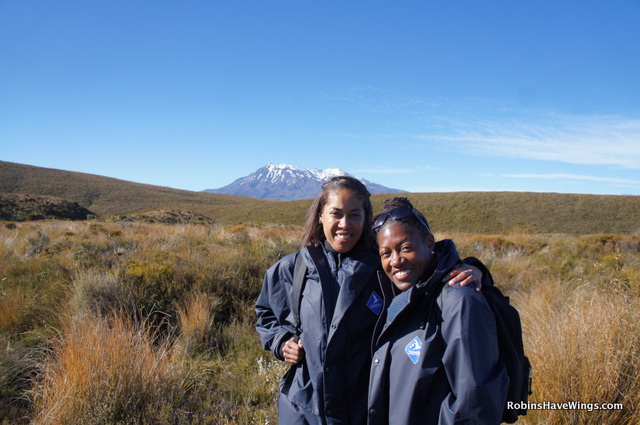
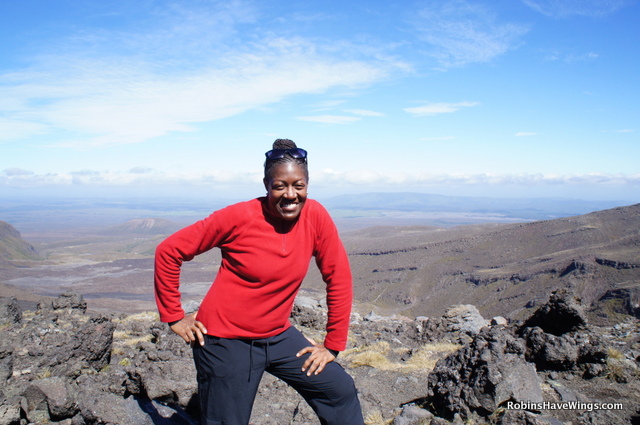
Pre-trek photo with Mt. Ruapehu in the background, a popular hiking and ski destination
And so it begins
A boardwalk into the mountains

We start to scramble across some rocks alongside a pretty stream of water and small waterfalls appear. It’s here that we start to realize what a gorgeous day this is shaping up to be. The sun is high, the sky is a perfect blue and it is starting to warm. Not too long after this realization, we come to another realization that it’s time to put in some work, because we reached the “Devil’s Staircase” and we watch people trudge up a series of haphazard stairs built into the mountain. This is where a lot of people struggle, Mel says, adding that we shouldn’t stop because it is harder to keep going if you do. The key is to maintain a steady pace. Somehow at this point I am in the front and I’m in attack mode. I want to power up these stairs. I can see the next ridge and I’m using it as motivation. Behind me, Mel says, “Robin, you’re a machine.” I keep at it until my lungs tighten in protest. I’m practically wheezing and trying to catch my breath, while Tanya has fallen a bit behind. I tell Mel that I can’t keep the pace and she takes over, taking each step with a slight pause to slow the pace and Tanya and I are grateful. It allows us to recover and the walk feels a little more manageable. If I’d continued at the pace I set, I’d be one of the people we are passing, now, sitting at the edges of the stairs with withering looks of exhaustion.

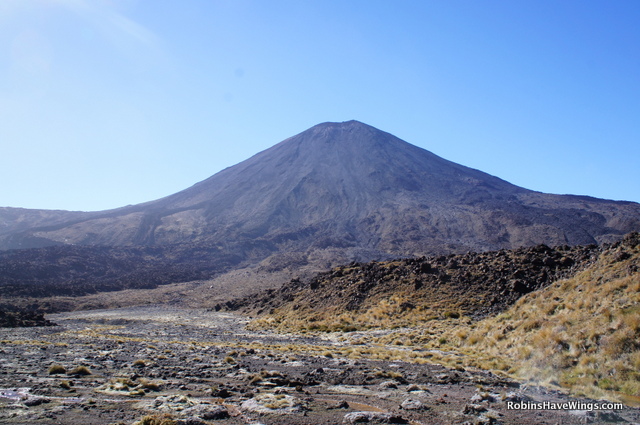
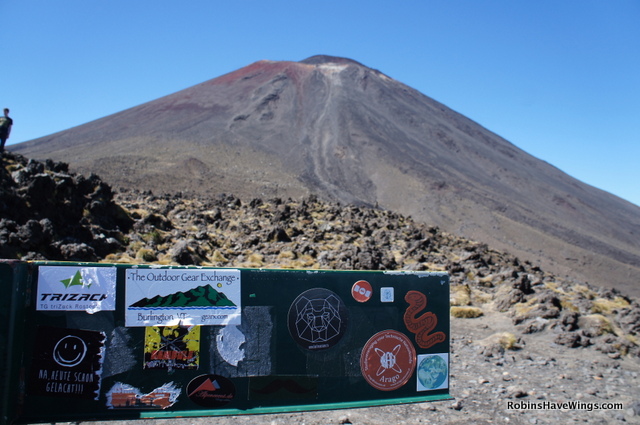
Of course Mel’s words of encouragement help, “How are you doing, ladies?” “Is this pace OK?” “You’re doing great.” Before we know it we’ve conquered the Devil’s Staircase and Mt. Ngauruhoe, AKA Mt. Doom, looms next to us. Mel says we’ll see the mountain throughout our trek from varying perspectives, at times it will look smaller and at others bigger. We reward ourselves with a closer look for the moment and a water break. There’s a signpost here where previous trekkers have left their mark in stickers. Tanya and I think of an artist friend who has been leaving his bespectacled visage all over DC and we wish we’d thought to bring one of his stickers to leave behind.

Mt. Doom, aka Mt. Ngauruhoe, from flat ground
We made it past the Devil’s Staircase where Mt. Doom looms
Devil’s Staircase conquered. We’re only a third of the way to the top!

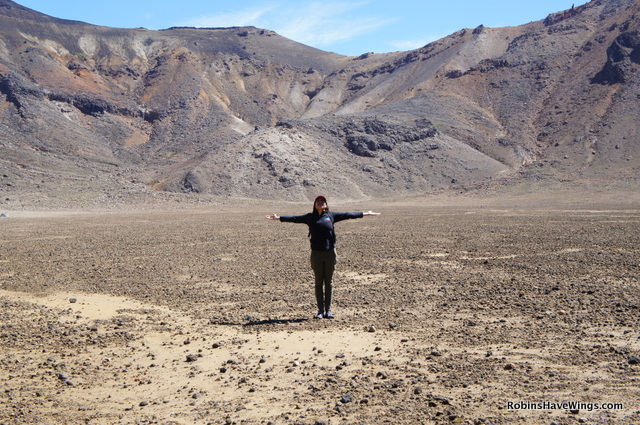
We’ll get even closer to Mt. Doom, but not before passing through the much heralded “Helm’s Deep,” site of the epic battle between the last men, elves, a white wizard and evil snarling orcs hell-bent on taking over Middle Earth in the Lord of the Rings movies. This part of our trek is a pleasant surprise, particularly for Tanya. We knew we’d be traveling in the shadow of Mt. Doom, but now, Helm’s Deep? Tanya is beside herself. (Further research suggests that our guide may have missed the mark here, Helms Deep was actually filmed near Wellington. Oh well, it sure looked like Helms Deep. Don’t tell Tanya.) She stands with arms outstretched in one of the few flat areas on the mountain, soaking in the Lord of the Rings aura.

Helms Deep? Don’t worry Tanya. The orcs may have marched here on the way to the Black Gate.
Marching out of “Helms Deep”

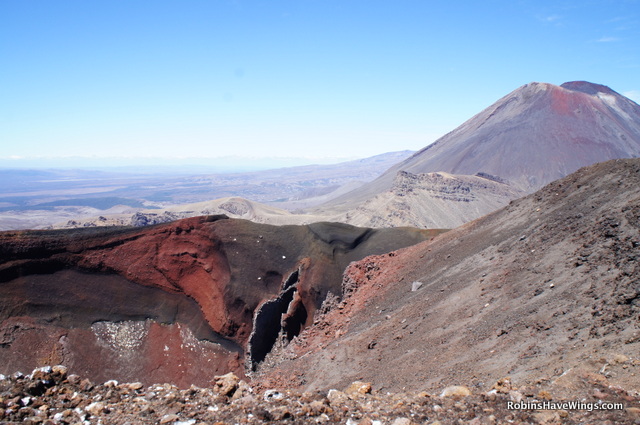
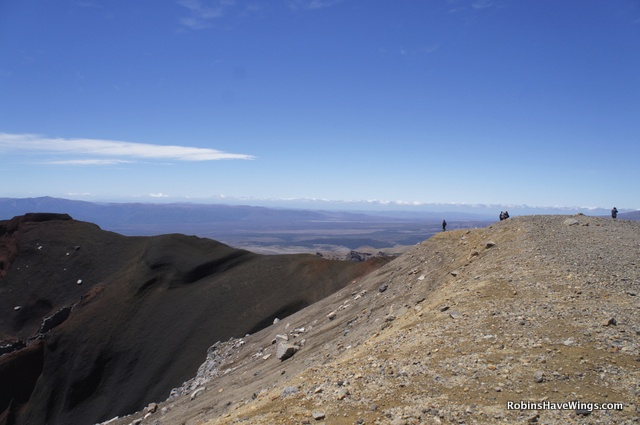
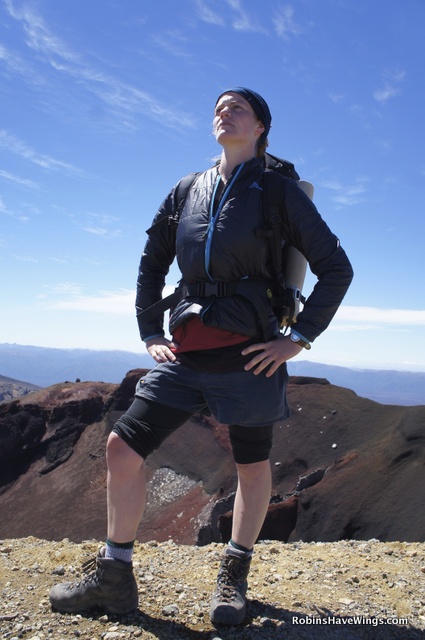
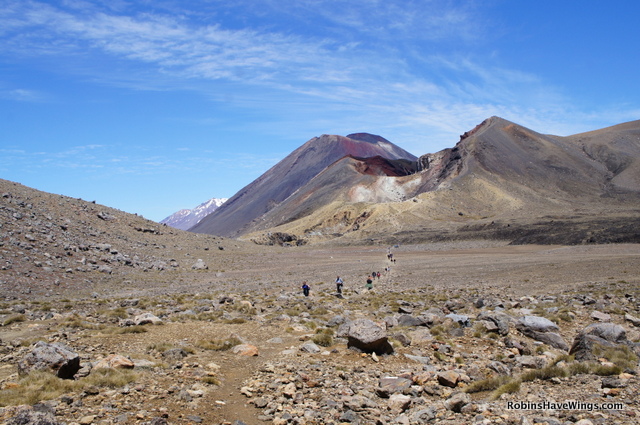
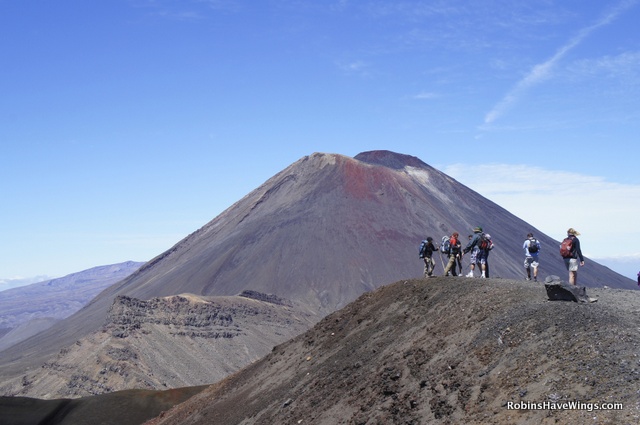
But we really are following in the footsteps of Frodo and Sam on the way to Mordor, and our own journey continues as we reach another ridge that we must scale taking us toward the Red Crater. Here the wind decides to attack us again, threatening to force us back down the mountain, but we are anchored by the stunning 360 views around us. The deep red soil surrounding a jagged crevice, evidence of previous lava flows, creates a stark contrast against the day’s crystal blue skies. It looks harsh and violent, yet beautiful and awesome at the same time. It also looks like something else. Tanya says, “Is it me, or does that look like a?” I say, “Yes, yes, it does.” We are both thinking of a part of the female anatomy and a Georgia O’Keefe painting flashes through my mind. We may have gotten a little loopy from the alpine altitudes.

Tongariro’s Red Crater with Mt Doom in the background
Peering into the Red Crater

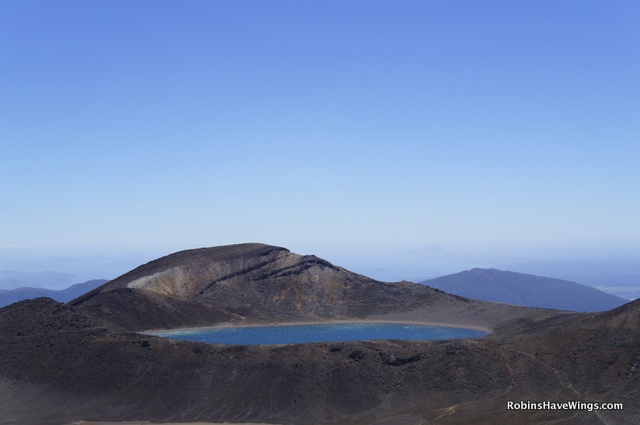
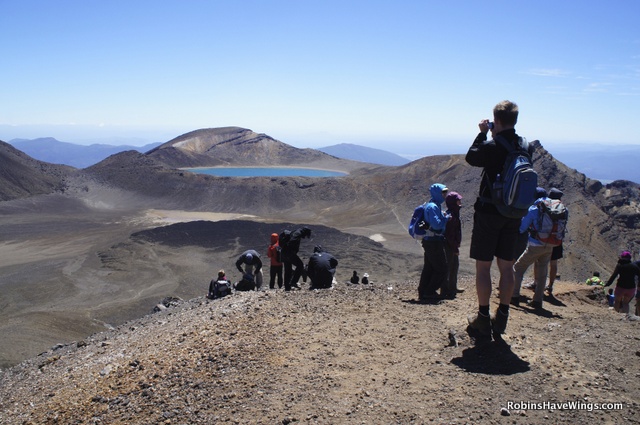
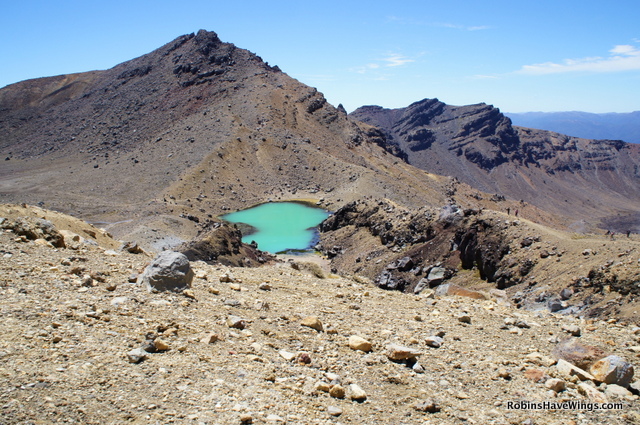
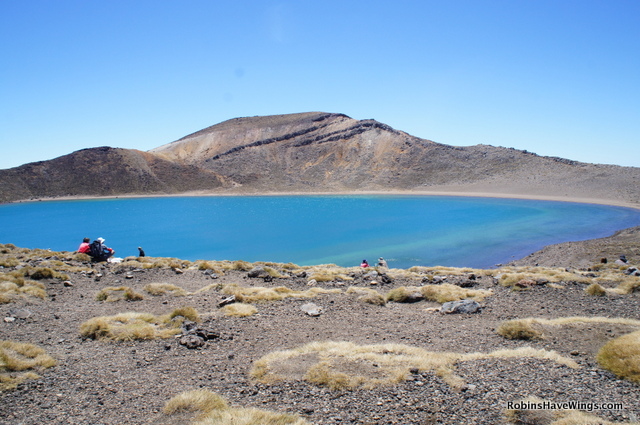
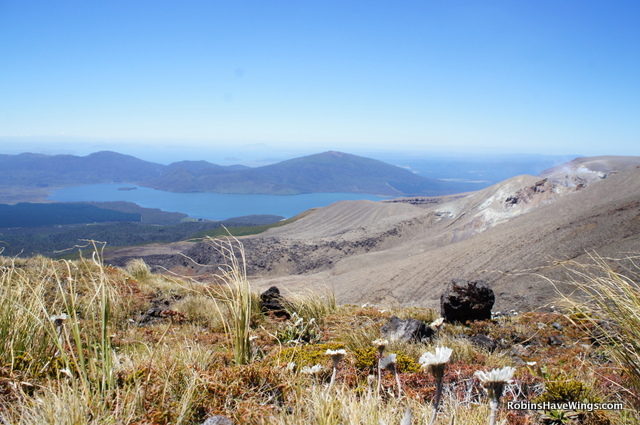
Just beyond the crater, we can see aquamarine sulfur pools, appropriately named the Blue Lake and the Emerald Lakes, glistening from the dark and desolate terrain. Mel has been telling us about this place. Every time, I stopped to take a photo of some amazing view, she’d say, “It gets better.” Well, she was right. I’m not sure where to aim my camera at this point, there are valleys, mountain peaks and pools to be captured in each direction. We’ve reached the highest point along the crossing at 1900 meters, over 1 mile high.

The Blue Lake. Have you ever seen anything like this before?
Photo worthy
The Mighty Mel. Couldn’t have done it without you, girl
Eye to eye with Mt. Doom

But we aren’t done and we still haven’t passed the most treacherous part of the trip. Mel tells us that we are going to have to do a kind of moonwalk through loose dirt to get to our next stop inside the South Crater. The dirt is actually volcanic rock and it is still steaming. The scent of sulfur rises in the air as we get closer to the Emerald Lakes in the crater below. Tanya and I are approaching this steep descent timidly, slowly inching downward and carefully placing our feet. We can imagine slipping off the narrow embankment packed with people into the Red Crater or worse into the pretty, but hot pools of sulfur below. The people around us don’t seem to be as cautious. In fact, they seem reckless, practically flinging themselves in haphazard fashion down the dusty hill sending ash flying. I trust my own steps, but I’m a little wary that some daredevil will take me out in their wild wake. Mel tells us that that some people have turned this into a sport, donning skis in the loose ash to make their descent. Tanya actually fell a couple of times and I managed to teeter and catch my balance in a few close calls.

An Emerald Lake

It seemed to take forever, but we made it safely into the South Crater where we celebrate our ascent to the pinnacle of Tongariro and pause for lunch. Packed sandwiches never tasted so good, especially with the tea and coffee that Mel brought along. She also shared some tasty New Zealand chocolate with peanuts. Here we get to know Mel a bit more. She’s been working outdoors for 8 years, mostly with kids and teaching them teamwork. She’s been with Walking Legends for a year and she loves that it gives her a chance to walk and talk with adults. She says she wasn’t the best of students and instead of going straight to college she headed straight outdoors to the school of life. I’d say she made a good choice. But she’s giving school another shot, studying to become a paramedic. She says she wants to help people. I think she’ll be great at it. We sure appreciate her help on this trip because we never would have made it without her, especially the Devil’s Staircase and that hellish volcanic ash skiing business a moment ago. We probably would have turned back long before now, but instead we made a video from the top:

Just as we finish lunch, Tanya looks up to see a guy wearing a New Orleans Saints hat. Tanya hails from New Orleans originally, so she excitedly asks the guy if he’s from New Orleans. He explains that he lives in Paris, but all of his family lives in New Orleans and he visits often. She’s thrilled. What are the chances of meeting someone from your hometown on a mountain in New Zealand? I’d say 1 in a million. Before we part ways, he tells Tanya that the Saints have advanced in the playoffs. We take this news on the final descent down the mountain. Along the way, Mel tells us a Maori legend of the mountains we’ve passed. Pihanga was the fairest mountain maiden of them all and all the warrior mountains were in love with her, but she was married to Tongariro who was very jealous and erupted with anger at the other mountains, fighting them all until he was victorious and sending them away to their current places in the mountain range. But “word on the street” is that Pihanga still had a thing for one of the mountains, Tauhara, and the pair made love children in a range of smaller mountains near by.

I love hearing tales like this. Earlier, she told us the legend of how New Zealand was born when Maui, a Maori demi-god, went fishing with his brothers with a magic hook. Maui’s hook pulled up a gigantic fish and he was so proud that he wanted to offer it to the gods. He told his brothers the leave the fish alone, but they were jealous and the wanted it for themselves so they beat the fish, the beatings created the mountain ranges of the North Island, while the canoe they were fishing in became the South Island. A more scientific explanation suggests that the area around Tongariro was formed by eruptions from 6 volcanic cones along the same mountainous chain hundreds of thousands of years ago.

But the volcanic activity here is not a thing of the past. As recently as 2012, Tongariro erupted, sending flaming hot rocks into homes miles away and belching sulfur into the air that could be smelled as far as Auckland and Wellington. The resulting mudslides did their own lasting damage to the landscape. We can still see Tongariro belching smoke as we leave it behind us and wind our way down the mountain through a lovely valley where the vegetation has returned and we spy Lake Rotorira in the distance. It’s at this point that our bodies begin to scream at us particularly our knees and feet. They wonder what possessed us to inflict close to 8 hours of punishment on them.

The Blue Lake up close
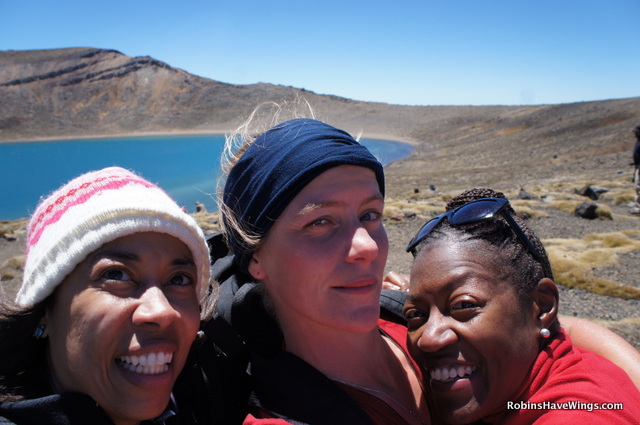
Selfies at Blue Lake
Out of the South Crater
This baby could blow at any minute
If you look closely at the mountain on your right, you can see smoke rising

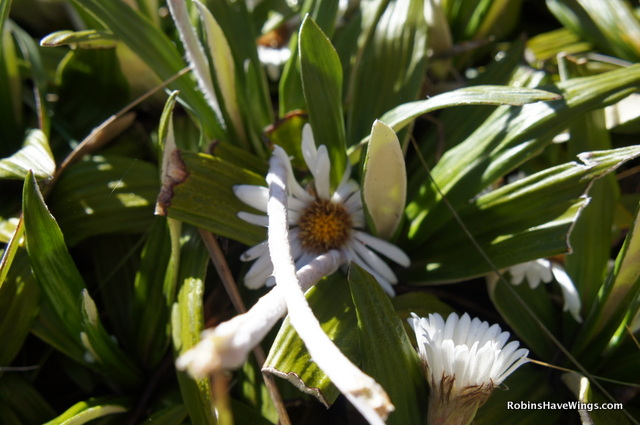
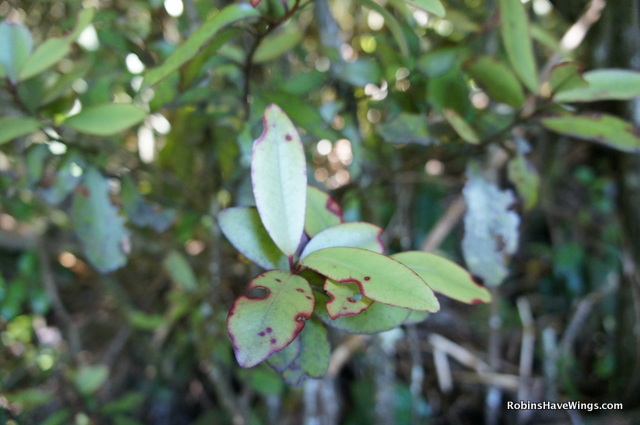
The zig-zaggy descent now feels like the longest part of our journey and Mel can sense that we are getting tired. She tells us about the plants that have begun to appear around us like the manuka, a pretty-smelling, delicate flower favored by local bees that produce New Zealand’s manuka honey and the flax plant that reminds me a bit of the gangly bird of paradise plant, used for years by Maori to make clothing. Earlier in our trip, Mel also pointed out the resilient mountain daisies with thick, hearty leaves that ward of frost and absorb water to survive long periods without rain. On a much needed chocolate break under a cool canopy of trees in an unexpected mountain forest, Mel invites us to taste the leaf of a pepper tree, once used as a numbing agent by dentists and sometimes added to spicy New Zealand dishes. Mel’s trivia is just one more thing that we love about this trip and it helps us forget how badly our knees and feet hurt. The chocolate was the perfect boost to keep us going another 30 minutes or so, moving at a steady clip to get us over knotted tree roots upended by the recent mudslides and across a fast moving stream to the light at the end of the forest…the car park. Tanya says, “Is that what I think it is?” And, it is. We’ve reached the parking lot and a covered sitting area where hikers who have reached this point before us are sitting quietly. It’s something I can’t understand and I ask, “Why is everyone so quiet? We made it to the end! People should be celebrating!” A few folks perked up with a cheer. Tanya, Mel and I cheer the loudest.

Hard core daisies
Pepper tree also known as kawakawa

And, what better way to celebrate tramping from 8 am to 4 pm than with champagne? The Walking Legends crew is waiting for us with cold flutes of pink bubbly, not the après-hike drink most would envision, but one we totally appreciate. If we just liked Walking Legends before, the champagne made us fall totally in love. It was such a nice, thoughtful touch and we totally sing Mel’s praises to her boss. Before the champagne, we had a few stressful moments, thinking our bus to Rotorua had left without us, but it wasn’t our bus. Ours wasn’t scheduled to leave until 5, so we relax with our champagne, laying back in the grass still giddy over our accomplishment.

We made it! We’ve already had our glass of champagne to celebrate our fabulousness

An hour later, we still haven’t left Tongariro because we are waiting for the group of Americans that traveled on the bus with us from Rotorua. Nelson, our bus driver is a little peeved. Nelson is rocking three gold chains and a thick gold rings on almost every finger. He’s like a Kiwi Mr. T and he’s ready to go. Finally, the New York-Massachusetts crew arrives looking a little worn and sunburned. They apologize for being so late. They thought they were making good time until they weren’t, stopping to offer help to a woman with a sprained ankle, and letting her companion borrow their phone. We swap Tongariro tales and Nelson softens in the front seat. Alyssa invites us for a dip in one of the thermal pools where she works at the Spa at QE. We take her up on the offer as we’d planned to hit the pools at the Polynesian Spa, but the Spa at QE is closer, just a block from our hotel.

The warm silken water from Rotorua’s active thermal pools is a welcome peace offering to our aching feet and knees. It makes me wish we’d had time for a thermal mud massage, too, but this will have to do, and it does. The company of our new friends is pretty cool, too.

Driving on the “Wrong” Side of the Road, Glowworms and Hobbits in New Zealand

I drove on the wrong side of the road and descended into a dark watery cave in an inner tube to see some shiny sh*t. It was fun! First, let me explain the shiny poo part. Going tubing, or blackwater rafting, to see the glowworms in caves at Waitomo is a popular activity in New Zealand because tubing is fun and seeing glowworms sounds cool. New Zealand is also one of the only places in the world that you can see these bioluminescent creatures.

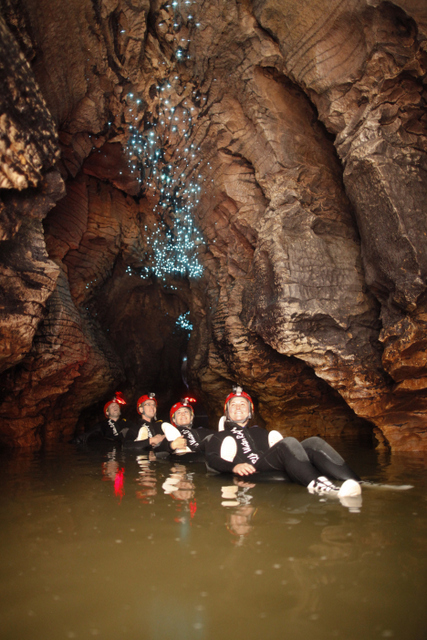
The fact is that glowworms are maggots. Carnivorous maggots that excrete poop that glows in the dark. This shiny maggot poo attracts curious insects that get caught in their sticky threads. Dinner comes to them. Sometimes they eat their own. The maggots then morph into horny flies that must mate in 3 days before they die, going on 48-hour copulating sprees. They sound downright disgusting, don’t they? But somehow they are still spectacularly pretty, these neon-green, star-sized lights twinkling from the cave ceiling in total darkness. I’m one of 12 people on the The Legendary Blackwater Rafting Company’s Black Labyrinth Tour peeping the strange bugs while standing up to our knees in cold rushing cave water, clinging to a slippery inner tube.

We couldn’t take pictures of the glowworms ourselves in the cave, so the Legendary Blackwater Rafting Company provided this one. I’m sure we looked just as geeky.

I’ve attached myself to a Canadian family from Manitoba. Nadine has recently moved to New Zealand and her daughter Chantel is visiting with her boyfriend Andrew. Tanya left on the blackwater rafting tour before mine because we didn’t book our tour together and didn’t realize that we got separate times until we arrived. But Nadine, Chantel and Andrew seem like good partners in adventure and I become Canadian for a day. At the entrance of the Ruakui cave, our leader Matt tells us the Maori legend of the cave where wild dogs once guarded its entrance, attacking young hunter that returned for his revenge. Matt has plenty of other stories along the way, including tales of hauntings, and Kenan comes along to demonstrate what to do and what not to do, like hop into a pit of swirling water along the way. He’s a great model; he kind of reminds me of Keanu Reeves and I think that Tanya would be beside herself right about now, seeing that she has a ridiculous crush on Keanu Reeves.

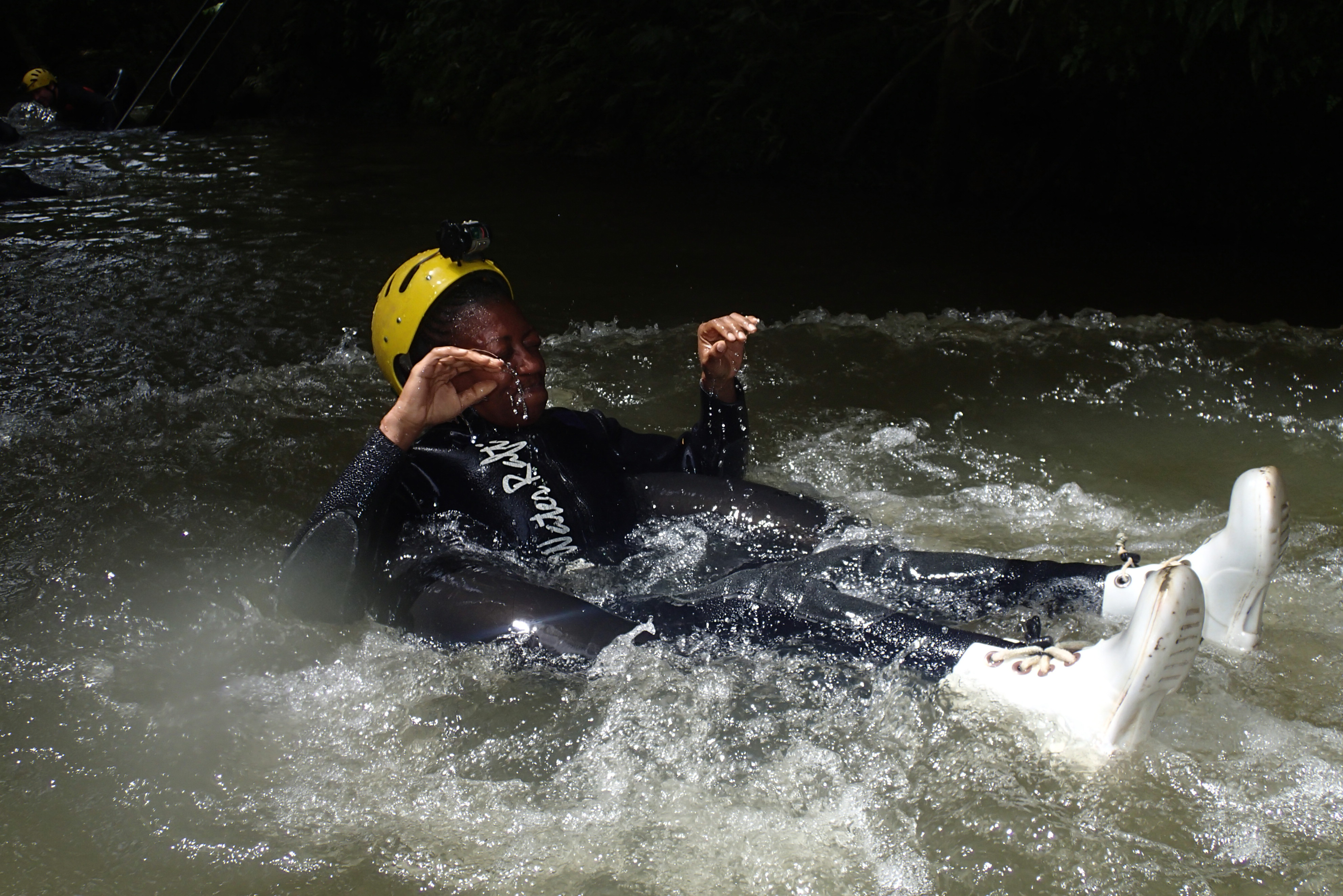
Once inside the cave, we are instructed to turn on our goofy headlamps and slosh about in frigid water that at times is ankle deep, then knee deep, until it’s even deeper, requiring our tube. Somewhere near the start of the cave we crouch low to avoid bumping our heads on stalagmites that we’ve been instructed to avoid touching to protect the fragile natural creations. Navigating the low hanging protrusions was particularly hard for Andrew who is over 6 feet tall and I warn him to get low. Chantel sees humor in this and starts singing the rap song, “Get Low.” At one point we get in our tubes and practically lay backwards with our noses inches from the cave ceiling. But the most fun is hurling ourselves backwards down short waterfalls with our butts jammed into our tubes and landing with an echoing splash. I find myself with twins Ima and Iba at these points. The twins are from the nearby town of Hamilton and have recently graduated college. They are enjoying a pretty cool holiday together to celebrate. They are also hoping to get to Tongariro Crossing just as Tanya and I are planning in a couple of days. They are super friendly and I find myself asking often, “Are you Ima” or Iba?” which must be totally annoying to them.

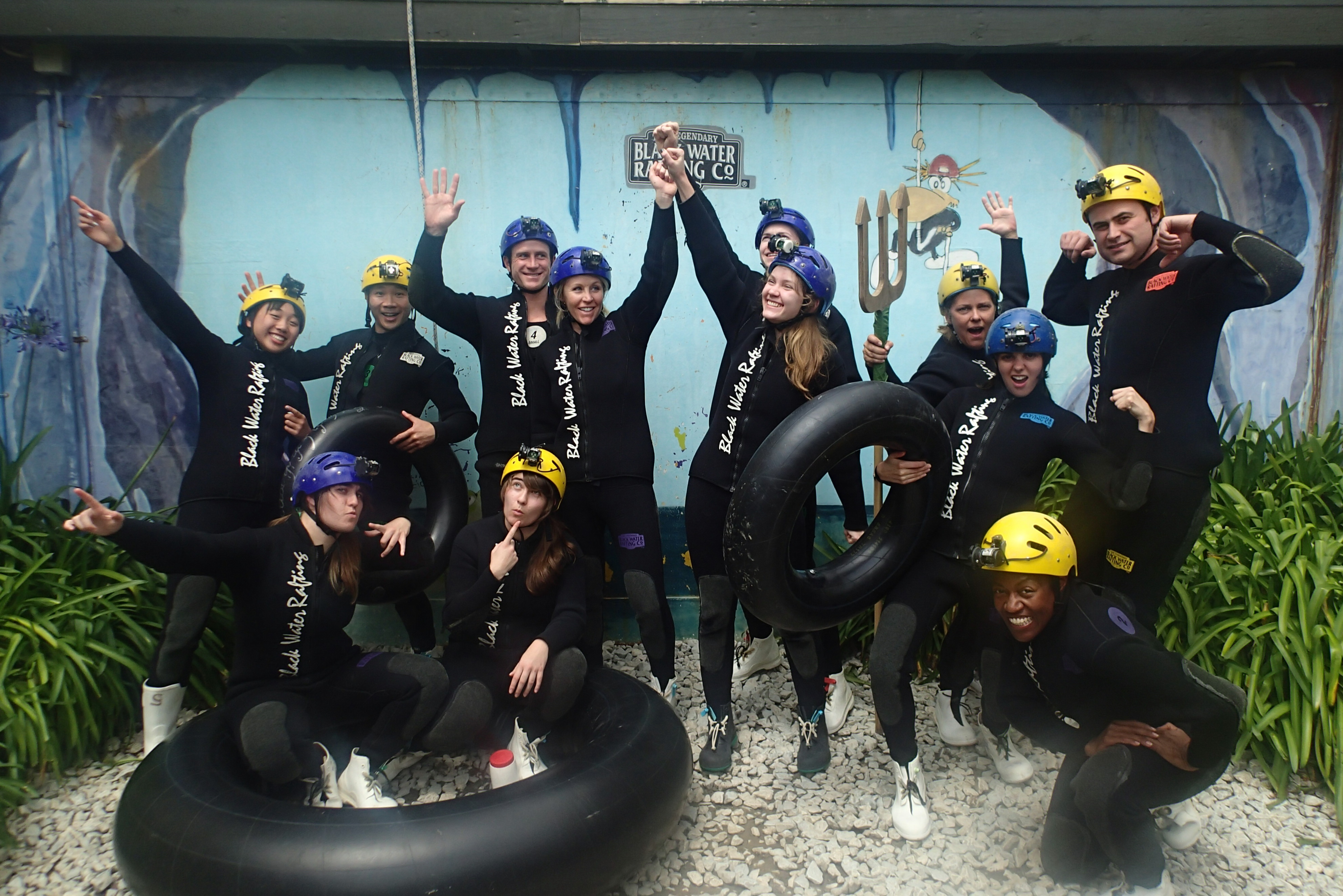
At the end of the trip, we form a human chain with our feet resting on the tube ahead of us, holding the feet of the person behind us, with Matt and Kenan pulling us along. Our headlamps are off so that we can simply stare up at the “stars” of the cave. When we emerge, everyone has smiles, pleased to have made it out, and we pose sopping wet for one of the last semi-embarrassing photos (see below) that Matt and Kenan have been taking along the way. We welcome the chance to shed our heavy wet suits, which were soggy to begin with and, now, we understand why. Upon removal, we dip our suits in a tub of soapy water before returning them to our guides. Finally, there’s the hot shower and a yummy warm cup of tomato soup and a bagel waiting for us in the rafting shop.
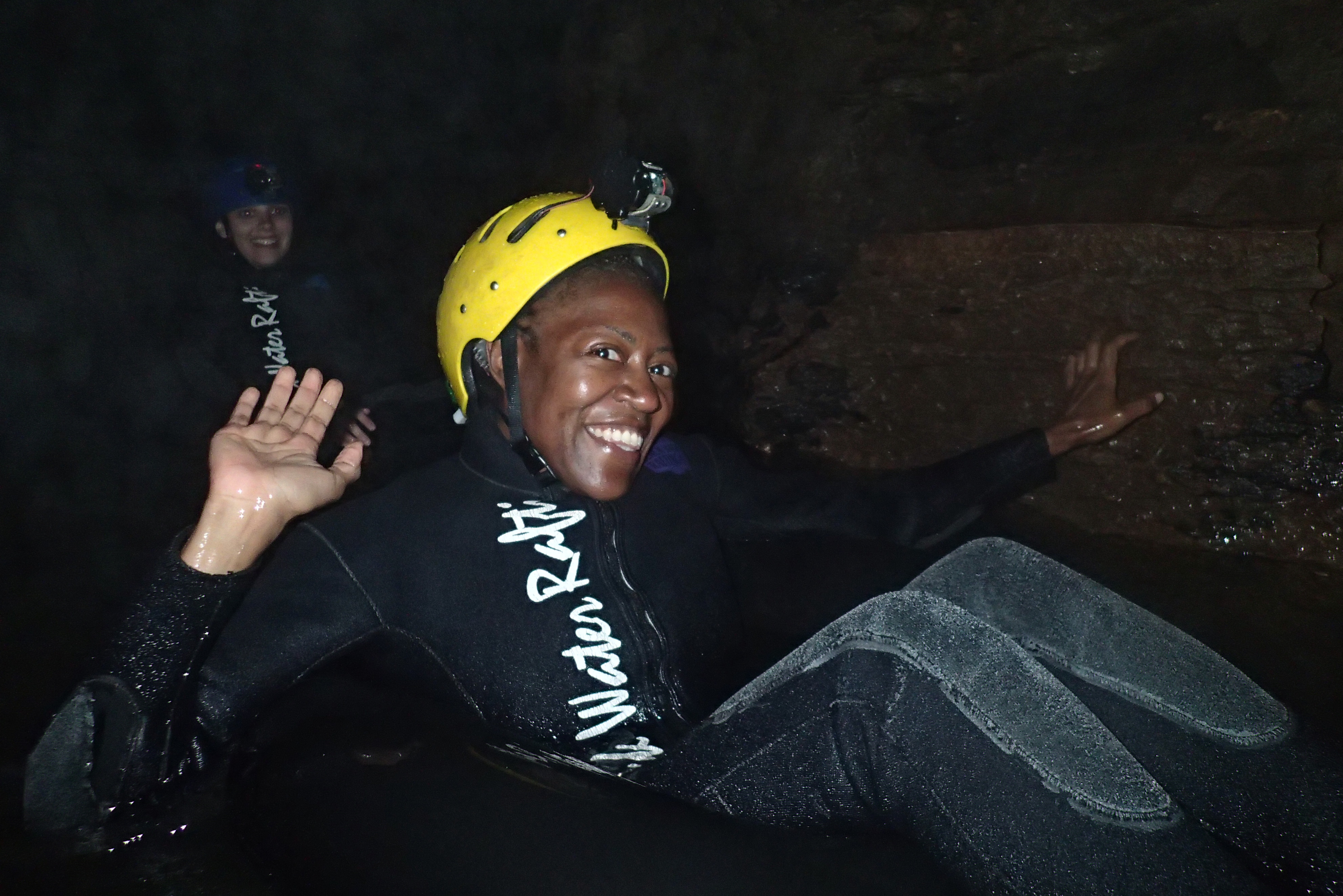
Look, I’m blackwater rafting!
Splash!
My blackwater rafting crew

Tanya and I reconnect in the rafting shop and compare notes. She was adopted by a British family in the cave that made sure that she made it through safely and chatted her up about BBC shows. They were baffled to learn that Downton Abbey is such a huge hit in the US. Tanya is beaming as usual and thrilled as says this has been one of the best days in New Zealand so far. I agree. Then she says something surprising, which is that she thinks she wants to drive back to Rotorua. I’m surprised, because while planning this trip I suggested that we rent a car for part of the journey to get to the various cities and tours. She couldn’t imagine driving on the other side of the road and felt really uncomfortable with the idea, certain that she’d forget which side was the “right” side and collide with oncoming traffic after her mental lapse. I tried to convince, her it would be fine as I’d driven in Australia without meeting a catastrophic end. As it turns out, the only way we could get to Waitomo was by car, so I drove us the two hours from Rotorua.

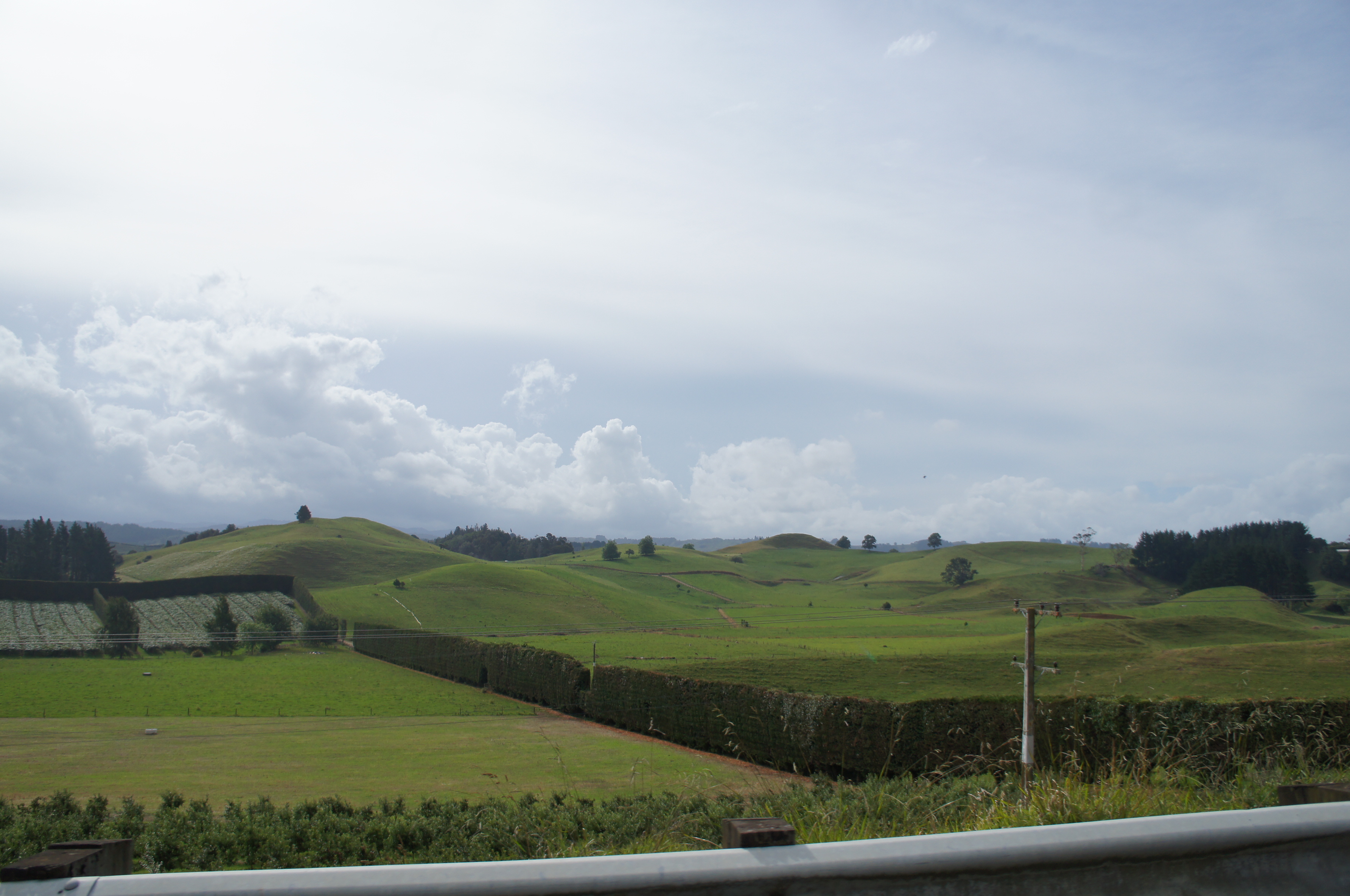
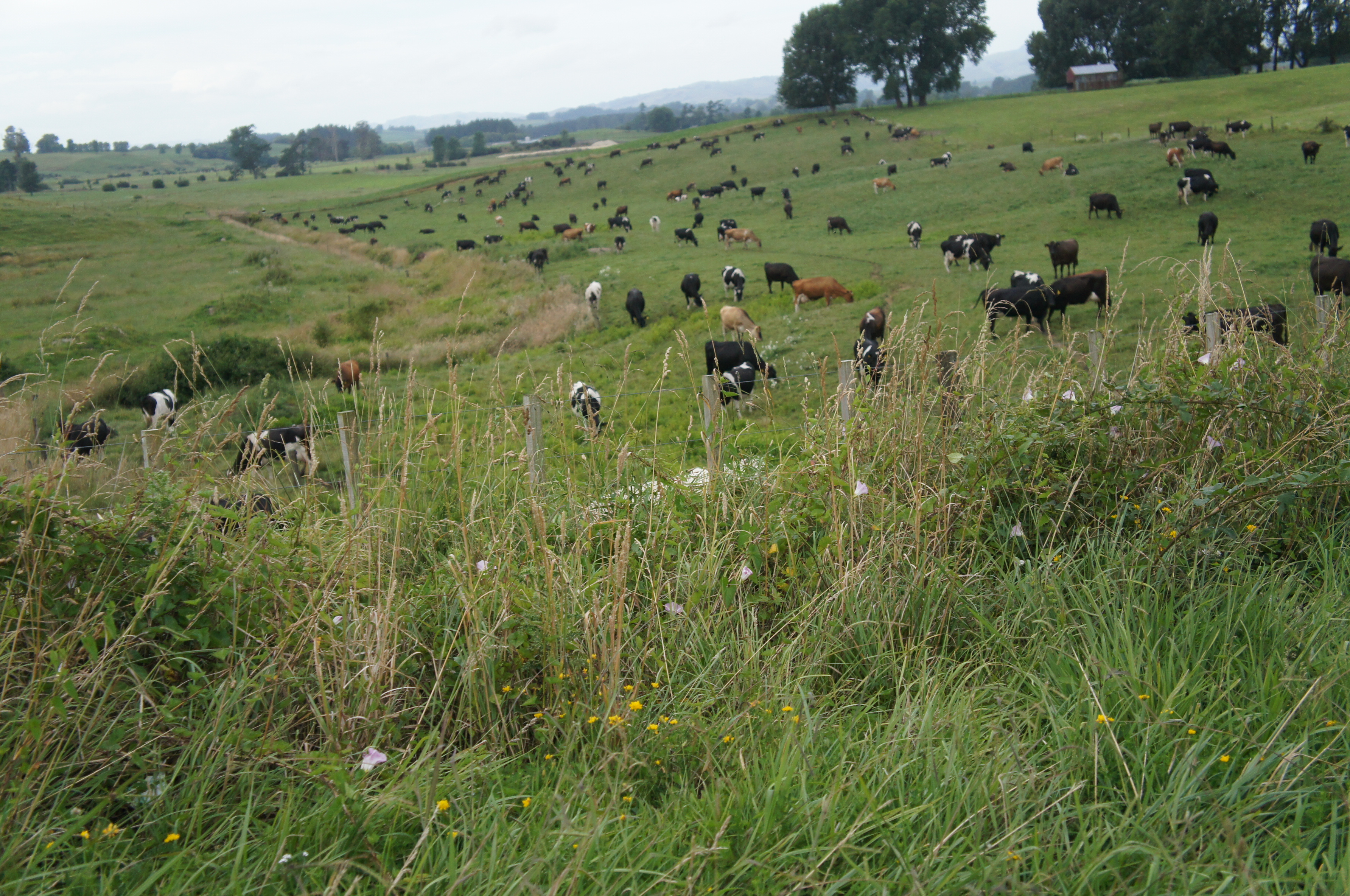
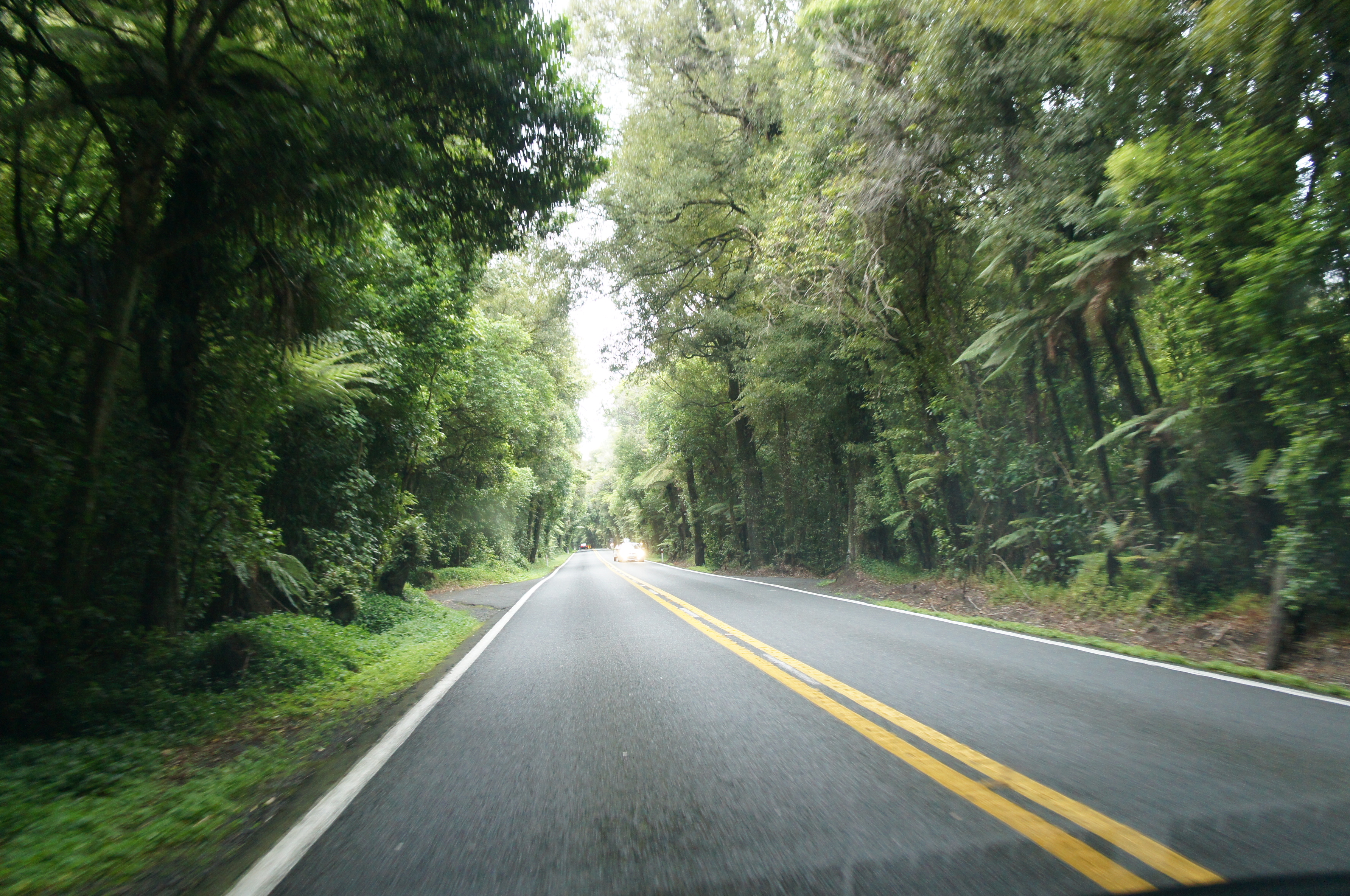
Tanya was a ball of nerves on the passenger side, but it was a smooth ride down two-lane thoroughfares with almost no traffic past picturesque farms filled with black and white cows against lush green landscapes. The number of cows was startling. They seemed to completely cover hills and ridges at some points. It left us wondering, “Where were the sheep?” We spotted them on one hillside during our entire drive. We’d later learn that New Zealand produces a third of the world’s dairy and most of the sheep are on the South Island. We made it to Waitomo in one piece, with the exception of almost taking out a jackrabbit, which left Tanya feeling emboldened, so I handed her the keys. She drove like a grandma about 20 km below the speed limit the entire way.
North Island country side
Cows everywhere


We drove through a forest

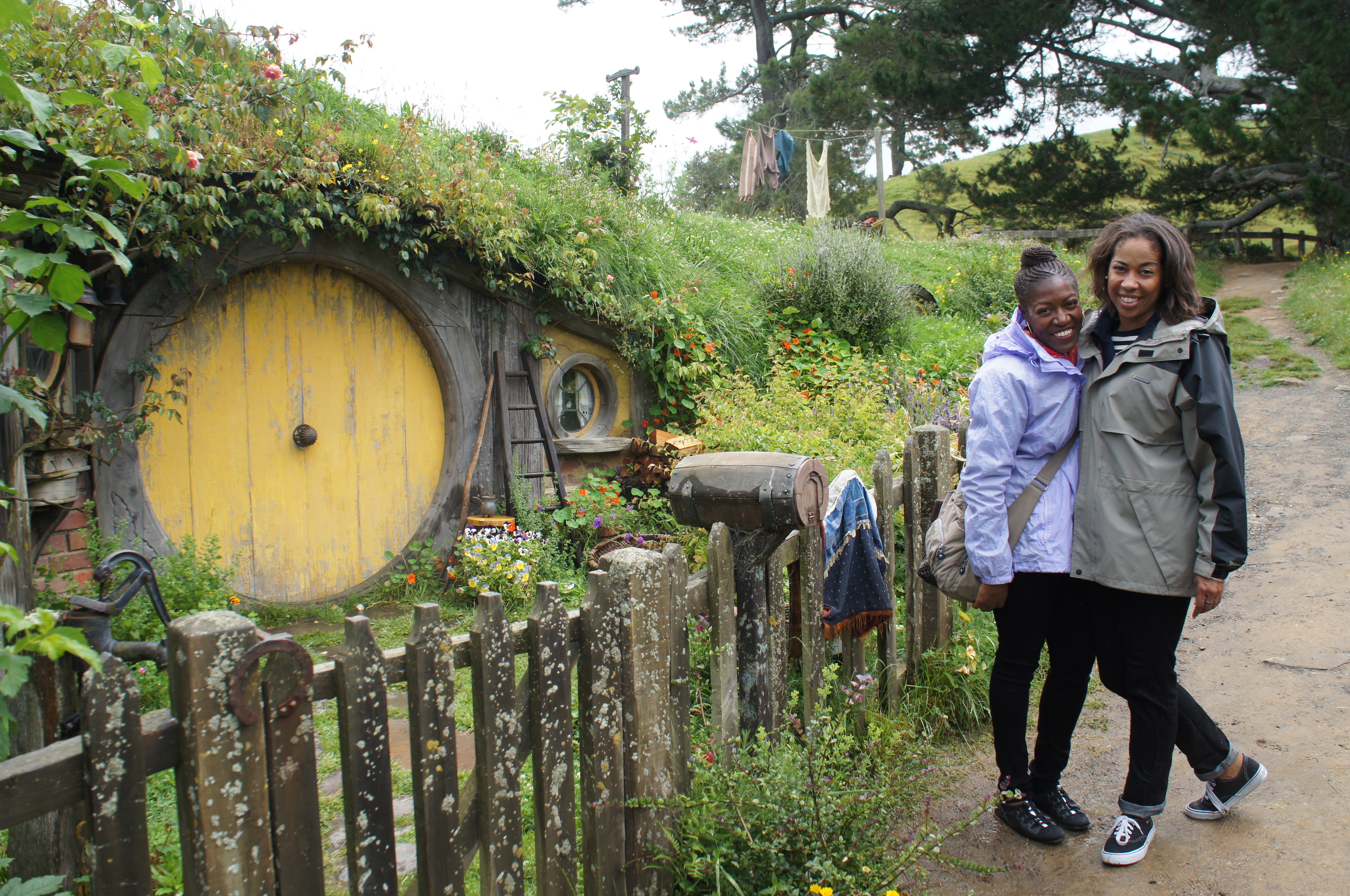
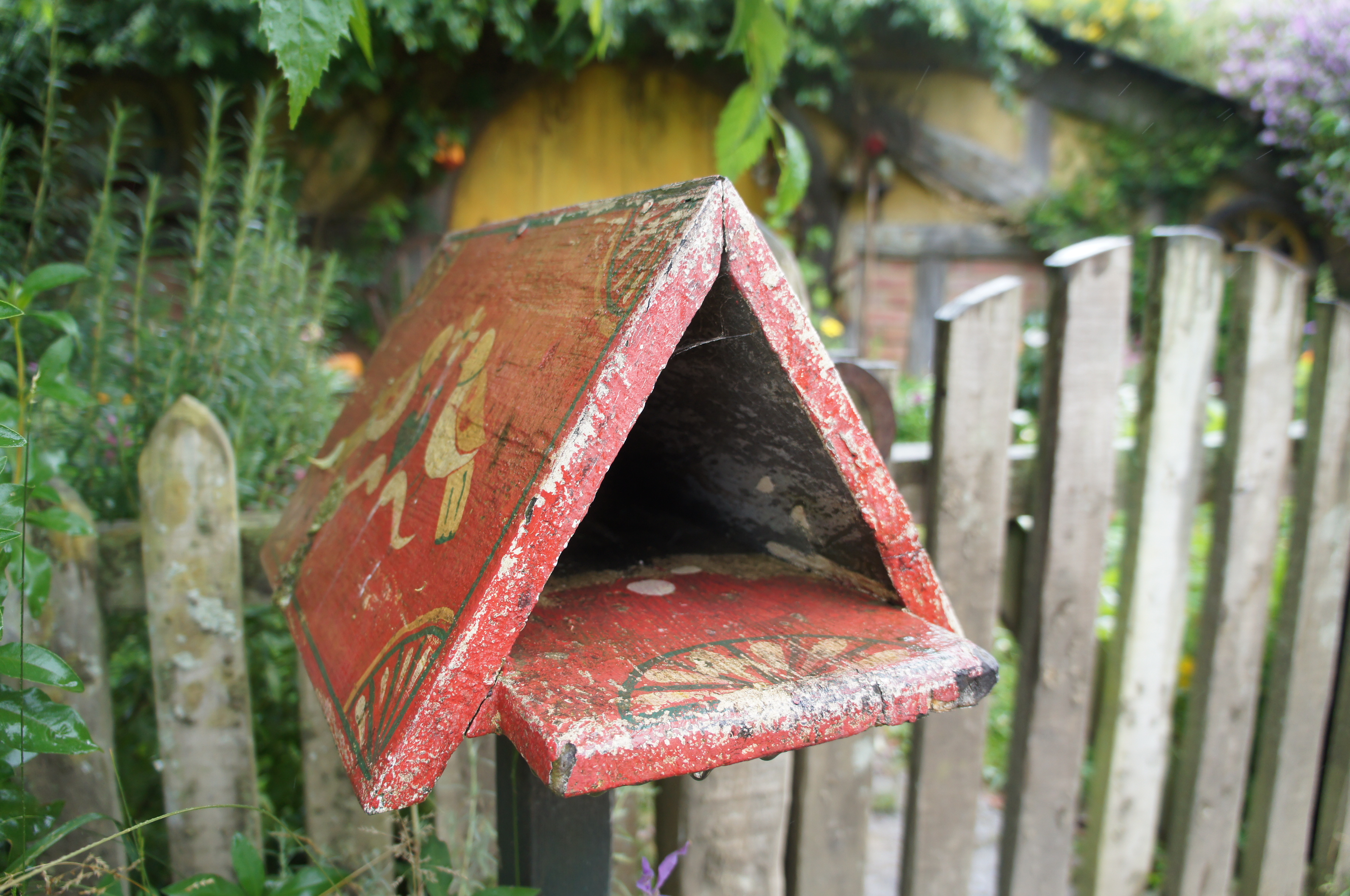
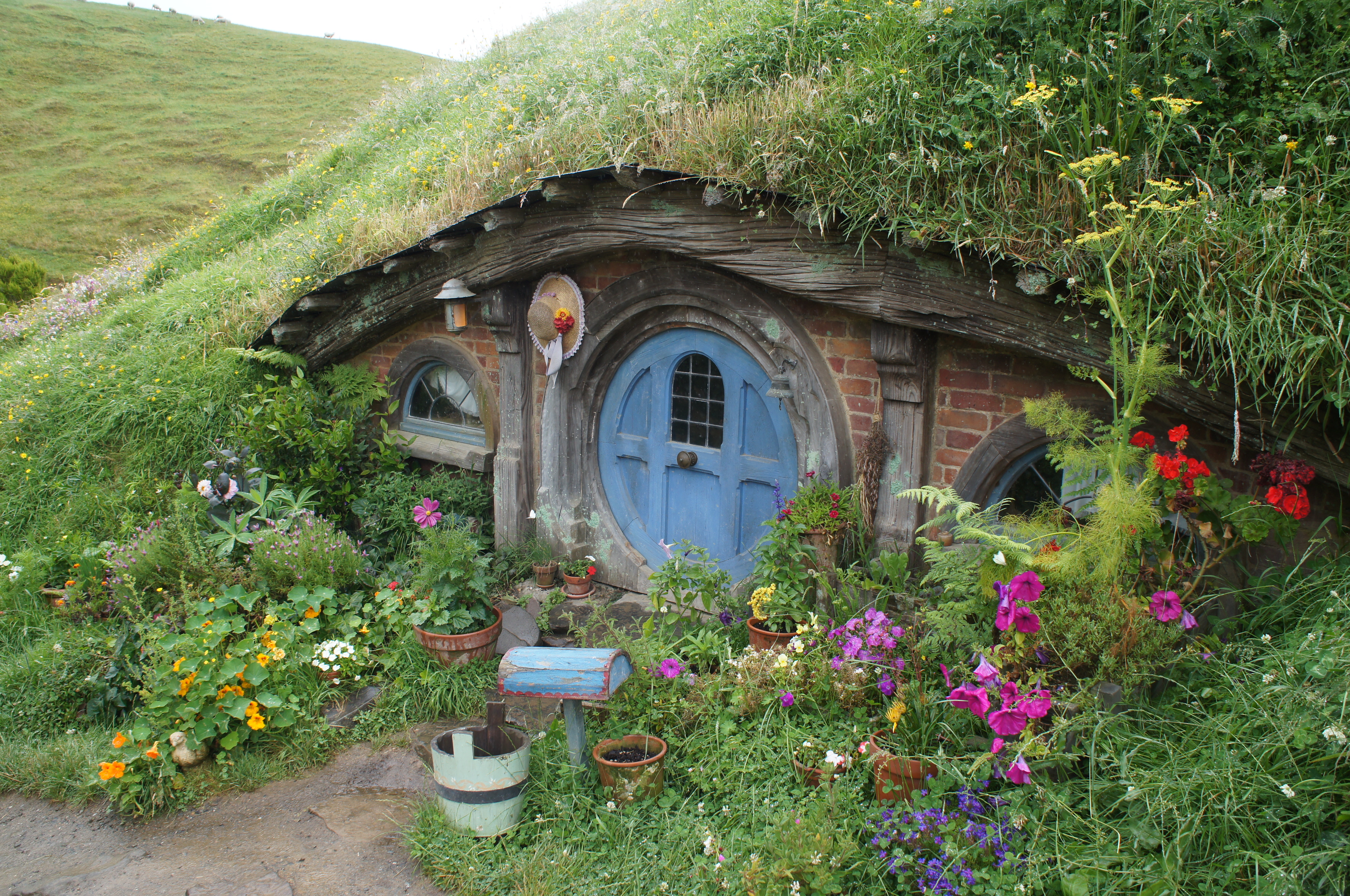
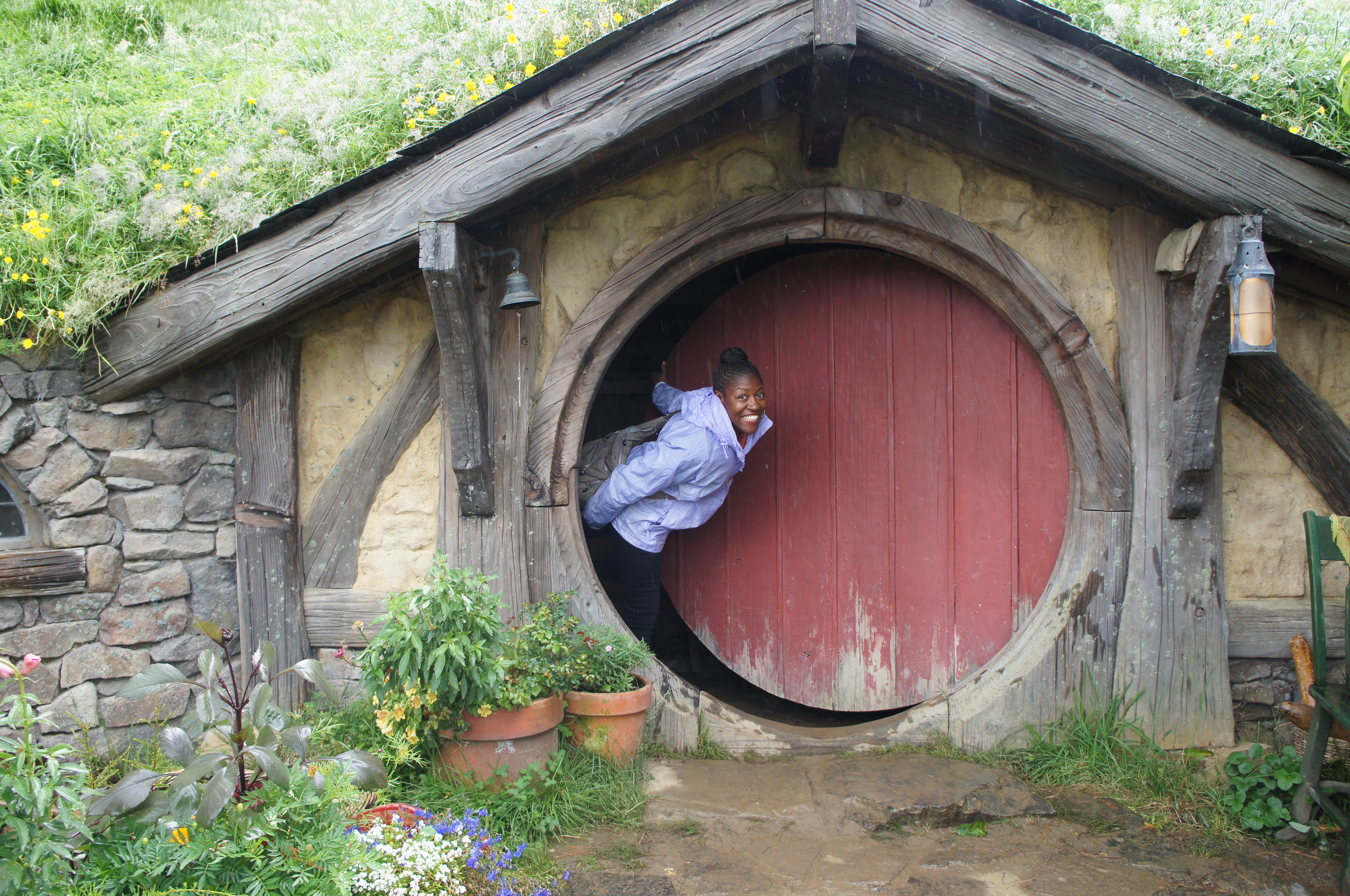
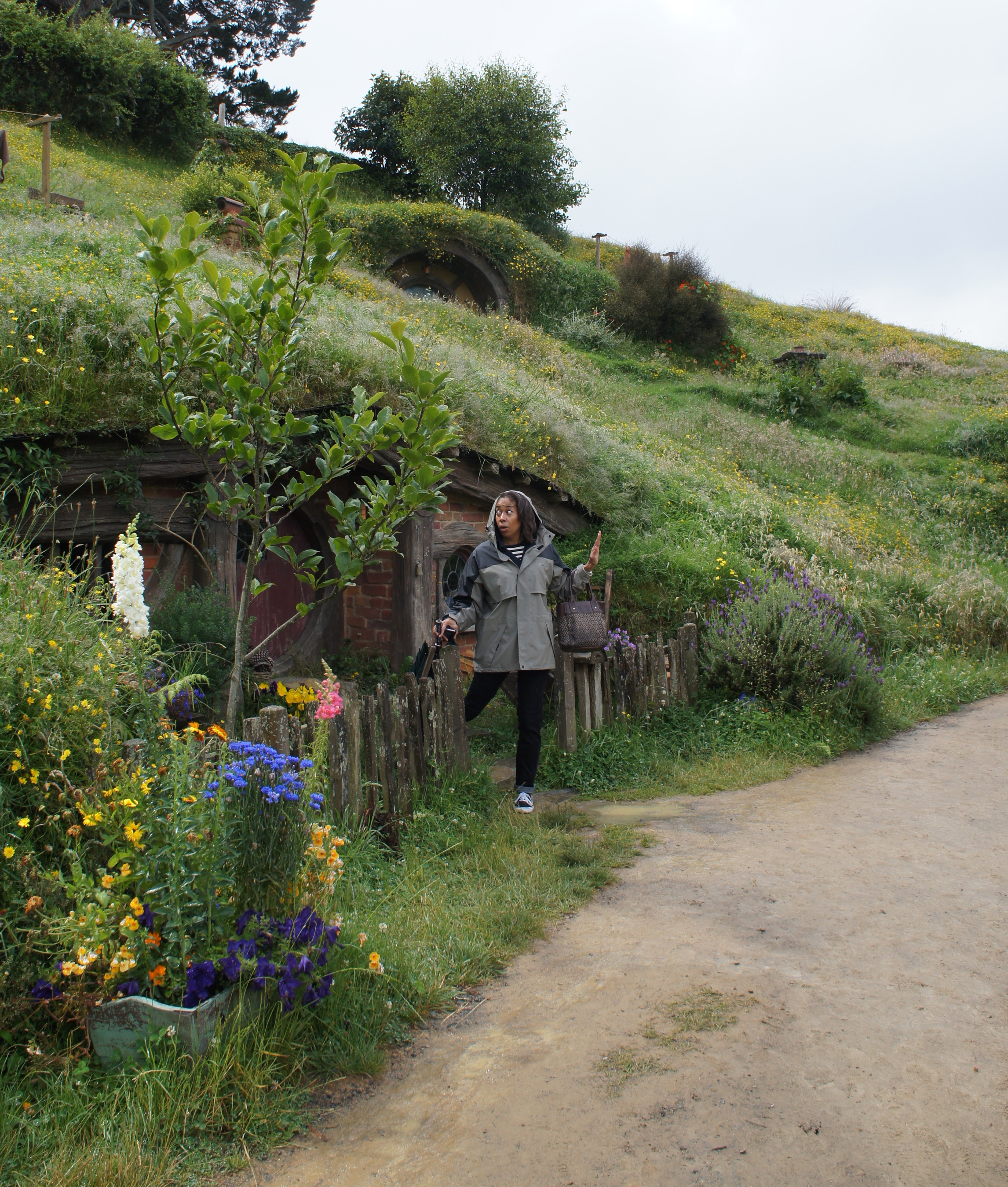
We’d take some of the same roads past the same farms on a big green Hobbiton bus the next day. The bus was a little late. We stood outside the hotel waiting for our pick up, thinking every tour bus might be the one. But when I saw the giant green bus with the gold letters “Hobbiton” emblazoned on the side, I said, “I guess that’s our bus.” Tanya practically skips to get on board. She’s been waiting for this part of the trip with more than baited breath. She’s been practically hyperventilating to see some “Lord of the Rings” sites. You see Tanya is a fan – the kind of fan that watches a movie over 100 times. Now, I’ve seen the “Lord of the Rings Trilogy” and I enjoy a good sci-fi, fantasy flick along with the best of nerds, but Tanya takes her fantasy fandom to obsessive levels, to which she’d readily admit. On our trip to Barcelona she took binders full of “Twilight” fan stories with her to read on the plane. So, a visit to Hobbiton for Tanya is like a pilgrimage to Mecca for the most devout Muslim. It’s pouring rain when we arrive at “The Shire,” the tiny township built for the movies on the Alexander Farm in Matamata. But this does not dim Tanya’s excitement and I have to admit, I’m a little excited, too. Actually, I’m impressed. The level of detail that went into creating these little hobbit homes is, well, impressive, down to the adorable little mailboxes. I’m obsessed with them. They are probably the cutest creations I’ve ever seen.

Cute hobbit mailbox
Cute hobbit house. This is one of 44.
The obligatory hobbit doorway picture

Throughout our tour, we learn that Sir Peter Jackson, the director of the “Lord of the Rings,” is a stickler for details. After finding identifying the rolling hills of the Alexander Farm as the perfect place for The Shire to nestle, he needed the perfect oak tree to stand behind Frodo Baggins home. Apparently none on the Alexander farm were suitable, so he takes to his helicopter again and finds the perfect tree on another nearby farm. He pays to have the tree uprooted, cut into puzzle pieces and reconstructed on the Baggins property. When that same tree rots and has to be removed, he sends pictures to a set design shop in Wellington to have the tree reconstructed, it leaves wired on individually, for a cool $1.6 million.

There are more stories like this. A little girl is forced to pick and eat a plum over and over for one second in one of the movies. Our guide tells us that he went to elementary school with a boy chosen to be a hobbit in the first Lord of the Rings movie who Jackson had fattened up for the film. The boy had to put on 40 kgs, over 80 pounds!

Of course, Tanya could narrate this tour all by herself. She recognizes the open field where the hobbits celebrate when they return to The Shire after their great adventure. She thinks she can identify the exact log that Frodo hid behind to escape dark horsemen in the woods. She was positively ebullient in front of Frodo’s hobbit hole. Videos were made to document her presence. Sir Jackson would be proud. Later we visit the Green Dragon, the local hobbit watering hole for a couple of mugs of hard cider, where we sit near a crackling fire to get dry before our journey continues on the big green Hobbiton bus.

Tanya geeking out The Shire
Tanya and I outside Samwise Gamgee’s hobbit hole


Frodo’s hobbit hole on the hill with the old $1.6 million oak

The bus makes one last stop at the Hobbiton gift shop, of course. Where Tanya takes to skipping again. She is excited about the prospect of finding elf ears to wear on our trek towards Mt Doom on the Tongariro Crossing tomorrow. She bounds up to an unsuspecting store clerk to ask if they have elf ears. They don’t, according to the clerk. Tanya is crestfallen. Upon seeing this, the clerk suggests that she may be able to find some in Welllington. This is not very comforting since we aren’t in Wellington at this moment. We continue to wander around the small store with a substantial “Lord of the Rings” figurine cabinet and strong promotion of the recent Hobbit movie in the form of caps, mugs and books. Tanya purchases some postcards and Gandolf stamps, before concluding, “This gift shop sucks.” But don’t think this has soured her on the Hobbiton experience. Back on the bus, she’s gotten over the lack of elf ears in the gift shop and renews her quest for them, much like a resolute Frodo Baggins determined to destroy an enchanted ring in the fires of Mordor.

One more cute hobbit house pic

Maori for a Night: Haka, Hongi and Hangi in Tamaki Village

Our driver, Wallace, is explaining to us that our bus is our canoe, or waka in Maori. The name of our waka is Kiwi. This is important to remember, he says, because if we don’t and we miss our canoe we must “walk-a” home. Wallace has got jokes, but he also has tons of instructions for us. He’s training us to become a good Maori family tribe, or iwi, before we reach the Tamaki Village, about 20 minutes outside Rotorua.

First, we must learn the proper greeting, “Kia Ora,” which means hello, but like “Aloha” for Hawaiians, it could also mean good-bye or maybe even answer the question, “Are you well?” according to Wallace. If someone greets you with Kia Ora, you should always say Kia Ora in return, it’s only polite. Then, we work through other basic terms like haka, which is the traditional dance of warriors that we’ll see, and hangi, the earth-oven-prepared feast that we are all looking forward to later.

Our waka is quite international with Germans, Mexicans, Indians, Swedish, Australians and Americans aboard and our journey together represents the journey that Maori, led by Polynesian explorer Kupe, made from their former home Hawaikinui, 1,000 years ago to search for a new land. Kupe called their new home, Aotearoa, or the Land of the Long White Cloud. As the legend goes he and his wife spotted the long cloud over the land and took it as a sign to stay.

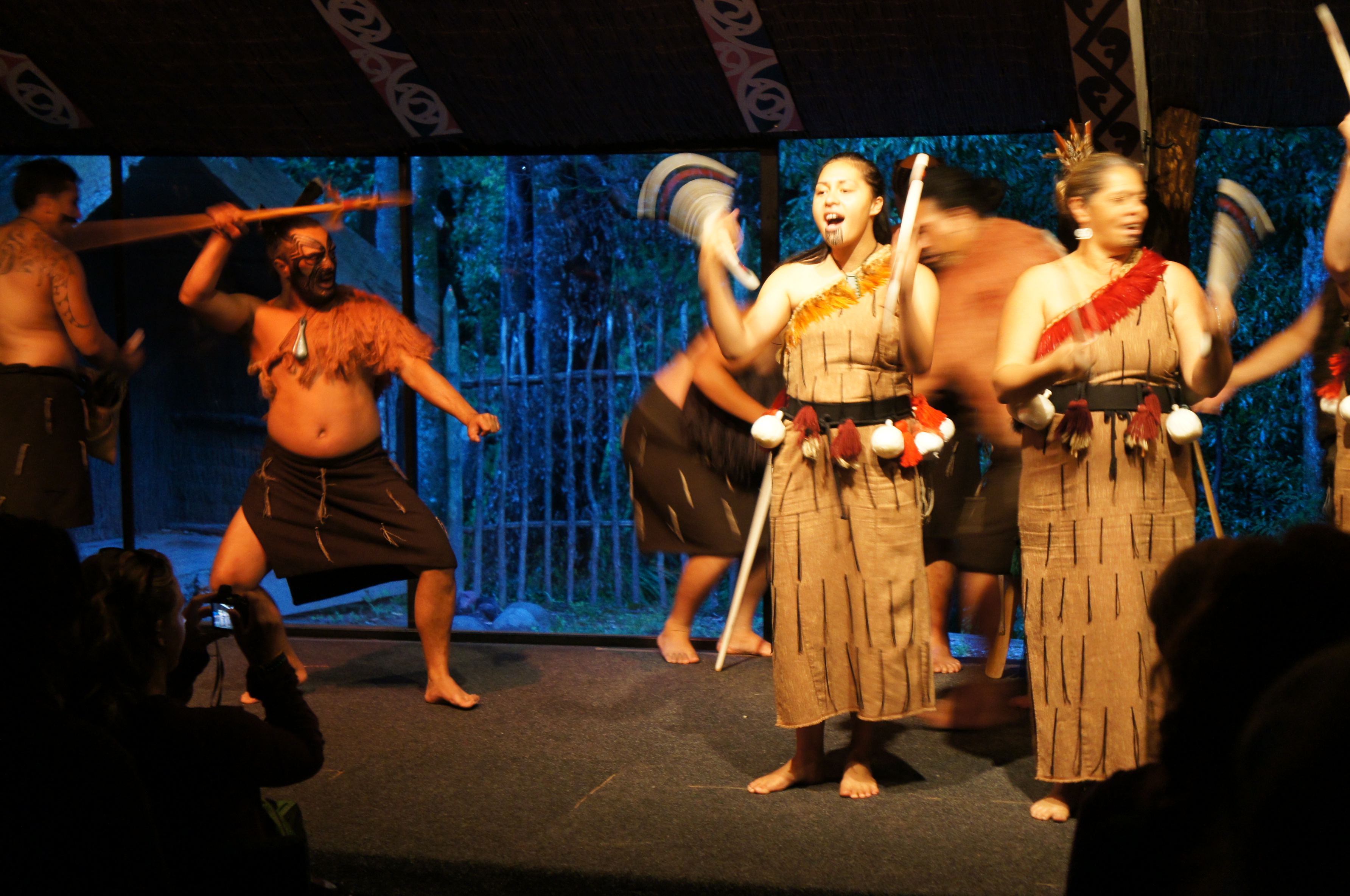
Our journey ends with us standing around a dusty amphitheater. Our leader from Massachusetts bravely stepped forward to represent our canoe and now stands with other waka leaders to participate in a traditional ceremony called the “Powhiri,” a challenge, then welcoming of new tribes, followed by the hongi, a greeting where two people press their noses together to embrace the same life breath. Everyone was transfixed by the Powhiri and remained silent to respect the tradition. It looked like this:

(this looked way better in person and on my mac until i uploaded to youtube!)

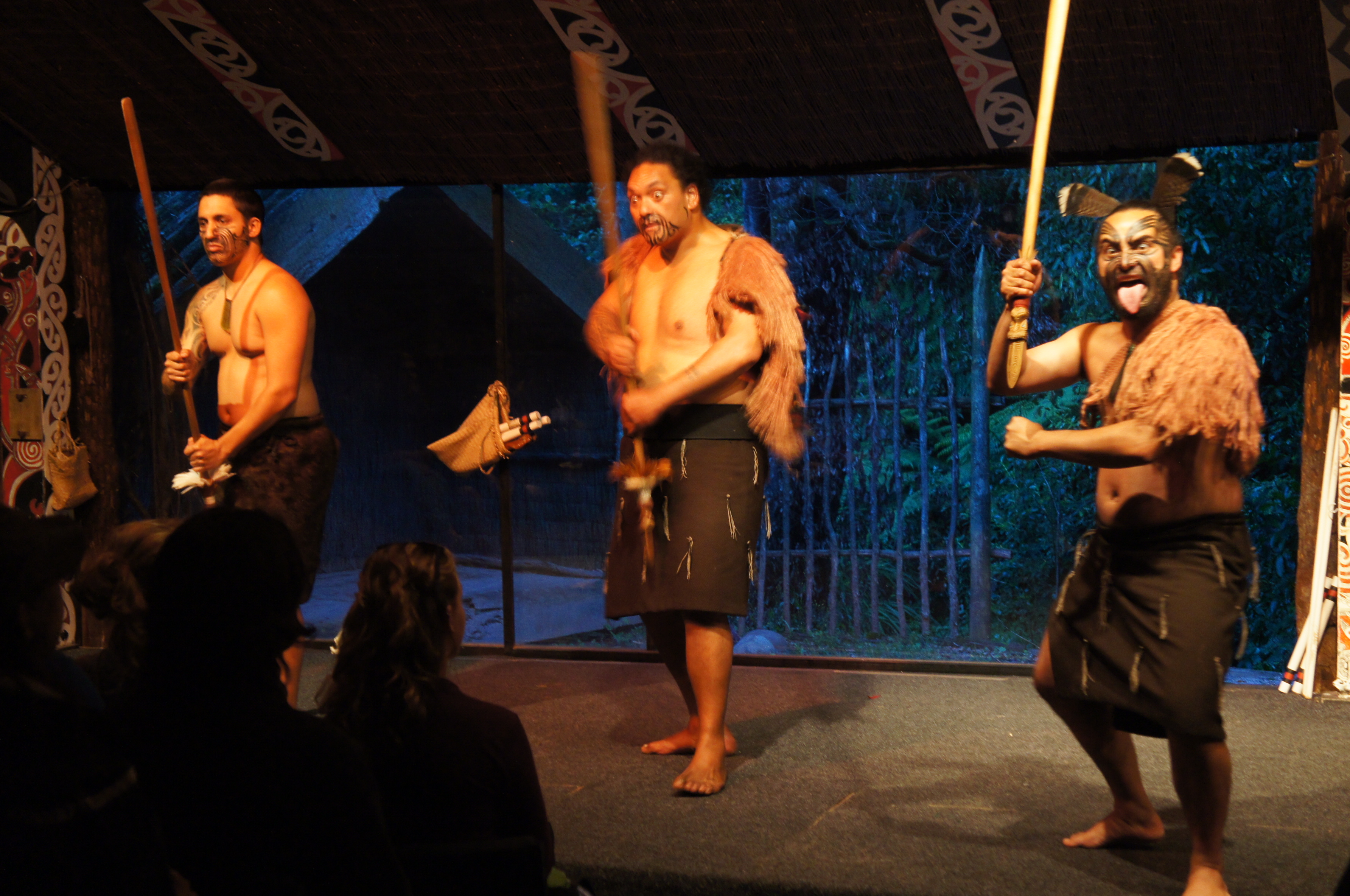
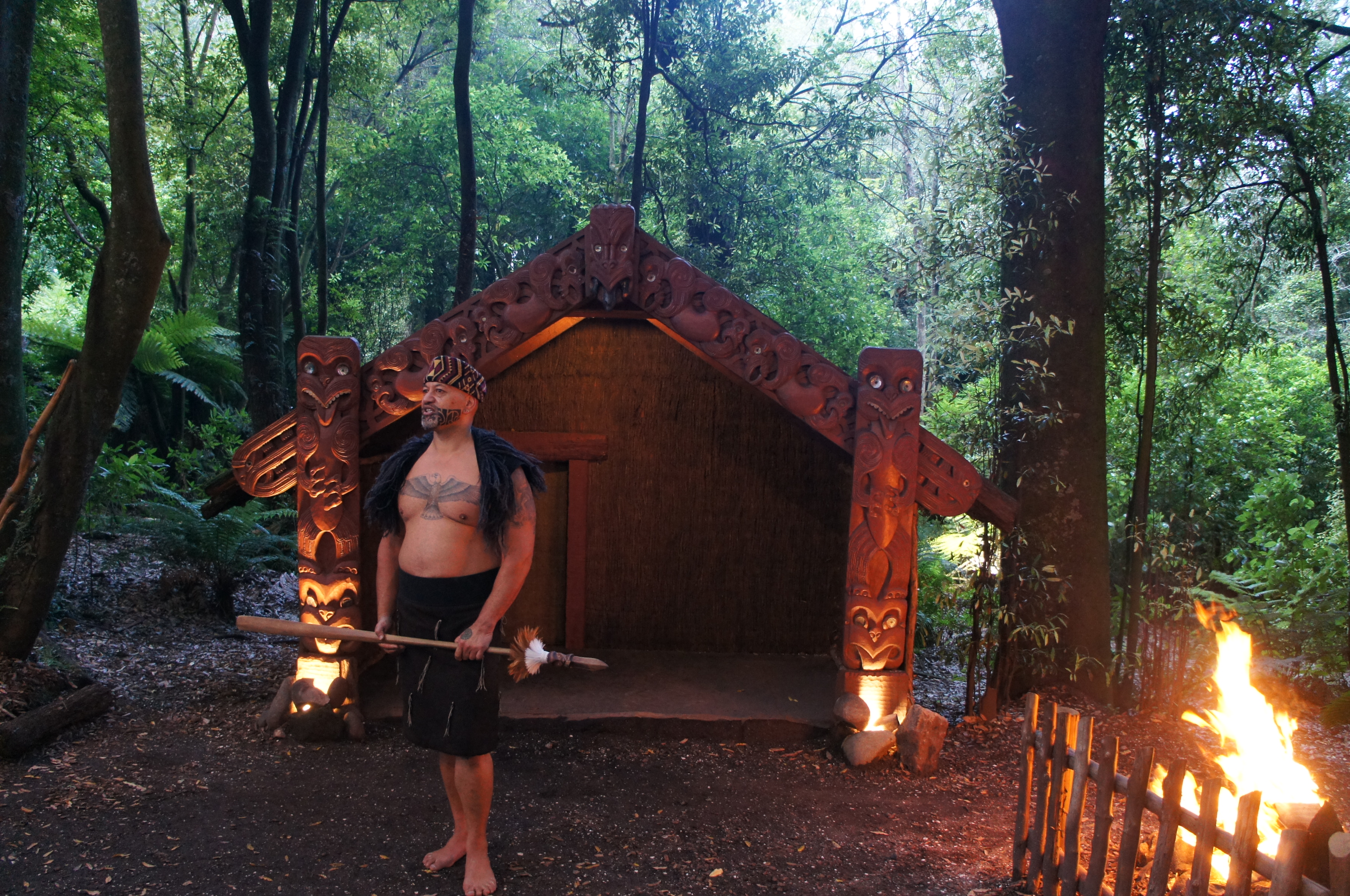
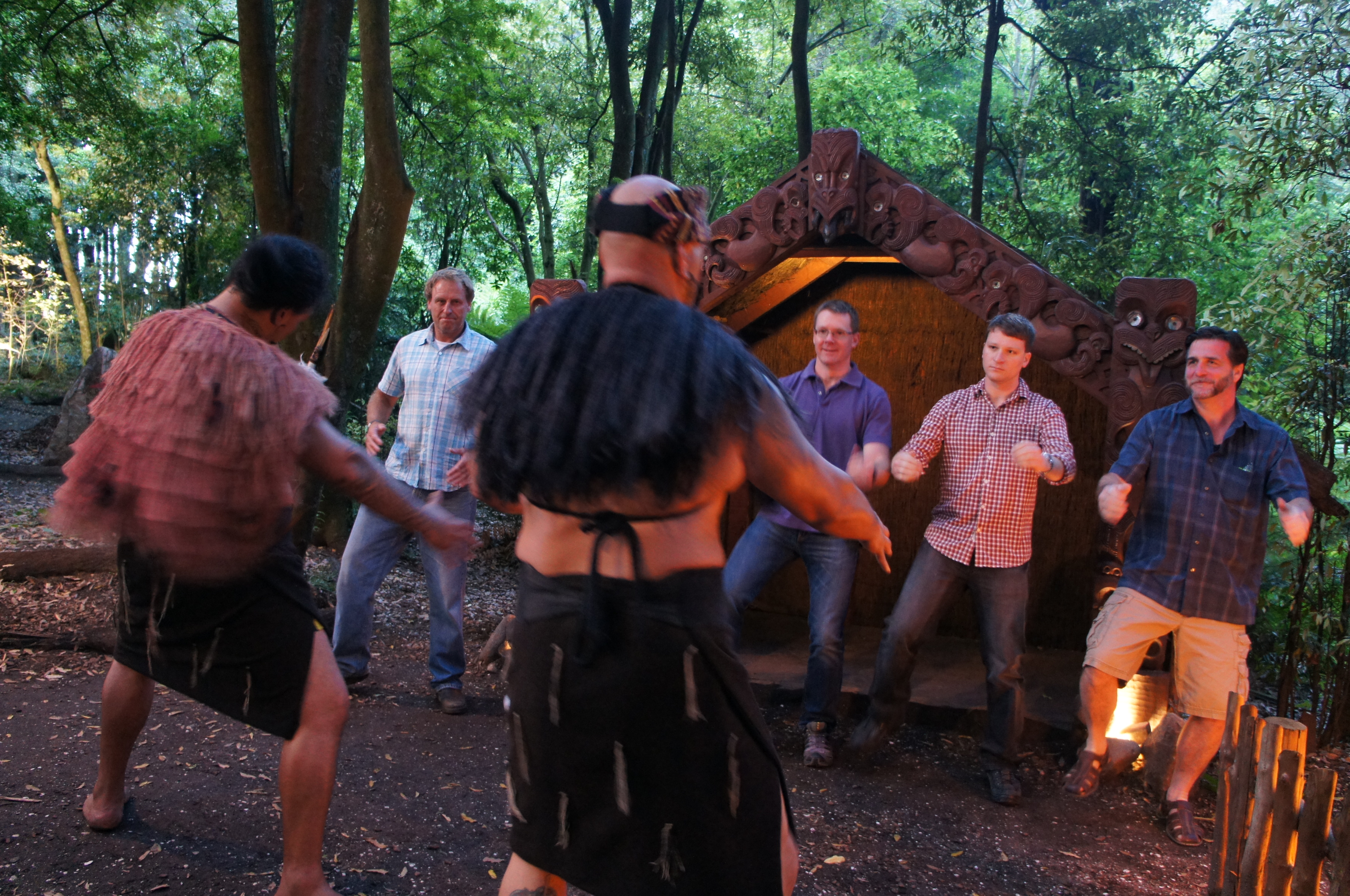
After the real Tamaki villagers decided it was OK to welcome the new Tamaki villagers, we were invited into an otherworldly, seemingly enchanted forest where the trees enveloped us and warm fires flickered. Tamaki villagers showed us to different parts of their village to share their culture and customs. Tanya and I start at the house where the warriors, namely our waka leaders, must learn the haka and how to make the most fearsome face, complete with bulging eyes, protruding tongue and guttural grunts. Our waka leaders tried, but I was left mildly amused rather than scared.

Where new Maori warriors will learn the haka
Learning to haka

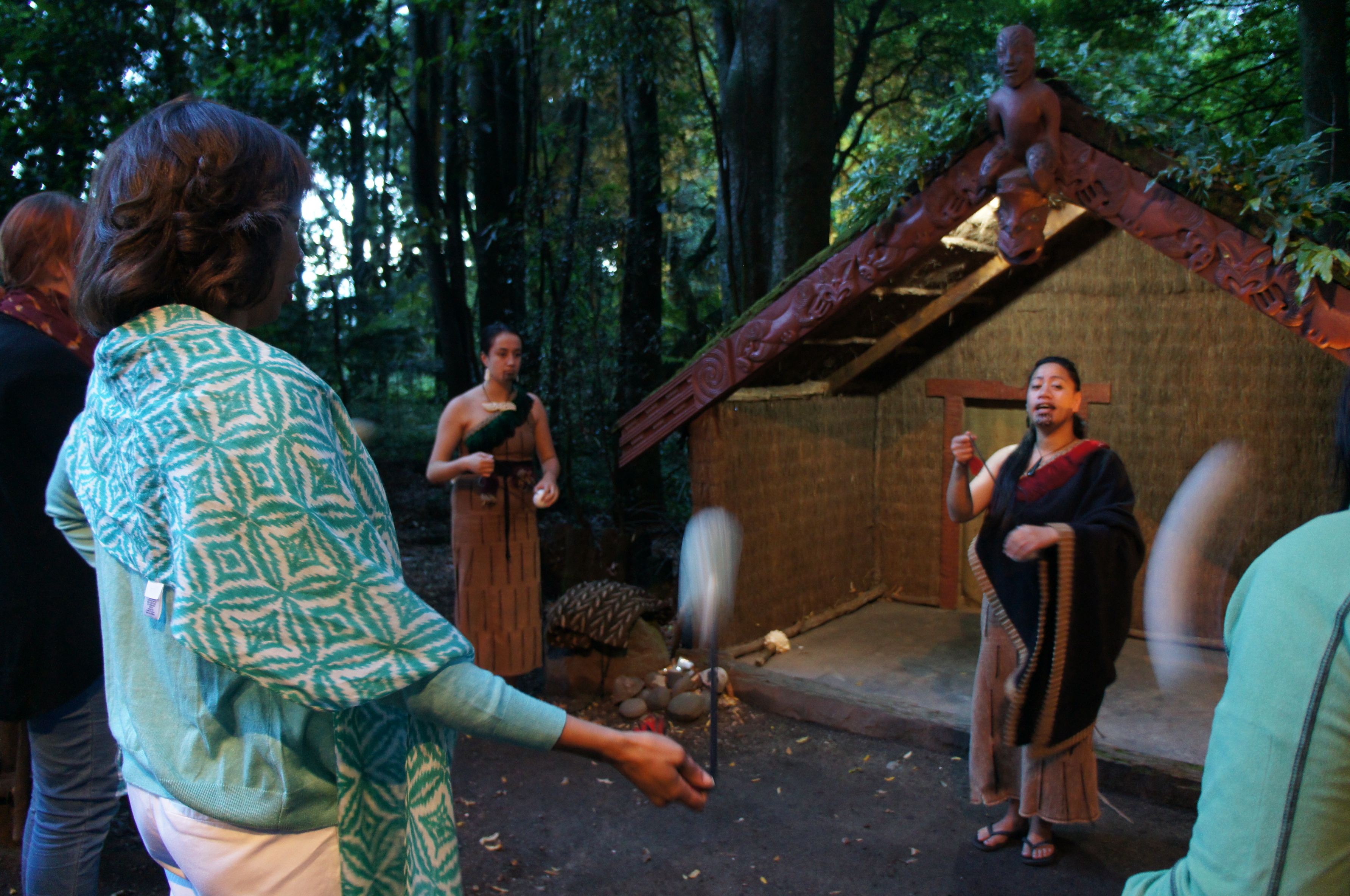
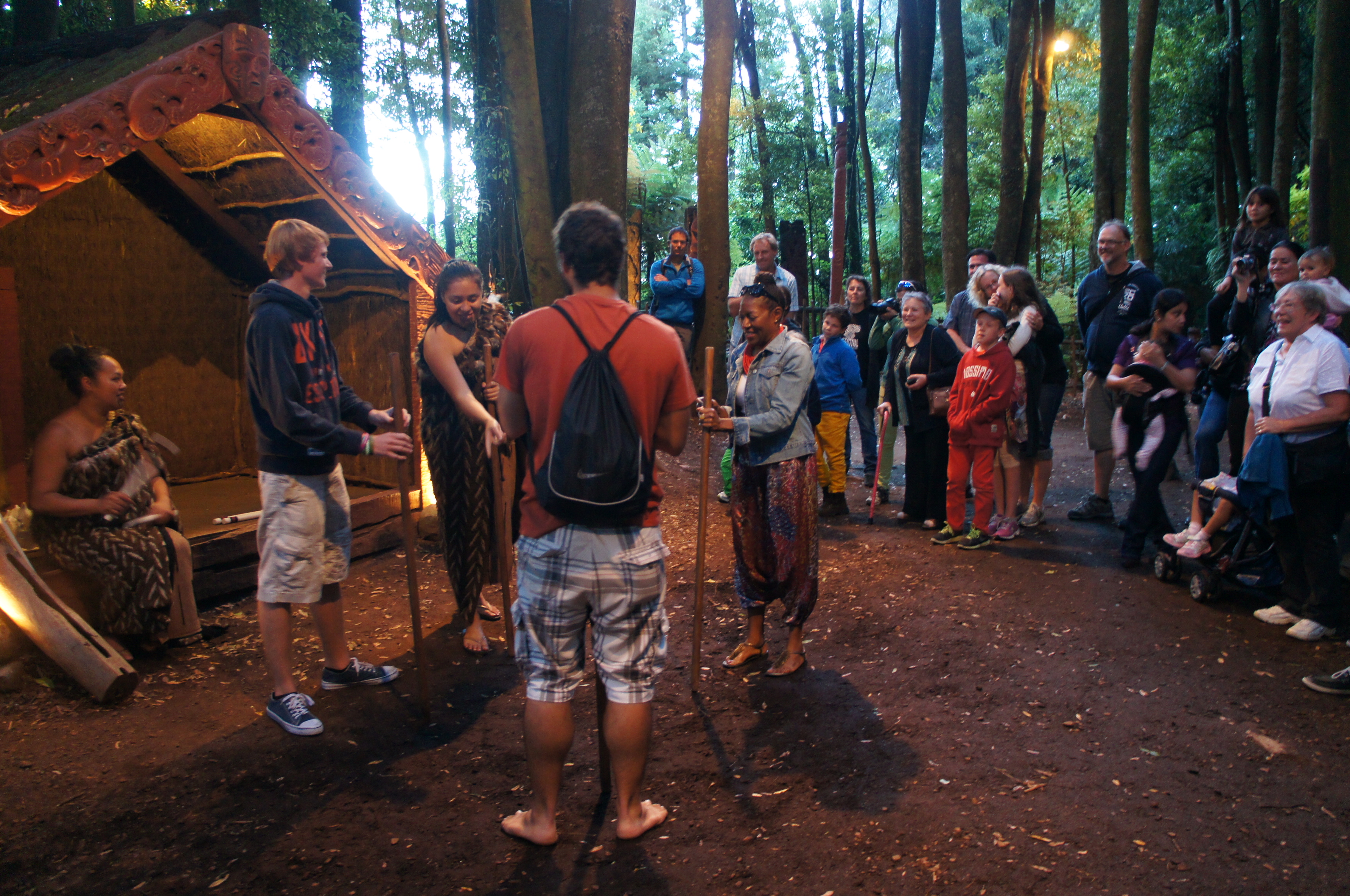
We continue through each home, experiencing Maori culture intimately amongst the trees. Tanya tries her hand at “poi,” a dance typically done by women that may have started as a way for men to train their wrists during battle. Women swing a soft ball, originally made from flax, on a piece of string of varying lengths in elaborate patterns. They make it look really easy. According to Tanya, looks can be deceiving. She said she had trouble controlling the ball, which can go flying if you swing too hard. I tried a children’s game called Ti Rakau that would eventually train them for better stick handling in battle. I stood in a circle with two other new villagers holding a stick and awaiting a call to move left or right, releasing our stick in time to jump and catch the stick next to you. If you miss you are out. It was an insane combination of musical chairs and “Simon Says.”

Tanya practicing poi
Playing Maori children’s games

We had a pretty good explanation of Ta Moko, or the Maori face tattoos, from Awhitia the day before, but here we learned more about how the tattoos are created with a tool made of bone to scratch into the skin and another to inject the ink. The scars were created, allowed to heal and widened again and again. The Tamaki storyteller says many warriors died in the process, but it was considered honorable to do so. The tattoo was like their form of identification, it told their personal story of who they were and where they came from, and their carvings were another form of storytelling revealing legends and genealogy.

By now, we feel honored to be honorary Tamaki. We watch our hangi meal get hoisted from a smoky pit, layer by layer and our mouths water. But first we watch more performances in the wharenui, or meeting house. I tell Tanya that I am more impressed by this than a luau I attended in Hawaii last year. There’s something about this that feels personal. The same people that shared their Maori traditions and stories are now performing the songs and dances that their ancestors passed to them. It doesn’t feel like a big production, but rather a real, honest exchange of culture. It really does make us feel at home.


Cultural exchange in the wharenui
Now that’s a fierce face

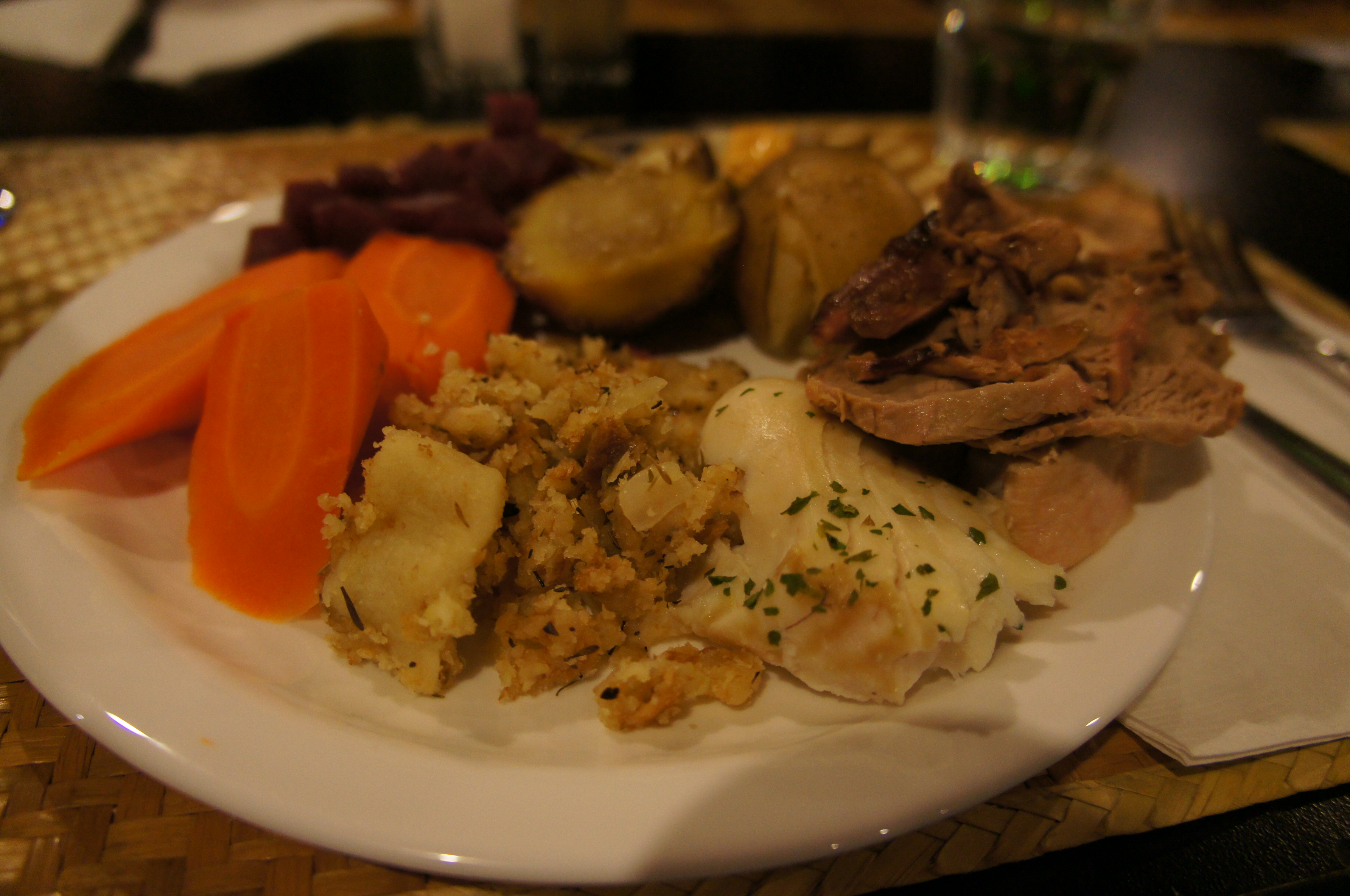
The hangi feast makes us feel even more at home. In fact, it reminds us of Thanksgiving. Everyone is heaping their plates with pork, chicken, sweet potatoes, potatoes, carrots, stuffing and I can’t even remember what else. I do remember the smoky flavor of those potatoes and the tenderness of the chicken. That was some good stick-to-your-ribs-eating. We also enjoyed the company of an Indian couple from Mumbai that was off the Queenstown the next day. Sadly, the wife was vegetarian and couldn’t enjoy much of the meal.
 

Hangi feast that reminds us of Thanksgiving

When we return to our waka, we feel like we’ve really bonded as an iwi. Wallace asks us to sing songs from our countries and Tanya leads in singing the Star-Spangled Banner, our Mexican family members sing “Cielito Lindo,” also known as the ay, ay, ay ay song, the Australians sing “Waltzing Mathilda” and all the others jump in with their traditional tunes. We love each rendition and cheer each other raucously and then Wallace ends with his own song, an American one, “She’ll be coming ‘round the mountain.” He sings as he whirls us around and around the Rotorua rotaries in our big white waka on the way back to our hotels.

Oh, the People You Meet in Auckland, New Zealand

Awhitia Mihaere is a true force of nature. We don’t find this out right away. It reveals itself slowly, like the plot in a good mystery, and with each story she tells or life experience she shares. We get a clue when we meet her outside the Auckland Art Gallery or Toi o Tāmaki in Maori. (The Maori name of the gallery is important to note, as you’ll see later.) We were running late to meet her and we apologize. She tells us that it was no problem because it gave her more time to meditate and she greets us with a warm embrace.

I have even more of a hint of Awhitia’s powers than Tanya. When I told my friend Lisa that I was planning to go to New Zealand, she told me that I had to meet Awhitia. Lisa was attending a women’s leadership conference in Bali when she saw Awhitia give an incredible speech in her native Maori language. She knew she had to meet her. Lisa’s friendship with Awhitia becomes my good fortune and one of the best days in New Zealand so far.

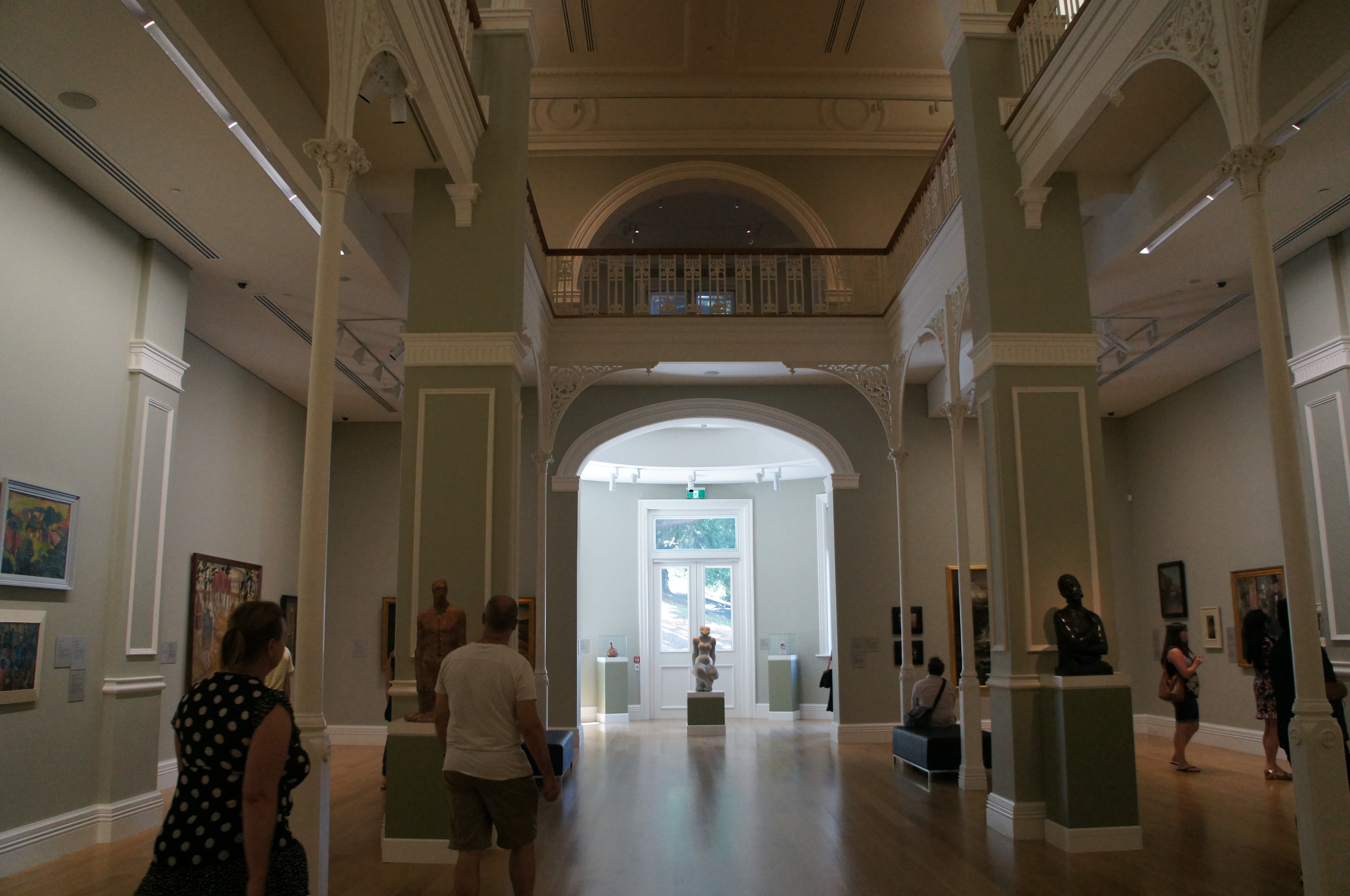
Toi o Tāmaki turns out to best place to meet Awhitia because each piece of art within seems to release an intense reflection, memory or personal story for her. For instance, I tell her that I am struck by the presence of a Maori translation with every art piece. She tells us that she joined a march in Auckland with thousands of other Maori to push Parliament to have Maori recognized as the official language of New Zealand, Aotearoa in Maori, meaning the land of the long white cloud.  In 1990, Auckland did just that and now Maori translations must appear in its public spaces, on signs and buildings.

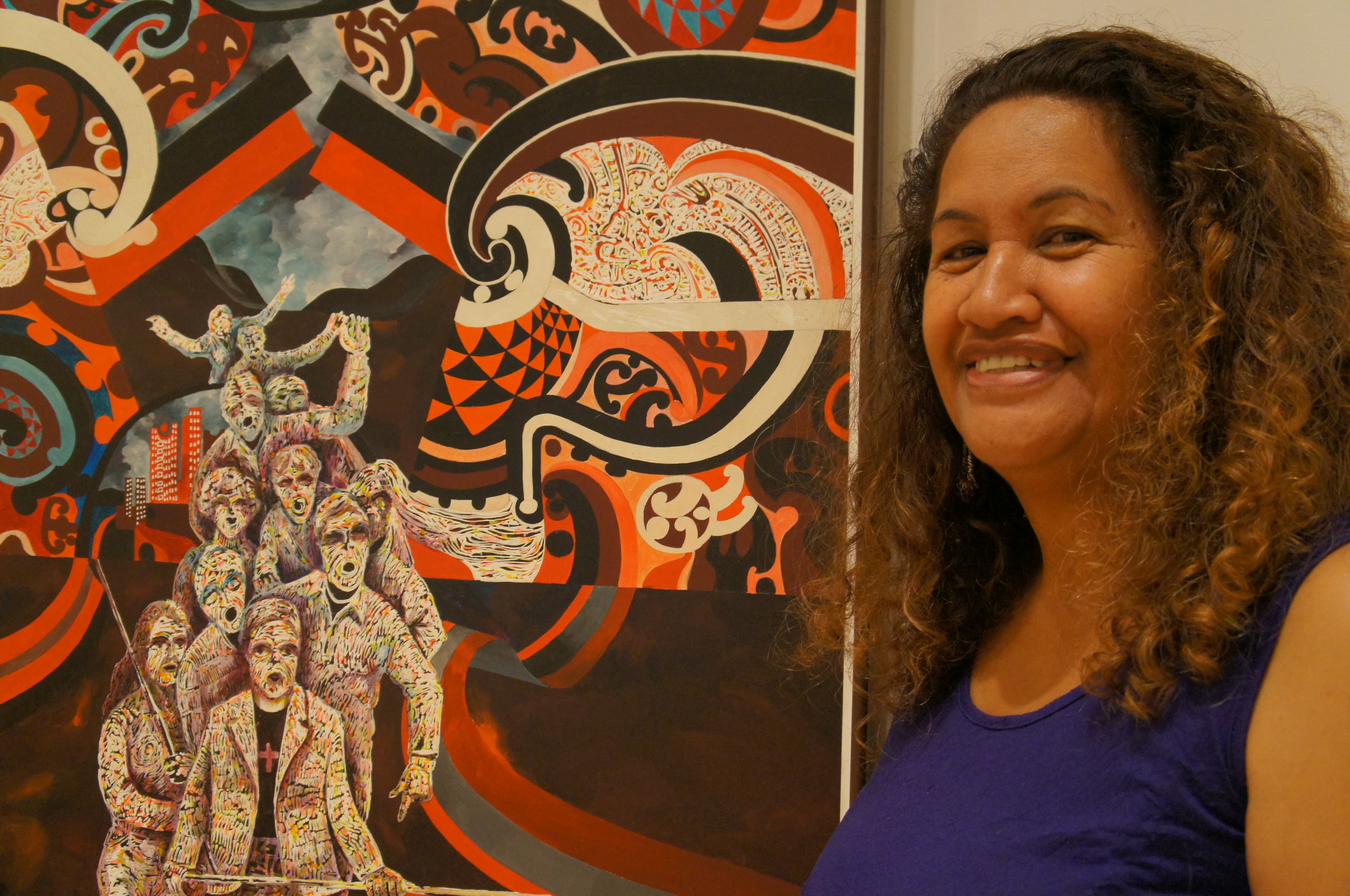
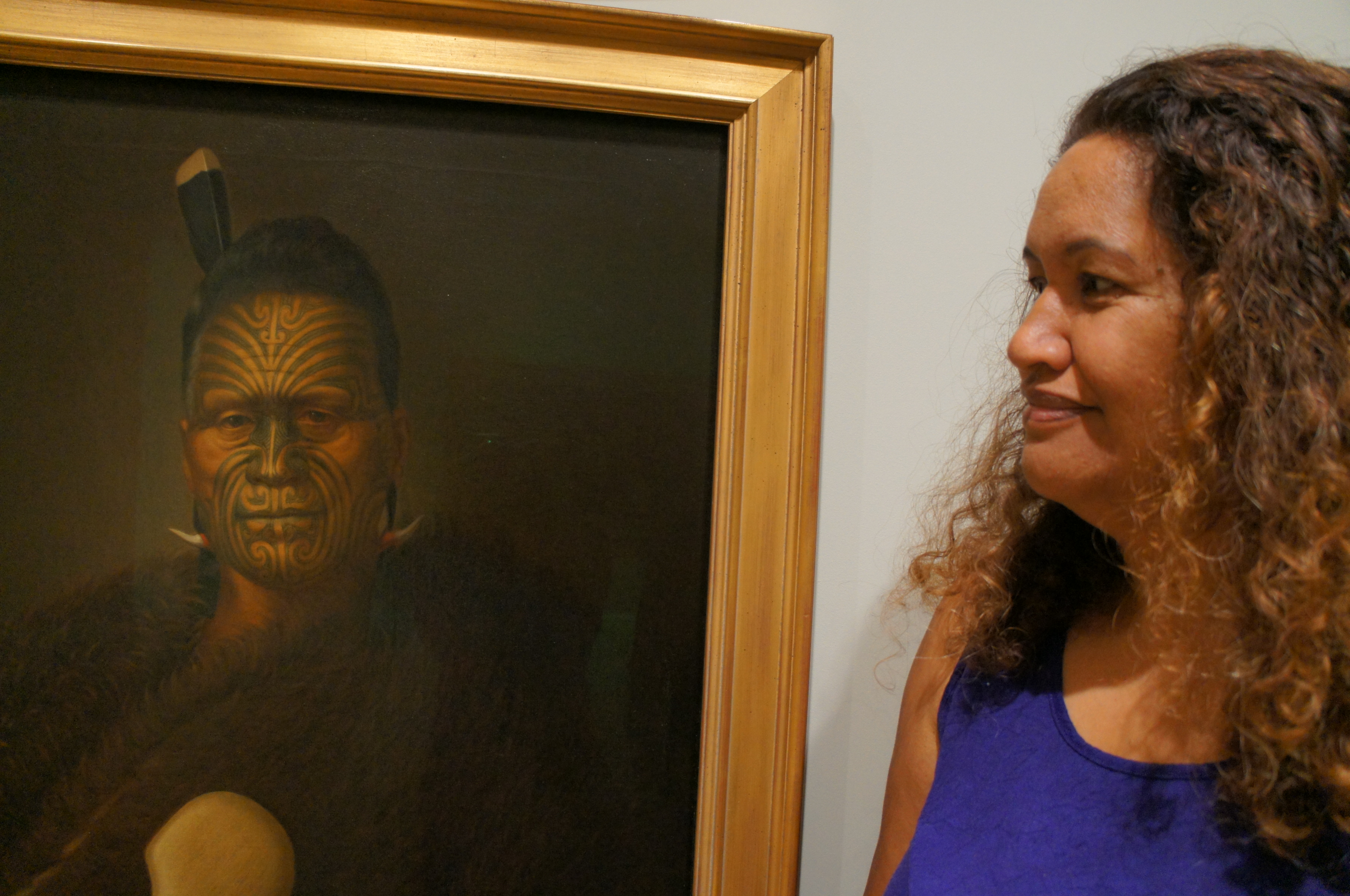
Awhitia with one of her favorite paintings, “This Land is Ours.”

A painting called “This Land is Ours,” by Buck Nin, inspires more protest talk. It depicts a 1975 march from the northern town of Te Haupa to Wellington led by Dame Whina Cooper to protest the loss of Maori land at the hands of the government with the rallying cry, “Not one more acre of Maori land.” As Awhitia tells the story behind the painting she beams with pride, remembering a Maori heroine in Cooper and her own role, joining the march as a teen. She seem so moved that I had to ask to take a picture of her next to the painting, which made her ecstatic. She pumped her fists in the air after I snapped the shot.

Awhitia’s activism actually seems to be her way of life, tightly woven into everything she does. She started a school in her home that has grown into a Maori institution that teaches students the Maori language, cultural arts and healing. She’s also a traditional birthing practitioner, helping modern Maori women give birth the way their ancestors did through ancient practices that her ancestors taught her. Besides massaging Maori women’s bellies with traditional oils during labor she encourages them to practice old traditions like having their placenta read to learn their child’s life path and then burying it in a place of their choosing so that the child always has a place to call home. Tanya and I think this one of the most beautiful concepts we’ve ever heard, and it’s at about this point that we start to realize that we are in the presence of a force of nature.

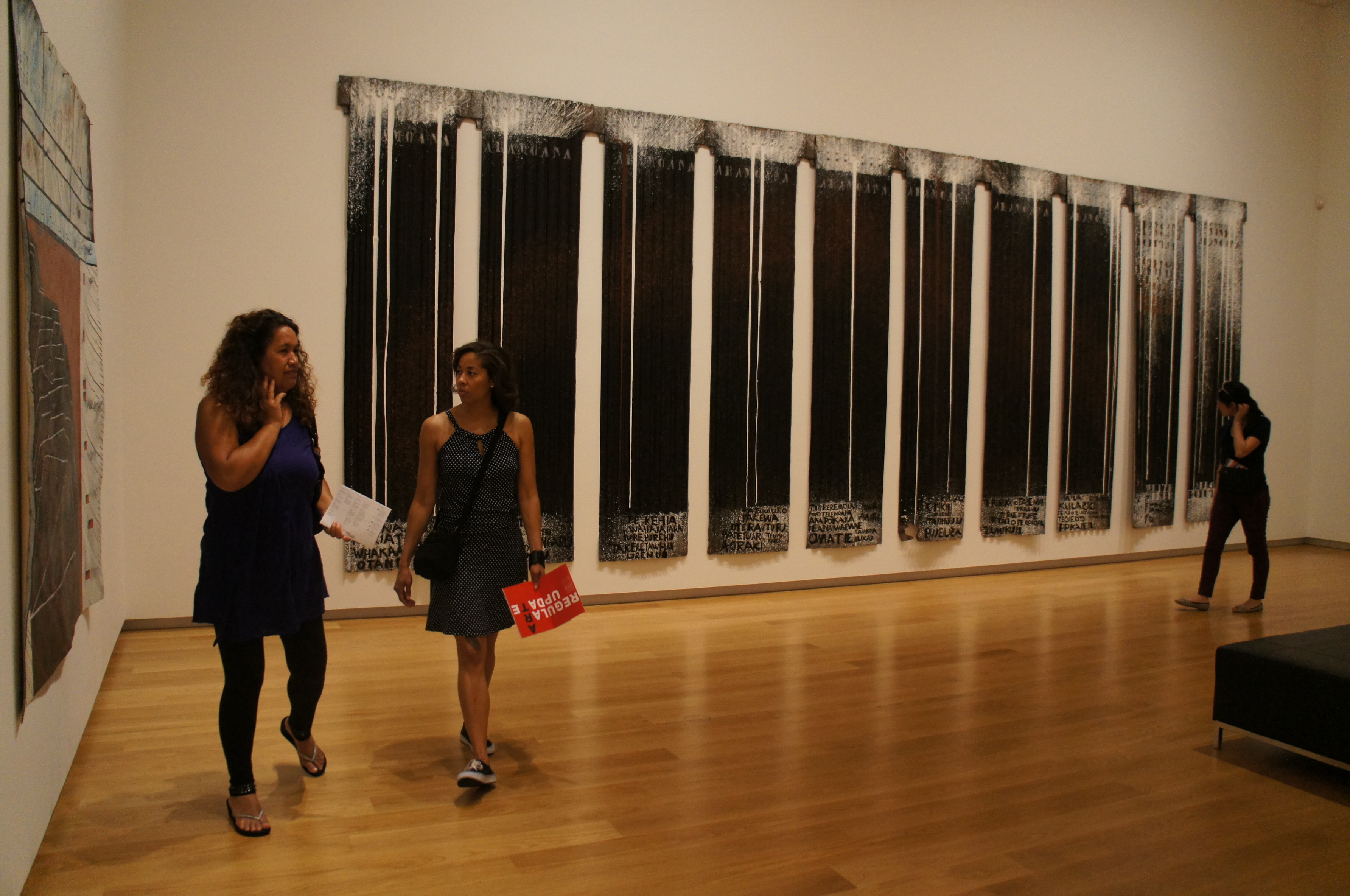
Awhitia and Tanya walk in front of a stunning piece called Aramoana by well-known Maori artist Ralph Hotere.

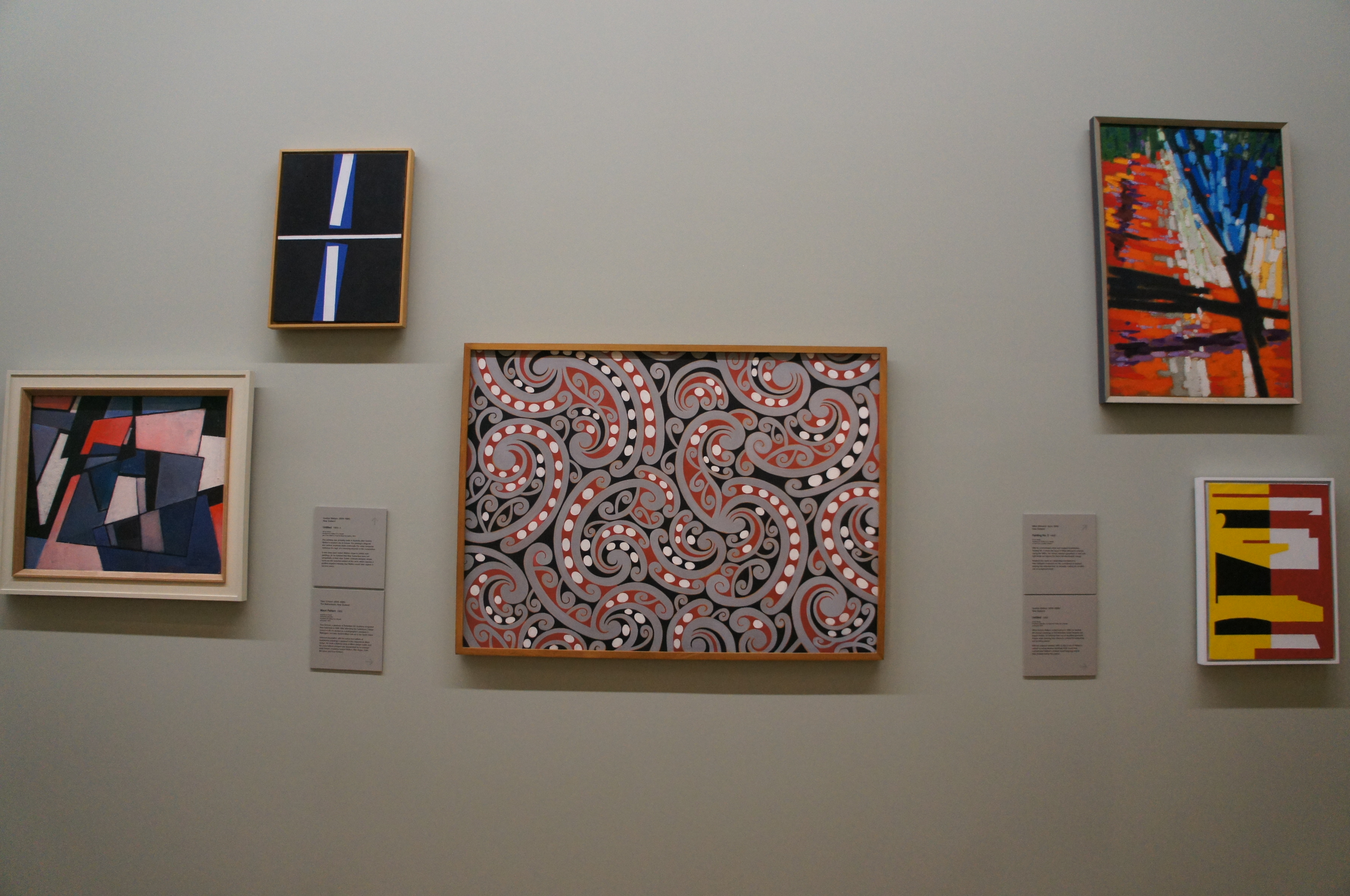
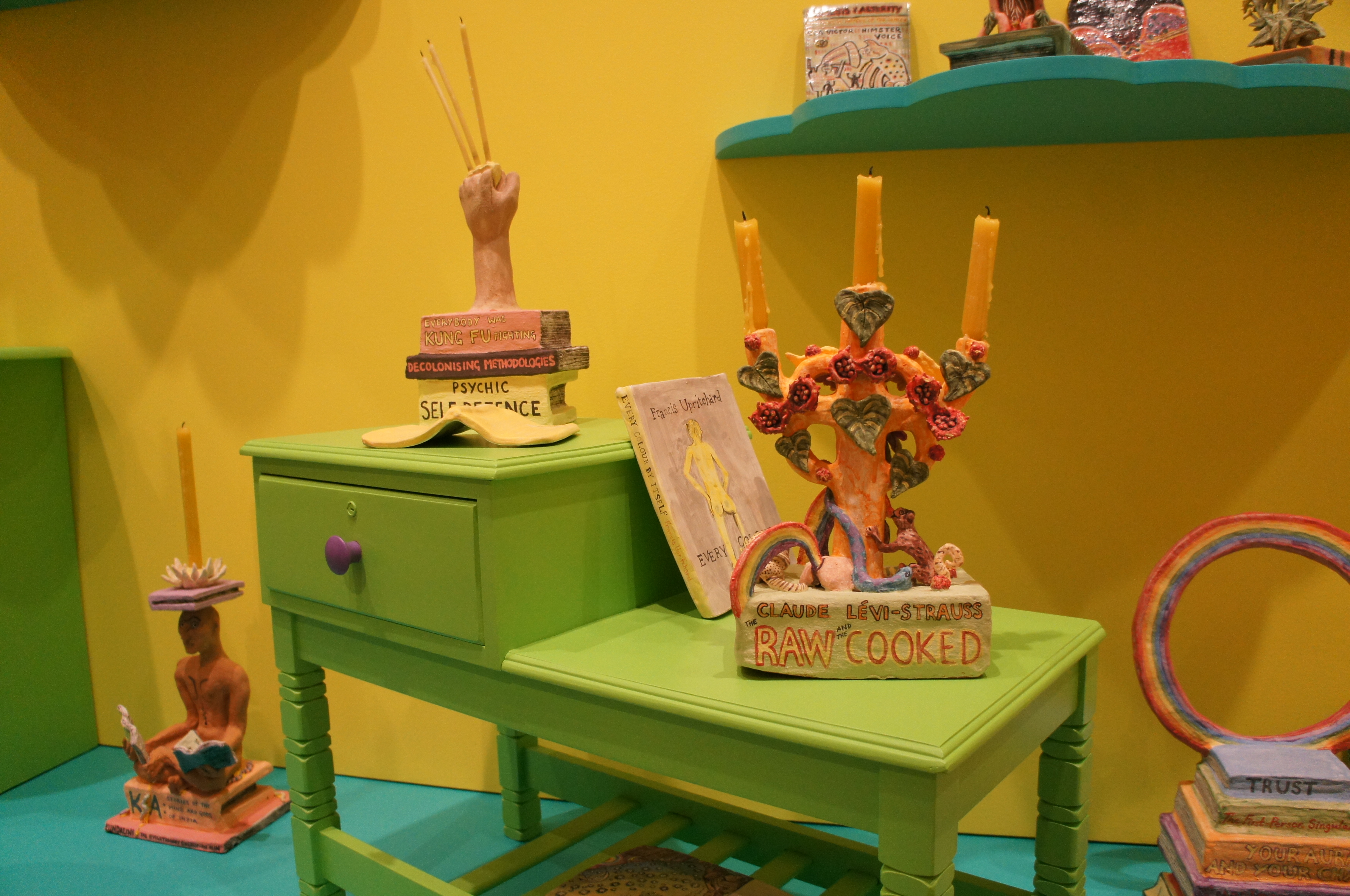
As we continue through the gallery, Awhitia shares more about the bright, bold pieces that we see and her connections to them. For one thing,  she’s friends with the indigenous curator of the museum and she knows many of the artists.  She points out paintings by some of the first Maori graduates of Auckland’s prestigious Elam School of Art and others that showcase Maori patterns. When we see an installation featuring provocatively titled books and colorful, primitively molded sculptures, the books remind her of her work as an indigenous cultural adviser in a prison, where she advised the prison on Maori traditions that should be up held by law. She brought romiromi  traditional massage healing practices into the prisons along with an ancient traditional Hawaiian practice of peace and forgiveness, ho’oponopono, practiced by her husband and his people.  Tanya and I can’t believe that we’ve uncovered another facet of this woman’s life and we tell her so. She admits that she’s had to scale back her prison work because of the negative energy, but also because her mother told her that she was doing too much.

This piece by  Robert Ellis looks at the intersection of urban and rural.
A gallery featuring a mix of art styles by Kiwi and Maori artists.
Maori pattern as interpreted by a New Zealand artist of Asian descent.
This piece reminds me of Mexican folk art, but it reminds Awhitia of her advocacy for Maori prisoners.

Awhitia’s stories inspire us to share our own stories of race and culture in the US. We admire her ability to trace her ancestry to its beginnings, something many African-Americans try desperately to do. She said the movie “Lincoln” infuriated her because while Lincoln legally freed the slaves, she says they weren’t free because they were taken from their land, moved from one continent to another. For her, and in Maori culture, owning your own land and having a place to call yours is the essence of freedom.

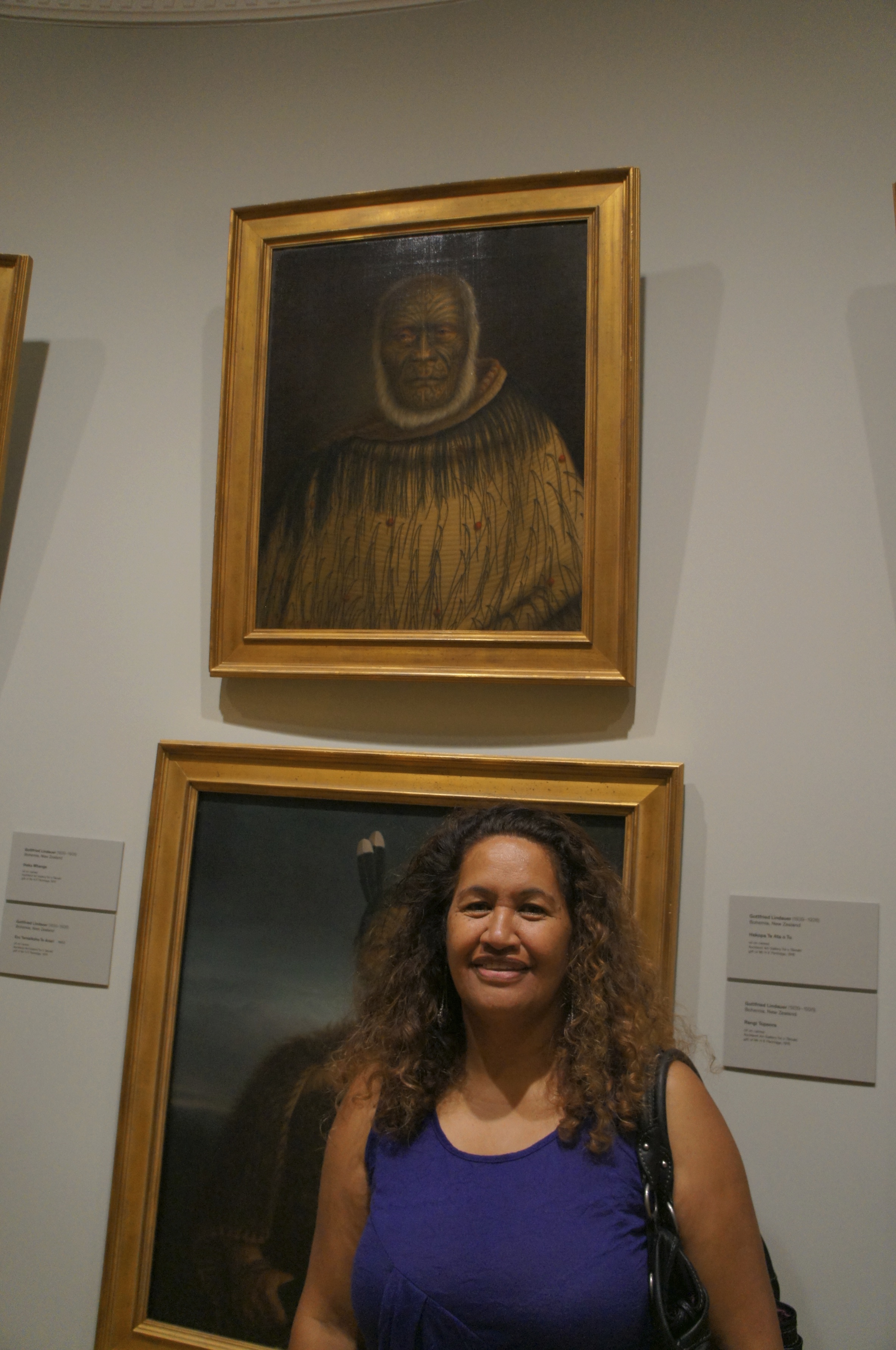
This inspires Awhitia to share her ancestors with us. We search the gallery for a small room featuring gilded framed paintings of stately looking Maori men and women. She points to a grey-haired and bearded man with a serene face filled with tattoos from hairline to chin. “This is my ancestor,” she says proudly. Ihaka Whanga is her great grandfather 3 times removed on her mother’s side. Then she points to her ancestor on her father’s side Tawahaio Matutaera, who bears a more fierce countenance wearing shark teeth earrings and carrying a weapon made of whale bone that can lop a rival’s head off. Both men were chiefs of different tribes. Ihaka Whanga of the Ngāti Kahungunu and Tawahaio Matutaera  of the Tainui, but both men wear the face tattoos known as Ta Moko from hairline to chin, indicating their status as chiefs and carrying their genealogy lines with one side of the face tracing the maternal line and the other the paternal line.

Awhitia is a direct descent of Ihaka Whaanga, a chief of the Ngāti Kahungunu
Awhitia’s ancestor Tawahaio Matutaera  of the Tainui

We think it is incredible that these leaders have been immortalized in oil and given a place in the gallery. Awhitia says that she is grateful that she always has a place to visit her ancestors and she thanks them for letting us spend time with them before we leave the gallery. We continue to bond over lunch at a down town sushi spot where Awhitia shares photos of her children, grandchildren and her Hawaiian hubby who is also a lomilomi practitioner, working with her in the art of massage in the birthing process. It was great to learn more about her family and we all feel like we’ve been girlfriends since forever.

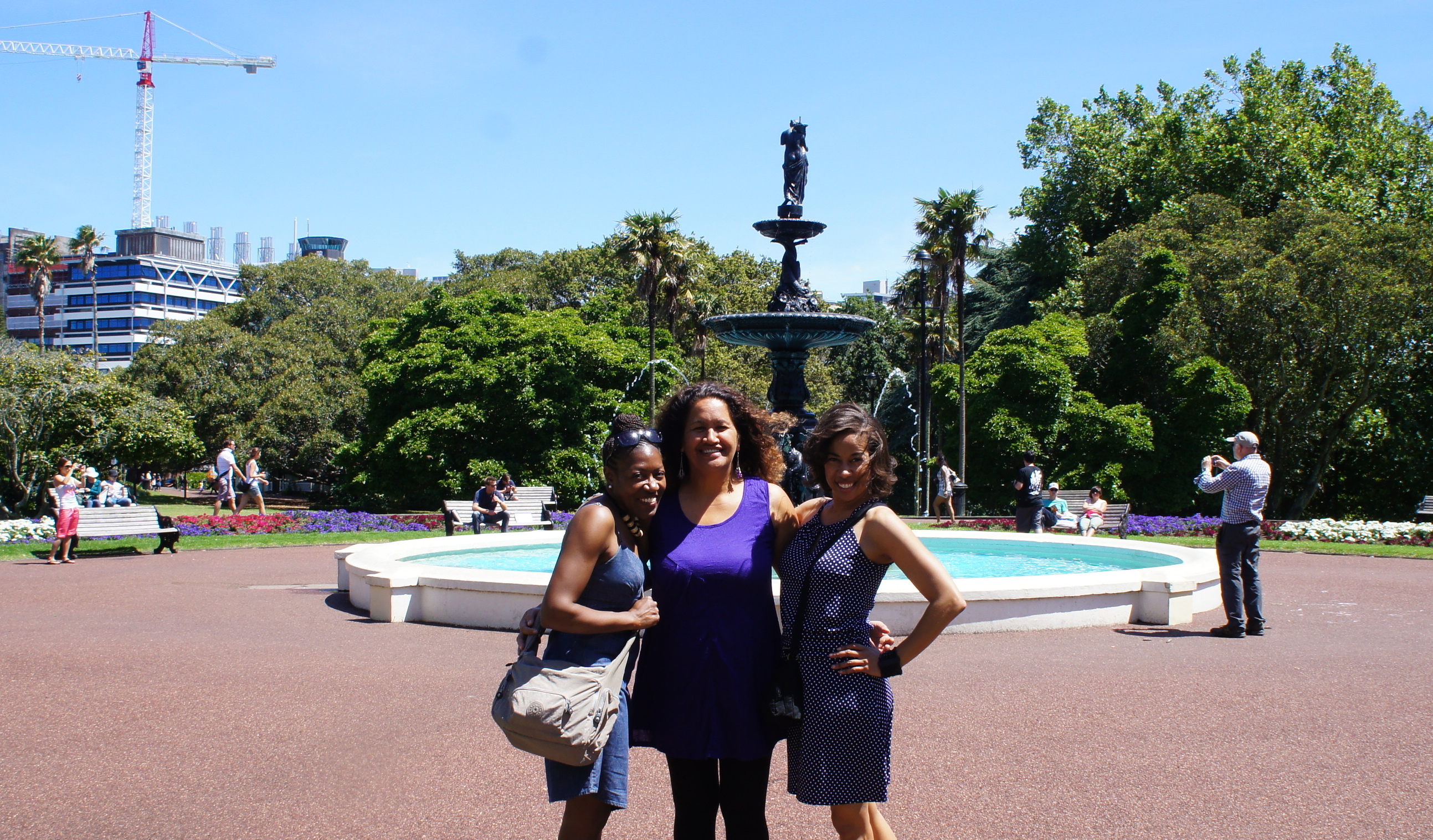
After lunch we go for a stroll in Albert Park, bordered by the art gallery and Auckland University. It’s a lovely vibrant green oasis on a hill in the middle of the city with perfectly placed bursts of hot pink and purple flowers. We are drawn to the pretty iron fountain at its center and we sit on a bench nearby to let the sun warm our shoulders. And then we do what best girlfriends do. We take selfies. It was a perfect way to spend an afternoon and a great way to gain a genuine sense of a place through a very genuine person.

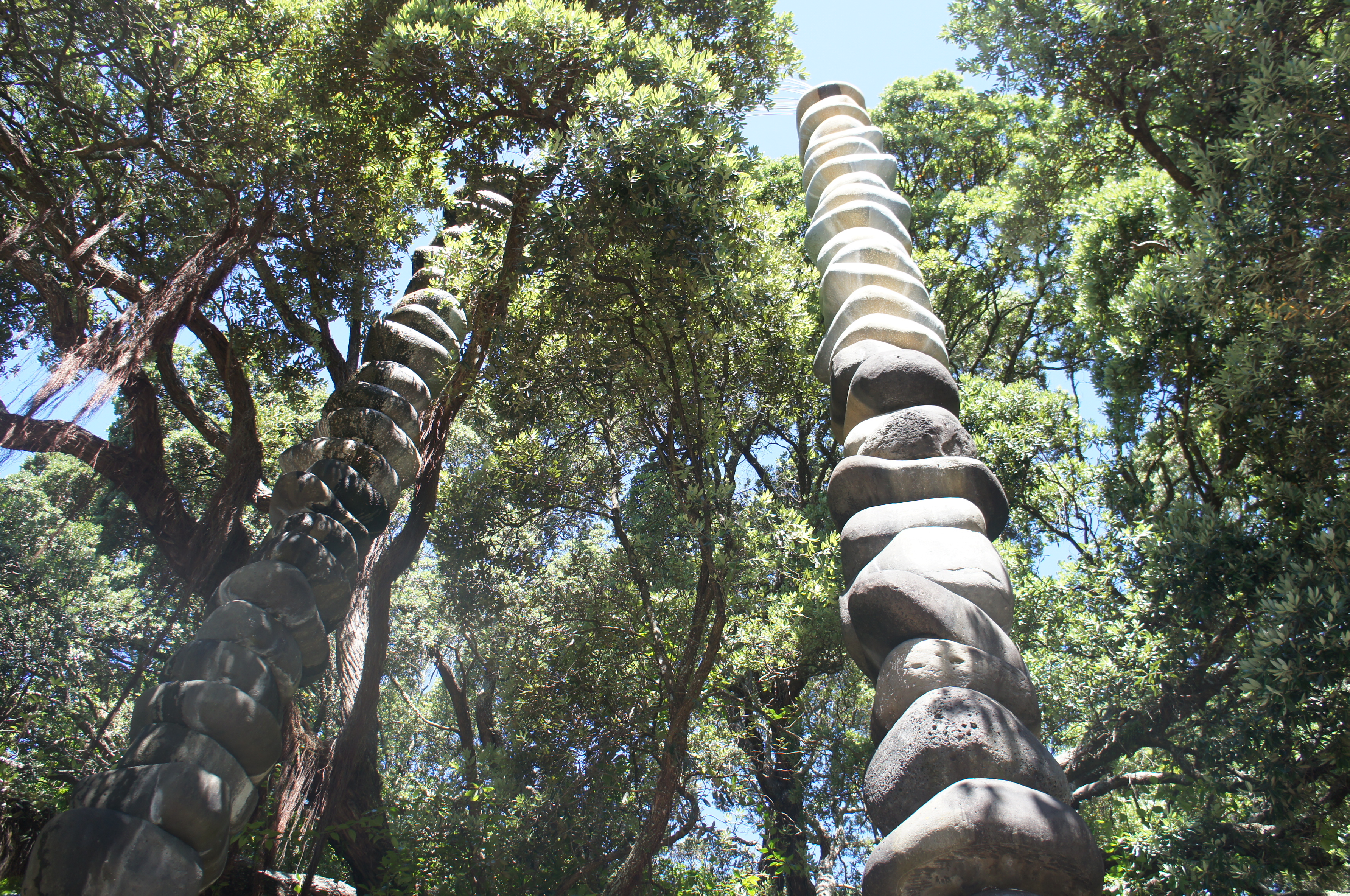
The striking gateway to Auckland’s Albert Park made from boulders gifted by the Ngati Kura people.
New friends enjoying the day in Albert Park

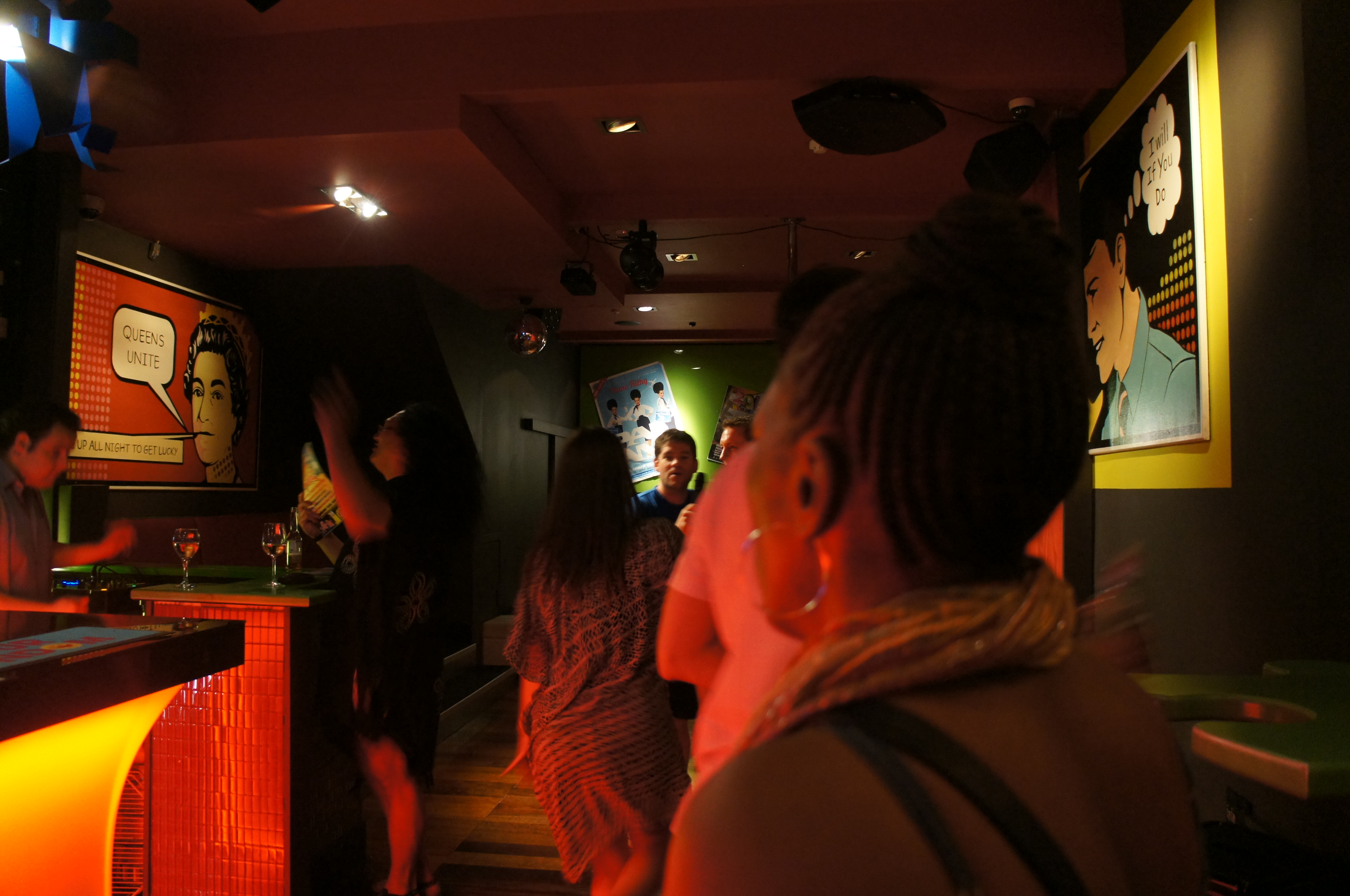
More than its monuments and natural landmarks, it’s the people that make a place and this turns out to be the theme for our third day in New Zealand. Tanya and I decided that we wanted to check out Auckland’s party scene our last night in the city. We set out down Ponsonby Road on a Thursday night to find almost every restaurant and bar closed. We’d pretty much give up around 10 pm when we decide to head back home, but we are stopped by the sound of karaoke crooners at a bar called Poof decorated with a comic strip theme. We’d walked past earlier in the evening and it was totally dead. Tanya said, “It’s karaoke, you know I have to go in.” And, I know she does. It’s the only thing happening on Ponsonby, so I’m game, too.

Tanya doesn’t really need to look at the songbook to know that she’s going to sing “Proud Mary.” But we look anyway to see if we can find a song that we can sing together. I never get the phrasing on Proud Mary right. That’s when Odin appears. He basically asks what we are doing there. He’s polite about it, but it’s clear that he’s shocked to find two black girls in a bar in Auckland, especially, two black girls in a gay bar in Auckland. Things start clicking. There’s a big Roy Lichtenstein-style painting on the wall saying, “We are the rainbow people.” Tanya remembers that the word “Poof” in Britain is often used to reference gay men. Then it hits me that there are way more men here than women. Odin continues his inquiry, he keeps asking, “Where are you really from?” After convincing him that we are from Washington, DC and that we are in Auckland on vacation, he invites us to hang out with his other friends, who are a few of the other straight people in the place.

Odin, Scott and Craig have taken their married friend Brett for a night out and the only place they can find is this spot. Scott tells us that Jan. 2 is some sort of national holiday and that’s why everything is closed. We pretty much have the same conversation with Scott as we did with Odin explaining how two black girls walked into a gay bar on Ponsonby Road in Auckland and with all the pleasantries dispensed folks start singing. Odin has decided that he and I should sing a song together and suggests, “The Power of Love.” I’m thinking Huey Lewis and the News, so it sounds good to me. But before we sing, Tanya, who has perfected her Tina Turner impression, decided to turn the bar out with Proud Mary complete with hair tossing and shimmying. There isn’t a crowd more appreciative than this group of gay men.

Then I find myself called to sing with Odin, who up until this point has been telling me how beautiful he thinks I am and I keep thanking him, flattered while noticing that he may be a tad drunk. It is very apparent later in the evening when he is walking around the bar with one flip flop on. At the point we start to sing, he has two flip-flops on, at least, I think, and I realize that I haven’t a clue what song we are singing. Never heard it before and I can’t catch the melody because Odin cannot sing. He is the epitome of bad karaoke singers in flip-flops. So, as he sings to me I try to jump in when I think I hear the hook, but our duet is tanking horribly and it’s one of those really long songs with like 10 verses. It’s as bad as it sounds. When it ends, Odin says, “I totally carried you.” He’s a funny dude. So, I think I’ll be his friend, in fact, Tanya and I decide we like these guys. Scott and Brett are in a band so they pretty much kill all the old 80s rock songs and Scott steps in to help a couple of girls failing horribly at singing “Roxanne.” You can clearly tell who has karaoke standards and know their way around a karaoke song book and those who don’t, but it’s all good and its all love in the only bar open in Ponsonby.

Inside Poof on Ponsonby
Tanya belts out a song and Odin joins in.
Me and Odin
Scott and Brett, the boys with the band
What’s missing in this picture?

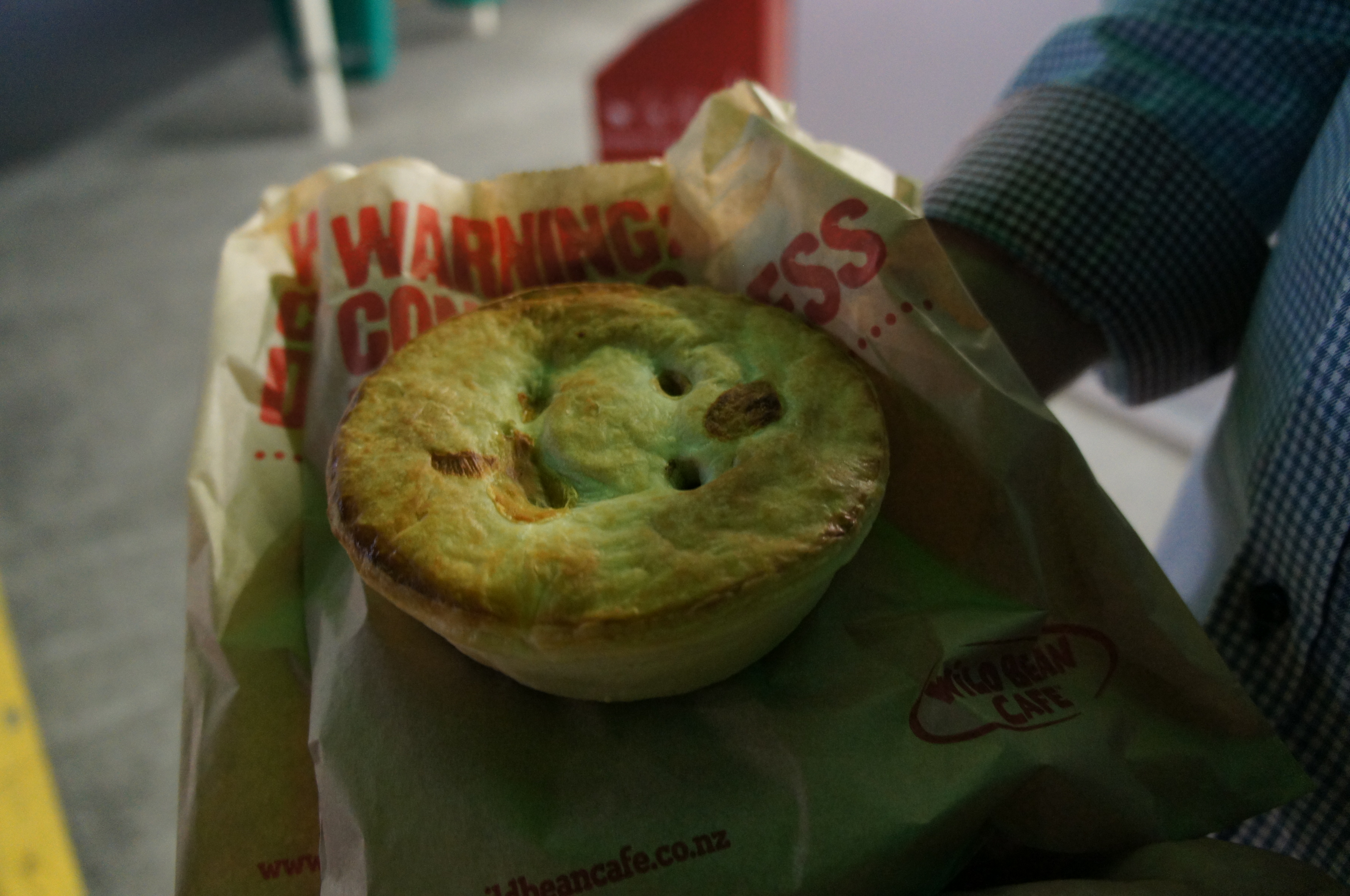
Scott really wants to impress us with more of his rock stylings and invites us back to his place for a jam session with the guys. I still have to pack before we leave for Rotorua and it’s 1 am, but Tanya is raring to go. “It’s our last night in Auckland,” she says. I know she’s right. This is part of the adventure. So, I gotta go. We do a very Kiwi thing on the walk to Scott’s and stop for meat pies at the local gas station. Well, they do and I just have a taste. Brett gets a Thai Chicken meat pie that wasn’t that bad. Craig, who once lived in San Fran and now lives in London, gets the traditional cheese and meat pie, which was pretty disgusting. The interior looked to be the consistency of mud.

After consuming meat pies, Scott breaks out a 2001 issue of the British Marie Claire featuring Odin as the bachelor of the month, his wide blue eyes staring out from its page. He answers questions like what’s his favorite movie: “There’s Something About Mary” and his favorite city, “London.” It’s awesome. The guys immediately start teasing Scott for having the magazine so accessible in his room with the page dog-eared. More wholesome hijinks ensure and we settle into Scott’s den converted into a music studio and listen to him and Brett play their favorite songs, mostly from Brit and Aussie bands, because there aren’t many popular Kiwi bands. Then he goes Canadian with some Bryan Adams. They aren’t bad. Tanya is enjoying herself thoroughly and doesn’t look like she wants to leave. But all good things must come to an end. We met some fabulous people in Auckland on our last day and we wish we’d had more time to spend getting to know them. But we’ve got to go. We have more adventures ahead in Rotorua.

Craig holds an infamous Kiwi meat pie.
Scott jams.

Wine Tasting and Good Company on New Zealand’s Waiheke Island

By the end of our Waiheke Island Wine Tour, Tanya and I are tightly hugging our fellow tour-goers and our guide, Wayne. It could be that we are really tipsy or we just really like them. Maybe it’s a little bit of both. When Wayne picked us up from the Waiheke ferry, we had no idea what to expect other than tasting some good New Zealand wine.

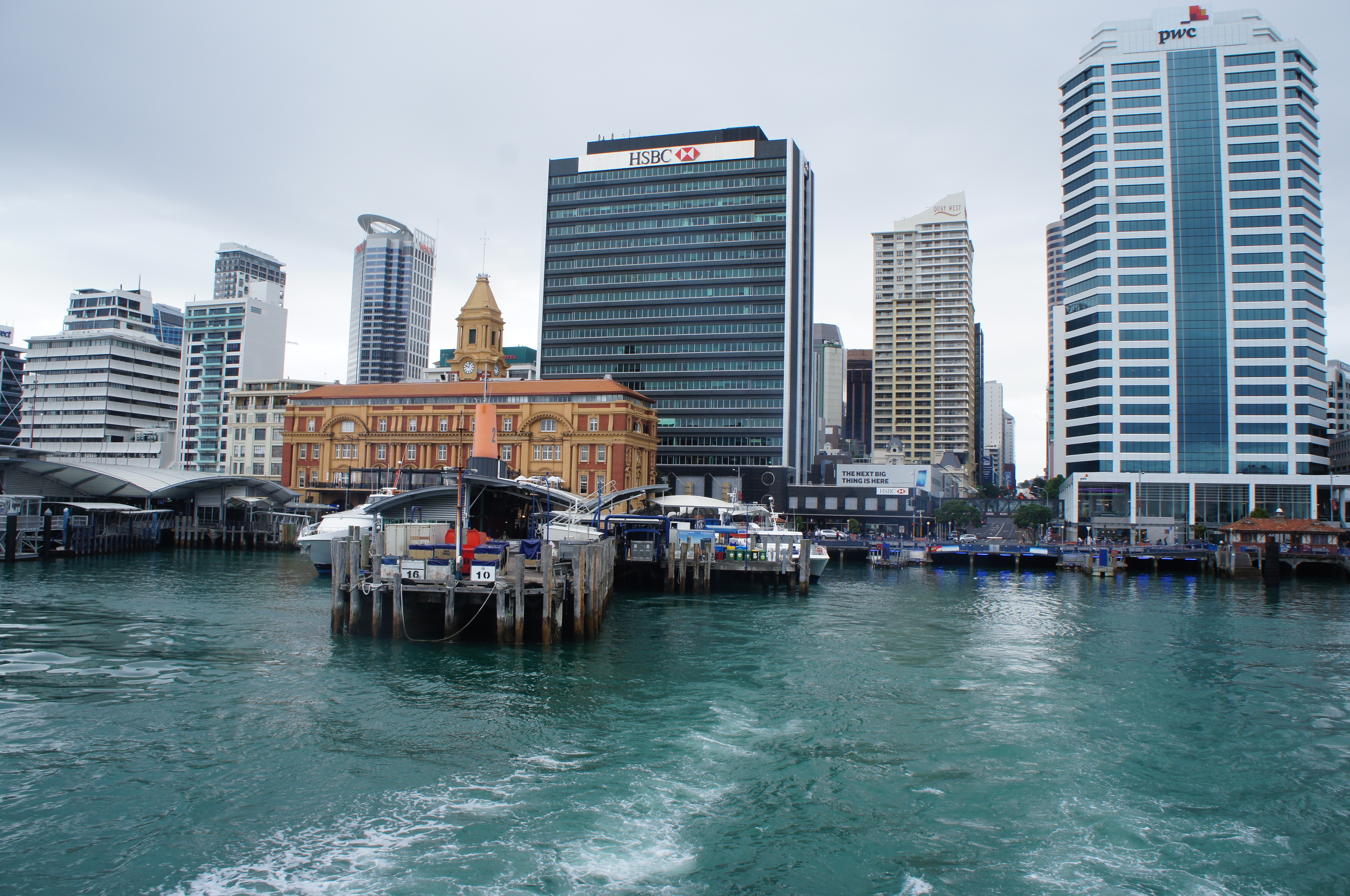
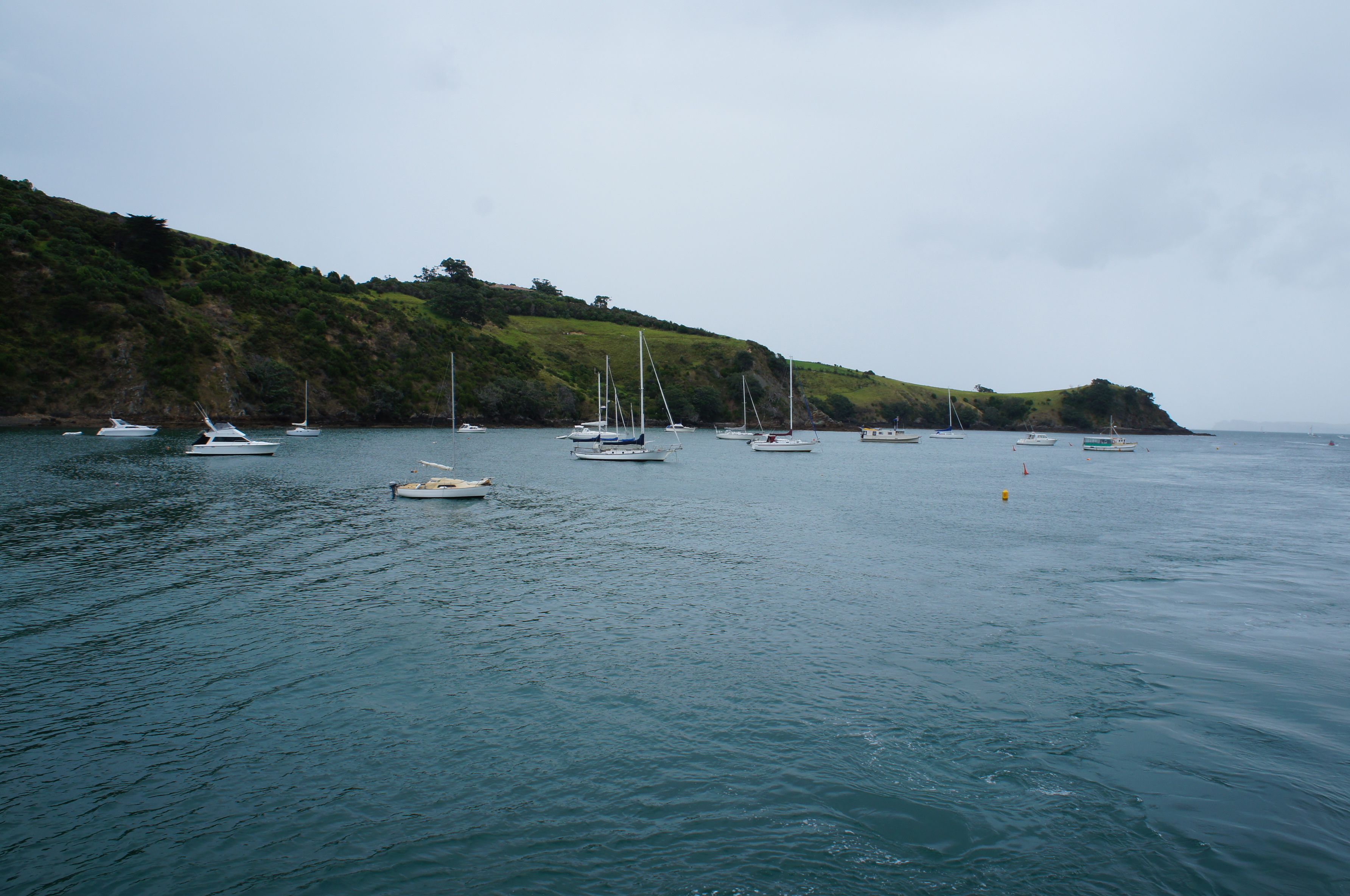
We already enjoyed our 40-minute ride from the Auckland Ferry Terminal across the slightly green-hued Hauraki Gulf to Waiheke. Despite the grey skies and light sprinkles, it’s a pretty ride. I was particularly struck by the old Auckland Ferry Building, a marigold-colored edifice, standing stark against Auckland’s more modern steel structures. Families gravitate to the rear deck to snap the perfect shot with the Auckland skyline as a backdrop. Arriving at Matiatia Bay on Waiheke is just as picturesque with its mouth holding a nice collection of sparkling white sailboats and yachts.

View of the Auckland Ferry Building from the Waiheke Ferry
Matiatia Bay on Waiheke Island

So, when we exit the ferry, we are ready to taste more of Waiheke and drinking wine is always better with good company. It turns out we have good company in fellow Americans, Steve and John from Chicago, Mike and Vee from Christchurch and Mei and Dan from Singapore by way of the UK. We didn’t know we’d all be the best of wine tasting buddies right away; that came after four or five glass tasting flights at three impressive New Zealand wineries.

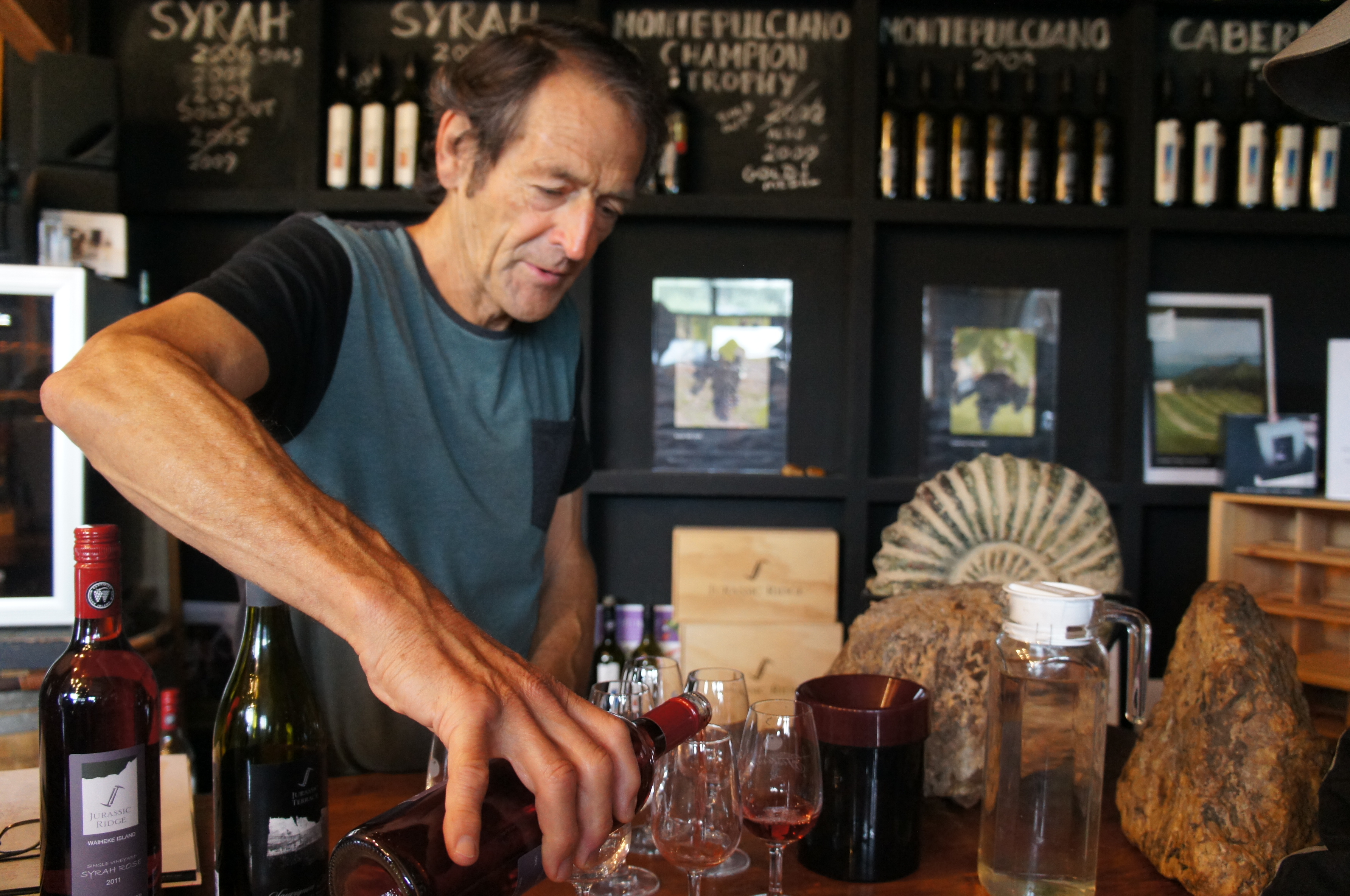
We start at Jurassic Ridge Vineyard and Winery operated by the impressive Lance Blumhardt, a former geologist and neurologist turned award-winning vitaculuralist, specializing in vegan wines. He’s already pouring wine for another group when we arrive and we squeeze into his tiny tasting room for our firsts tastes of New Zealand wine. We politely sip his Syrah Rose and Sauvignon Blanc, trading places with the first group between pours. One of the ladies in the group happens to be from the Washington, DC area, too, Great Falls, VA in specific. She lives in New Zealand now and she and a friend from LA are on a road trip across the country. She complains that her friend keeps getting into the drivers side of the car before realizing her mistake in a country where the driver sits on the right, not the passenger. As we chat about the DC area, the woman from LA throws out a statistic noting more men per capita than women in DC. Tanya and I look at her incredulously and ask, “Really?” But this conversation sounds like something from an episode of “Sex in the City.” Back to the wine.

Lance Blumhardt pouring at Jurassic Ridge Winery

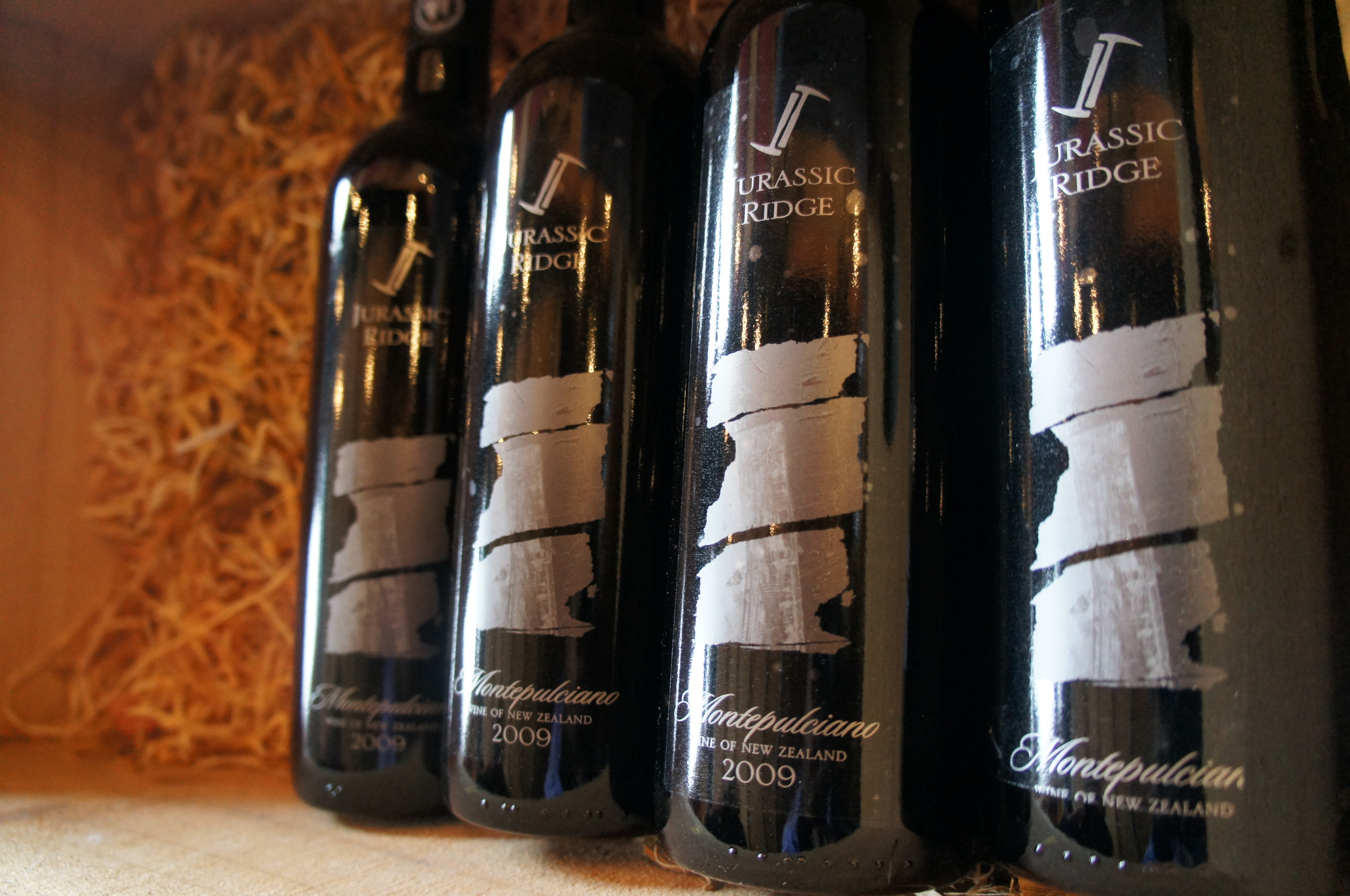
With the Jurassic Ridge tasting room all to us, our tour group starts to loosen up a bit. Particularly when Lance pours his baby, a Montepulciano that calls his Sophia Lauren of wines. It’s Italian, round and full-bodied. Naturally, this wine gets a lot of attention, winning a gold medal and champion trophy in New Zealand’s top wine awards. It seems to be well deserved. The Montepulciano is delicious. It’s fruit forward with a hint of spice, like my favorites reds, Zinfandels and Malbecs.  While enjoying this flavorful concoction, I ask Lance if there are similarities between his life as a neurologist and a winemaker. First, he says the obvious, doctors and wine makers like to drink wine. But then he says something unexpected, cleaning. He says just like in a operating room, you have to keep wine making equipment sterile to keep out bacteria or anything to alter the winemaking process. I’m tempted to buy the Montepulciano, but this is just our first stop. Mike and Vee have been here before though and they stock up before leaving.

The Sophia Lauren of wines. Jurassic Ridge’s Montepulciano. It’s as fun to say as it is to taste.

We drive deeper into Waiheke to reach our next winery, Obsidian, on the way Wayne shares more about the history of the island through his own family history. He’s a native to Waiheke and his great-great grandfather came to the island during a particularly violent period in New Zealand. The British were intent up on removing the indigenous Maori from the land and paid men to fight in exchange for the land that they would eventually take from the Maori. He talks about the Musket Wars in Waiheke, in which one Maori tribe decimated all its rivals when its chief was introduced to the musket.

Wayne Eggleton, owner and guide, Waiheke Island Wine Tours

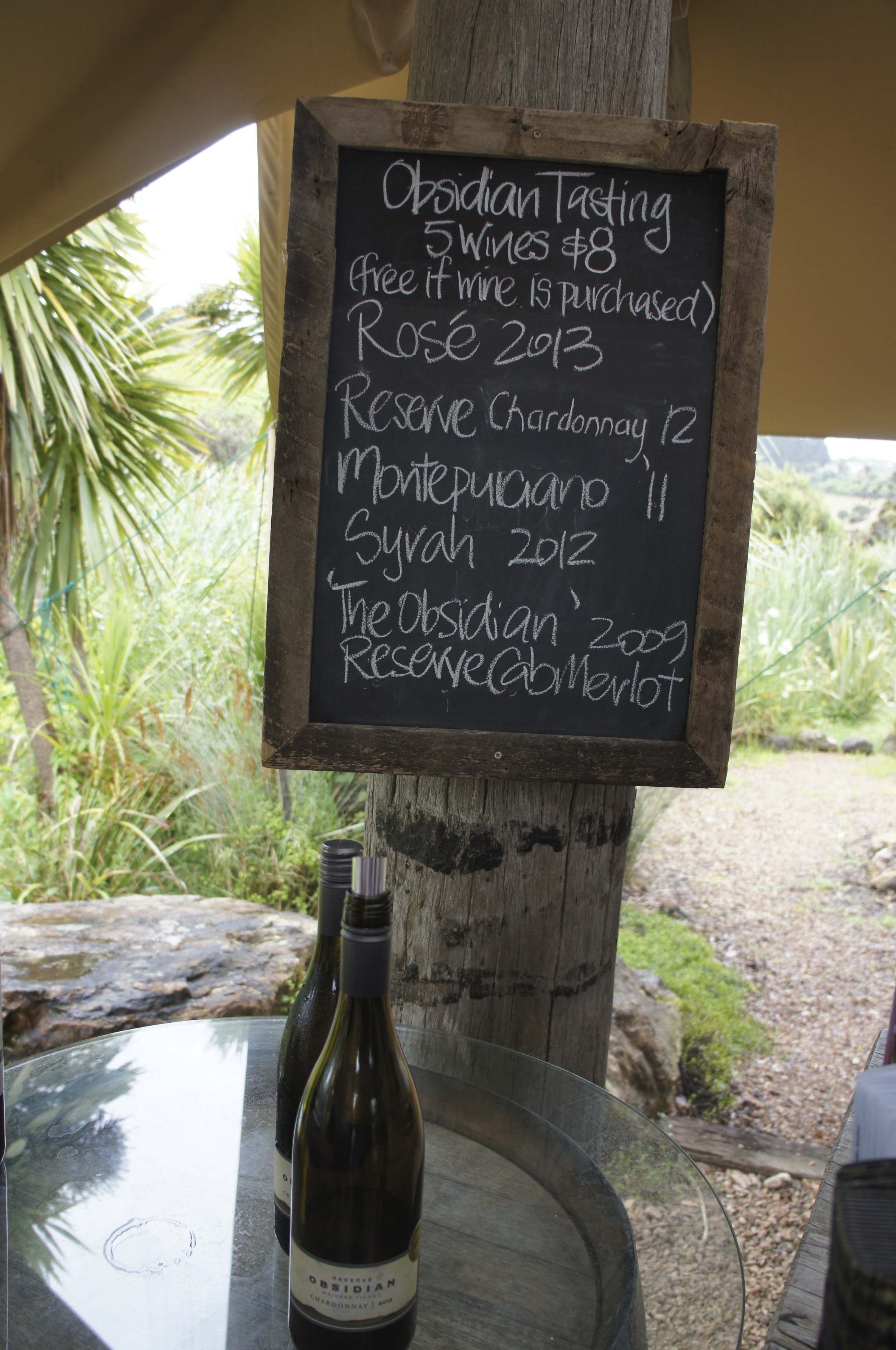
But the Obsidian Vineyard is nothing but peaceful. The tasting space is outdoors under an awning in full view of the vines. We start again with a Rose, followed by a great Chardonnay, stored in recycled oak barrels for a more balanced blend of oak, citrus and butter flavors. I see that Steve is impressed and Tanya and I definitely like it. So much so that we get bottles later. We also taste their Montepulciano, Syrah and Reserve Cabernet Merlot. All seem to be on the more mellow side, smoother and maybe lighter than what we tasted at Jurassic Ridge, but still good in its own way. Wayne and the sommelier here share more about the history of wines in New Zealand, noting that the country has only been growing wine for 35 years. I’m surprised to hear this because you always seem to hear about how great New Zealand wines are. Their reputation suggest years of cultivation, so to speak. But the explosion of vineyards has only occurred recently.

Our tasting menu at Obsidian Vineyard
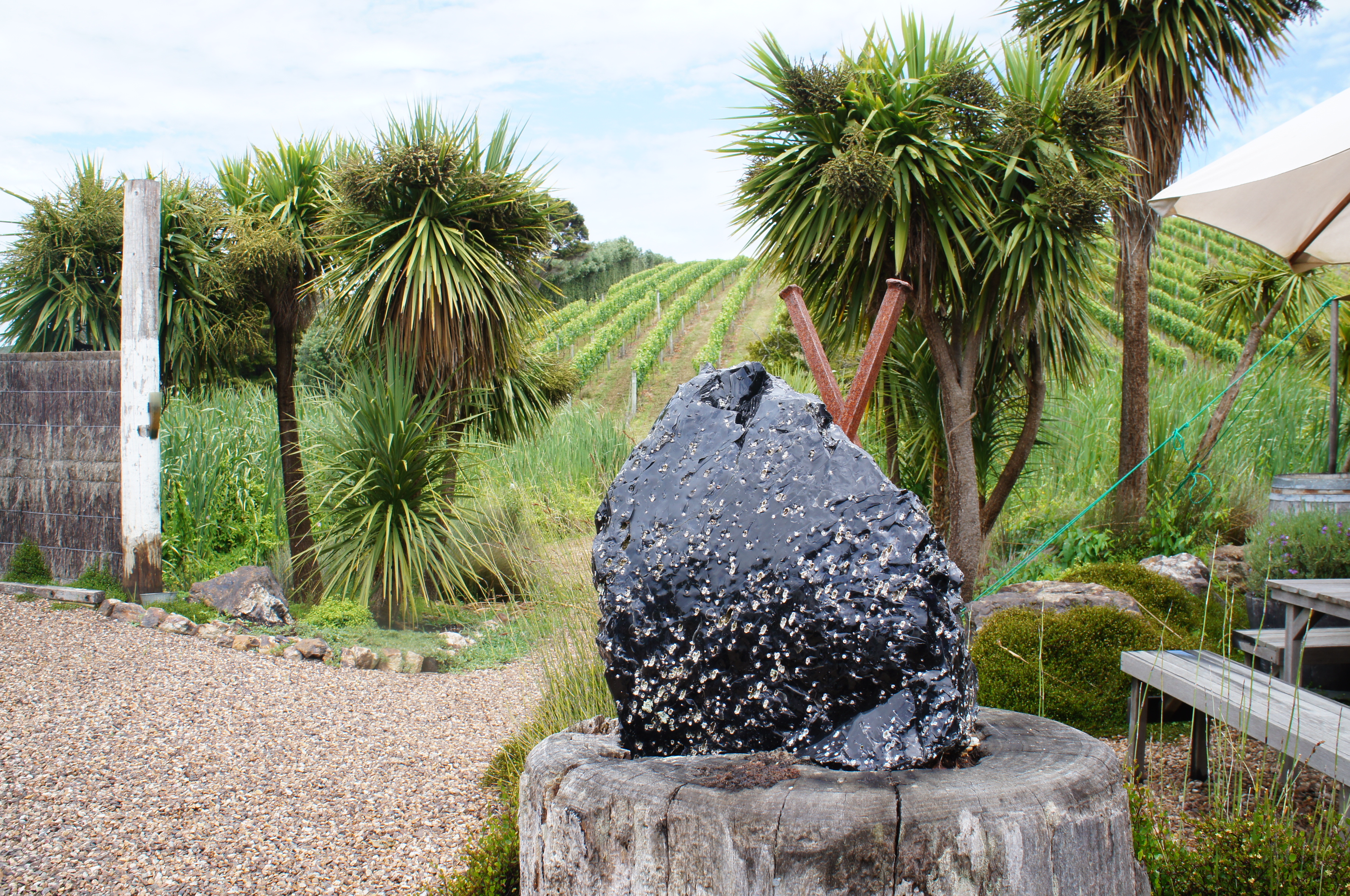
Black lava rock at Obsidian Vineyard. One of the sommeliers didn’t know that this was a piece of commissioned art for the vineyard. She thought it was just a rock. I can see her mistake.

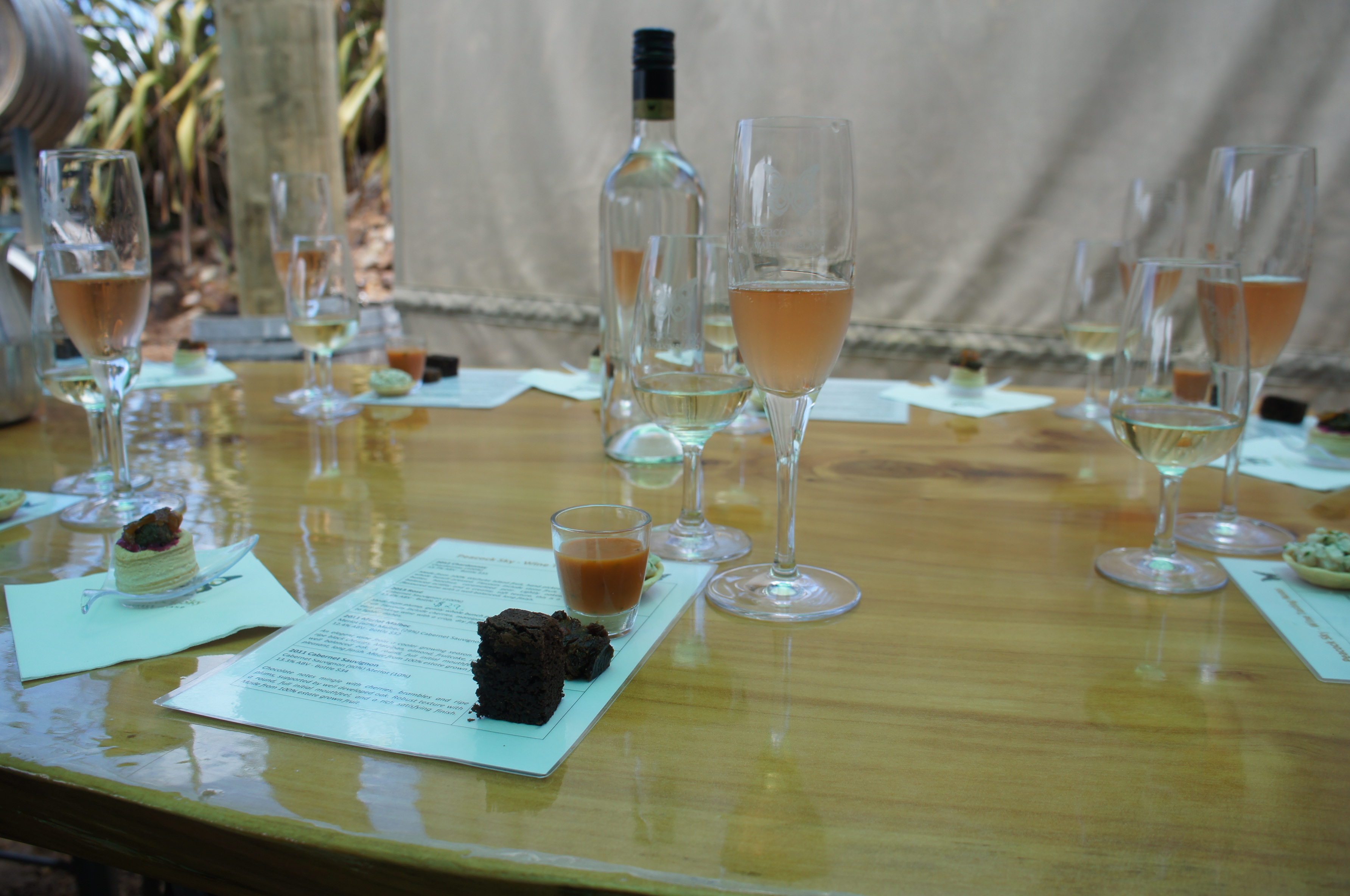
Our final stop on the wine tour is apart of this explosion and where our wino bonding really took place. The Peacock Sky Vineyard is the perfect setting with rows and rows of vines blanketing the nearby hills and the quaint tasting room nestled below. Wayne tells us that peacocks actually frequent the place, released by a woman who once owned them. Besides the beautiful landscape, the table scape for our tasting is pretty eye-catching, too. Our sommelier is already pouring pale pink sparkling wine into our glasses and there is an assortment of goodies placed neatly on a tasting card to be paired with our wines. It’s almost too pretty to eat, but at the same time, we can’t wait.

Our tasting table at Peacock Sky Vineyard
Entrance to the Peacock Sky Vineyard’s shop and restaurant

First, we are encouraged to taste the sparkling wine and we happily oblige, toasting each other a Happy New Year. Next we try a Chardonnay and we are instructed to do a mouthwash to taste the citrusy burn along the sides of the tongue. Then we taste a bite of what looks to be chicken salad in a pastry with the Chardonnay and the citrus magically disappears. Their wines seem to have more magical properties. Their Rose enhances the red peppery spice of a tomato soup, an oaky Merlot Malbec turns chocolately with a piece of gooey fruitcake. We all marvel at the transformations taking place in our mouths. Tanya and I say this is the best fruitcake we’ve every tasted, it’s moistness dispelling any thought of using at a doorstopper. Steve tells us that his grandmother made a delicious fruitcake that he remembers from his childhood. In his attempt to recreate it, he found that molasses was the secret to the moist texture.

We start to learn more about each other through stories like these over a gorgeous and delicious lunch, which we pair with more wine and champagne. We learn that Mike’s nickname is Stubby from his last name Stubberfield and that he and Vee used to throw incredible parties. Mei and Dan talk about life in Singapore. We talk about politics in the US, UK and Christchurch and we even talk about moonshine. There seems to be no end to the things you can favorably discuss with a little help from some well-fermented grapes. This leads to all the hugging at the start of this post. We hug when we exit the van at the ferry, thinking it will be our final goodbye, then we realize that we are all boarding the same ferry. We hug again when we disembark. The wine definitely has something to do with this, but we genuinely like these people and we hope to stay in touch.

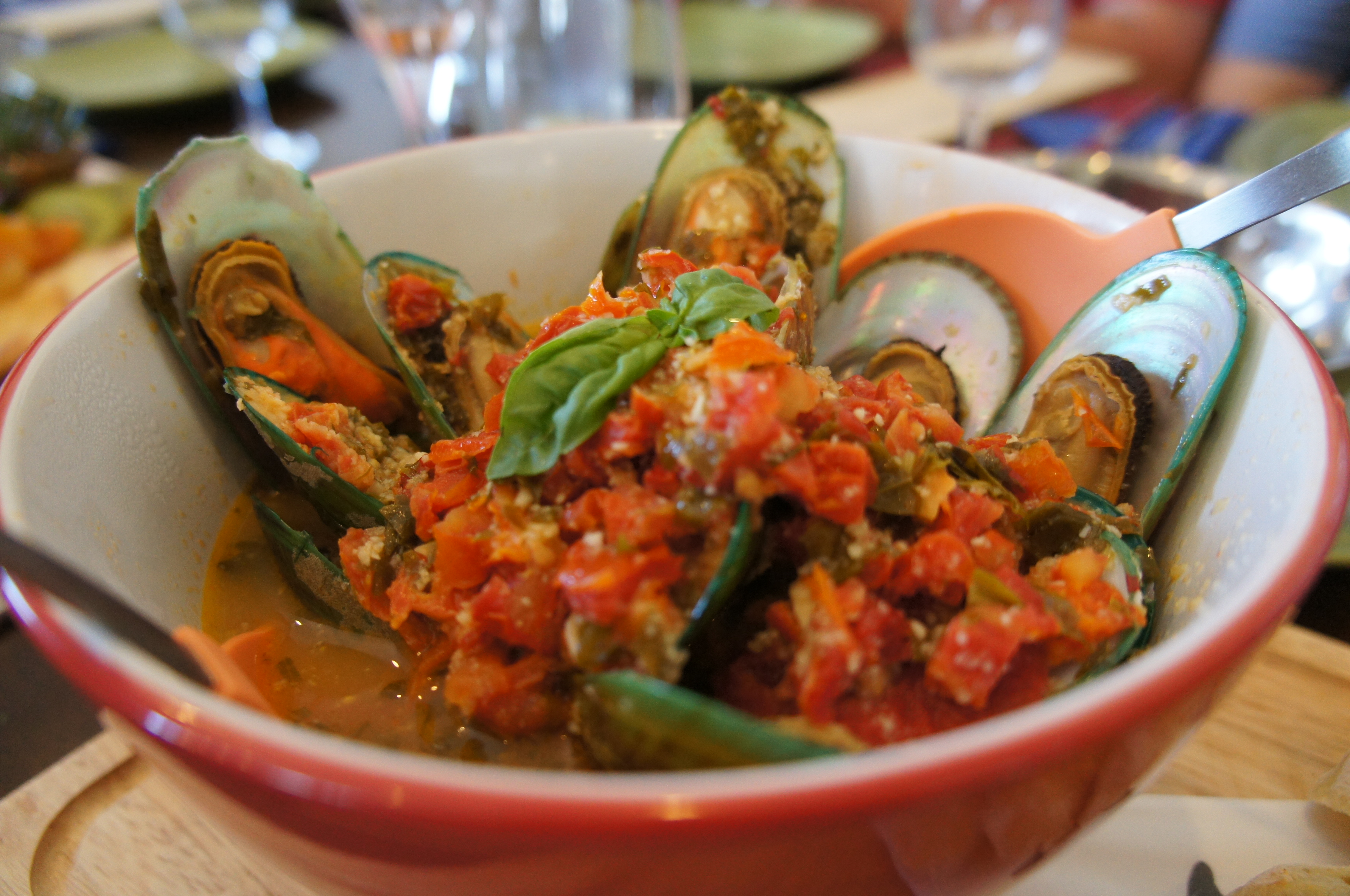
New Zealand Green-Lipped Mussels in Spicy Chardonnay Broth. Fabulous.
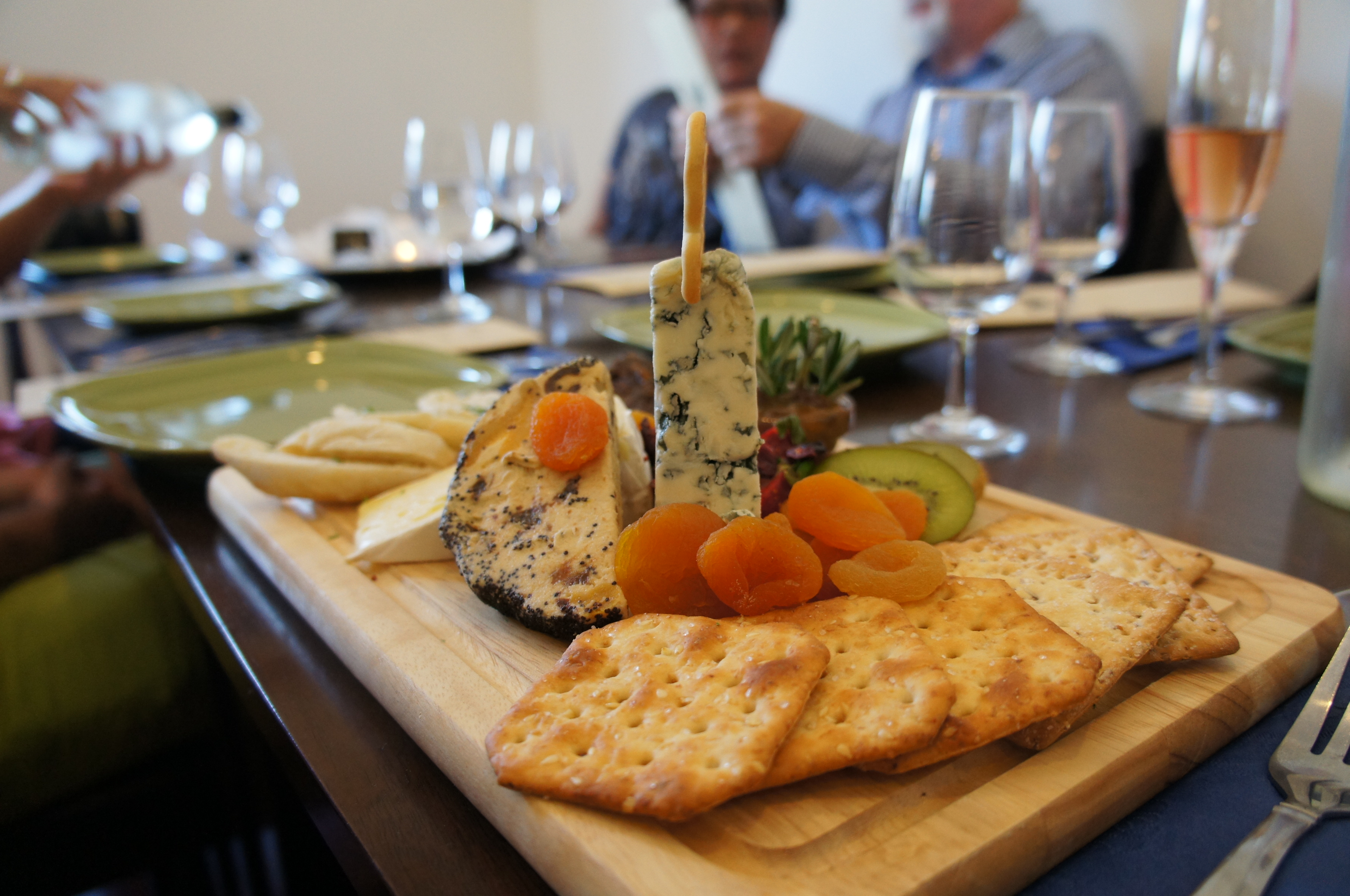
Tanya’s cheese plate at Peacock Sky
The Waiheke Island Wine Tours Group

At the ferry terminal, we realize that we are steps away from Auckland’s Viaduct. Steve and John are staying at the Hilton modeled for a cruise ship near by. Steve mentions that the area was redeveloped for the America’s Cup in 2000. They point the way to the outdoor space before we hug yet again.

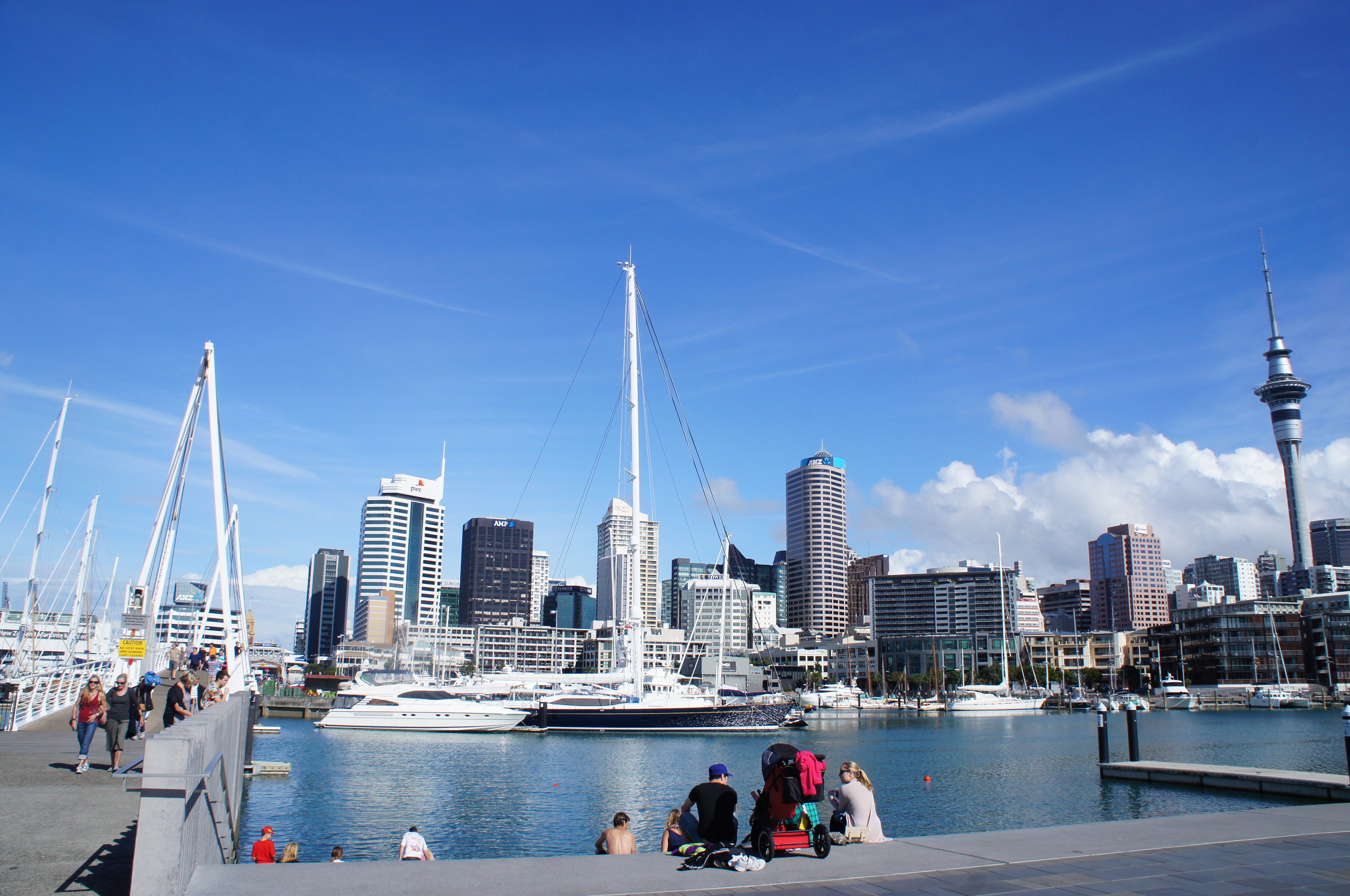
The rain from earlier in the day has completely dissipated and the sun has returned with a vengeance. We peel off our layers and embrace the heat with a slow stroll along the Viaduct. Here are some of the things we saw along the way.

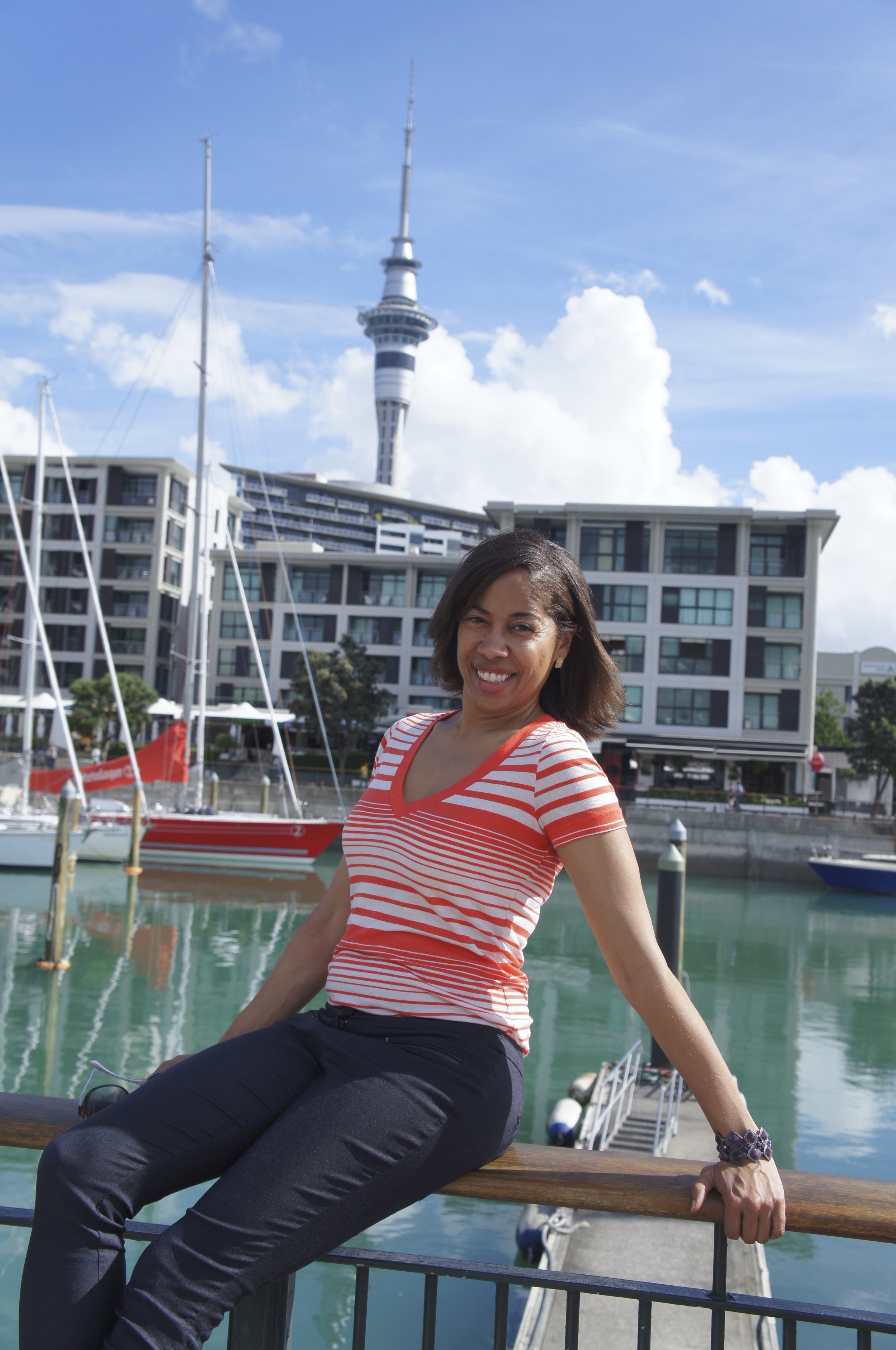
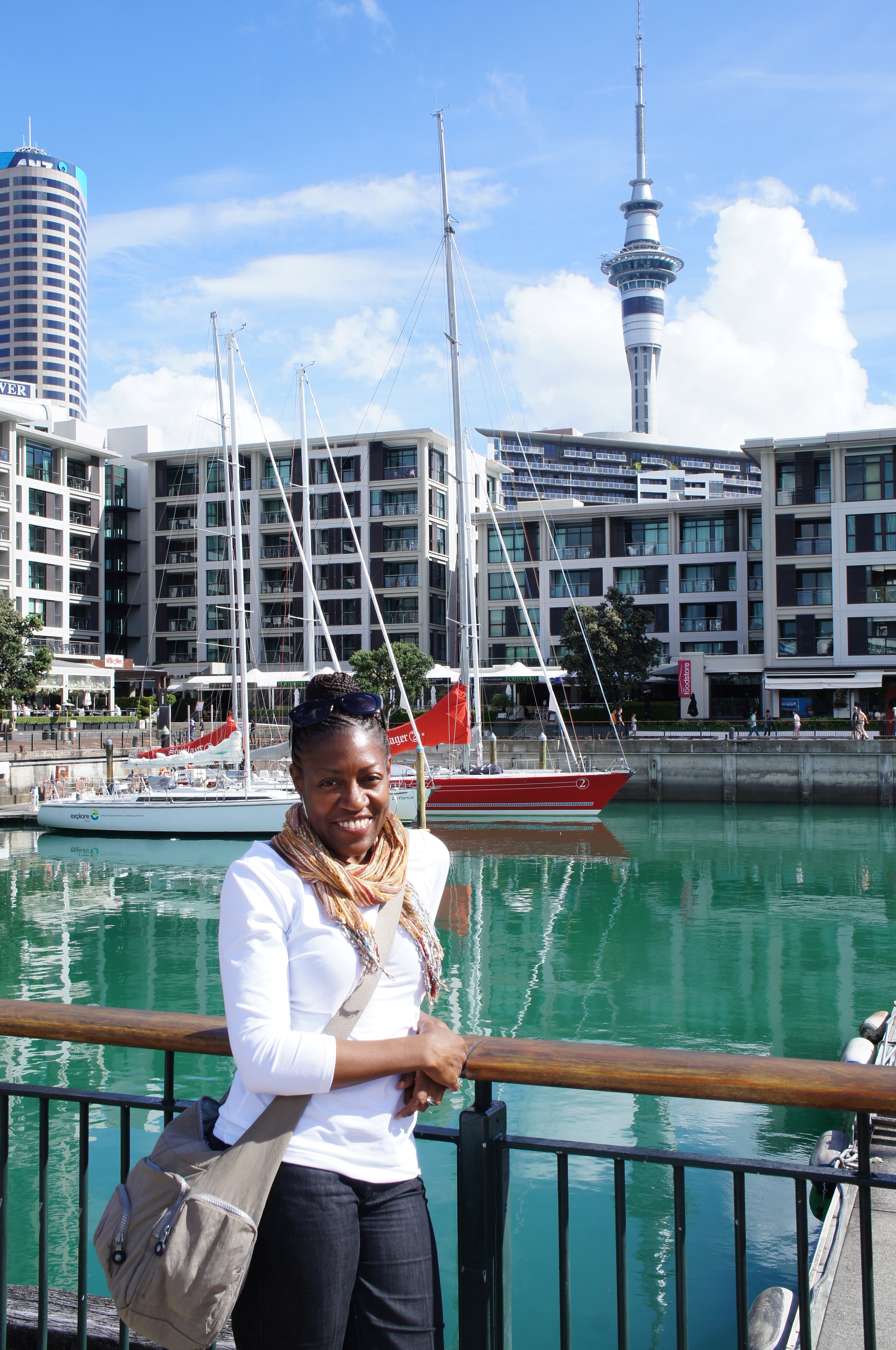
Boats, families, blue sky and the Sky Tower on the Viaduct
An outdoor reading nook on the Viaduct
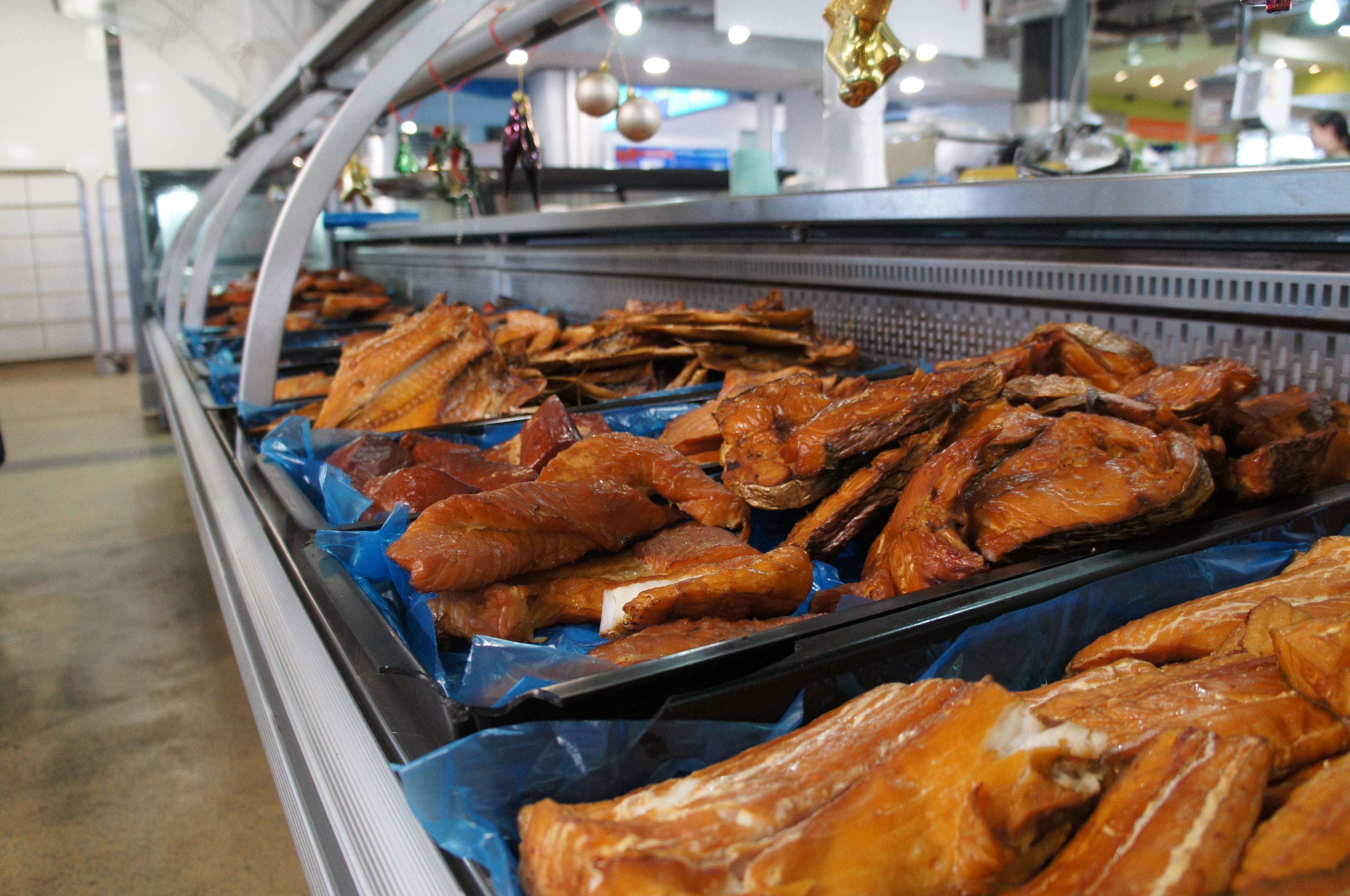
The Auckland Fish Market
Tanya on Auckland’s Viaduct
A robin on Auckland’s Viaduct


5 Places on My Travel Bucket List… For Now

So, the Traveling Brown Girls Blog Carnival has presented an interesting challenge: List 5 places that I’ve never been (and why I want to go). First, you may be asking, “What is the Traveling Brown Girls Blog Carnival?” It’s a blog party started by Tracey Friley of OneBrownGirl.com and hosted by other bloggers (AbsoluteTravelAddict.com, GirlGoneTravel.com, MoTravels.com and BrownGirlsFly.com) to promote the work of underrepresented travel bloggers and share their talents more widely with the travel world, and the World Wide Web. Thus, the reason for this post that’s got me thinking. You see, I want to go EVERYWHERE and I don’t travel with the goal of checking places off a list as some people do. I often get asked, “Where do you want to go next?” My answer depends on the moment and could change at the drop of a hat. I mainly travel when opportunity strikes or a place presents itself. For instance, Thailand wasn’t top of mind as a travel destination, but when my high school friend, Lyle, invited me to visit, I knew I was going. It was the same for my travels in Sri Lanka. I never would have considered the place, if I hadn’t met my friend Sid, a native Sri Lankan, at a New Year’s Eve party a few years ago. A Danish tennis partner sparked my desire to go Denmark. That being said, the following is a list of places that have captured my attention of late or have lingered in my travel consciousness for sometime. Will I make it to these places? Maybe. But it is more likely that I’ll wind up someplace totally unexpected, just the way I like it.

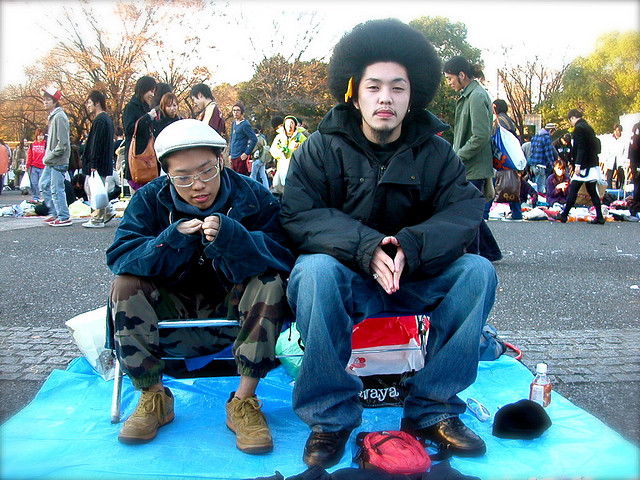
Yoyogi Park, Tokyo, Japan. CC Image courtesy of hawken king at flickr

#5 Japan
The reason that I am interested in going to Japan may be controversial for some. I am absolutely intrigued by the Japanese fascination with black culture. I’ve read pieces written by black travelers who have been there and find this fascination somewhat disconcerting. Is it a genuine appreciation or a cultural exaggeration of stereotypes that have seeped across the Pacific? I want to see for myself and getting a photo of a Japanese girl in a “Black for Life” t-shirt seems all too ironic. I’m already used to curious Asian folk, having been swarmed by Cambodians for a family photo at Angkor Wat recently and followed by Chinese tourists at the Forbidden City years ago. I’ve got that part down. I suspect that I’ll get to hear great music as I’ve heard that R&B musicians are beloved in Japan. On the food front, I am a big fan of sushi and even more so of tea. I’d be all over the tea ceremonies and I love ancient temples. Finally, I really want to stay in a capsule hotel. I’m all of 5’1, so I think I’d be snug as a bug in one of those things.


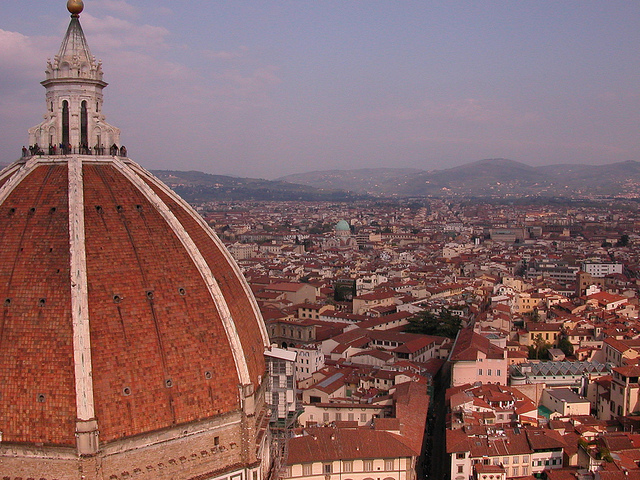
Florence, Italy. CC Image courtesy of TripNotice.com at Flickr

#4 Italy
I took an art history class in high school that I absolutely loved. We studied the works of the great Italian masters like Titan, Caravaggio and Michelangelo, of course. Each spring our art history teacher, Ms. Batza, organized a student trip to Rome to experience Italy’s art and architecture. I wanted to go very badly, but it wasn’t in my parents’ budget. My friend Inez and a few others went and they came back with fabulous stories of cute Italian boys following them around the Eternal City. So, I still kind of harbor this high school longing to go and it flares up when I have a really good Italian meal or see some some pop culture reference to Italy. For instance, whenever I see Fabio, one of the chefs from “Top Chef,” I want to go to Italy. I wanted to go after I read “Eat, Love, Pray.” All of the recent pomp and circumstance for the new Pope at the Vatican is the latest reason why I’d like to go. When I do go, I’d be just as enamored of the historically-significant art found in Florence as the attractive men.


South African artist Kwelagobe PO Box Sekele. Photo Courtesy of Lerato Mogoatlhe at madamafrica.wordpress.com

# 3 South Africa
Nelson Mandela is the biggest reason why I want to go to South Africa, but this is another place that has lingered in my travel consciousness for some time. Growing up in the Washington, DC area, we’d often drive past the South African Embassy on the way to school during the “Stop Apartheid” demonstrations. Later in the day we’d learn some big celebrity like Steve Wonder had gotten arrested for protesting. I took a History of South Africa class in college and during a college internship with Time Magazine, I got to cover Nelson Mandela’s first visit to the United States after his release from prison. So, I feel like I have a connection. And, as an African-American child of parents who lived through Jim Crow, there is definitely a cultural solidarity to be explored. Last year, I met a woman named Lerato from Pretoria through my friend Sid. He introduced us because she is a travel blogger and journalist, too. Her blog is called Madam Africa and she is making it her mission to travel the entire continent. I snagged a photo from her blog post about a South African musician that she’d seen perform at the Cape Town Jazz Festival. This is the South Africa that I want to see.


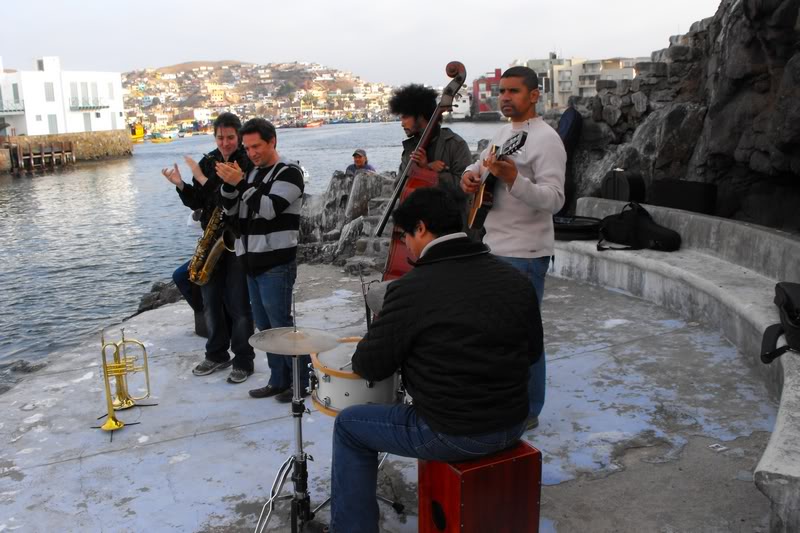
Gabriel Alegria Afro-Peruvian Sextet Peru Tour. Photo Courtesy of GabrielAlegria.com

#2 Peru
Mystical Macchu Picchu makes many traveler bucket lists. The journey is arduous, maybe even more than most realize as Boyd Matson wrote in his story “The Best Worst Trip Ever” in April’s National Geographic Traveler, where he talks about the grueling trek that left him questioning his preparedness. But he, like everyone else who’s been, says it’s all worth it. I have no doubt that it would be the same for me who especially loves to contemplate ancient civilization and architecture rivaling most modern creations. And while, Macchu Picchu is reason enough to want to go to Peru, something else has piqued my interest–Afro-Peruvian culture. While traveling in Thailand, my friend Karen mentions that there is a New York Afro-Peruvian Jazz band that arranges group tours to Peru to learn about Afro-Peruvian musical traditions from local musicians in Lima. This sounds more and more like the best trip ever. Any tour that allows me to feel immersed in a culture that few have experienced is going to be a winner in my blog.


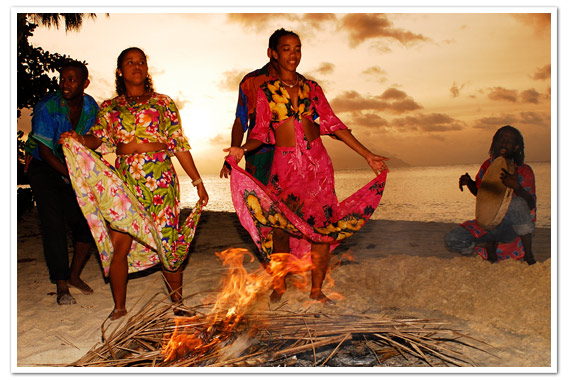
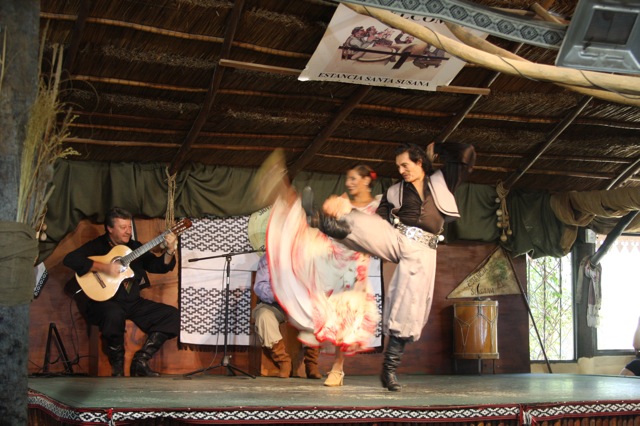
Creole dance in Seychelles. Photo Courtesy of Seychelles Tourism Board.

#1 Seychelles
This group of islands off the coast of Tanzania has become a bit of an obsession of late. I, like most, heard of the islands when the royal super couple, William and Kate, went there for their honeymoon. But I was really keen to go last year when I learned that Ethiopia Air introduced new flights to the Seychelles with an amazing airfare sale. I was going to make it happen until other travel opportunities intervened. At this year’s Travel and Adventure Show in Washington, DC, I met a member of the Seychelles Tourism Board and I asked him what I needed to know about the place besides the fact that William and Kate honeymooned there. He told me of the county’s early beginnings as a pirate stopover and a point along the Spice Trade, which brought about its mélange of French, British, Indian and African cultures. He bragged about the creole cuisine and the country’s commitment to preserving the environment. This guy was really good at selling his country, because now I really want to go there. It sounds like the perfect combination of beach getaway, eco-friendly adventure and authentic laid-back culture. So, it makes the top of my ever-shifting list, for now.

Do you have a travel bucket list? Where do you want to go?

Photo Flashback: The Pope is From Argentina. I Went to Argentina!

Exactly one month after traveling to Argentina with STG Tours, the Vatican selected its first Argentinian pontiff, Pope Francis I. How perfectly relevant. Seems like a great reason to reminisce on a great trip with a few good pics. These aren’t mine, though. I’m sharing my fellow travelers’ favorite photos from Argentina. It’s cool seeing the trip and the country from perspectives as varied as the people on our trip. Enjoy!

Sheneekra took this photo at the Familia Zuccardi Winery in Mendoza. “The wineries in Argentina are a perfect blend of art and wine. I really gained a better appreciate for artistry for wine making while in Argentina”
Here’s another photo from Sheneekra. “I enjoyed the show at Estancia Santa Susana. Dancing was amazing.”
This is another from Sheekra. It’s a photo of her with Kenitra, her roommate during the trip. “Kenny and I at Parsai Olive Oil plant. I’m glad she told me about the trip. I had a great time.”
This photo was taken by Kenitra. During our group trip, we had a couple of days to wander on our own. These beautiful shuttered windows must have caught her eye on one of those days.
Kenitra and Sheneekra visited Argentina’s museum of modern art, MALBA, during their free day in Buenos Aires. This is a lovely shot of Sheneekra in one of the exhibits.
Gia didn’t bring a camera on this trip, but she got this great shot of racing gauchos on horseback at Santa Susana with her smartphone.
Gia took this picture on our side trip to Montevideo in Uruguay at its monument La Carreta. She’s kind of photobombing our trip leader, Gai, in the background. Gia, Gai. Gai, Gia. Cute, right?
Presleith fell in love with Colonia on her side trip to Uruguay. It’s an hour-long boat ride from Buenos Aires and the city is a UNESCO World Heritage site. She and fellow traveler, Carmen, climbed to the top of this lighthouse, even though Presleith is deathly afraid of heights.
Presleith found some of the most interesting places to pose for a picture on this trip. Here she is in Colonia at an old fort.
Our fearless trip leader, Gai, took in a Bocca Juniors soccer match while in Buenos Aires. She and fellow traveler, Floyd, survived the crush of soccer-crazed fans.
Gai got this picture with her cell phone during our cooking class at La Tupina in Mendoza. This scrambled egg dish may be one of the best tapas we made and ate that day. The presentation was the coolest, too. Scrambled eggs served in its shell. Yum.